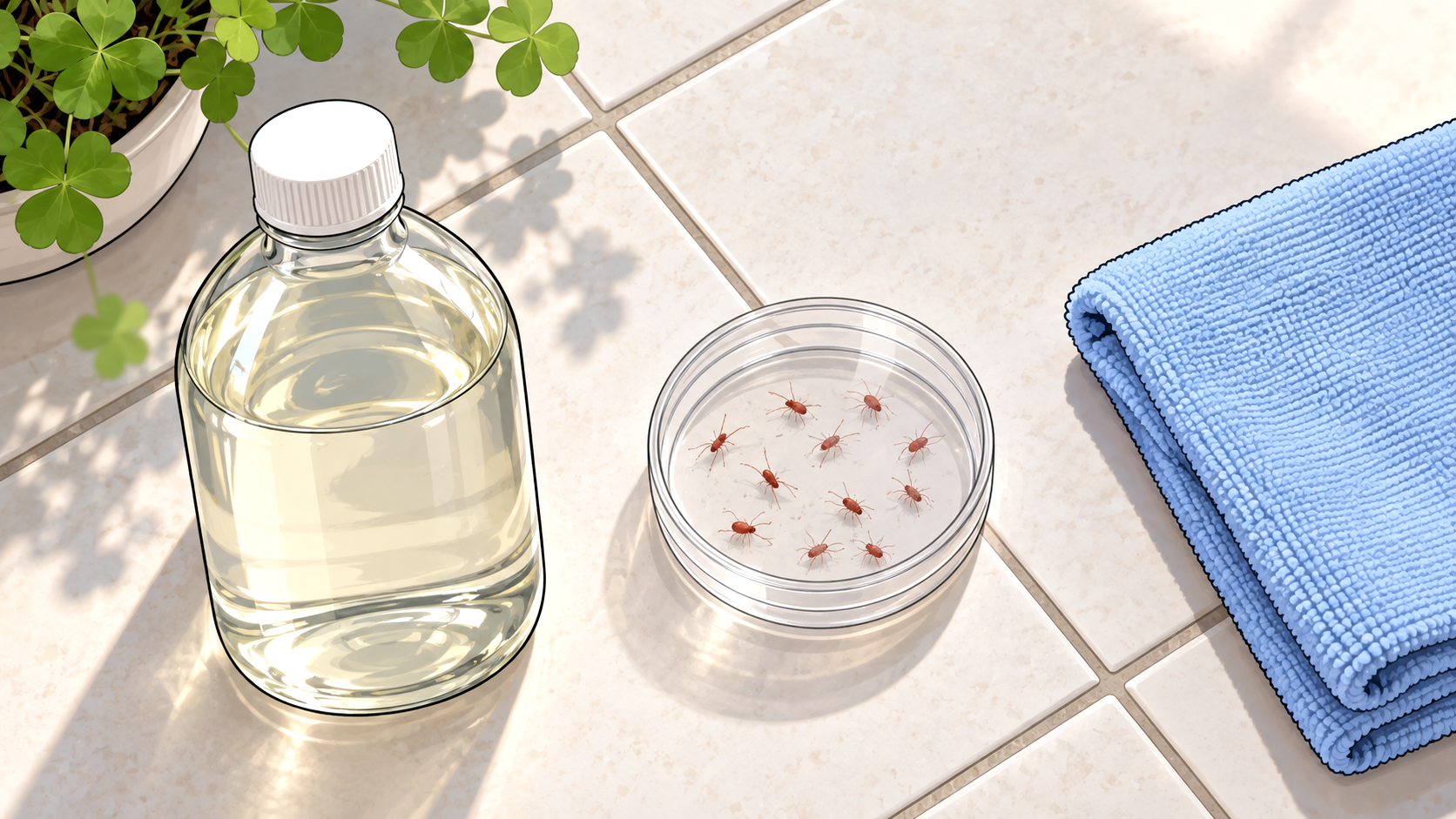
Vinegar gets suggested for almost every tiny bug that turns up around a house, but clover mites are a poor place to assume that an acidic kitchen liquid doubles as pest control. There is not good evidence that ordinary household vinegar is a reliable treatment for clover mites, so we would not use it as the main way to control an infestation. Directly soaking a tiny mite in vinegar may injure or kill it, but that is very different from demonstrating effective control of clover mites on a lawn, foundation, patio, or inside a home.
More importantly, established clover mite management recommendations do not depend on vinegar. Small indoor invasions can be physically removed, while recurring populations are managed through exclusion, landscape changes, and, when necessary, appropriately labeled pesticides.
Contact With Vinegar Is Not the Same as Clover Mite Control
Household vinegar is usually a dilute solution of acetic acid. Acidity can damage biological tissue, so it is plausible that sufficiently direct exposure could harm a clover mite. That observation alone cannot establish an effective treatment rate, required exposure, residual effect, plant safety, or performance against mites protected in cracks and vegetation.
There is also no useful residual barrier to assume from spraying kitchen vinegar around the house. Clover mites can continue arriving from outdoor feeding sites, especially when conditions around a property support recurring populations. Killing a few exposed individuals would leave that source untouched. Established control guidance instead recommends measures such as removing indoor mites without crushing them, separating suitable vegetation from the foundation, and sealing structural openings.
Vinegar Can Damage the Plants Around an Infestation
Spraying vinegar across turf or landscaping is particularly questionable because acetic acid is phytotoxic. EPA documentation for pesticidal acetic acid describes it as a contact herbicide that damages and dries plant foliage. The plants surrounding a clover mite infestation may therefore be injured by the attempted treatment.
That risk is especially relevant because clover mites commonly develop in grass and other vegetation. When clover mites are affecting a lawn, spraying the grass with vinegar introduces a second potential source of plant injury and makes later symptoms harder to interpret. The same caution applies to infested ornamentals and houseplants carrying clover mites.
Stronger vinegar is not a sensible workaround. EPA notes that acetic acid concentrations above those typical of grocery-store vinegar can cause severe burns and eye damage. Increasing the concentration in pursuit of a stronger mite treatment can therefore increase hazards without establishing that the mixture will control the infestation.
Ordinary Vinegar Is Not an EPA Minimum-Risk Pesticidal Active Ingredient
The regulatory details expose another weakness in many online vinegar recipes. EPA permits vinegar containing no more than 8% acetic acid as an inert ingredient in qualifying minimum-risk pesticide products, but vinegar is not on the agency’s minimum-risk active-ingredient list. EPA specifically states that vinegar cannot serve as the pesticidal active ingredient in an unregistered minimum-risk pesticide.
That does not mean possessing kitchen vinegar and cleaning with it is unlawful. It means “vinegar is natural” should not be confused with evidence that it is an established pesticide for clover mites. When an actual pesticide is needed, use a product labeled for the intended pest and application site. EPA evaluates registered products according to factors that include where they will be used, how much is applied, and how often they are used.
Skip the Vinegar and Match the Method to the Location
For mites already inside, vacuuming avoids both unnecessary pesticide exposure and the rusty stains produced when clover mites are crushed. An indoor population does not need to be sprayed with vinegar simply because the mites are visible. Indoor clover mite removal can remain entirely physical in many cases.
Outside, repeated migrations call for attention to the source. Keeping host vegetation away from the foundation, managing favorable turf conditions, and sealing entry points can reduce the movement of mites toward the structure. These measures fit naturally into nonchemical clover mite control without relying on an unsupported homemade spray.
A severe outdoor population may justify a registered product instead. Current guidance identifies properly labeled formulations containing active ingredients such as bifenthrin or lambda-cyhalothrin among the chemical options most likely to assist with clover mite control. Product selection still depends on the current label and intended site, which is why choosing an insecticide for clover mites is a different decision from reaching for vinegar in the kitchen.
Questions About Using Vinegar on Clover Mites
Will vinegar remove the red stain left by a crushed clover mite?
Do not assume it will. The appropriate stain treatment depends on the affected material, and vinegar itself can damage some stone, finishes, fabrics, and other surfaces. Follow the cleaning instructions for the material rather than treating every clover mite stain with acid.
Can you mix vinegar with another pesticide to make it stronger?
No, unless the pesticide label specifically directs that mixture. EPA advises users to follow pesticide labels exactly, including application and mixing directions. Adding household ingredients can change a formulation without evidence that the resulting mixture is safer or more effective.
Does the smell of vinegar repel clover mites?
There is not sufficient authoritative evidence to recommend vinegar odor as a dependable clover mite repellent. Physical exclusion provides a more defensible way to stop migration, including sealing the openings clover mites use to enter homes.
Is vinegar worth trying on a large clover mite infestation?
We would skip it. A large infestation needs correct identification and control aimed at the population source. If reasonable DIY measures are failing, professional help becomes more useful than escalating an unverified vinegar treatment.