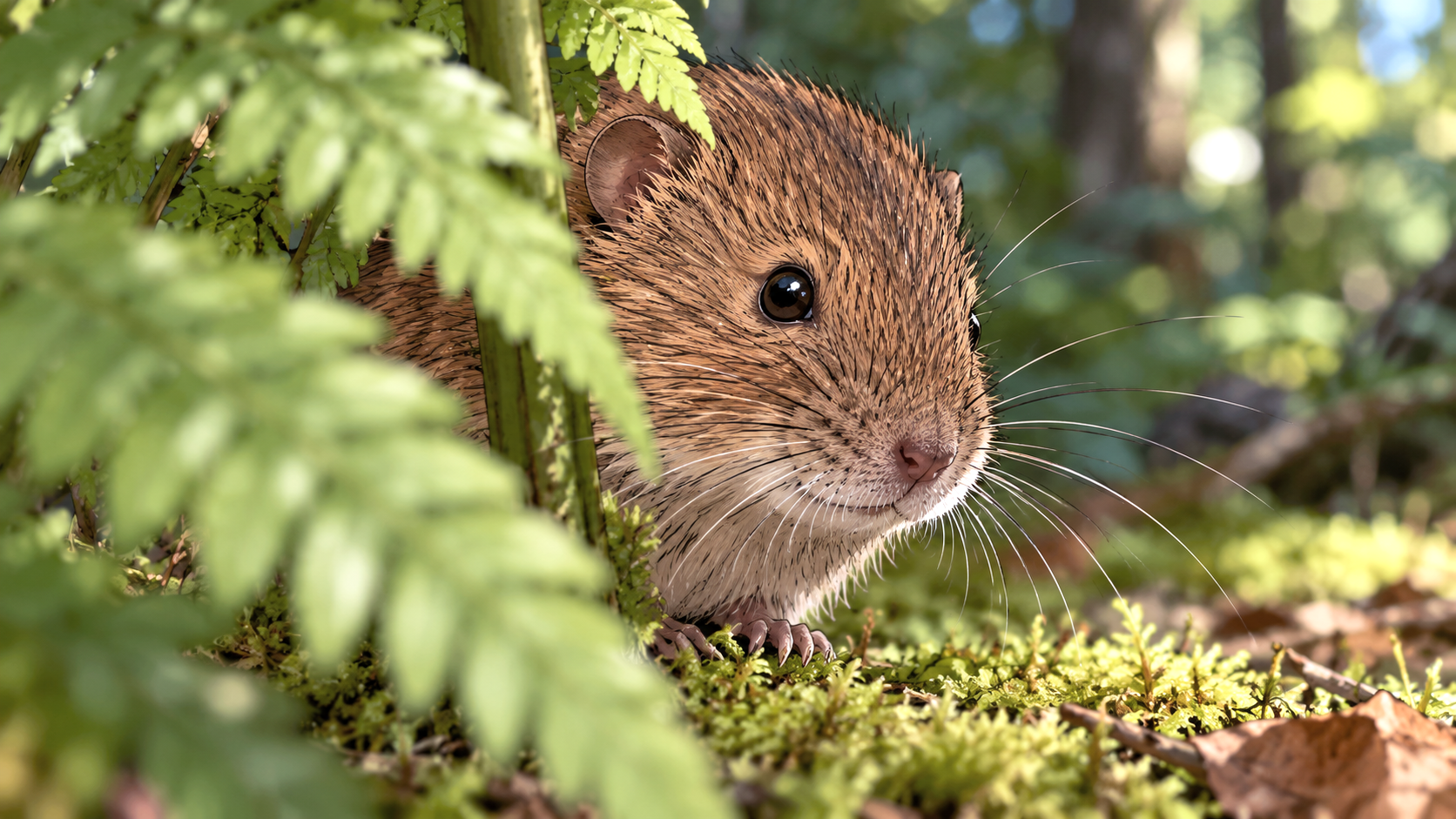
Voles are not blind. They can detect visual information, but their eyesight varies considerably between species. Prairie voles have functioning visual-processing regions in their brains, while experiments on the underground-dwelling Mandarin vole have demonstrated extremely poor visual acuity and reduced depth perception. Voles also use smell, hearing, and touch to gather information about their surroundings, so navigating their environment does not depend entirely on sight.
The misconception comes partly from their small eyes and tendency to move through concealed spaces. Neither characteristic proves blindness. An animal can have limited visual resolution while retaining the ability to detect light and respond to visual stimuli.
How Much Can Voles Actually See?
Scientific experiments provide a clearer picture of vole vision than eye size or behavior alone. Research examining the sensory cortex of prairie voles identified a primary visual area, known as V1, at the rear of the brain. Electrophysiological recordings established the organization of this region alongside areas responsible for hearing and touch. The results demonstrate functioning visual-processing pathways, although they do not establish how sharply prairie voles resolve objects at different distances.
Further investigation of connections within the prairie vole’s visual cortex revealed pathways linking visual regions with areas responsible for other sensory information. This arrangement allows information from different senses to contribute to the animal’s perception of its surroundings. It also provides a neurological explanation for why vision and other sensory capabilities need to be considered together rather than ranked using assumptions about how a vole behaves.
An animal’s ability to detect a moving shape is different from its ability to recognize fine detail. Visual acuity measures how well an eye can resolve closely spaced features, while other visual functions include detecting movement, distinguishing brightness, and judging depth. The presence of a functioning visual cortex establishes that visual information is processed, but it cannot provide a universal visual-acuity measurement for all voles.
Some Underground Voles Have Exceptionally Poor Vision
The Mandarin vole (Lasiopodomys mandarinus) offers a documented example of reduced eyesight associated with underground living. Experiments investigating its visual system and behavioral responses measured visual acuity below 0.02 cycles per degree and found impaired depth perception. A cycle per degree describes the ability to distinguish alternating light and dark patterns across a given visual angle. A low value indicates poor resolution of fine detail.
Researchers also identified differences in the Mandarin vole’s retina and visual pathways compared with laboratory mice and surface-dwelling Brandt’s voles. These included changes in the proportions of retinal photoreceptor cells and the organization of a brain region involved in transmitting visual information. The findings support a relationship between the species’ subterranean lifestyle and reduced visual function.
Poor visual acuity is not equivalent to complete blindness. The Mandarin vole retains components of the visual system despite its reduced performance. Its measured results also cannot be assigned to meadow, prairie, woodland, or other voles without comparable evidence from those species. The different types of voles occupy different environments, and findings from one species do not establish the eyesight of the entire group.
How Voles Find Their Way Without Relying Entirely on Sight
Touch provides an important source of information for voles moving through confined spaces. Their facial whiskers, called vibrissae, detect physical contact and supply sensory information about nearby surfaces. Recordings from the prairie vole’s somatosensory cortex identified extensive representation of the whiskers and surrounding mouth region. These sensory structures receive substantial processing capacity in the brain, consistent with their importance in tactile interaction.
Smell contributes another category of information. Prairie voles detect chemical cues associated with other animals, and these signals influence social recognition and behavior. Experiments investigating chemosensory cues in prairie voles demonstrated behavioral responses to chemical information. Brain-imaging research has also recorded olfactory-system activity following exposure to novel odors. Smell therefore provides information that visual observation alone cannot supply, including chemical signals left by other animals.
Hearing is equally relevant to how prairie voles perceive their environment. Their auditory cortex occupies a comparatively large area of the brain relative to several other rodents studied. The organization of these sensory regions supports processing across multiple sensory systems, allowing an animal to respond to its surroundings through more than visual information. The particular sounds voles produce form one part of their acoustic environment, although the ability to hear should not be confused with the ability to identify every sound’s source or meaning.
Can Voles See in the Dark?
Voles possess visual pathways, but the available evidence does not establish one universal level of night vision across species. Detecting faint light, resolving details in dim conditions, and navigating complete darkness are different capabilities. A functioning visual system cannot be used to conclude that an animal sees clearly without illumination.
The Japanese field vole’s visual pathways illustrate the complexity. Anatomical research identified well-developed connections associated with image-forming vision alongside less-developed components of another visual pathway. Different portions of the visual system can therefore show different degrees of specialization within the same animal.
A vole moving through dark vegetation or an underground passage can also obtain information through whisker contact, sound, and odors. Successful movement in darkness does not, by itself, demonstrate excellent night vision. Likewise, a vole observed in daylight is not evidence of unusually strong eyesight. The daily activity patterns of voles must be evaluated separately from the capabilities of their eyes.
Can a Vole See You Approaching?
A vole can receive visual information about its surroundings, but there is no single scientifically established distance at which every species recognizes an approaching person. The animal’s response can involve movement, sound, vibration, scent, and visual stimulation, making a sudden retreat insufficient evidence that it clearly saw someone’s face or body.
Consider a vole beside a garden bed that retreats when a person walks toward it. The animal may have received several sensory signals during the approach. Its reaction does not reveal which signal triggered its movement. Remaining motionless is equally inconclusive because detection and an observable escape response are separate events.
For an ordinary homeowner encounter, approaching slowly and observing the animal without handling it is more useful than attempting to test its eyesight by waving objects or shining a bright light toward it. A vole’s lack of reaction to one stimulus cannot establish blindness, particularly when the species and circumstances are unknown.
One thought on “Are Voles Blind? How Good Is Their Eyesight?”