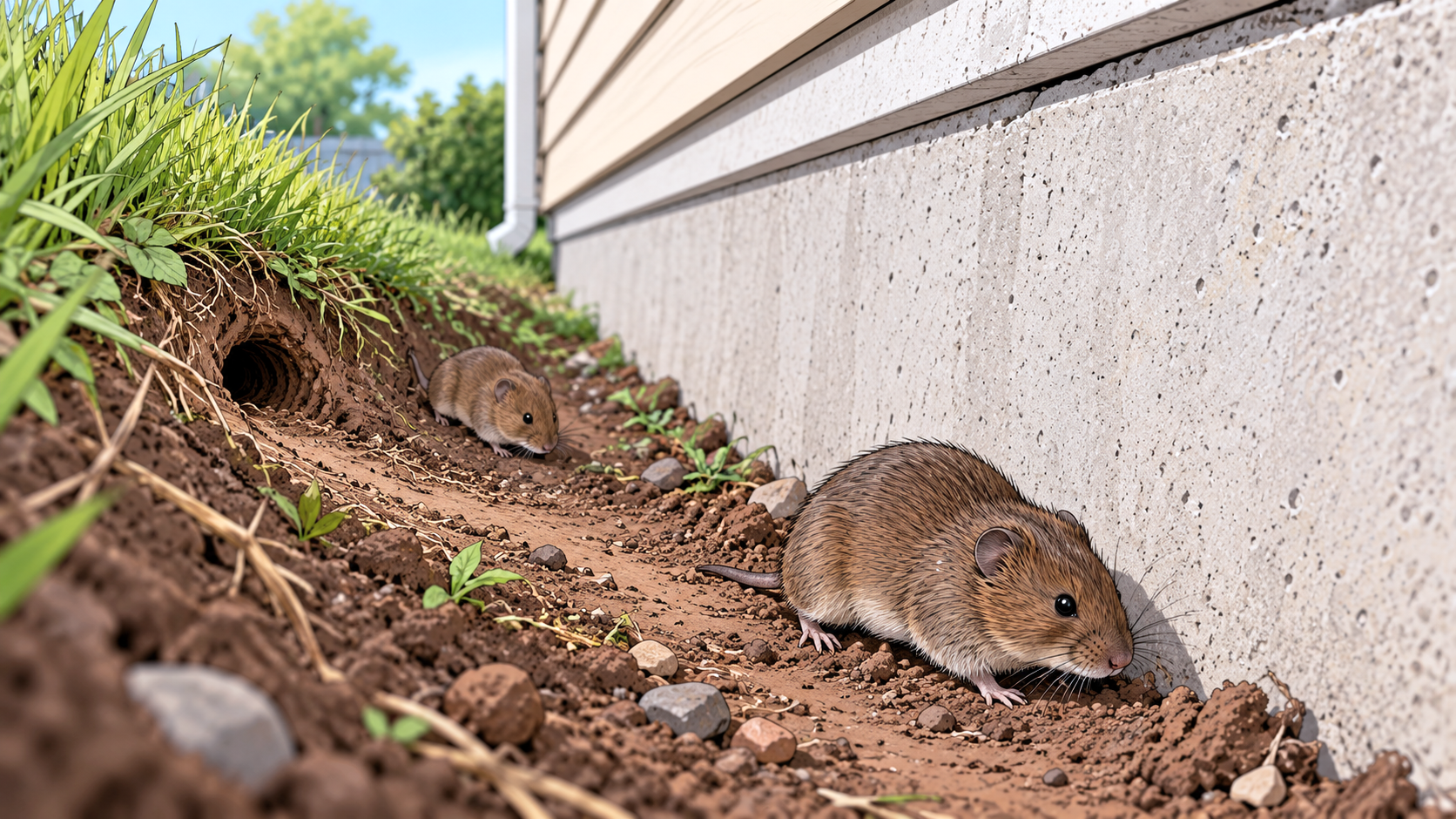
Voles can create small holes, shallow tunnels, and minor depressions in the soil around a house, but they are not known to cause major foundation damage or true geological sinkholes. Their digging is generally too shallow and localized to undermine a properly constructed residential foundation. Cracking walls, significant settlement, and expanding ground cavities require investigation for other causes rather than automatically blaming nearby voles.
A property can have both active voles and a genuine foundation problem without the two being causally related. The presence of burrows establishes that animals have disturbed some soil; it does not establish that the ground supporting the building has lost its stability.
What Voles Can Actually Do to the Ground Around Your House
Most common voles excavate relatively shallow passages or travel along paths concealed beneath vegetation. Their activity can loosen surface soil, create small openings, and occasionally leave localized depressions when unsupported material settles.
Meadow voles frequently use surface runways, while woodland voles spend more time in shallow underground networks. Vole burrows are generally shallow, although some species excavate deeper passages. Their tunnels primarily provide access to food and shelter rather than creating large underground chambers.
A shallow void beneath lawn turf may collapse underfoot or settle after rainfall. This can leave a small indentation that resembles a miniature sinkhole, particularly when the surrounding grass conceals the original opening. The depth and extent of vole tunnels influence the amount of soil disturbed, but even a branching network does not automatically affect the deeper ground supporting a house.
The distinction becomes more important near buildings. A small hole beside a foundation wall may indicate animal activity in the adjacent soil, but its location alone does not mean the vole has excavated beneath the footing.
Can Vole Tunnels Undermine a Concrete Foundation?
There is no established evidence that ordinary vole burrowing is a common cause of structural foundation failure.
Residential foundations transfer building loads into supporting soil or rock. Serious undermining involves losing enough support beneath or around the structural elements to cause damaging movement. Small, shallow rodent passages generally do not produce that scale of soil displacement.
Voles can occur beside concrete foundations because vegetation, mulch, and other ground-level cover provide protected conditions. A narrow opening at the edge of the building may represent a superficial passage rather than excavation extending beneath the foundation.
The shallow burrowing behavior of meadow and woodland voles makes them substantially different from animals that excavate large underground chambers and move considerable volumes of soil.
Nevertheless, no one should dismiss a structural concern merely because small rodent holes are nearby. Existing voids, disturbed backfill, drainage failures, and poor soil conditions can affect a property independently of animal activity. Determining whether a foundation remains adequately supported requires examining the building and ground conditions, not simply identifying the animal closest to the problem.
Can Voles Cause Sinkholes?
A vole burrow collapsing is not the same thing as a geological sinkhole.
True sinkholes commonly develop where groundwater dissolves susceptible underground rock, particularly limestone, gypsum, or salt deposits. Over time, the resulting cavities may lose the support needed to hold the overlying material, producing gradual settlement or sudden collapse.
These sinkhole formation processes operate on a different physical scale from the construction of small rodent tunnels.
The word sinkhole is sometimes used informally to describe any depression in a yard. That can create confusion when a shallow patch of turf collapses over a vole passage. The surface may sink slightly, but there is no basis for concluding that the animal created a large geological cavity.
Land subsidence also has causes unrelated to sinkholes, including soil compaction, drainage of organic soils, groundwater withdrawal, and other forms of underground material movement.
The presence of voles does not exclude any of these processes. An enlarging depression or unexpectedly deep opening needs assessment on its own merits, regardless of whether small rodents have been seen nearby.
What Else Could Be Causing the Ground to Sink?
Settlement around residential foundations is frequently associated with soil disturbed during construction. After excavation, the area beside a foundation is backfilled, and that material may settle differently from undisturbed ground.
As the backfill settles, shallow depressions can develop alongside the building. Rainwater may accumulate in these low areas, particularly when the finished grade slopes toward the wall. Foundation backfill settlement and inadequate drainage are recognized building-maintenance concerns that have nothing to do with voles.
Water can also move soil. A leaking underground pipe, damaged drain, overflowing gutter, or poorly directed downspout may create erosion or saturation beneath the surface. Soil erosion below downspouts and basement water seepage are warning signs worth investigating when a depression occurs near a house.
Other possible explanations include decomposing buried organic material, poorly compacted fill, abandoned utility trenches, and ground disturbed by larger burrowing animals. In regions with soluble bedrock, natural subsidence must also be considered.
These possibilities cannot be reliably distinguished by looking at the depression’s diameter alone. Its depth, rate of enlargement, location relative to drainage infrastructure, and effects on nearby structures provide more useful evidence.
How to Distinguish Minor Vole Disturbance From a Serious Ground Problem
A small surface opening surrounded by recognizable vole runways and recent activity is more consistent with ordinary rodent disturbance than a broad depression involving substantial soil movement.
Other observations should change the assessment.
| Observation | What it may indicate |
|---|---|
| Small, stable openings among grass or mulch | Possible shallow animal passages |
| Slight localized depression over an old burrow | Minor settlement of disturbed surface soil |
| Depression that enlarges or deepens | An unresolved subsurface problem needing investigation |
| Repeated sinking near a downspout or buried drain | Possible erosion, drainage failure, or backfill settlement |
| Foundation cracking accompanied by ground movement | Possible structural or geotechnical concern |
| Sudden, deep collapse or a substantial underground void | Potentially dangerous ground instability requiring urgent professional assessment |
The visible characteristics of vole holes can support identification of animal activity, but they cannot establish whether deeper soil is stable.
A small opening also should not be probed aggressively with a rod or enlarged with a shovel when its depth or origin is uncertain. If the ground already appears unstable, additional disturbance could make assessment more difficult or create an immediate hazard.
Can Voles Cause Cracks in Walls, Floors, or Foundations?
Finding voles near a cracked wall does not demonstrate that the animals caused the crack.
Concrete and masonry can develop cracks through shrinkage, temperature changes, settlement, moisture-related movement, and structural loading. Some cracks remain stable, while others indicate a continuing problem.
More concerning observations include cracks that progressively widen, displacement across a crack, bowing foundation walls, doors or windows that begin binding, and floors that develop noticeable changes in level.
Ground settlement can occur through several subsurface processes, and identifying the cause requires more than assuming that a visible animal burrow explains the movement.
An engineer can evaluate whether a crack is primarily cosmetic or potentially structural. Where the concern includes abnormal ground movement, geotechnical investigation may also be appropriate.
Do not attempt to determine the seriousness of a foundation crack by counting vole holes around the building. The number of openings provides no validated measure of foundation stability.
What Should You Do If You Find Vole Holes Beside Your Foundation?
Begin by distinguishing ordinary surface disturbance from signs of ongoing settlement. Photograph the opening and surrounding ground, note its approximate size and location, and check whether the depression changes over time. Observe whether nearby drainage directs water toward the affected area.
Small, inactive holes in stable lawn soil may be suitable for ordinary repair. The filling of abandoned vole openings is a surface-maintenance task, not a structural repair.
Avoid assuming that pouring material into a visible opening will correct any underlying void. Concrete, expanding foam, loose gravel, or large amounts of water can conceal the original evidence or create additional complications when the condition has not been properly identified.
Where surrounding ground has settled toward the building, appropriate grading and drainage deserve attention. Maintaining a slope that carries surface water away from the foundation helps reduce water accumulation beside the structure.
If the depression is enlarging, unexpectedly deep, or associated with foundation movement, keep people and equipment away from the unstable area and arrange a qualified assessment. A suspected major collapse should be treated as a potential safety hazard rather than an ordinary pest problem.
When Should You Call a Structural Engineer Instead of an Exterminator?
A pest-control professional may be able to establish whether voles are present and whether recent animal activity is occurring near the affected area. That does not qualify the professional to determine whether the building’s foundation is structurally sound.
An engineer or appropriately qualified foundation specialist is more suitable when the concern involves significant cracking, uneven settlement, displaced masonry, or suspected loss of ground support. An expanding cavity may require a geotechnical specialist, particularly where the underlying soil or bedrock is uncertain.
The decision to obtain professional vole control should remain separate from the decision to investigate structural movement. Both services may occasionally be needed at the same property, but they address different problems.
For a small, stable opening without signs of building movement, monitoring and ordinary ground maintenance may be sufficient. For structural changes or unexplained subsidence, identifying a nearby vole is not an adequate diagnosis.