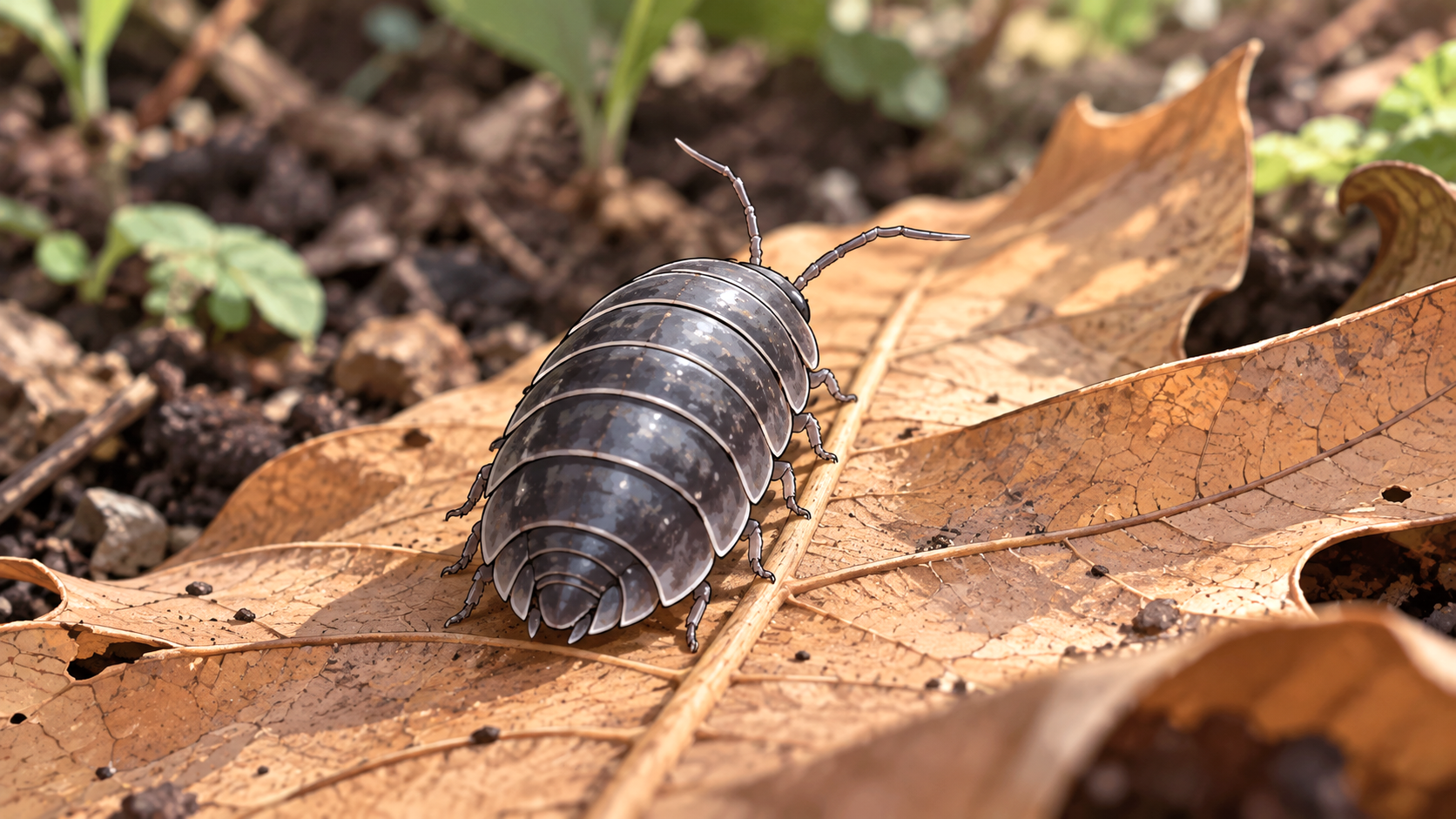
Roly-polies and pill bugs are the same animal. Both names commonly refer to Armadillidium vulgare, a small, land-dwelling crustacean recognized by its rounded, segmented body and ability to curl into a protective ball. Roly-poly is a nickname inspired by the animal’s rolling behavior, while pill bug describes its resemblance to a small pill when curled. Neither name identifies a separate species, although both may be applied to other closely related pill woodlice.
The common pill bug’s scientific description uses both names for Armadillidium vulgare. Whether someone calls the animal a roly-poly, pill bug, or pill woodlouse usually reflects regional vocabulary rather than a biological difference.
Why Do People Use Two Different Names?
The names emphasize different features of the same animal. Roly-poly describes the familiar action of curling into a ball, while pill bug refers to the compact shape produced by that movement. Both developed as everyday descriptions rather than formal scientific terms.
Roly-poly is particularly familiar in the United States, where children often encounter these animals beneath stones, flowerpots, and fallen wood. Pill bug is more common in identification guides and pest-control publications. In Britain, Armadillidium vulgare is generally called the common pill woodlouse, as reflected in the Natural History Museum’s species classification.
Other regional names include doodlebug, potato bug, and armadillo bug, although some of these terms also refer to unrelated animals. The regional naming conventions associated with pill bugs illustrate why common names can become confusing when people from different locations discuss the same creature.
For scientific identification, Armadillidium vulgare provides greater precision than either nickname. It identifies one species, whereas the everyday term pill bug can include several species that share the ability to roll up.
Are Pill Bugs and Sowbugs Also the Same?
Confusion usually arises when people use pill bug and sowbug interchangeably. Both belong to the terrestrial isopods, but typical sowbugs lack the specialized body structure that allows pill bugs to close themselves into a complete sphere.
The difference is visible without magnification. A pill bug has a strongly rounded back and a smooth-looking rear end when viewed from above. A sowbug has a flatter, elongated body with two noticeable appendages extending from its rear. Those projections are called uropods.
| Feature | Roly-poly / pill bug | Sowbug |
|---|---|---|
| Common example | Armadillidium vulgare | Porcellio scaber |
| Overall shape | Rounded, strongly arched | Flatter, more elongated |
| Defensive movement | Curls into a tight ball | Runs or seeks shelter |
| Rear appendages | Not prominently projecting | Noticeably protruding |
| Scientific group | Terrestrial isopod | Terrestrial isopod |
The University of California’s pill bug and sowbug identification information establishes the differences in their body shapes and defensive behavior. Both animals have seven pairs of walking legs as adults, separating them from six-legged insects.
Does Every Roly-Poly Belong to Armadillidium vulgare?
Several species of pill woodlice can curl into a ball, so the nickname roly-poly does not always establish an identification as Armadillidium vulgare.
For example, Armadillidium nasatum, the nosy pill woodlouse, resembles the common pill bug but has a more prominent frontal projection and cannot close itself into the same completely sealed ball. Other members of Armadillidium also differ in body markings, proportions, and geographical distribution.
The broader term woodlouse includes both pill bugs and sowbugs. Woodlice belong to Oniscidea, a group of terrestrial isopods within the crustaceans. Their armored bodies sometimes cause confusion with millipedes, although their leg arrangements and body structures differ. Smaller isopods mistaken for springtails can also occur in moist soil and decomposing plant material.
A photograph of an animal curled into a ball can establish that it has pill bug characteristics, but reliable species identification may require examining its head, body plates, and rear segments.
Which Name Should You Use?
Both names are appropriate when referring to the familiar garden pill bug. Roly-poly works naturally in everyday conversation, while pill bug is preferable when describing the animal in a pest identification or gardening context.
For a specimen that cannot be identified beyond its general appearance, pill bug is a reasonable common name. Use Armadillidium vulgare only when the identifying features support that particular species, rather than assigning a scientific name solely because the animal can roll into a ball.