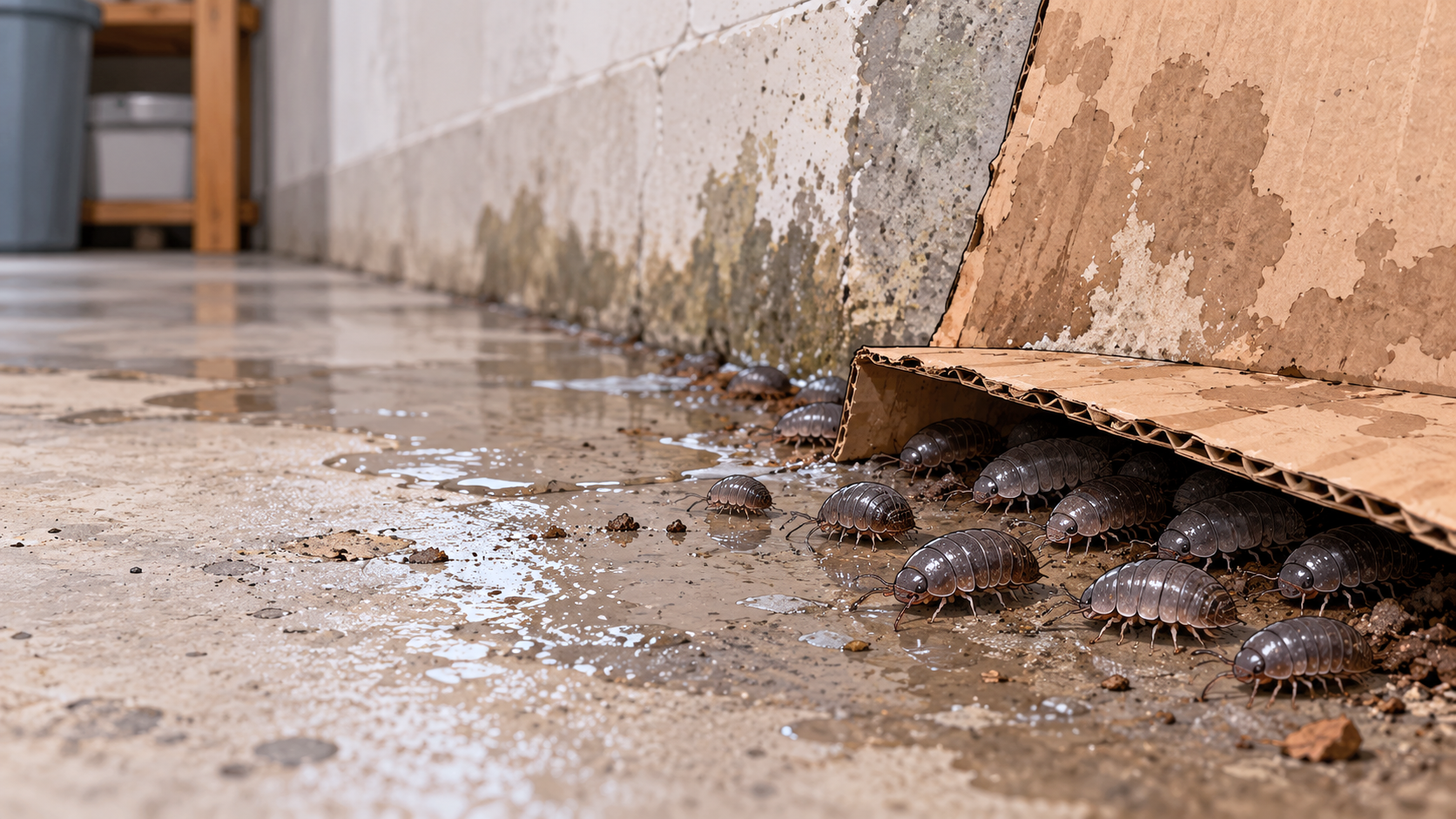
The most common signs of a roly-poly infestation are large numbers gathering beneath damp objects, repeated sightings around exterior doors, and pill bugs appearing inside basements or ground-floor rooms. Roly-polies, also called pill bugs, normally live outdoors, but unusually favorable conditions can support dense populations near a house. An occasional individual is no cause for concern. Repeated indoor appearances, particularly in the same location, deserve investigation because they often indicate excess moisture or an entry point connecting the home to an established outdoor population.
Unlike termites or cockroaches, roly-polies do not ordinarily establish destructive household infestations. Their presence is primarily a nuisance, although large outdoor populations can occasionally damage tender garden plants.
Large Numbers Hiding Beneath Outdoor Objects
Lifting a flowerpot and discovering dozens of roly-polies clustered underneath is one of the clearest indications of a substantial local population. Similar concentrations occur beneath damp boards, landscape stones, discarded containers, and thick accumulations of leaf litter. These sheltered spaces retain moisture and provide access to decomposing organic material, allowing numerous individuals to occupy a relatively small area.
The feeding and sheltering habits of pill bugs explain why populations concentrate in particular locations instead of spreading evenly across a yard. An individual hiding place can contain many animals without the entire property having unusually high numbers. However, finding similar concentrations beneath several objects, especially around the foundation, provides stronger evidence of a widespread local population.
A useful inspection involves checking multiple locations rather than counting the animals beneath one stone. Compare a damp flowerbed, the area beside an exterior doorway, and a drier section of the yard. If substantial numbers consistently appear near the house, those sheltered areas deserve closer attention.
Roly-Polies Repeatedly Appearing Inside the House
Finding roly-polies along the same basement wall or near the same exterior door on successive days indicates that animals are regularly entering the building. They can pass through gaps beneath doors, foundation cracks, and openings around other ground-level building components. The number seen indoors often reflects the population immediately outside rather than an established breeding population within the living space.
The indoor behavior of pill bugs and sowbugs shows that substantial indoor activity commonly originates from outdoor soil populations. Most individuals survive only a short time in ordinary dry rooms. Repeatedly finding dead pill bugs along a baseboard can therefore indicate continued entry, even when no living animals are visible during the day.
Living roly-polies appearing consistently in a damp basement or crawlspace raise an additional concern. Such spaces can provide enough moisture to support prolonged activity, particularly where exposed soil or decaying organic matter is present. Other moisture-associated arthropods, including springtails that enter houses, may occur in the same locations. Their presence can help direct attention toward damp conditions, although each animal requires separate identification.
Increased Activity After Rainfall or Irrigation
A sudden increase in visible roly-polies following wet weather can make a previously unnoticed population appear much larger. Moisture allows them to move across exposed surfaces with less risk of drying out, while saturated hiding places can encourage movement into nearby sheltered areas.
The pattern is especially noticeable where irrigation repeatedly wets soil against a building. Water collecting beside foundation walls, beneath downspouts, or around poorly drained planting beds can sustain favorable conditions for long periods. The University of Maryland’s pill bug management recommendations identify damp outdoor habitats and moisture around buildings as major contributors to household invasions.
Weather-related activity should be interpreted over time. A single surge after heavy rainfall does not establish a persistent infestation. Animals appearing repeatedly during ordinary weather, particularly around the same entrance, provide more convincing evidence that nearby habitat conditions are supporting excessive numbers.
Damage to Seedlings and Low-Growing Vegetables
Feeding damage can accompany large outdoor roly-poly populations, although the animals must be observed before assigning responsibility. Pill bugs occasionally chew tender seedlings, young roots, and vegetables resting directly against damp soil. Newly planted gardens are more vulnerable than established lawns or mature ornamental plants.
A gardener may find small irregular feeding marks near the base of young plants or damage to strawberries touching wet ground. However, slugs and other garden organisms can produce similar injuries. The feeding characteristics of pill bugs and sowbugs establish that they can damage susceptible vegetation, particularly when populations are abundant.
Inspect affected plants after dark and examine the soil immediately beneath damaged fruit or leaves. Finding roly-polies actively feeding offers stronger evidence than discovering them nearby during daylight. Earwigs feeding in gardens can also damage certain plant tissues, making identification of the actual feeding animal important before treatment.
How to Distinguish an Infestation From Normal Activity
There is no universal number of roly-polies that defines an infestation. A garden naturally containing many decomposers is different from a household experiencing repeated invasions or a planting bed suffering confirmed feeding injury.
The following comparison helps prioritize observations.
| Observation | What it indicates |
|---|---|
| A few roly-polies beneath one garden stone | Normal outdoor activity |
| Large gatherings beneath several objects | Favorable habitat supporting a substantial population |
| Repeated sightings along the same interior wall | An established entry route or nearby moisture source |
| Dead pill bugs accumulating indoors | Continued entry into unsuitable indoor conditions |
| Living pill bugs repeatedly found in a crawlspace | Moist conditions requiring inspection |
| Roly-polies observed feeding on damaged seedlings | Active plant injury associated with the population |
This comparison is useful because the number of animals alone does not establish severity. A large population beneath a decomposing log away from the house may require no action, while fewer individuals appearing repeatedly inside a living space can justify investigating a foundation opening.
What to Check When the Signs Keep Appearing
Start with the areas where roly-polies are most concentrated. Inspect door thresholds, foundation joints, nearby planting beds, and places where water remains after rainfall. Move unnecessary damp debris away from the building, repair leaks, and make sure exterior doors close against properly fitted weatherstripping. The Utah State University isopod management recommendations emphasize reducing moisture and hiding places, sealing foundation openings, and removing individuals that enter buildings.
Where roly-polies accumulate beneath indoor plant containers, inspect the potting medium and the space beneath drainage trays. Springtails in potted plants can also become conspicuous in damp growing media, but their much smaller bodies and jumping behavior distinguish them from pill bugs. Identifying which organisms are present prevents unnecessary treatment of harmless soil inhabitants.
Chemical treatment is rarely justified by sightings alone. The integrated pest management approach to household pests favors identification, prevention, and correction of contributing conditions before pesticide use. Removing the animals without addressing persistent moisture or open entry points leaves the conditions supporting their activity unchanged.
If roly-polies continue appearing after visible openings have been sealed and outdoor debris has been cleared, investigate concealed moisture around the affected area. Persistent dampness, water-damaged wood, or unexplained moisture in a crawlspace deserves attention independently of the pill bugs. The animals themselves are usually harmless, but the conditions sustaining repeated indoor activity may require repairs.