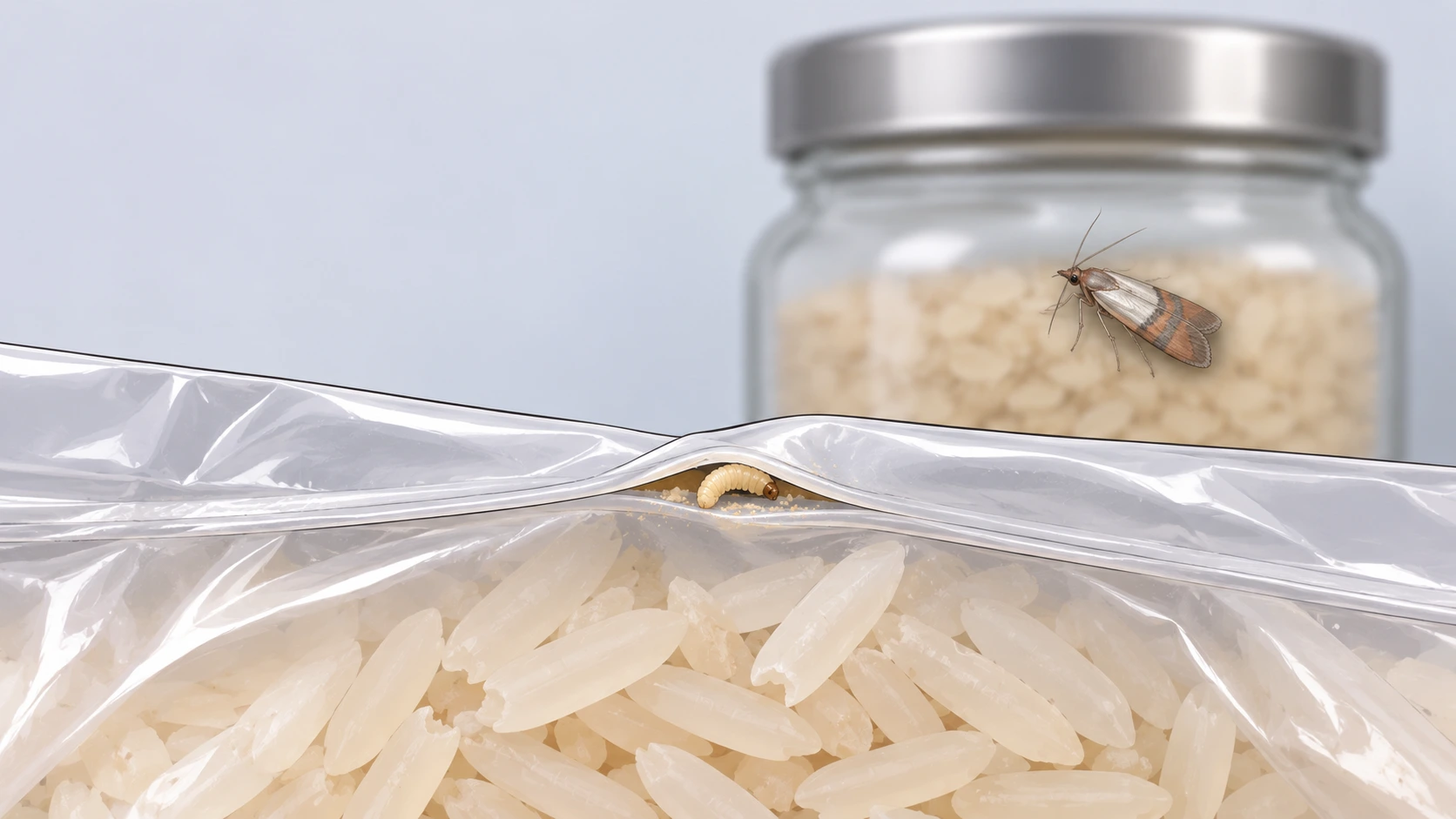
You open a supposedly sealed bag of cereal and find pale caterpillars or strands of silk. The bag looks undamaged from the outside. Indian meal moths can appear in unopened food packages because larvae entered through an opening, penetrated vulnerable packaging, or were already present before the package was sealed. A factory closure, a folded bag top and a tight-lidded storage jar do not offer the same degree of protection.
The important question is what the package actually prevented. An unbroken-looking wrapper may have a narrow seam or pinhole that a person cannot easily see. Conversely, moth larvae developing inside a genuinely intact barrier do not prove that they chewed their way in. The package may have contained eggs or young larvae when it was filled. These possibilities call for different interpretations of the evidence.
Can Indian meal moth larvae get through an unopened package?
Yes, under some conditions. Indian meal moth caterpillars are small enough to exploit packaging defects, and they can damage certain relatively thin films. An unopened package is therefore not the same thing as an insect-proof package. The practical distinction is between an unopened retail wrapper and a container that has an intact, close-fitting, insect-resistant barrier.
Larvae are the life stage responsible for penetrating packaging. Adult moths do not chew through pantry bags to reach food. Once a female deposits eggs near a suitable food source, newly hatched caterpillars may encounter exposed product, a package seam or a wrapper they can penetrate. Egg placement itself is described in more detail in where Indian meal moth eggs are laid.
Both invasion through existing openings and penetration of the packaging material have been demonstrated. In a controlled experiment with multilayer polypropylene food wrappers, Indian meal moth larvae penetrated tested packages, with older larvae generally more successful than the youngest larvae and thicker film proving more resistant. Those results show that some commercial plastic packaging can be vulnerable. They do not establish that larvae can bore through every type or thickness of plastic.
How do larvae use seams, folds and tiny gaps?
A bag does not need a visible tear for an insect to enter. Heat seals, glued flaps, overlapping folds and the corners of wrappers can contain narrow channels or imperfectly joined surfaces. A tiny pre-existing puncture may also be enough. If larvae can reach the food through one of these routes, no new chew hole is required.
A typical example is a boxed food with a thin inner bag. The printed cardboard looks intact, but the inner bag is loosely folded or its seal has a weak corner. A caterpillar may move between the box and its liner before entering the food through that opening. Similarly, a bag clipped shut after use is closed for ordinary kitchen handling but may not block a small larva along its folded edge.
Pantry insects can crawl through folds and seams or chew into susceptible unopened packages. A sealed-looking front panel is less informative than the quality of the entire closure, including the underside, ends and corners. For the nearby places where insects may hide around stored packages, the Indian meal moth pantry hiding-place guide addresses shelf joints, box folds and other refuges.
Does a zipper bag count as sealed?
A resealable zipper bag can appear completely closed and still be a poor long-term insect barrier. The film may be thin, the zipper may not be fully engaged at one corner, and flour dust or crumbs can interfere with the closure. Repeated opening can also create wear or small tears. This does not mean every zipper bag is defective; it means the word resealable describes convenience, not a guarantee of resistance to stored-food insects.
A folded paper sack held shut with a clip offers even less assurance. The folds remain potential entry routes, and paper is not inherently larva-proof. When a moth is found in a bag, look closely at how it was shut before concluding it was penetrated through a solid surface.
Which packaging materials are most vulnerable?
Material and construction matter together. Thickness, seal quality, openings and handling damage can all change the answer. A thick package with a badly fitted closure may be less protective than a thinner package with a reliable, continuous seal.
| Package or container | Main vulnerability to consider | What its appearance tells you |
|---|---|---|
| Paper sacks and thin cardboard boxes | Chewing damage, folds, glued joints and gaps | An unbroken exterior does not establish that the food was inaccessible. |
| Thin plastic film or lightweight bags | Punctures, penetrable film, weak seams and closures | A smooth-looking film can still have a small entry point. |
| Cellophane, foil-laminate or wrapped snack packaging | Pinholes, crimped ends or faulty seals; resistance depends on the construction | The material name alone cannot confirm insect resistance. |
| Rigid plastic food-storage containers | A lid that sits loosely, is warped, or fails to engage around the rim | The rigid wall is generally less concerning than an imperfect closure. |
| Glass jars and metal canisters | Lid gaps, damaged gaskets or incomplete closure | Intact rigid walls provide a strong barrier, but the lid must fit. |
These are relative vulnerabilities, not claims that a particular brand or package is guaranteed to fail or succeed. Extension guidance specifically warns that Indian meal moth larvae can chew through lightweight plastic and identifies tightly covered glass or rigid plastic storage as more protective. The barrier offered by rigid containers depends on their lids as well as their walls.
There is no contradiction between saying that thin bags are vulnerable and saying that some plastic packages resist penetration. Different films, thicknesses, seams and test conditions produce different results. The relevant question is not simply, “Is it plastic?” but, “Can a larva find or make a route through this particular package?”
Can moths get into a jar with a screw-on lid?
A clean, intact glass wall is not a plausible chewing route for an Indian meal moth larva. If moths appear in a jar, first consider the lid and the contents’ history. A screw-on lid may sit crooked, have damaged threads, lack a proper liner or leave a slight gap at the rim. Food dust on the sealing surface can also keep a lid from seating correctly. Similar issues can occur with snap-on plastic lids that are warped or incompletely fastened.
A container that closes firmly with an intact gasket gives stronger protection against outside entry. Even so, a strong barrier can trap an infestation inside if the food was already infested when transferred. The appearance of larvae in a well-sealed jar does not establish a failure of the jar itself.
Consider two jars filled on the same afternoon. In one, larvae were already present in an old bag of nuts before the nuts were transferred. In the other, uninfested cereal was placed in a clean jar with a damaged lid. A later discovery of webbing might look similar, but the first case involves insects already inside and the second allows for later entry. A jar’s contents and closure history matter as much as its material.
How can you tell whether insects entered later or were sealed inside?
Often, you cannot determine the route with certainty after the fact. The most useful approach is to compare the condition of the barrier, the time the product was packaged or transferred, and any evidence around its exterior. The appearance of Indian meal moth larvae may help establish what insect is involved, but it does not reveal when it entered.
Signs that may support entry after packaging include a clear hole in a thin wrapper, an open seam, a badly seated lid, or webbing and larvae concentrated where the food meets a damaged edge. The presence of other infested goods nearby also makes movement between packages plausible. None of these observations proves which insect created a hole or exactly when entry occurred.
Signs consistent with infestation already being inside include an intact rigid container with a sound seal, or an unopened package showing developing insects but no detectable entrance. Eggs and small larvae can be overlooked when food is processed, packed or transferred. Stored-food insect contamination can occur at several points between harvest and the home. For that reason, a package discovered with moths inside should not automatically be blamed on the most recent storage location or retailer.
Even a microscopic opening can escape casual inspection, so an apparently intact flexible package cannot conclusively distinguish these routes. If you are trying to establish responsibility for a particular product, preserve its packaging and identifying details rather than assuming that a visible moth proves when the contamination happened. The broader routes by which infestations first arrive in a household are addressed under where Indian meal moths come from.
Can eggs get into packages without an adult moth crawling inside?
Yes. An adult female need not enter a package for its offspring to reach the food. Eggs may be deposited on or near exposed food and package openings, and the emerging larvae can exploit an accessible route. This is different from an adult moth passing through a tiny seam. It also helps explain why a small defect can matter even when there is no room for a full-sized moth.
Experiments with packaged cereal-fruit bars found that perforations in wrappers increased opportunities for egg deposition in the food. The study tested particular polypropylene packages and hole conditions, so it should not be read as evidence that an intact package is routinely penetrated by adult moths. It illustrates why the position and integrity of openings matter.
Finding silk inside a bag indicates that larvae have been active there, not that they originally crossed the bag’s outer surface. The characteristic webbing produced by Indian meal moth larvae can make affected food clump and may also collect along package corners and seams. Where the webbing occurs may guide an inspection, but it is not a timestamp of entry.
What should you check on a package that appears sealed?
Start with the actual barrier rather than the label’s claim that a bag was sealed or unopened. If you can examine the package safely without spilling its contents, check its crimped ends, folds, bottom seam, zipper track and any thin inner liner. Look for tiny holes, compromised seals, food powder escaping from a corner, or silk extending toward an opening. With a rigid container, examine the full circumference of the lid, not just the center of the cap.
Do not assume that a hole proves moth larvae caused it. Package damage can result from handling, manufacture or other pests, and once an opening exists, larvae may simply use it. Likewise, failing to find a hole does not prove that an insect was introduced at the factory. A package can have been opened previously or have a defect too small to notice.
If live larvae or obvious webbing are present in food, the sensible immediate response is to isolate the suspect item so insects cannot move into adjacent food. The broader assessment and disposal sequence belongs in how to get rid of Indian meal moths, while the full approach to choosing containers and protecting new supplies is covered in how to prevent Indian meal moths. A pantry spray cannot repair a seam or remove larvae already feeding inside a bag.
A sealed-looking bag is evidence that someone closed it, not proof that every insect was excluded. Small openings, susceptible materials and pre-existing contamination can each account for moths found inside. Inspecting the barrier and considering when food was last transferred will usually tell you more than the word sealed on its own.