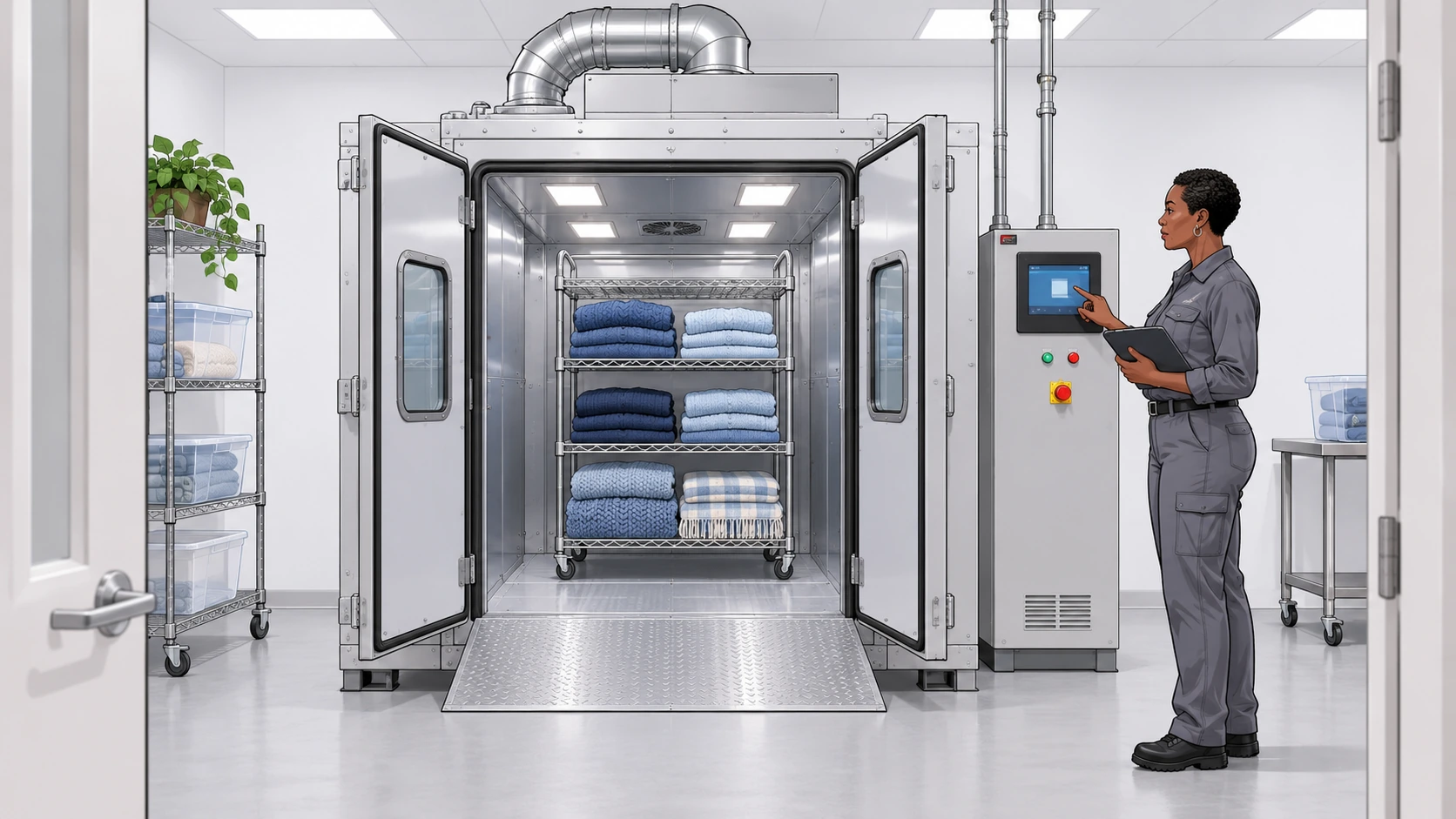
Heat can kill carpet beetles, including their larvae, but the temperature must be high enough for long enough to reach the insects wherever they are hiding. Published pest-control guidance describes heat exposures ranging from 105°F (40.6°C) for four hours to temperatures above 130°F (54.4°C) for several hours. These figures describe different treatment conditions and should not be treated as interchangeable guarantees. For a practical heat treatment, the reading that matters most is often the temperature inside the infested material, not the air surrounding it. A thick cushion, folded rug, or upholstered item can remain cooler internally even while exposed surfaces become hot.
What Temperature Kills Carpet Beetles?
Several established pest-management references describe effective heat treatments, but they do not all specify the same temperature or exposure duration. Their recommendations differ in the insects or stages being considered, the types of materials treated, and the conditions under which the treatment is applied.
The following figures provide useful reference points.
| Temperature | Exposure described in published guidance | What the figure means |
|---|---|---|
| 105°F (40.6°C) | Four hours | Published guidance for killing or repelling carpet beetle larvae in infested items |
| 120°F (48.9°C) | At least 30 minutes | A published heat-treatment option for infested objects, with a warning to consider material damage |
| 120°F (48.9°C) | One hour | A separate recommendation for infested stored-food products |
| Above 130°F (54.4°C) | Several hours | Broader dermestid beetle disinfestation guidance that emphasizes sustained exposure |
| 131°F (55°C) | One to several hours | A conservation-treatment reference for insect-infested objects, with duration dependent on material thickness |
These are published treatment conditions, not five equivalent guarantees. The numbers cannot be combined into a universal formula for every carpet beetle species, life stage, and household item.
The lower-temperature example comes from heat exposure guidance for carpet beetle larvae, which describes 105°F for four hours. That statement specifically discusses larvae and should not be interpreted as proof that every egg, pupa, and adult hidden inside a thick object will die under the same conditions.
A separate carpet beetle management reference describes heating infested objects for at least 30 minutes at 120°F or higher. Its recommendation is paired with a caution about potential damage to treated belongings.
For broader dermestid beetle infestations, sustained temperatures above 130°F for several hours are described as capable of killing insects in infested items. Larger objects need additional time because heat must penetrate into the material.
Specialized collection-conservation methods also use high-temperature exposure. These generally require controlled equipment, attention to object thickness, and careful handling of materials that might be damaged.
If you want one number that illustrates a widely used high-temperature treatment range, approximately 130°F to 140°F (54°C to 60°C) is more representative of controlled thermal disinfestation than ordinary household warmth. But that is a treatment range, not a promise that briefly heating an object’s exterior will eliminate an infestation.
Why Temperature and Exposure Time Must Be Considered Together
Heat kills insects by disrupting biological processes they need to survive. As temperatures rise beyond an insect’s tolerance, damage to proteins, cells, and other physiological systems becomes increasingly difficult to survive.
A moderately elevated temperature may require prolonged exposure, while a higher temperature can cause lethal injury more quickly. The relationship is not perfectly interchangeable because survival depends on species, developmental stage, heating rate, and environmental conditions.
This is why 105°F for four hours does not mean that 105°F for a few minutes is enough. The same problem applies when someone sees that an appliance reached 130°F and assumes the contents were treated immediately.
A successful treatment needs to establish both a sufficient temperature and sufficient time at that temperature.
The exposure period is especially easy to misunderstand. If a device has been running for one hour, an object inside it may not have spent one full hour at the intended treatment temperature. Much of that hour could have been spent warming up.
A useful way to think about thermal exposure is:
Effective treatment exposure = time spent at an adequate temperature where the insects are located.
This is an explanation of how exposure should be evaluated, not a validated dose calculation for carpet beetles. You cannot determine effectiveness simply by multiplying an arbitrary temperature by an arbitrary number of minutes.
Why the Temperature Inside the Material Matters More Than the Air
An appliance, room, or treatment chamber can reach a target temperature well before the center of a thick object reaches the same level.
Heat must travel from the surrounding environment into the object’s outer layers and then deeper toward its center. Thick, densely packed, or insulating materials generally take longer to warm throughout.
Imagine two infested objects exposed to the same 130°F air.
A thin piece of material may warm relatively quickly, leaving little difference between its exterior and interior temperatures. A densely stuffed cushion could take much longer. Larvae buried in its filling may experience lower temperatures than those near the surface.
Both objects have been exposed to the same air temperature, but the insects have not necessarily received the same thermal exposure.
For a proper treatment, the relevant measurement point is the coldest plausible insect-harboring location. Depending on the item, that might be a central fold, thick padding, an interior seam, or a concealed layer.
The principles used in controlled heat treatments for insect-infested objects recognize that exposure depends on an object’s thickness and may need to be established through direct measurement.
Air Temperature, Surface Temperature, and Core Temperature
These measurements answer different questions.
| Measurement | What it tells you | What it cannot prove |
|---|---|---|
| Ambient air temperature | How warm the surrounding air is | That the interior of an object is equally warm |
| Surface temperature | How hot an accessible surface has become | That larvae beneath the surface received the same exposure |
| Material-core temperature | How warm a selected internal location is | That every other hidden location is equally warm unless the measurement represents the coldest relevant area |
An infrared thermometer is useful for measuring accessible surface temperature, but it generally cannot tell you how hot the inside of a cushion or folded textile has become.
A suitable temperature probe can provide an internal measurement where it can be placed without damaging the item. Its location matters. A probe near an exterior seam may overestimate the exposure experienced by insects buried deeper inside.
This explains a common failure in household heat attempts: the heat source appears hot enough, but the treatment never establishes whether the insects reached the target conditions.
Do Carpet Beetle Eggs Need More Heat Than Larvae?
Eggs, larvae, pupae, and adults can all be killed by appropriate thermal treatment, but it is not safe to assume that every stage has identical heat tolerance.
Each developmental stage differs in structure, physiology, and the places it occupies. Eggs may be deposited in protected areas near food, larvae can shelter inside materials, and pupae may remain concealed in a final larval skin. Adult beetles may be more exposed or may move away from an unfavorable location.
Those physical differences can matter just as much as differences in biological heat tolerance. An exposed larva and an egg hidden inside a fold may receive very different temperatures during the same treatment.
The number often cited for 105°F over four hours is specifically associated with larval control. It should not be expanded into a guaranteed egg-kill temperature without supporting evidence.
Broader thermal disinfestation procedures are intended to eliminate the complete insect population within a treated object. Their temperature and time requirements account for the need to reach concealed insects rather than relying on visible adults or larvae as the only targets.
The practical lesson is that killing the larvae you can see does not establish that all developmental stages have been eliminated.
Does Heat Kill Carpet Beetle Pupae and Adults Too?
Sufficient heat can kill pupae and adults, as well as larvae and eggs. The challenge is applying an appropriate treatment throughout the object rather than exposing only the most visible insects.
The familiar household pattern of adults near windows and larvae among fabrics can lead to misleading conclusions. Killing adult beetles on a warm surface says little about the survival of larvae in a cooler material elsewhere.
Similarly, an apparently lifeless larva is not a reliable indicator that an entire object has been disinfested. Heat-related inactivity and death are different outcomes, and surviving stages may remain concealed.
Does Warm Weather or a Hot Room Kill Carpet Beetles?
Ordinary warm indoor conditions are not reliable carpet beetle treatments. Carpet beetles can develop in warm environments, and conditions favorable for their growth are not the same as lethal exposure conditions.
Temperature influences insect development, reproduction, and activity. Different species have different preferred conditions, and prolonged development can occur within temperatures that feel quite warm to people.
The temperature requirements of carpet beetles therefore should not be confused with the much higher temperatures used for deliberate thermal control.
Turning up a household thermostat is unlikely to produce the temperatures necessary throughout an infested item. It may also create unnecessary discomfort, energy costs, or risks without addressing the actual food source.
Sunlight introduces another problem. A sunlit surface can become hot while shaded portions remain cooler. Insects may move away from an uncomfortable area rather than remain exposed long enough to die.
Because thermal conditions can vary greatly between locations, heat buildup in a parked car should be evaluated separately from a controlled heat treatment. A hot environment alone cannot establish that every concealed insect received lethal exposure.
Why Heated Objects Do Not All Respond the Same Way
The structure of an infested object affects both heat penetration and the risk of damage.
A thin, loosely arranged item may heat more evenly than a thick or tightly packed one. Rolled textiles, layered upholstery, and materials containing dense filling can create cooler internal areas.
A large object may also contain components with different heat tolerances. Wood, adhesives, foam, synthetic coverings, natural fibers, and decorative finishes can respond differently to elevated temperatures.
The material may be damaged before a reliable insect treatment has been completed.
For example, a cushion with a heat-sensitive covering might become discolored or distorted while insects in its cooler interior remain alive. A wooden object with glued joints could experience changes to its finish or construction.
Thermal disinfestation guidance for household items specifically cautions against heating some fabrics, glued objects, and oil paintings. The risk comes from the object itself, not from the carpet beetle species.
The condition and construction of upholstered furniture therefore affect whether heat is a suitable option at all.
Can a Hair Dryer, Space Heater, or Household Oven Provide Enough Heat?
A household appliance may produce air hotter than the published lethal temperatures, but its maximum output does not establish treatment effectiveness.
A hair dryer concentrates moving hot air in a small area. Surfaces directly in the airflow may heat quickly, while insects inside upholstery, behind seams, or beneath thick material remain protected. Holding the appliance close for extended periods can also damage fibers, melt components, or cause burns.
Portable space heaters create another problem because ordinary room heating does not provide the temperature distribution, monitoring, or fire protection expected in a controlled disinfestation system. Do not improvise whole-room pest heat treatments with space heaters, ovens, or other household heating devices. Misuse can cause fires, electrical hazards, burns, or damage to the building.
An oven can reach high temperatures, and some older extension guidance describes oven treatment for suitable small objects. That does not make an oven appropriate for clothing, bedding, stuffed toys, foam, plastic, adhesives, or other mixed-material belongings. Many household ovens cannot reliably maintain low treatment temperatures, and putting unsuitable materials inside can create fire or damage risks.
Microwaves are also inappropriate as a general carpet beetle treatment. Heating can be uneven, hidden materials may overheat, and metallic components can introduce additional hazards.
In each case, the appliance’s advertised heat output answers the wrong question. What matters is whether a particular item can be treated safely while every infested location receives a validated thermal exposure.
Heat Treatment Does Not Replace Finding the Source
Even a properly heated object can become infested again if nearby feeding material remains untreated.
Carpet beetle larvae may develop in wool, fur, feathers, insect remains, accumulated animal hair, or other suitable materials depending on the species. Treating a visible rug does little if the active feeding source is an overlooked item in storage or debris beneath furniture.
Before choosing a treatment, finding the material supporting carpet beetle development helps establish which objects actually need attention.
Heat also leaves no lasting insecticidal barrier. After an item cools, additional beetles may reach it if the surrounding problem persists.
For this reason, disappearance of visible insects immediately after heating is not sufficient proof that the infestation has ended. Follow-up evidence matters, particularly fresh larvae, new shed skins, and continuing damage.
Monitoring whether carpet beetles are actually gone requires comparing new activity with older signs rather than treating one quiet inspection as confirmation.
How to Judge Whether a Heat Treatment Is Reliable
A proposed heat treatment is much easier to evaluate when the provider or equipment instructions can answer four questions.
First, what pest and developmental stages does the procedure address? A claim about exposed larvae may not establish complete control of eggs, pupae, and adults.
Second, where is temperature measured? A sensor recording warm chamber air is not equivalent to a probe in a thick, infested object.
Third, when does the exposure period begin? If the treatment requires a sustained target temperature, time spent warming the object cannot automatically count toward that exposure.
Fourth, can the material tolerate the treatment? A method capable of killing insects may still be unsuitable if it causes shrinkage, melting, structural changes, or damage to finishes.
A reliable professional process should also account for uneven heating, concealed spaces, temperature monitoring, and safety controls. For delicate or valuable objects, specialized conservation treatment may be more appropriate than ordinary household equipment.
Where these details cannot be established, the result should be treated as uncertain rather than guaranteed.
Does Repeated Heating Work Better Than One Treatment?
Repeated heating is not automatically a substitute for one properly controlled exposure.
Several insufficient exposures may kill some exposed larvae while leaving more protected insects alive. The overall outcome depends on the actual temperatures reached, the time at those temperatures, and the survival of hidden developmental stages.
Repeated heating can also increase material stress. An object that tolerates brief warmth may still deteriorate with repeated cycles, particularly when adhesives, finishes, or sensitive fibers are involved.
If carpet beetles remain after a heat attempt, the cause may be inadequate penetration, untreated objects, surviving stages, or a separate feeding source. Persistent activity after carpet beetle treatment is a reason to reassess the evidence rather than simply repeat an uncontrolled heating attempt.
For materials that can be treated through ordinary fabric-care processes, the appropriate washing, drying, and freezing options for carpet beetles depend on the item and the method. Those processes have their own operating requirements and should not be reduced to the general heat thresholds discussed here.
The Temperature That Actually Matters
Heat is an effective way to kill carpet beetles when it is delivered under suitable conditions. Published guidance includes a larval exposure of 105°F for four hours, an item-treatment recommendation of at least 120°F for 30 minutes, and broader dermestid treatment conditions above 130°F for several hours. None should be taken as a universal guarantee for every object or developmental stage.
The most useful temperature is the one reached and maintained where the insects are hiding, for a duration appropriate to the treatment. Hot air, a warm exterior, or a high appliance setting cannot establish that result by themselves.
Before relying on heat, consider the actual pest stage, the thickness and construction of the material, the available temperature measurements, and the risk of damage. A controlled treatment that reaches the infested areas is far more defensible than simply making an item as hot as possible.