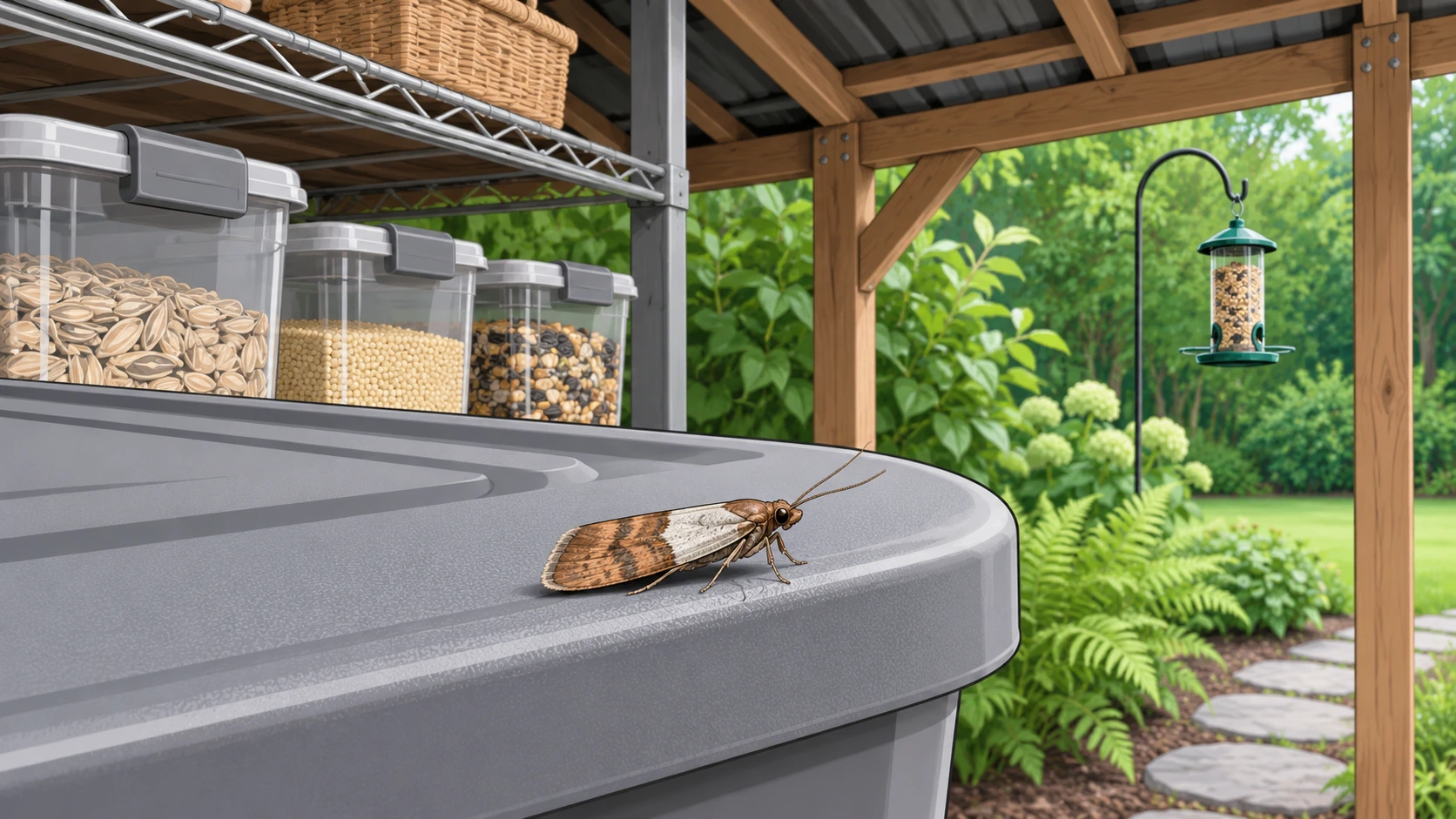
Indian meal moths can live outside, and in suitable warm environments, they can reproduce outdoors. However, their ability to survive outdoors depends on temperature, access to dry food materials, and protection from harsh weather. An adult moth flying across your patio may be a temporary visitor, while larvae developing in stored seed or grain outside can indicate a breeding population.
Indian meal moths (Plodia interpunctella) are best known as pantry pests because their caterpillars feed on stored foods. Their association with kitchens and food-storage buildings sometimes creates the impression that they cannot survive outdoors. That is not true. They can live successfully outside in warm climates, including Florida, although exposed populations face greater seasonal limitations in colder regions.
The practical question is whether the outdoor environment provides enough food and shelter for the moths to complete their development. A few adults resting on an exterior wall are different from a recurring population developing inside an outdoor supply of grain, seeds, or other suitable dry material.
Can Indian Meal Moths Survive and Reproduce Outdoors?
Indian meal moths can survive outdoors without necessarily establishing a breeding population. Adult moths can fly through outdoor spaces, rest on vegetation or buildings, and remain active during favorable weather. Their presence alone does not establish that eggs, larvae, and pupae are developing nearby.
Reproduction requires more than a suitable resting place. Female moths deposit eggs on or near material that their larvae can eat. After hatching, the caterpillars must have access to suitable food long enough to grow and eventually pupate. The resulting adults can then reproduce if environmental conditions remain favorable.
Outdoor populations are particularly plausible in warm regions with accessible stored-food materials. The species lives successfully outdoors in Florida, where suitable temperatures can support its development beyond heated buildings.
In colder climates, outdoor activity may be seasonal. Adults can appear during warm periods, but persistent reproduction becomes more difficult as temperatures decline. Sheltered food supplies may support development longer than exposed locations because their internal conditions can differ from the surrounding air.
This means an Indian meal moth can be present outdoors without the outdoor environment supporting a permanent population.
What Do Indian Meal Moths Need to Live Outside?
The most favorable outdoor habitat combines a suitable food source, shelter from weather, and temperatures that allow development. An exposed patio or flower bed does not automatically provide these conditions, even when adult moths occasionally appear there.
A reliable source of dry food
Food availability is especially important because Indian meal moth larvae are responsible for feeding and growth. Adult moths do not feed, so an adult can temporarily occupy an area without finding a food source there. Its offspring, however, need suitable material after hatching.
Outdoor environments can contain such materials, particularly where people store grain, seeds, nuts, animal feed, or similar products. A covered container of birdseed with an insecure lid, for example, can offer a more favorable developmental environment than an open lawn.
Larvae can feed on numerous stored grains, seeds, nuts, and dried food products. Their feeding commonly produces silk that binds particles together. This combination of suitable food and larval webbing is more meaningful evidence of a breeding site than the presence of an adult moth alone.
Outdoor food supplies are not all equally suitable. Their condition, accessibility, moisture exposure, and susceptibility to deterioration influence whether larvae can develop successfully.
Protection from rain, wind, and disturbance
Indian meal moths do not require an enclosed house to survive, but protected locations can offer more stable conditions than fully exposed surfaces.
A covered grain bin, sheltered seed container, or dry accumulation of stored food beneath a roof may provide some protection from rain and wind. Cracks, joints, and sheltered surfaces near food can also offer places for mature larvae to pupate.
Excessive exposure to weather can make these environments less favorable. Rain may wet or disperse food, while wind and disturbance can affect exposed insects. Moisture can also spoil stored products, although the relationship between humidity and moth development is more complicated than simply assuming that every dry location is suitable.
Indian meal moths commonly pupate away from the material where their larvae feed. Consequently, a sheltered outdoor breeding site may contain larvae within food and pupae in nearby protected crevices.
Temperatures suitable for development
Temperature strongly influences how quickly Indian meal moths develop. Warm conditions generally allow faster development, while cooler conditions slow growth and can interrupt the progression from larva to adult.
This is one reason outdoor breeding success varies considerably between climates and seasons. A protected food supply in a warm environment can support repeated development, while the same material in an exposed location during a cold winter may not.
The insects also respond to conditions within their immediate shelter, not simply the temperature displayed on a nearby weather report.
Can Indian Meal Moths Survive Outside During Winter?
Indian meal moths can survive some cold conditions, particularly as larvae in protected food-storage environments, but they cannot withstand every winter outdoors.
The outcome depends on how cold the environment becomes, how long the insects remain exposed, whether they have acclimated to declining temperatures, and how much protection their surroundings provide.
Larvae can enter a period of arrested development called diapause, which allows development to pause under unfavorable conditions. This response can help them persist through periods when normal growth would be difficult. It does not make them immune to freezing temperatures.
Cold tolerance also differs between insects that have gradually acclimated to low temperatures and those suddenly exposed to severe cold.
A study of Indian meal moth overwintering in southern Minnesota illustrates this difference. Laboratory-reared fifth-instar larvae exposed to 14°F (-10°C) reached 100% mortality after 12 hours. Cold-acclimated field-collected larvae required 312 hours at the same temperature to reach 100% mortality. In the study’s outdoor grain-bin conditions, overwintering mortality eventually reached 100% at all monitored locations.
These results show that acclimation and shelter can substantially change survival time. They do not establish a universal temperature or exposure duration that will kill every Indian meal moth in every outdoor setting.
In relatively mild winters, sheltered larvae may survive until conditions improve. In regions with prolonged severe freezing, year-round outdoor establishment is much less likely.
The species can also overwinter as larvae in unheated buildings. An unheated structure is not necessarily equivalent to an exposed outdoor location because stored products and building materials can moderate temperature changes.
Why winter survival differs from winter reproduction
An insect that survives winter has not necessarily been growing or reproducing throughout that period. Indian meal moth larvae may remain inactive or develop very slowly under unfavorable conditions, with adult emergence occurring after temperatures improve.
In contrast, heated buildings can allow the life cycle to continue during seasons when outdoor development is severely restricted.
For homeowners, this explains why a stored-food infestation can persist through cold weather even when adult moths are rarely visible outside. The absence of winter flight activity is not proof that every sheltered immature stage has died.
Where Might Indian Meal Moths Live Outside?
Indian meal moths are more likely to establish populations around accessible dry food materials than in ordinary garden vegetation.
Several outdoor or semi-outdoor situations deserve attention.
Birdseed and seed-storage areas
Birdseed is a suitable larval food, particularly when it remains in storage for extended periods. A covered porch, outdoor storage cabinet, or sheltered seed container may provide both food and protection.
The location of an adult moth near a bird feeder does not prove the feeder contains larvae. More convincing evidence would include caterpillars, silk-bound seed particles, or pupal material associated with stored seed.
Birdseed that has become wet, spoiled, or contaminated presents additional handling considerations. The appropriate response to an affected supply is covered in our Indian meal moth birdseed guidance.
Grain bins and other stored agricultural products
Bulk grain and related stored commodities can provide substantial amounts of food for developing larvae. The temperature and condition of the stored material may differ considerably from outdoor air, particularly deeper inside a grain mass.
Grain-storage environments also illustrate why shelter alone is not sufficient to predict winter survival. Cold can penetrate stored grain over time, and the position of larvae within a grain mass influences their exposure.
Indian meal moth larvae commonly feed near the surface of stored products and may leave webbing that binds food particles together. These feeding habits help explain why protected grain-storage environments can support populations under suitable conditions.
Covered patios and exterior storage spaces
An outdoor cabinet containing dry pet food, seed packets, or other susceptible materials may offer opportunities for development if the contents are accessible to larvae.
A patio with no stored food may still attract occasional resting or flying adults. In that situation, the moths may be using the area temporarily rather than reproducing there.
A sheltered structure should therefore be evaluated according to its contents and conditions, rather than its name or whether it is technically indoors or outdoors.
Protected accumulations of seeds and nuts
Indian meal moth larvae have also been found in stored caches of seeds and nuts associated with rodents. These accumulations can occur in protected spaces around buildings.
Such locations are easy to overlook because the food supply may not belong to the homeowner or be immediately visible. A protected cache containing suitable dry material can offer a more plausible developmental site than a nearby patch of living grass.
The presence of stored seeds or nuts is not sufficient evidence on its own. Larvae, silk, and other associated insect material are needed to establish that Indian meal moths are actually using the food.
Does Finding an Indian Meal Moth Outside Mean There Is an Infestation?
No. A single Indian meal moth outdoors is not enough to establish an infestation. Adults can move through an area without reproducing there, and other small moth species may look similar during a brief sighting.
The location and pattern of sightings matter. An adult resting on a porch wall provides little information about where it developed. Several moths repeatedly appearing around the same stored-food supply, especially alongside larvae or silk, provide stronger evidence of local activity.
The following comparison helps separate temporary outdoor encounters from situations that deserve closer inspection.
| Outdoor observation | What it may indicate |
|---|---|
| One adult moth flying across a yard | Temporary presence; no breeding source established |
| An adult resting on a porch or exterior wall | A resting insect, not proof of local reproduction |
| Repeated adults around stored seed or grain | Possible nearby food source worth inspecting |
| Caterpillars feeding inside stored dry food | Active larval development in that material |
| Silk-bound food particles with larvae | Strong evidence of an established feeding site |
| Pupae or cocoons near affected food | Development has progressed beyond the feeding stage |
Correct identification matters before interpreting these observations. Many outdoor moths have similar sizes or brownish wings, so a quick sighting does not reliably identify Plodia interpunctella.
Indian meal moth adults have a characteristic two-toned forewing pattern, with a pale inner portion and a reddish-brown or coppery outer portion. A closer look at the adult Indian meal moth’s identifying features can help distinguish it from unrelated moths.
If the species is confirmed, the next question is whether suitable food and immature stages are present nearby.
Do Indian Meal Moths Live in Gardens, Grass, or Trees?
Indian meal moths may fly through gardens, settle on leaves, or rest on tree trunks and other outdoor surfaces. These observations do not mean that living garden plants are their normal larval food.
The species is primarily associated with stored dry foods and related materials. Its caterpillars are not typical leaf-feeding garden pests, and a moth resting on a plant should not be interpreted as evidence that the plant is being eaten.
There is a meaningful difference between a garden containing living vegetation and an outdoor area containing stored seeds or other suitable dry material.
For example, an adult Indian meal moth might rest on a shrub beside a covered birdseed container. The shrub offers a resting surface, while the stored seed could provide larval food if it is accessible. Finding the moth on the shrub would not establish which location, if either, supports reproduction.
The same reasoning applies to grass, fences, tree bark, and exterior siding. These surfaces may be used temporarily by adults without becoming breeding habitats.
Where caterpillars are actually feeding on living leaves, identification should be reconsidered rather than automatically attributing the damage to Indian meal moths.
Why Do Indian Meal Moths Sometimes Appear Outside Only in Warm Weather?
Warm weather creates more favorable conditions for adult activity and for the development of immature stages. As temperatures rise, moths that were inactive or developing slowly in protected locations may become more noticeable.
Seasonal outdoor sightings can therefore reflect a combination of adult movement, emergence from sheltered material, and more favorable conditions for reproduction.
The timing of sightings also matters. Indian meal moth adults commonly fly during the evening and nighttime, although they can be seen at other times. Their daily activity patterns help explain why someone might notice them outdoors during warm evenings but rarely see them during colder daytime periods.
Seasonal changes should not be treated as proof that an infestation has disappeared. Outdoor flight may decline while larvae remain sheltered inside suitable food material.
In warm climates, activity may continue for a much greater portion of the year. In colder climates, outdoor populations face stronger seasonal interruptions.
Can Indian Meal Moths Establish a Permanent Outdoor Population?
A self-sustaining outdoor population requires suitable conditions across successive generations, not merely the survival of a few adults.
Warm temperatures, dependable larval food, and protected developmental sites make sustained reproduction more plausible. Regions with mild climates can provide those conditions for longer periods, while severe winter weather limits establishment in exposed environments.
The distinction between outdoor reproduction and persistence in protected storage is especially important. A moth population developing inside a grain bin may be influenced by outdoor temperatures without experiencing the same conditions as insects exposed directly to rain, wind, and freezing air.
Likewise, an outdoor food-storage site can support a temporary population during warm months without maintaining that population through winter.
No single sighting can establish permanent outdoor residency. Evidence of reproduction across generations, together with the persistence of suitable food and shelter, would be needed to support that conclusion.
What Should You Do If You Keep Seeing Indian Meal Moths Outside?
If the sightings are occasional and no susceptible food is stored nearby, there may be little reason for concern. First confirm that the insects are Indian meal moths rather than ordinary outdoor moths.
When sightings repeatedly occur around a particular outdoor storage location, inspect accessible dry food materials for larvae, silk, and other evidence of feeding. Pay particular attention to seed, grain, and animal-feed supplies that have remained undisturbed.
Keeping susceptible food in sound, tightly closed containers reduces access for insects. Dry, clean storage areas also make it easier to notice developing problems before substantial material becomes affected.
These measures are consistent with established stored-product pest prevention practices, which emphasize secure storage, removal of spilled food, and inspection of susceptible products.
There is no reason to spray an entire yard simply because an adult Indian meal moth has been observed. Broad outdoor insecticide applications would not address larvae protected within stored food and could expose non-target organisms unnecessarily.
If an actual infestation is present, the affected food material is the relevant starting point. The broader Indian meal moth removal process addresses established infestations rather than isolated outdoor sightings.
Can Indian Meal Moths Live Outside Without a House Nearby?
Can Indian meal moths reproduce outdoors without a nearby building?
Yes, provided suitable larval food, shelter, and environmental conditions are available. A building is not a biological requirement for reproduction. However, many favorable habitats involve stored food materials associated with human activity.
Will Indian meal moths die if you release them outside?
Not necessarily. An adult released during mild weather may survive for some time. Its fate depends on the conditions it encounters, and releasing adults outdoors is not a reliable way to eliminate an established infestation because eggs and larvae may remain in the original food source.
Can Indian meal moths survive outside in freezing temperatures?
Some cold-acclimated larvae can withstand substantial cold exposure, particularly in protected environments, but prolonged freezing can be fatal. Survival varies with life stage, acclimation, temperature, exposure duration, and shelter. A freezing outdoor temperature alone does not establish that every sheltered larva has died.
Do Indian meal moths build nests outside?
They do not build communal nests comparable to those of social insects. Larvae feed within suitable material and produce silk, while mature larvae may form cocoons in sheltered locations. These structures should not be confused with a single organized moth nest.
The Bottom Line
Indian meal moths are capable of living outdoors, and warm environments with suitable dry food can support reproduction. Their survival is not restricted to kitchens, pantries, or heated buildings.
Outdoor conditions become less favorable when temperatures fall, food is unavailable, or insects are exposed to severe weather. Sheltered larvae may survive periods that exposed adults cannot, but even protected populations have limits during prolonged cold.
For homeowners, the most useful distinction is between an adult moth temporarily present outside and larvae actively developing in an outdoor food supply. An occasional sighting rarely establishes an infestation. Repeated activity associated with suitable food, especially when larvae or silk are present, provides a much stronger reason to investigate.