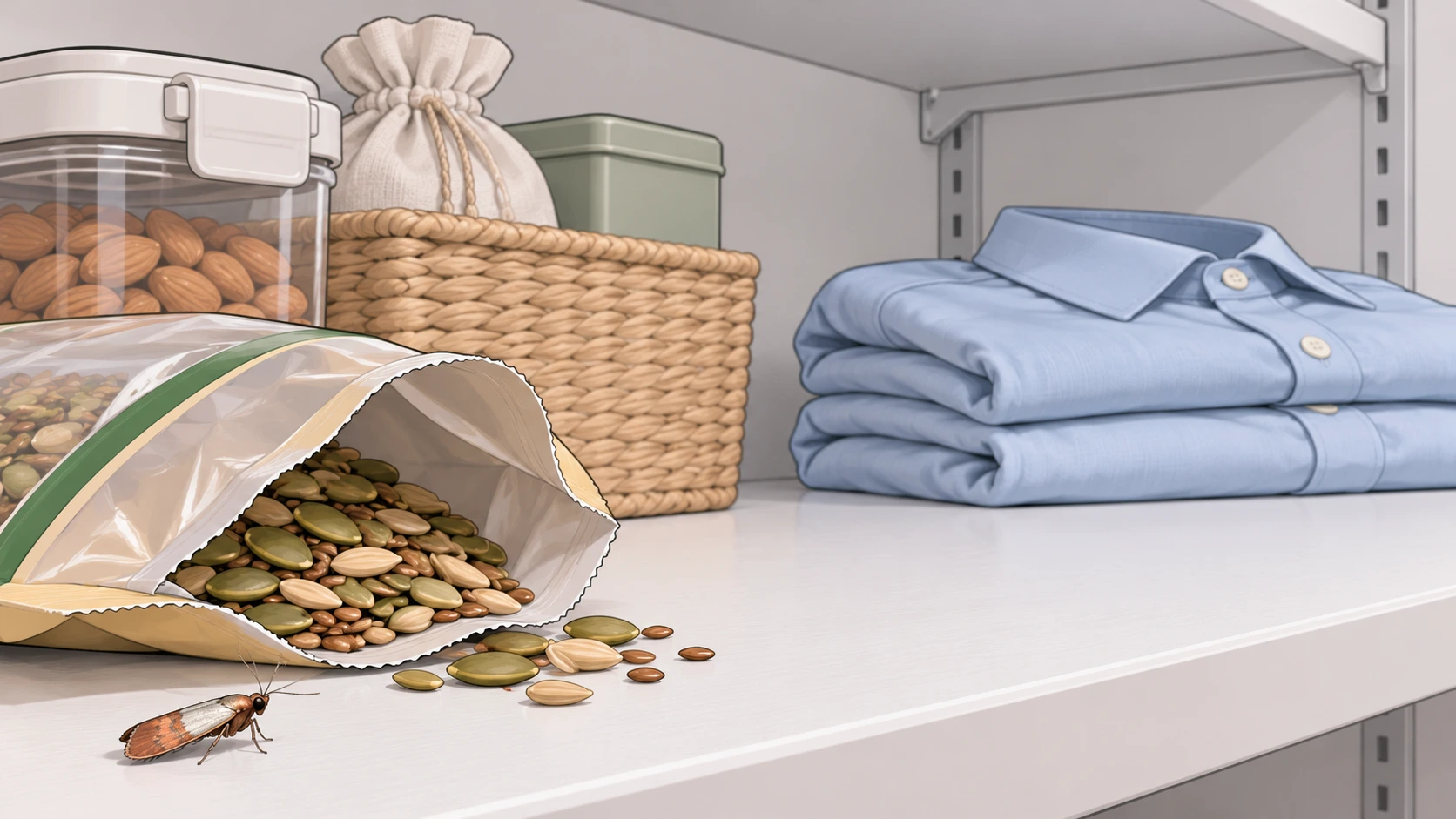
Finding Indian meal moths in your bedroom or closet does not necessarily mean they are breeding there. Adult Indian meal moths can fly away from the stored food where they developed, while mature caterpillars may crawl into quiet corners, ceiling joints, and other sheltered locations before pupating.
However, a bedroom or closet can sometimes contain the actual infestation source. Forgotten snacks, stored birdseed, edible decorations, or dry food kept in a closet can support Indian meal moth larvae just as they would in a kitchen cupboard.
The key is to determine whether the moths are simply passing through or whether their caterpillars have access to suitable food in the room.
Indian meal moths (Plodia interpunctella) are stored-product pests. Their larvae feed on susceptible dry materials, while the adults fly and reproduce. This difference explains why finding a moth on your bedroom wall does not necessarily reveal where the insect spent its earlier life.
We recommend starting with the evidence around the sighting rather than assuming every moth in a closet is a clothes moth or every moth in a bedroom represents a new infestation.
Why Would an Indian Meal Moth Be in My Bedroom?
An adult Indian meal moth may enter your bedroom after emerging somewhere else in the house.
These moths are mobile, and they can travel considerable distances from the food that supported their development. A moth originating in the kitchen may eventually appear near a bedroom lamp, window, ceiling, or closet door.
Artificial lighting can influence where adults become noticeable. Indian meal moths are attracted to certain lights, so a bedroom lamp may draw attention to a moth that would otherwise have remained unnoticed.
The movement of adult Indian meal moths between rooms is well documented. Adults can appear far from an infestation and may consequently be mistaken for insects that damage clothing.
Imagine a bedroom on the second floor of a house. An adult moth emerges from a pantry downstairs and eventually flies toward an illuminated upstairs hallway. It then enters the bedroom and settles above the bed.
Nothing about that sequence requires food to be present in the bedroom.
The moth’s location identifies where you found it, not necessarily where its larvae developed.
Are Indian Meal Moths Attracted to Bedroom Lights?
Bedroom lights can attract adult Indian meal moths.
An illuminated bedside lamp, ceiling fixture, or window can become a noticeable point of attraction. However, the moth’s response depends on the lighting conditions, and not every individual will immediately move toward the brightest object.
Finding a moth circling a lamp does not demonstrate that the room contains an infestation.
Likewise, turning the lamp off may reduce the moth’s attraction to that particular light without affecting larvae developing elsewhere.
The response of Indian meal moths to artificial light explains why adult sightings may cluster around fixtures even when the source is in another room.
Why Are Indian Meal Moths in My Closet?
A closet provides sheltered places where adult moths can rest and mature larvae can pupate. It may also contain stored materials capable of supporting an infestation.
Those are three different explanations, and they should not be confused.
An adult moth resting on a closet wall may simply have flown there. A cocoon attached to a shelf joint may belong to a larva that developed elsewhere and crawled into the closet before pupating.
A closet containing old snacks, birdseed, or other susceptible dry materials presents a third possibility: Indian meal moths may actually be reproducing there.
The stored-product pest guidance for closets and clothing-storage areas specifically cautions that moths found around clothing are not always clothes moths. Forgotten food in garment pockets and food products stored in closets can support stored-product moth infestations.
That observation changes how a closet should be inspected.
Instead of immediately treating every sweater and coat as infested, begin by asking whether the closet contains any suitable larval food.
Can Indian Meal Moths Live in a Closet Without Food?
An adult Indian meal moth can temporarily rest in a closet without any larval food being present.
Similarly, a mature larva may enter the closet to pupate after feeding elsewhere. It may form a cocoon in a crack or along a shelf support and later emerge as an adult.
Those insects are using the closet as a temporary location rather than establishing a feeding population.
A sustained breeding population is different. Newly hatched caterpillars need suitable food to develop successfully.
A closet containing only clean clothing and ordinary household objects is therefore a less likely breeding location than one containing accessible stored food or seed-based materials.
The presence of insects in a room does not automatically establish that the room provides everything necessary for their development.
Where Should You Look for Indian Meal Moths in a Bedroom?
Begin with locations that could contain the insects’ food rather than inspecting every corner of the room with equal priority.
A bedroom used for eating, studying, gaming, or working may contain small amounts of stored food that are easy to forget. A snack left inside a drawer or beneath a bed can remain undisturbed long enough for insects to develop.
Some bedrooms also contain decorative items made from dried plant materials, grains, or seeds.
The following table separates locations that could support feeding from places where moths may merely be resting or pupating.
| Bedroom or closet location | What to look for | What the finding may mean |
|---|---|---|
| Desk drawer containing crackers or snacks | Live larvae, silk, clumped food, or damaged packaging | Possible local breeding source |
| Box of stored cereal or dry food | Larvae and webbing within the product | Strong evidence of feeding in the room |
| Forgotten food in a backpack or coat pocket | Insects, silk, or food debris | Possible concealed source |
| Seed-based decorative items | Feeding damage or silk among seeds | Possible larval development |
| Closet ceiling corner | Cocoons or isolated mature larvae | Possible pupation after feeding elsewhere |
| Bedroom window or lamp | One or more adult moths | Adult presence, not proof of local breeding |
| Clean clothing or bedding | An adult resting on the surface | Location alone does not demonstrate fabric feeding |
This is a source-assessment framework, not a claim that every listed location is equally likely to contain an infestation.
The deciding evidence is whether susceptible material contains feeding larvae or their associated silk.
Check Forgotten Snacks and Food Containers
A bedroom snack stash deserves closer attention than an empty wardrobe.
Packets of crackers, cereal, nuts, or other susceptible dry products may contain developing insects, especially when opened packages have been stored for long periods.
Examine the actual contents and their packaging folds. Look for webbing, small caterpillars, and food particles held together by silk.
A package may look reasonably normal from the outside while larvae are developing inside.
The ability of stored-product pests to remain concealed in packaged food makes examination of the contents more useful than simply checking the surrounding shelf.
If an item is visibly infested, remove it from use. There is no need to wait until adult moths emerge before recognizing that it is affected.
Check Backpacks, Drawers, and Coat Pockets
Forgotten food does not always remain in its original storage location.
A backpack may contain an unfinished packet of snacks. A coat pocket may hold a forgotten food item. A drawer used for stationery may also contain opened food packaging.
These places can be overlooked because they are not considered food-storage areas.
The useful question is whether a suitable product has remained accessible long enough for larvae to feed.
Finding an adult moth inside an otherwise empty backpack would not establish that the bag is infested. Finding caterpillars and silk in a forgotten packet inside it provides much stronger evidence.
We would inspect these locations before assuming that the closet’s textiles are responsible.
Can Indian Meal Moths Breed in Bedroom Decorations?
Certain decorations made from dried edible materials can support stored-product insects.
Examples include ornamental arrangements containing grains or seeds and craft objects made from suitable dried plant material.
The important factor is the material itself.
A decoration made from accessible grain or seed components is different from an ordinary plastic ornament, framed photograph, or synthetic fabric item.
Indian meal moth larvae may feed on suitable dried materials when those materials provide the nutrition they need.
The range of places stored-product pests may develop includes dried botanical decorations and objects made from seeds or nuts.
If moths repeatedly appear around a closet shelf holding an old seed-based decoration, inspect the object for feeding damage and silk.
An adult merely resting on an unrelated decorative object is not equivalent evidence.
Does Finding a Moth on Clothes Mean It Is Eating Them?
An adult Indian meal moth can rest on clothing without using the clothing as food.
A moth on a sweater, coat, or blanket may have landed there after flying into the closet.
The species is associated primarily with stored food rather than textile feeding. Its adult stage also does not normally feed.
However, moth identification remains important. Other moth species can be associated with animal-derived textiles, and finding damage to clothing introduces a different question.
Do not identify a moth as an Indian meal moth solely because it is small and brown.
The specific question of whether Indian meal moths eat clothes is separate from explaining why an adult might be found resting in a wardrobe.
For this investigation, the useful point is that clothing contact alone does not establish a breeding source.
What If You Find Holes in Clothes and Indian Meal Moths Nearby?
The two observations may be unrelated.
A damaged garment and a nearby Indian meal moth do not prove that the insect caused the holes.
Clothing damage can have several explanations, including ordinary wear, snagging, and insects associated with textiles.
The correct approach is to identify the moth and assess the damage independently.
Indian meal moth adults have distinctive reddish-brown or coppery outer forewings and a paler inner section. These markings can help separate them from some other small household moths.
The appearance of adult Indian meal moths offers a more dependable starting point than the room or object on which an insect was found.
If the specimen does not match, avoid applying Indian meal moth assumptions to a different species.
Why Do Indian Meal Moth Larvae Appear on Bedroom Ceilings?
A caterpillar on a bedroom ceiling may have traveled from a food source elsewhere before pupation.
Mature Indian meal moth larvae commonly stop feeding and search for sheltered locations where they can complete development.
They may crawl along walls, cross ceilings, and enter narrow joints.
This behavior can produce sightings far from the original food source, particularly when suitable shelter is available.
The documented movement of mature larvae away from infested food explains why finding a caterpillar on a ceiling does not prove that the room contains suitable food.
A larva on an upper wall may be traveling rather than feeding.
We would distinguish a few isolated wandering caterpillars from repeated discoveries of young larvae associated with an actual food product.
The reason Indian meal moth caterpillars and cocoons appear on ceilings depends on their behavior before pupation, not on the ceiling serving as food.
How Can You Tell Whether the Bedroom Is the Actual Infestation Source?
The strongest evidence of local breeding is developmental activity associated with suitable material in the room.
Adult sightings alone are weak evidence because moths can fly between rooms. Cocoons are more informative about where pupation occurred, but they do not necessarily identify the earlier feeding location.
Feeding larvae and silk inside a susceptible product are much stronger evidence.
A practical assessment can be organized around three situations.
<text></text>
| What you find | Most reasonable interpretation | Where to focus |
|---|---|---|
| One adult on the wall, no food or larval evidence | Likely visitor or wandering adult | Check the insect’s identity and watch for additional evidence |
| Several adults near a bedroom light, no larvae found | Adults may be arriving from another room | Look for developing insects rather than assuming the lamp marks the source |
| Cocoons in closet corners, no local food found | Pupation may have occurred after larvae wandered | Inspect nearby sheltered locations and consider a source elsewhere |
| Live larvae and silk inside snacks in a drawer | Strong evidence of local larval feeding | Treat the affected material as an infestation source |
| Repeated adults and newly discovered webbing in a stored seed decoration | Evidence supports local development | Examine the decoration and its immediate surroundings |
The purpose of this comparison is to prevent the most common investigation mistake: treating every room with an adult moth as if it contains a separate breeding population.
An infestation source is established by evidence of development, not simply by the number of flying insects noticed nearby.
Why Are There Indian Meal Moths in My Bedroom but None in the Kitchen?
A bedroom sighting does not require a simultaneous kitchen sighting.
Adult moths may fly away from an infested product, and their movement is not restricted to rooms where food is stored.
The kitchen may also contain developing insects that are still hidden inside packaging. During that period, no adult moth needs to be visible near the product.
Alternatively, the actual breeding source may be somewhere other than the kitchen, such as food stored inside a closet, a study room, or another storage area.
The absence of visible adults in the kitchen does not rule out a food-associated infestation there.
Likewise, repeated bedroom moths do not establish that food is present in the bedroom.
The process of identifying the actual Indian meal moth infestation source relies on developmental evidence rather than using adult flight location as proof.
What If You Keep Finding Moths in the Same Closet?
Repeated sightings in one closet deserve closer investigation, but they can have more than one explanation.
An infested snack or decorative item may be producing adults locally. Another possibility is that mature larvae from elsewhere selected the closet as a sheltered pupation site.
Adult moths may also repeatedly settle in the same area because of lighting or environmental conditions.
The next useful observation is whether you can find live caterpillars feeding in a stored product.
Cocoons around a shelf joint suggest that pupation has occurred nearby. Larvae and silk distributed through a food item provide a more direct connection to feeding.
A closet containing no susceptible stored material is less likely to support continuing reproduction, even if an occasional adult still appears there.
Avoid using the frequency of sightings as the only deciding factor.
What If You Find Moths in a Closet With No Food at All?
When a closet genuinely contains no suitable food, we would initially consider adult movement or pupation after larval wandering more likely than local breeding.
Inspect accessible corners and shelving for cocoons, but do not assume every crack contains a hidden infestation.
The question is whether any developing insects could obtain food there.
If no suitable material or active feeding evidence is present, the investigation should extend beyond the closet.
A particular cupboard or room can accumulate visible moths without providing the food needed to produce them.
Should You Spray Your Bedroom or Closet for Indian Meal Moths?
We would not recommend spraying bedroom walls, clothing, bedding, or closet shelves simply because Indian meal moth adults have been seen there.
The insects may have developed elsewhere, and treating their resting location does not address larvae inside an infested food product.
Pesticide use in living spaces also introduces exposure concerns, especially around bedding, clothing, children, and pets.
Ordinary household insecticides should not be treated as substitutes for identifying the stored material supporting the infestation.
The recommended approach to pantry moth infestations emphasizes inspection, removal of affected food, and prevention rather than routine pesticide applications.
An individual moth can be collected without applying insecticide to the surrounding room.
If the room contains an actual infested food item, addressing that material is more useful than spraying surfaces on which adults happen to rest.
How Long Will Moths Keep Appearing in the Bedroom?
Adult moths may remain visible for a period after the original breeding source has been removed.
Some larvae may already have left the food before it was discarded. Others may have formed cocoons in protected locations and can emerge later.
A few adult sightings during the following two to three weeks can therefore be consistent with an infestation that is winding down.
The typical time needed for Indian meal moth sightings to stop is useful when deciding whether lingering adults represent delayed emergence or a continuing source.
Repeated sightings beyond approximately three weeks after all known affected material has been removed warrant renewed investigation.
That period is a practical checkpoint rather than a guarantee. Fresh larvae or silk associated with stored food justify attention immediately, regardless of how recently the first infestation was discovered.
Frequently Asked Questions
Why Do I Find One Indian Meal Moth in My Bedroom Every Night?
Repeated sightings may reflect adults emerging from protected pupation sites or traveling from an infestation elsewhere in the house. A regular pattern near a bedroom light does not prove the moths developed there. Look for larvae and silk associated with suitable stored materials before assigning the source to the bedroom.
Can Indian Meal Moths Lay Eggs in a Closet?
A female can deposit eggs in a closet if she encounters suitable material or a surface near it. However, successful development requires food for the larvae after hatching. The presence of eggs alone would not establish that clean clothing or empty shelving can support a continuing infestation.
Why Is an Indian Meal Moth Sitting on My Bed?
An adult may have landed on the bedding after flying through the room. Its location does not show that it feeds on the mattress or sheets. Correctly identify the insect and look for other evidence before assuming the bed is an infestation source.
Are Indian Meal Moths Attracted to Dirty Laundry?
There is no reason to treat ordinary dirty laundry as a preferred breeding material for Indian meal moths. Finding an adult on a laundry pile is more likely to reflect where it landed. If food has been left in a pocket, that material presents a different possibility.
Can Indian Meal Moths Hide in Closet Boxes?
They may rest or pupate in protected cardboard folds and joints. A box containing susceptible dry food or seed-based objects could also support feeding larvae. A cocoon inside an otherwise empty box does not prove the insect ate the cardboard.
Should I Empty My Entire Closet After Finding One Moth?
A single properly identified adult does not automatically justify emptying every shelf or treating all your clothes. First consider whether there are signs of larvae, cocoons, or suitable stored food. A more extensive inspection becomes reasonable when repeated sightings are accompanied by evidence that insects are developing nearby.
The Bottom Line
Indian meal moths can appear in bedrooms and closets without breeding in either room. Adults fly away from their original food sources, while mature larvae may travel to sheltered locations before pupation.
A closet can also contain a genuine infestation source if forgotten snacks, dry food, or seed-based materials are stored there.
The most useful evidence comes from feeding larvae and silk associated with a susceptible product. An adult on a bedroom wall, a moth beside a lamp, or a cocoon in a closet corner does not independently establish where the insects developed.
Inspect the materials that could actually support larvae, identify the moth correctly, and use repeated sightings as clues rather than proof. That approach helps separate a passing adult from a local infestation without treating an entire bedroom or wardrobe unnecessarily.