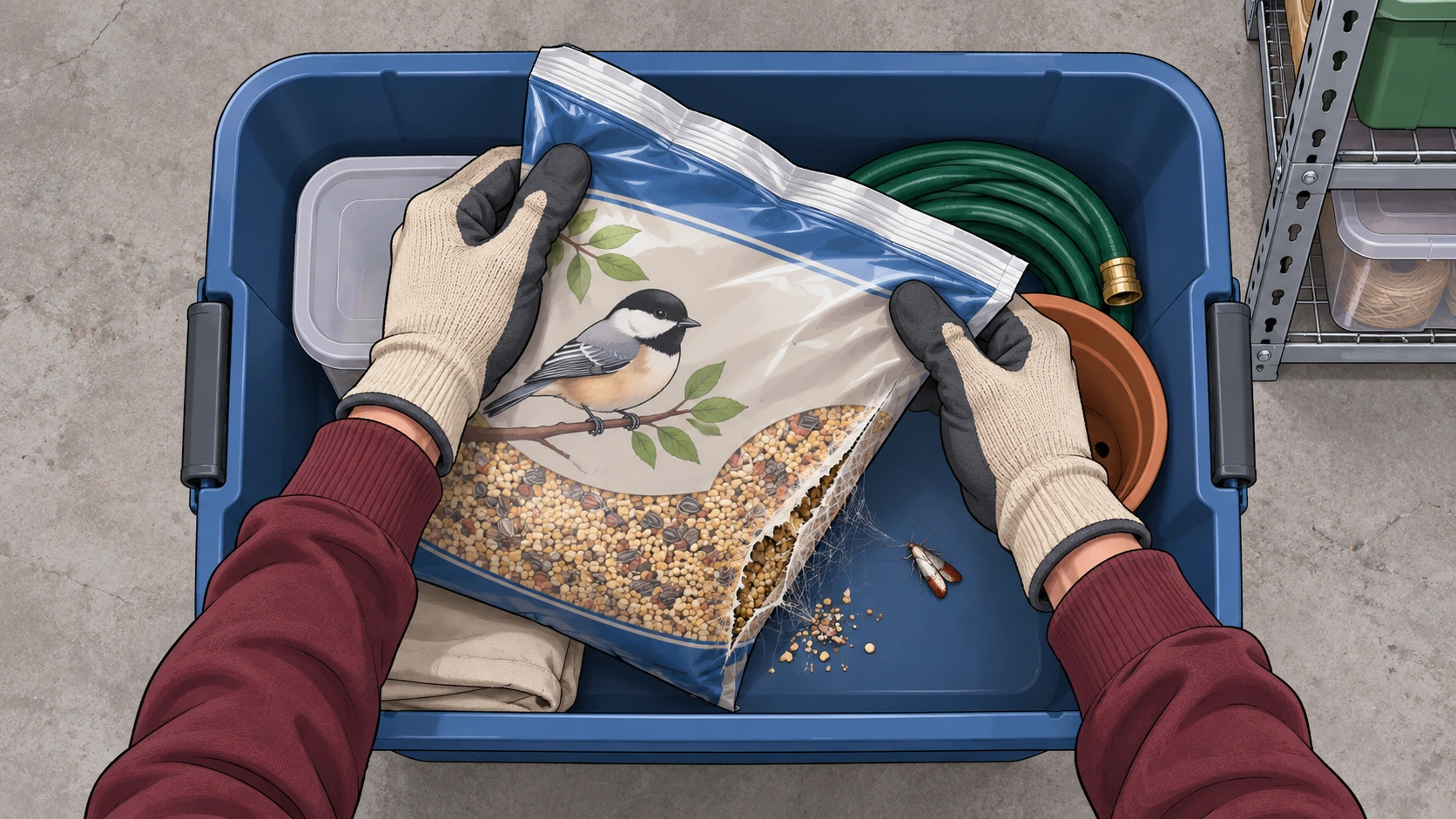
To get rid of Indian meal moths in your garage, locate and remove infested dry supplies, vacuum spilled material from shelving and floor joints, and inspect nearby cracks for larvae and cocoons. Store unaffected supplies in tightly sealed containers, and check the doorway connecting the garage to your home to reduce the chance of moths spreading indoors.
Garage infestations can be more difficult to locate than kitchen infestations because food-related products are often stored among tools, seasonal decorations, paint cans, and other household belongings. A bag of birdseed may sit behind a lawn mower, while a container of dry animal feed remains unopened for months.
Indian meal moths (Plodia interpunctella) are stored-product pests. Their larvae feed on suitable dry materials and produce silk that binds food particles together. Mature larvae can leave their food source to form cocoons in sheltered locations, while adults may fly into other parts of the building.
A garage can therefore contain two distinct problems: infested supplies that continue producing moths and hidden larvae or pupae that remain after the original material has been removed.
The most effective approach is to work outward from the stored supplies, address the shelving and floor debris associated with them, and then check the places where the insects may have dispersed.
Why Are Indian Meal Moths in Your Garage?
Garage infestations often begin with stored supplies containing grain, seeds, or other dry materials that can support Indian meal moth larvae.
The garage provides several conditions that can make an infestation difficult to notice. Products may remain undisturbed for long periods, packaging can be damaged during storage, and small quantities of spilled feed may accumulate beneath shelves.
An adult moth flying near the garage ceiling does not necessarily identify the infested product. Adults can move away from their feeding source, and mature larvae may crawl into nearby cracks before pupating.
Indian meal moths are documented in garages and other enclosed storage locations. Their presence around stored grain, birdseed, and dry animal feed warrants inspection of those materials, especially when adults repeatedly appear.
A clean-looking garage can still contain an infestation. A single affected package tucked into a storage cabinet may be enough to sustain the problem.
Where to Look for Indian Meal Moths in a Garage
Begin with bulk dry supplies, then investigate the shelving and floor areas immediately surrounding them.
An effective garage inspection follows the locations most likely to contain developing larvae before turning to the places where adults or wandering caterpillars may have settled.
| Garage location | What to inspect | Why it matters |
|---|---|---|
| Bulk feed and seed storage | Opened bags, package seams, bottom corners, and contents | Larvae can develop within suitable stored material |
| Large plastic storage bins | Lid seals, grooves, undersides, and old material at the bottom | Insects may already be inside, and debris can remain after refilling |
| Wire or wooden shelving | Shelf joints, brackets, undersides, and the wall behind them | Spilled particles and pupating larvae can accumulate |
| Floor beneath stored supplies | Cracks, concrete joints, loose grain, and debris under pallets | Fallen food can remain available to larvae |
| Cardboard boxes | Folded flaps, corners, and boxes near infested supplies | Mature larvae may use folds as sheltered pupation sites |
| Garage wall and ceiling joints | Cocoons, caterpillars, and trapped adult moths | Larvae may travel away from their original feeding material |
| Doorway to the house | Threshold, frame joints, and nearby storage | Insects may move between the garage and living areas |
The purpose of this inspection order is to identify the material supporting larval development before spending hours examining unrelated garage belongings.
An adult moth on the ceiling is a useful clue that insects are present. Several caterpillars feeding inside a bag of grain are much stronger evidence of the infestation source.
Start With Bulk Bags and Forgotten Supplies
Large bags deserve priority because they may contain enough material to support repeated moth development.
Look for silk strands between particles, clumps held together by webbing, live caterpillars, shed skins, and insects resting around the package opening.
Do not assume that a factory-sealed bag is necessarily free of insects. Eggs or larvae can be present before a product reaches your garage, and some packaging materials or seams may permit later entry.
A useful inspection technique is to examine the material over a light-colored tray. This makes small caterpillars and silk-bound fragments easier to notice than they would be against a dark garage floor.
Avoid shaking a heavily infested bag. That can scatter insect debris and loose food particles, potentially spreading the material across the garage.
Check Storage Bins Even When Their Lids Are Closed
A closed storage bin can contain an infestation if insects were already present in the material when it was sealed.
The container may prevent insects from moving into other supplies, but it does not necessarily kill eggs or larvae inside.
Inspect the underside of the lid, the rim, and any recessed handles or grooves. A mature larva may leave the food and form a cocoon in a protected part of the container.
Pay attention to old material remaining beneath fresh supplies. Repeatedly topping up a container without emptying it can leave older contents undisturbed.
For future storage, heavy plastic, glass, or metal containers with tight-fitting lids offer better protection than loosely folded bags. Pest-resistant storage and removal of infested products are central to controlling stored-product insects.
Remove Infested Supplies Without Scattering Them
Once you identify an affected product, contain it before carrying it through the garage or house.
Place the package inside a sturdy bag or other suitable enclosure. If the original packaging has holes or torn seams, use an additional outer bag to contain loose material and insects.
Heavily infested products are generally best discarded. Extensive webbing, numerous larvae, and substantial insect debris make the material difficult to assess and unsuitable for normal use.
Move sealed waste to an appropriate outdoor disposal container. Do not leave an open bag of infested grain beside the garage garbage can while deciding what to do with it.
Also avoid dumping the contents onto a compost pile or scattering them outside as an easy disposal method. That can leave the material accessible to insects and other animals.
For limited infestation in otherwise sound products, a properly controlled freezing treatment may be possible. The correct temperature and exposure time for killing Indian meal moths depend on how cold the product becomes throughout, not simply the freezer’s setting.
Freezing does not remove silk, droppings, mold, or other contamination. Products that are heavily affected or spoiled should not be salvaged merely because the insects can be killed.
Clean Shelving and Floor Areas Where Bulk Supplies Were Stored
After removing infested supplies, clean the surfaces and gaps that may contain loose food, larvae, or cocoons.
Garage shelves often have more concealed spaces than kitchen cabinets. Wire shelving may collect particles near brackets, while wooden shelves can contain rough edges and joints that provide shelter.
Remove the remaining supplies from the affected section so you can reach the underside and back of the shelf.
Use a vacuum with a crevice attachment to collect spilled grain, fine dust, webbing, and accessible insects. Work along the wall behind the shelf, around support brackets, and beneath the storage area.
The recommended sanitation measures for Indian meal moths emphasize locating infested materials and vacuuming the spaces where insects and food debris accumulate.
Empty the vacuum container or discard the collected bag promptly according to the vacuum manufacturer’s instructions. Do not leave insect-filled debris in a machine stored beside the same shelves.
Wash suitable hard surfaces with warm soapy water after loose debris has been removed. Allow them to dry completely before returning supplies.
For unfinished wood, electrical equipment, or surfaces that could be damaged by moisture, use an appropriate dry-cleaning method rather than soaking the material.
Pay Special Attention to Concrete Floor Joints
A garage floor can hold more food debris than its appearance suggests.
Concrete expansion joints, cracks near walls, and gaps around shelving feet may collect seed fragments and grain dust. These areas often remain untouched during ordinary sweeping.
A broom may move visible debris while leaving small particles deep inside the joints.
Vacuuming accessible cracks is more useful when the objective is to remove the material that could continue supporting larvae.
You do not need to tear up a sound concrete floor because a moth was seen nearby. Concentrate on joints and gaps with actual food residue, larvae, or silk.
If damaged flooring repeatedly traps spilled material, repairing the defect after the area is clean may make future sanitation easier.
Do You Need to Move Heavy Garage Shelving?
Move or partially empty shelving when there is a reasonable likelihood that infested material or insect debris remains behind it.
For example, if a bag of grain leaked from the back of a rack, the wall and floor beneath the rack deserve inspection.
There is less reason to dismantle an unrelated shelving unit across the garage when no stored food or insect evidence is associated with it.
Do not pull over loaded shelving or attempt to move heavy cabinets without proper support. Secure tall units against tipping, and use assistance where necessary.
The objective is to reach likely refuges safely, not to disassemble every storage fixture in the building.
Check Garage Walls, Ceiling Corners, and Hidden Pupation Sites
Indian meal moth larvae can leave the material where they fed and travel to sheltered places before becoming adults.
That behavior explains why caterpillars or cocoons may appear above storage shelves, along ceiling joints, beneath brackets, or inside cardboard folds.
A larva found six feet from a seed bin does not necessarily indicate a separate breeding source at that spot.
Look for small silken cocoons or pupal remains along protected edges. They may be difficult to see against dusty wood or unfinished surfaces.
Collect accessible larvae and cocoons with a vacuum or another suitable physical method.
The movement of Indian meal moth larvae before pupation explains why an infestation can leave insects in places that contain no food.
You may find empty cocoons after the adults have already emerged. Removing them helps clear the area, but an empty cocoon alone does not prove that a new generation is currently developing there.
What About Cracks You Cannot Reach?
Not every narrow garage gap can be cleaned completely without damaging the structure.
Prioritize locations connected to the infestation. A crack directly behind a leaking grain container deserves more attention than an inaccessible gap on the opposite side of the garage.
A flashlight and crevice vacuum attachment may be enough for many shallow joints.
If a removable baseboard, shelf panel, or storage fixture blocks an area containing obvious debris, carefully accessing that space may be worthwhile.
Do not drill into walls, dismantle electrical boxes, or open structural cavities merely to search for Indian meal moths. Electrical equipment and concealed wiring create hazards unrelated to the insect problem.
Where inaccessible spaces continue producing moths despite the removal of accessible sources, a targeted inspection may be needed.
Sealing a clean, unused gap can reduce future debris accumulation, but sealing over infested food or concealed insects is not a substitute for addressing the material supporting them.
How to Stop Garage Moths From Spreading Into the House
An attached garage creates a potential connection between stored supplies and living spaces.
Adult Indian meal moths can fly through an open interior door. Mature larvae may also move away from infested materials before pupation.
Focus on the garage-to-house doorway while the infestation is being addressed.
Keep the connecting door closed when it is not in use. Check the weatherstripping and threshold for gaps, and replace damaged seals where appropriate.
Avoid carrying opened bags or uncovered bins of suspect material through living areas. If a product must be moved for disposal, keep it enclosed.
Do not relocate suspect supplies into the kitchen or pantry simply to make garage cleaning easier. That can place infested material beside additional susceptible foods.
The ways Indian meal moth infestations spread from stored materials show why an apparently separate storage area can still be relevant to activity inside the home.
What If Moths Have Already Appeared in the Kitchen?
A few adults appearing indoors do not prove that the kitchen has its own breeding source.
They may have moved from the garage. However, suitable stored materials inside the home should still be considered if sightings continue.
For now, contain the garage infestation and compare indoor sightings with activity around the garage’s affected supplies.
If adults continue appearing inside after the garage source has been removed, investigate whether developing insects remain elsewhere.
The signs of an Indian meal moth infestation are more informative than treating every adult sighting as evidence that moths are breeding in that particular room.
Should You Use a Fogger or Insecticide in the Garage?
A fogger is generally a poor solution for Indian meal moths in stored garage supplies. It may affect exposed adults, but it cannot reliably reach eggs or larvae protected inside bags, bins, or packed food material.
Garage use also introduces hazards involving fuel containers, gas appliances, ignition sources, and electrical equipment.
A product being sold for flying insects does not establish that it is appropriate for Indian meal moths, nor does a garage location automatically make pesticide application safe.
The National Pesticide Information Center’s pantry moth guidance prioritizes finding infested products, cleaning cracks and corners, and preventing further exposure of sound supplies.
Never apply ordinary household insecticide directly to animal feed, birdseed, or other material intended for consumption unless a product is specifically registered and labeled for that exact use.
Do not place mothballs inside storage bins or near exposed feed. Mothballs release pesticide vapors and are not an appropriate way to treat food-storage materials.
If considering any pesticide, the current label determines the permitted pest, location, application method, and safety restrictions.
For most garage infestations, correcting the stored-material problem and removing accumulated debris provide a more direct response than spraying the surrounding space.
How to Protect Clean Supplies After the Garage Is Treated
Once the affected area is clean and dry, return only materials that have been inspected and are suitable for storage.
Use containers with tightly fitting lids rather than relying on loosely folded paper sacks or lightweight plastic bags.
For large quantities, consider dividing supplies into smaller sealed portions. This reduces the amount of material exposed whenever a container is opened and makes later inspection easier.
Keep containers raised on stable shelving where practical, rather than placing opened bags directly on the floor. That makes debris easier to notice and clean.
Do not put new supplies on top of old material remaining in the bottom of a bin. Empty and clean the container before refilling it.
Labeling containers with purchase or opening dates can also help identify material that has remained in storage longer than expected.
Garage storage is especially vulnerable to becoming disorganized because the space often serves several purposes. Keeping susceptible supplies together in one accessible section makes future inspection more manageable.
The long-term prevention of Indian meal moth reinfestation depends heavily on protecting suitable products and preventing unnoticed food residues from accumulating.
How Long Will Indian Meal Moths Keep Appearing After Garage Cleanup?
Some adult moths may appear after the infested supplies have been removed because larvae already left the food and formed cocoons elsewhere.
A few adults during the following two to three weeks can be consistent with delayed emergence.
However, the garage presents additional uncertainty because temperature fluctuations may affect insect development.
A consistently heated garage may support a different pattern of activity from an unheated garage that becomes very cold during winter.
The practical checkpoint remains whether sightings decline and whether fresh larvae or silk are appearing.
The expected timeline for Indian meal moths to disappear is commonly around two to three weeks after all infested material has been removed.
Repeated sightings beyond that period warrant another inspection, particularly when the number of adults remains steady or increases.
Do not assume that every adult appearing shortly after cleanup means the original effort failed. Conversely, do not ignore ongoing activity for months because you expect the moths to disappear eventually.
What If Indian Meal Moths Keep Returning to the Garage?
Recurring moth activity usually means that some suitable material remains available or another affected supply has been introduced.
Start by reassessing the original storage section. Look for spilled grain beneath the rack, old material in container bottoms, and damaged packaging that may have escaped the first inspection.
Then consider whether other bulk products in the garage contain larvae or silk.
A garage can also accumulate forgotten materials in cardboard boxes, seasonal decorations, or storage bins that are rarely opened.
One practical mistake is repeatedly cleaning the floor while leaving the same suspect bag on the shelf. Adult numbers may temporarily decline, but larvae can continue developing inside the product.
Another is placing newly purchased supplies into a container that still holds old seed dust, silk, or insects.
Use the location of new larvae and webbing to guide the renewed search. Adults flying near a ceiling light can be far from the food where they developed.
How Can You Tell Whether the Problem Is Actually Gone?
Successful removal is supported by three observations: the infested source has been addressed, no fresh larval activity or webbing is found in stored material, and adult sightings decline and stop.
An isolated dead moth on a windowsill is not the same as active feeding in a storage bin.
Likewise, an empty pheromone trap does not prove that every egg or larva is gone. These traps mainly reflect activity by males responding to the lure.
A practical way to monitor progress is to note the number and location of adults over comparable periods and check for fresh evidence around the original storage section.
The following interpretation can help:
| What happens after cleanup | Most reasonable interpretation | Next action |
|---|---|---|
| Occasional adults, with fewer sightings each week | Possible delayed emergence from surviving pupae | Continue observation |
| No new larvae or silk and adult sightings stop | Encouraging evidence of successful clearance | Maintain protected storage |
| Fresh larvae appear in a bulk container | A source is still active | Reinspect and address the affected material |
| Adults continue appearing beyond three weeks | Another source or protected developing insects may remain | Reassess stored supplies and refuges |
| Moths appear inside the house while garage activity continues | Movement between areas is possible | Maintain doorway containment and investigate developmental evidence |
These are practical interpretations, not guaranteed diagnostic rules. The strongest evidence remains active larvae and silk associated with a suitable material.
Common Questions About Garage Indian Meal Moths
Can Indian Meal Moths Live in an Unheated Garage?
They can persist in some unheated storage environments, although survival and development depend on temperature and other conditions. Cold weather may slow activity, but simply leaving the garage unheated is not a reliable eradication method. The Canadian Grain Commission notes that Indian meal moth larvae can overwinter in unheated buildings.
Will Opening the Garage Door Make the Moths Leave?
Opening the garage door may allow some adults to fly out, but it will not remove larvae protected inside stored material. It may also admit other insects. Ventilation is not a substitute for identifying and removing the source.
Can Indian Meal Moths Live Under Garage Shelves?
Larvae may shelter or pupate beneath shelves, especially near stored food. Spilled grain or seed beneath a rack can also provide food for developing larvae. A clean, empty shelf underside is more likely to serve as a temporary resting or pupation location than a complete feeding source.
Should You Throw Away Every Bag Stored in the Garage?
No. Inspect susceptible stored materials and distinguish confirmed infestation from unaffected products. Heavily infested supplies should generally be discarded, while sound products can be protected in sealed containers. An adult flying nearby does not establish that every bag is contaminated.
Can Indian Meal Moths Damage Cardboard Boxes?
Larvae may use cardboard folds as shelter or pupation sites. Some can exploit weak packaging materials, but ordinary cardboard is not their primary food source. Finding a cocoon inside a box does not prove the insects were feeding on the cardboard.
Do You Need to Clean the Entire Garage?
Concentrate first on bulk stored supplies and the nearby shelving, floor joints, and pupation refuges. Broaden the inspection when moth activity or spilled food extends beyond that area. There is no reason to dismantle unrelated equipment or treat every wall simply because one adult moth was seen.
The Bottom Line
Indian meal moths in a garage usually persist because suitable dry supplies or spilled material continue supporting their larvae.
Begin with the stored products, not the flying adults. Inspect bulk bags, remove infested supplies, and clean the shelving and concrete joints where food particles have accumulated. Check protected corners for cocoons left by larvae that moved away before pupation.
In attached garages, keep the connecting door closed and avoid carrying suspect supplies through living areas. Store sound replacement material in clean containers with secure lids.
Some moths may still emerge after the original source has been removed, but activity should decline. Fresh larvae, new webbing, or persistent adult sightings indicate that more material may need attention.
A garage infestation does not require treating every tool, wall, or storage box. It requires finding the food that supports the insects and removing the sheltered material that allows them to remain.