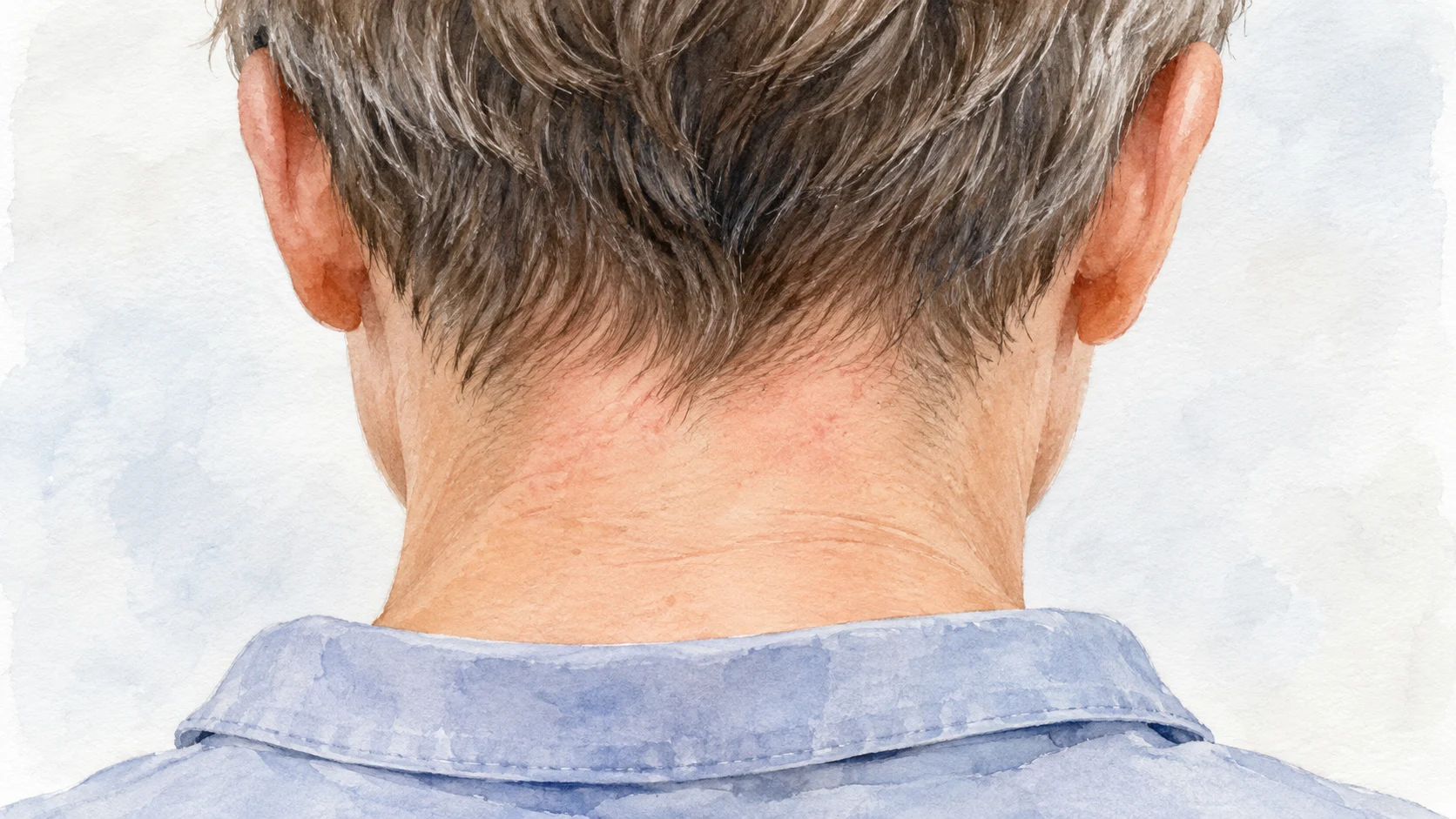
Head lice can cause an itchy rash around the back of the neck, particularly near the hairline. However, a rash spreading across the chest, stomach, arms, or legs is not typical of head lice. These insects live and feed primarily on the scalp, so their associated skin reactions are usually concentrated around the head and adjoining hairline.
A person with head lice may notice irritation behind the ears, along the nape of the neck, or just below the hairline. These areas are close to where the insects commonly live. A rash appearing much farther down the body deserves a different level of scrutiny, even when head lice have already been found. The location and extent of the rash are useful clues, but neither can confirm its cause. Head lice can be present without any visible rash, and someone can develop a neck rash for reasons unrelated to lice.
Why Head Lice Can Cause a Rash Around the Neck
Head lice feed on human blood, and their saliva can trigger an immune response in the skin. This reaction is responsible for much of the itching and inflammation associated with an infestation.
Although the insects primarily occupy scalp hair, the lower hairline extends onto the back of the neck. Lice may feed close to this boundary, allowing irritation to become noticeable where the hair ends.
The nape of the neck is a particularly common area for head lice activity. A rash may therefore appear along the lower scalp and immediately adjoining skin without indicating that the insects have spread across the body.
The usual symptoms of head lice include a possible scalp rash, with the back of the neck being a common location. This fits the insects’ preference for areas near the hairline rather than exposed skin farther down the torso.
Not everyone develops this reaction. Some people experience substantial itching without an obvious rash, while others have only mild irritation.
The response may also be delayed. During a first infestation, the immune system can take several weeks to become sensitive enough to produce noticeable symptoms. Consequently, the appearance of a neck rash does not reveal exactly when the lice arrived.
How Far Down the Neck Can a Head Lice Rash Extend?
A rash associated with head lice is most plausible around the nape, lower scalp, and immediately adjoining neck. There is no medically established distance below the hairline that can be used as a cutoff.
A few irritated areas just beneath the hairline may be consistent with a local reaction. Extensive redness covering the entire neck, however, is less characteristic and should not automatically be attributed to head lice.
The distinction is anatomical. Head lice are adapted to grasp scalp hair, where they remain close to the skin to feed. They are not normally insects that travel down the neck and establish themselves on the shoulders or chest.
Their preference for the nape and the skin behind the ears is reflected in clinical descriptions of where head lice occur. These locations help explain why irritation may be concentrated near the edge of the hair.
A rash can also seem more extensive when someone scratches or rubs a larger area than the original site of irritation. The resulting redness does not establish that lice have fed throughout that entire area.
If the affected skin extends well beyond the hairline, especially when the rash is persistent or worsening, a clinician should consider whether another process is responsible.
Can Head Lice Cause a Rash on Your Shoulders, Back, or Chest?
A widespread rash on the shoulders, back, or chest is not a usual manifestation of head lice infestation.
Head lice generally remain in scalp hair rather than living beneath clothing or feeding across the trunk. Someone with confirmed head lice can also develop a body rash, but the coexistence of the two conditions does not establish that one caused the other.
For example, a child may have living lice in their hair and an itchy eruption on the upper back. The lice explain the infestation on the scalp, but they do not automatically explain the separate skin changes on the back.
The normal habitat and symptoms of head lice center on the scalp. Their presence is not a sufficient explanation for a rash affecting distant body areas.
A rash that covers both arms, much of the torso, or the legs should not be described as head lice spreading through the body without direct evidence. Head lice do not typically establish infestations in these locations.
When symptoms involve a large body area, a healthcare professional can assess whether the rash has a different cause or whether more than one condition is present.
Head Lice and Body Lice Do Not Cause the Same Distribution of Symptoms
The word lice describes several different human parasites, and confusing them can lead to incorrect conclusions about a body rash.
Head lice live primarily in scalp hair. Body lice, by contrast, live and lay eggs mainly in clothing seams, moving onto the skin to feed. Their different habitats produce different patterns of exposure.
Body lice can cause itching and rashes on parts of the body that come into contact with clothing, including the shoulders, waist, and trunk. A person who assumes every louse-related rash comes from head lice may overlook this distinction.
The typical symptoms and habitat of body lice are associated with clothing and body skin rather than an infestation confined to scalp hair.
This does not mean that a rash on the torso proves body lice are present. Many conditions can affect the trunk, and a clinician may need to evaluate the distribution and other findings.
The important distinction is that head lice and body lice are not interchangeable explanations for a rash. Their different habitats and health implications need to be considered before attributing symptoms to either parasite.
Head lice are not known to transmit infectious diseases. Body lice have different public-health implications because they can transmit certain bacterial diseases. Having head lice does not mean someone also has body lice.
Can a Head Lice Rash Spread Even When the Lice Stay on the Scalp?
The visible extent of skin inflammation does not necessarily match the exact location of an irritating exposure. Rubbing, scratching, and individual skin sensitivity can make a local reaction appear more extensive.
However, there is insufficient reason to assume that head lice routinely cause a generalized allergic rash across the body. Such a claim would go beyond the usual clinical description of head lice infestation.
A person might notice redness along the neck after repeatedly rubbing the area, even though the insects remain on the scalp. This does not mean that lice are living on every affected patch of skin.
Similarly, the intensity of itching does not establish how far the infestation has spread. Someone may have a strong response to relatively few lice, while another person with an infestation has little discomfort.
The variation in itching during head lice infestations is one reason that symptoms cannot reliably measure the extent of lice activity.
If a rash appears in areas where head lice do not ordinarily live, especially if it continues expanding, the possibility of another cause becomes more important. The rash should be assessed on its own merits rather than being explained entirely by the known scalp infestation.
Does a Neck Rash Mean the Head Lice Infestation Is Severe?
A neck rash does not reliably indicate how many head lice are present or how long the infestation has existed.
Skin reactions depend partly on the individual’s sensitivity to louse saliva. Some people develop noticeable irritation after becoming sensitized, while others have few symptoms despite carrying living lice.
A rash near the hairline may therefore occur without a particularly heavy infestation. Conversely, the absence of a rash does not establish that only a small number of insects are present.
The number and location of visible skin reactions should not be used as a substitute for evidence of living lice. The signs of an active head lice infestation are more informative than rash severity alone.
A particularly widespread or uncomfortable rash deserves attention because of the skin symptoms themselves, not because it proves a high lice count.
Could a Neck or Body Rash Be Related to Lice Treatment Instead?
Sometimes a rash develops or becomes more noticeable after someone has used a head lice treatment product.
Topical treatments can irritate the skin. Depending on the product, its ingredients, and how it was applied or rinsed, irritation may affect areas that came into contact with the preparation.
The timing matters. A rash that first appears after treatment, particularly outside the original areas of itching, should not automatically be interpreted as evidence that lice are spreading.
Skin irritation from a topical product and the immune response to louse saliva are different possibilities. Neither can be established solely from the appearance or timing of a rash.
The recognized irritation associated with head lice treatments includes itching or burning that can persist after the insects have been killed.
When symptoms arise after applying a product, follow its safety instructions and seek medical or pharmacist advice if the reaction is significant. Do not apply extra medication because the rash remains visible.
Persistent discomfort following treatment is addressed more specifically in why the head may itch after lice treatment.
When Should a Clinician Assess a Rash Associated With Head Lice?
A clinician should assess a rash that is widespread, persistent, worsening, or difficult to explain from the known location of the head lice infestation.
A rash covering substantial areas of the torso or limbs deserves particular attention. Its distribution is not typical of head lice, and assuming otherwise may delay recognition of an unrelated skin condition.
Medical advice is also appropriate when the rash is painful, accompanied by fever, or associated with significant swelling. If a child appears unwell or the rash is progressing rapidly, prompt assessment is preferable to waiting for the lice infestation to resolve.
A new rash following treatment warrants assessment when irritation is severe, continues to worsen, or extends beyond the application area. Widespread hives, especially with swelling, may indicate a significant reaction.
Difficulty breathing, swelling of the tongue or throat, or faintness associated with a rapidly developing reaction requires emergency medical care.
For a mild rash limited to the hairline, the presence of living head lice may provide a plausible explanation. Nevertheless, a persistent rash should not be assumed to have the same cause indefinitely, particularly if it remains after the lice have been eliminated.
The clinician’s role is to evaluate the skin findings and determine whether another explanation needs investigation. A general body rash cannot be diagnosed reliably from the knowledge that someone also has head lice.
Questions About Head Lice and Neck Rashes
Can head lice cause a rash behind the ears?
Irritation behind the ears can occur with head lice because this is one of the areas where they commonly live. However, a rash in that location does not confirm an infestation without additional evidence.
Can head lice cause a rash on the stomach?
A stomach rash is not a typical manifestation of head lice. These insects live primarily in scalp hair, so a rash confined to the abdomen should not automatically be attributed to them.
Can a child have head lice and a body rash at the same time?
Yes. The two findings can occur together without necessarily having the same cause. A widespread rash should be evaluated separately, particularly if the child is unwell or the skin changes are worsening.
Will a neck rash disappear when the head lice are gone?
A lice-associated inflammatory reaction may gradually settle after the infestation is eliminated, but skin irritation does not always disappear immediately. If the rash persists, spreads, or worsens, a healthcare professional should assess it rather than assuming it is residual lice irritation.
What the Location of the Rash Can Tell You
A rash around the back of the neck or along the lower hairline can be consistent with head lice because those areas are close to their normal habitat. The same explanation becomes less convincing when the rash extends across the chest, abdomen, arms, or legs.
A neck rash is not proof of head lice, and a body rash is not evidence that head lice have spread throughout the body. Symptoms must be interpreted alongside the actual location and presence of the insects.
When a rash extends beyond the areas typically affected by head lice, becomes progressively worse, or occurs with other concerning symptoms, clinical assessment is more appropriate than attributing every skin change to the scalp infestation.
One thought on “Can Head Lice Cause a Rash on the Neck or Body?”