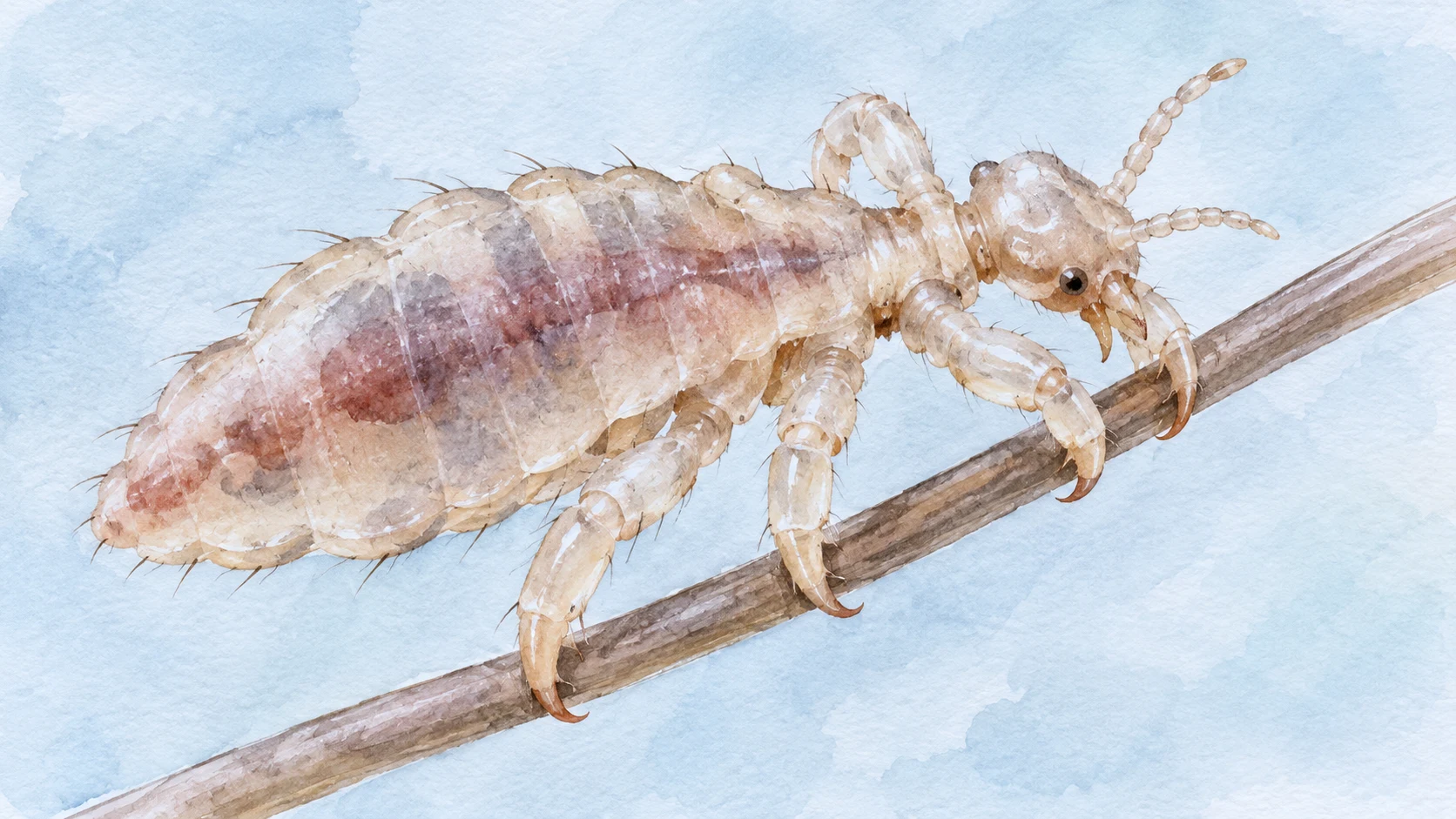
Head lice cannot jump, fly, or swim. They move by crawling, using six short legs equipped with specialized claws that grip individual strands of human hair. Although they can move surprisingly quickly through hair, they cannot leap through the air or propel themselves through water like swimming insects.
Water introduces an important qualification. Head lice cannot swim, but they can survive being submerged for several hours. Experiments have shown that submerged lice may become motionless and later resume normal activity after being removed from the water.
Their ability to survive underwater should not be confused with an ability to swim. A head louse can remain alive during immersion without being capable of directing its movement through the water.
How Do Head Lice Move?
Head lice move by crawling along hair shafts and across the scalp. Their bodies and legs are adapted to navigating the relatively narrow surfaces provided by human hair.
Each of their six legs ends in a claw that can grip a strand of hair. This arrangement allows the insect to hold on while moving, feeding, or changing position.
The claws are especially useful because a head louse spends much of its life among moving strands of hair. The insect must maintain its grip as the person walks, turns their head, or brushes against other surfaces.
Unlike insects that rely on broad walking surfaces, head lice are adapted to moving through a network of individual hairs.
The specialized claws and crawling behavior of head lice explain why these insects can move efficiently without wings or jumping legs.
A louse can crawl forward, change direction, and move from one hair to another when the strands are positioned appropriately. It does not need to detach from the hair and launch itself into the air.
This crawling ability is central to the insect’s normal movement. Jumping, flying, and swimming are not part of its locomotion.
Can Head Lice Jump From One Person to Another?
No. Head lice cannot jump.
They lack the specialized jumping structures found in insects such as fleas. Their legs are designed primarily for gripping and crawling rather than generating the powerful propulsion required for a leap.
A head louse cannot deliberately spring from one person’s hair toward another person’s head. It also cannot jump across a gap between two people.
The physical limitations of head lice movement are consistent across major public-health references: head lice crawl, but they do not hop or fly.
Their rapid crawling can sometimes create the impression that they have jumped. A small insect may disappear behind a strand of hair and reappear somewhere nearby, making its movement difficult to follow.
That apparent sudden change in position is not evidence of jumping.
The distinction is particularly useful when interpreting an insect’s movement. If an insect repeatedly launches itself into the air using its legs, that behavior is not characteristic of a head louse.
The movement involved when head lice pass between people depends on crawling rather than jumping. The broader circumstances of transmission are a separate subject from the insect’s physical abilities.
Can Head Lice Fly?
Head lice cannot fly because they have no wings.
The human head louse, Pediculus humanus capitis, is a wingless insect. Neither adult males nor adult females possess functional wings, and immature head lice cannot fly either.
This is a permanent anatomical characteristic, not a temporary limitation caused by age, feeding, or environmental conditions.
Some insects develop wings only after reaching adulthood. Head lice do not. An immature louse eventually becomes a wingless adult.
The wingless anatomy of human lice reflects their specialized parasitic lifestyle. Their bodies are adapted for gripping hair and remaining close to a human host rather than traveling through the air.
A head louse cannot take off from the scalp, hover, glide under its own power, or fly toward a nearby person.
If a tiny insect appears to fly out of someone’s hair, the observed flight should not be attributed to a head louse without further evidence.
Air currents may move lightweight objects, and physical contact can dislodge insects, but neither event gives head lice the biological ability to fly.
How Fast Can Head Lice Crawl?
Head lice can crawl rapidly for insects of their size.
Published observations describe movement approaching 23 centimeters per minute, or approximately 9 inches per minute, under certain conditions. Other experimental measurements have reported slower speeds.
The reported crawling speeds of head lice demonstrate that these insects can move across short distances relatively quickly.
A speed of 23 centimeters per minute is equivalent to approximately 0.38 centimeters per second. That may seem slow compared with a walking person, but it is considerable for an insect only a few millimeters long.
The figure should not be treated as a constant speed that every louse maintains. Actual movement depends on the surface, hair arrangement, and circumstances in which the insect is moving.
A louse may also pause, change direction, or remain stationary while gripping a hair.
Laboratory measurements using hair models are not necessarily identical to movement through hair on a living person’s scalp. The surrounding hair creates obstacles and opportunities for gripping that vary from one situation to another.
The relationship between hair structure and head lice movement is therefore more complicated than assuming a single crawling speed applies equally to every hairstyle.
The practical observation remains that a head louse can crawl fast enough to be difficult to follow with the naked eye.
How Do Head Lice Move Between Hair Strands?
Head lice use their claws to grip and release individual strands as they crawl. When hairs come close enough together, the insect can move from one strand to another.
This movement requires physical access to another suitable surface. The louse does not need to jump across the space between hairs.
Its body position and the angle of neighboring strands can influence whether it can make the transition.
Experimental observations have shown that the orientation of hair affects the ease with which head lice move between strands. A neighboring hair presented in a favorable position can provide a route for crawling, while an awkward angle may make the transfer more difficult.
This is one reason head lice are so closely associated with the physical structure of human hair.
Their claws allow them to maintain a secure grip while moving through a changing arrangement of strands. The same gripping ability helps them resist being dislodged during ordinary movement.
The reasons head lice remain close to the scalp also involve feeding and environmental requirements, but their leg structure makes movement through hair possible.
Can Head Lice Swim in Water?
No. Head lice are not capable of active swimming.
Swimming requires an animal to propel itself through water using coordinated movements. Head lice have legs adapted for gripping hair rather than structures specialized for aquatic propulsion.
When submerged, they do not normally release their grip and swim toward another location.
The distinction between movement and survival becomes especially important here. An insect can remain alive underwater without being able to swim.
A controlled experiment involving submerged head lice found that the insects became immobile in water. After removal and a brief recovery period, they resumed activity.
The experimental observations of submerged head lice support the conclusion that surviving immersion does not mean the insects are active swimmers.
A head louse’s inability to swim should therefore not be interpreted as proof that contact with water immediately kills it.
What Happens When Head Lice Are Submerged?
Head lice commonly become motionless when submerged in water. Their apparent inactivity can make them look dead, even when they remain alive.
In one experiment, lice submerged for 20 minutes in different water solutions became immobile and did not respond to physical prodding. After removal from the water, they recovered movement and resumed feeding.
The study included ordinary water, seawater, salt solutions, and chlorinated water. The observation of temporary immobility was not limited to one particular water type.
A separate laboratory investigation examined head lice submerged for longer periods. Movement of the antennae and legs stopped rapidly, yet the insects survived several hours underwater.
The experimental findings on drowning and oxygen deprivation in head lice demonstrate why a motionless submerged louse should not automatically be considered dead.
The researchers observed recovery after immersion, including the return of movement following removal from water.
This response is better described as a temporary state of immobility than as ordinary swimming behavior.
A submerged louse is not necessarily actively searching for food or moving between hair strands. It may remain attached and relatively inactive until conditions change.
How Long Can Head Lice Survive Underwater?
Head lice can survive underwater for several hours, although survival depends on the conditions and duration of immersion.
One laboratory study found that none of the 188 lice submerged for periods of one to six hours died during those tested intervals. In a separate group submerged for 24 hours, approximately half were alive after recovery.
These results demonstrate substantial tolerance of immersion under the experimental conditions. They do not establish that every head louse can survive for 24 hours underwater or that all lice respond identically.
The tested insects were observed under controlled laboratory conditions. Results from those experiments should not be converted into a guaranteed survival time for lice in every real-world situation.
The important distinction is between surviving immersion and moving through water.
A head louse may remain alive while submerged without swimming, feeding, or moving normally. When removed from the water, it may recover its ability to crawl.
The ability of head lice to survive water exposure also helps explain why ordinary wetting should not be treated as proof that lice have been eliminated.
The exact duration of underwater survival is less useful than recognizing that water exposure alone is not a dependable way to determine whether an insect is dead.
Do Head Lice Hold Their Breath Underwater?
Head lice do not breathe through lungs like humans. They obtain oxygen through a system of small external openings called spiracles, which connect to internal respiratory tubes.
Their ability to tolerate immersion is sometimes described casually as holding their breath, but that expression can be misleading.
The insect does not deliberately inhale and then hold air in lungs. Its respiratory anatomy and physiological response to immersion differ from those of a human swimmer.
Laboratory experiments show that head lice can become immobile during submersion and later recover. However, those observations do not justify claiming that every louse consciously closes its breathing openings for a fixed number of hours.
Researchers have investigated how oxygen deprivation and water exposure affect lice, including the temporary loss of visible movement.
The available evidence supports the conclusion that head lice can tolerate extended periods of immersion under certain conditions. It does not support treating their behavior as equivalent to a person deliberately holding their breath.
Can Head Lice Crawl While Their Hair Is Wet?
Head lice can remain attached to wet hair, and water does not automatically remove their ability to grip individual strands.
Their claws are designed to hold onto hair shafts. When water surrounds the hair, that physical attachment may remain intact.
However, full submersion can produce temporary immobility, so movement underwater should not be assumed to be identical to crawling through dry hair.
The condition of the insect and the extent of water exposure matter. Damp hair, wet hair exposed to air, and complete underwater immersion are not identical circumstances.
The behavior of head lice during ordinary hair washing should therefore be distinguished from laboratory experiments involving prolonged submersion.
A louse that remains attached while the hair is wet has not demonstrated an ability to swim. It is using its claws to maintain contact with a familiar surface.
Likewise, seeing no movement during water exposure does not establish that the insect is permanently incapacitated.
Why Head Lice Are Better at Gripping Than Jumping or Swimming
The physical abilities of head lice reflect the environment in which they normally live.
Human hair provides narrow, flexible strands rather than a broad surface for walking. A louse benefits from being able to grasp those strands securely while remaining close to the scalp.
Its six legs and specialized claws are suited to that environment. Powerful jumping legs, wings, and swimming appendages are not part of its anatomy.
The insect’s movement is therefore specialized rather than versatile.
A flea can jump using anatomical adaptations that head lice lack. A flying insect uses wings that head lice do not possess. Aquatic insects may use modified legs or other structures to propel themselves through water, whereas head lice are adapted to gripping hair.
These comparisons explain the mechanical differences without suggesting that head lice need to move like other insects.
Their ability to crawl and hold onto hair is sufficient for their normal activities on a human host.
The feeding requirements of head lice also reinforce this specialization. The insect’s food source is the scalp, so its movement is adapted to remaining within reach of that environment.
Can Head Lice Fall or Be Knocked Off Hair?
Yes. Although head lice have effective gripping claws, they are not permanently attached to hair.
A louse can lose its grip or be physically dislodged. That is different from deliberately jumping or flying away.
The insect’s ability to hold on depends on its contact with the hair and the forces acting on its body.
Movement, handling, or mechanical disturbance may change its position. However, the fact that a louse can be dislodged does not mean it has an independent method of moving through the air.
If a louse falls, gravity is responsible for the downward movement. The insect is not performing a controlled jump or flight.
Similarly, an insect carried along by moving water is being transported by the water rather than swimming under its own power.
These distinctions are useful because the word move can describe several different physical events. Only crawling is the normal self-directed locomotion of a head louse.
Common Questions About Head Lice Movement
Can head lice jump several inches?
No. Head lice cannot jump any distance under their own power. Their legs are adapted for gripping and crawling, not leaping.
Can head lice fly when they become adults?
No. Adult head lice remain wingless. They do not develop wings as they mature.
Can head lice move quickly without jumping?
Yes. Head lice can crawl relatively quickly along hair shafts. Their small size and movement through overlapping strands can make them difficult to follow.
Can a head louse look dead underwater and still be alive?
Yes. Experiments have shown that submerged lice can become motionless and later recover after removal from the water. Lack of visible movement during immersion does not prove death.
Can head lice swim toward someone underwater?
Head lice are not active swimmers. Their legs are adapted for gripping hair, and experimental observations show that they become immobile during submersion rather than swimming through the water.
Can Head Lice Jump, Fly, or Swim? The Bottom Line
Head lice move by crawling. They cannot jump because their legs lack the adaptations needed for leaping, and they cannot fly because they have no wings.
They also cannot actively swim. However, head lice can survive underwater for several hours, sometimes becoming motionless before recovering after removal from the water.
Their specialized claws allow them to grip hair securely, and their crawling ability lets them move through strands without jumping or flying.
Understanding these differences prevents two common misconceptions: that head lice can leap or fly through the air, and that an insect incapable of swimming must immediately die when submerged.
2 thoughts on “Can Head Lice Jump, Fly, or Swim?”