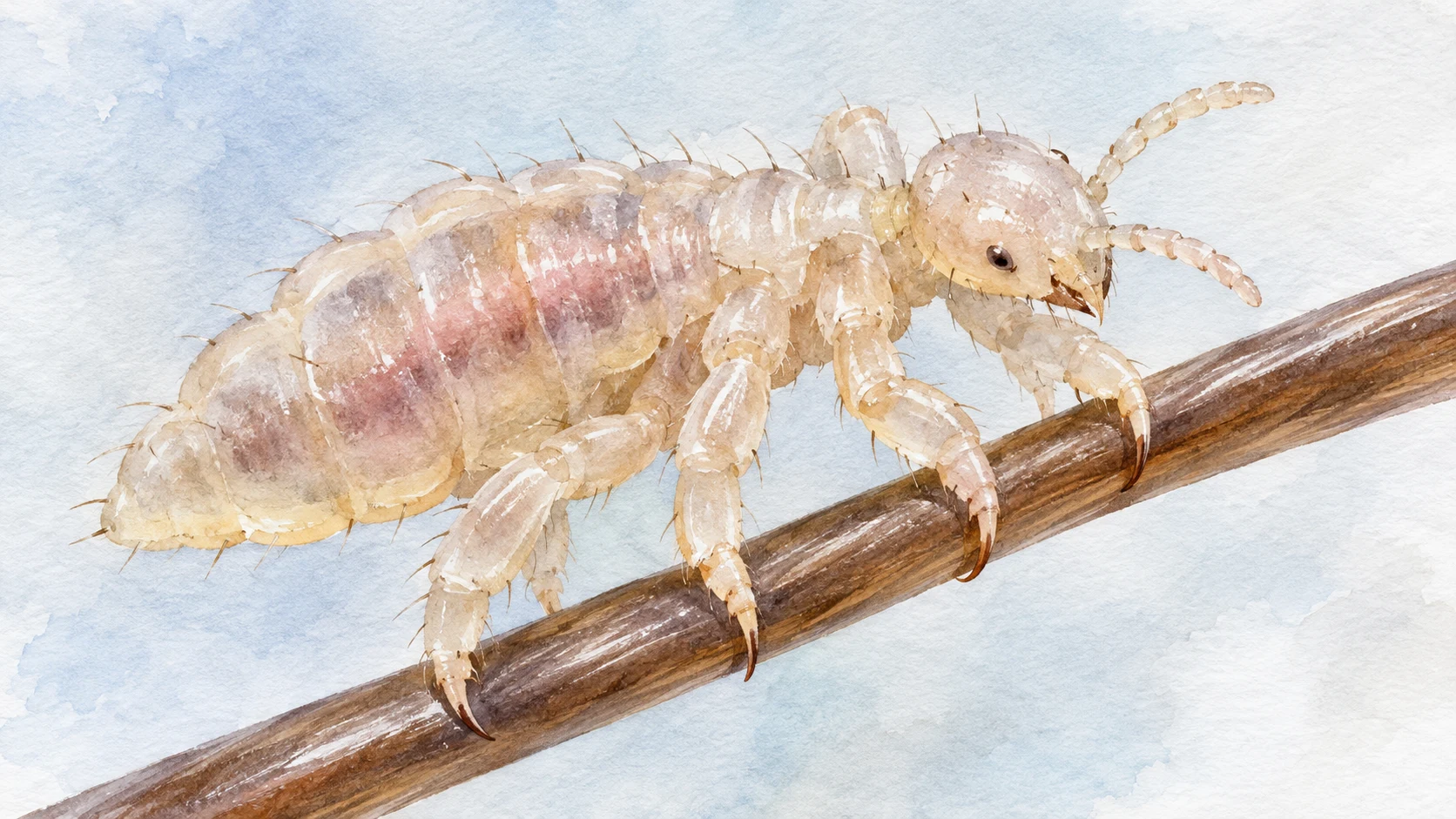
Baby head lice, called nymphs, look like miniature head lice with tiny, elongated bodies, six short legs, and claws that grip individual strands of hair. Newly hatched nymphs are approximately the size of a pinhead, often around 1 to 1.5 millimeters long. They may appear pale gray, beige, tan, or almost transparent, although their bodies can look reddish after feeding on blood.
Despite their small size, nymphs are fully formed, crawling insects. They do not resemble worms or tiny white flakes. Their recognizable insect shape is present from the beginning, but the details are difficult to see without magnification. The typical appearance of newly hatched head lice is therefore easier to recognize in an enlarged photograph than during an ordinary examination of someone’s hair.
What Does a Newly Hatched Head Louse Look Like?
A newly hatched head louse has a narrow head, a compact middle section, and an elongated abdomen. Its body is flattened, allowing it to remain close to the scalp and move between individual hairs. The proportions are broadly similar to those of a mature louse, although the entire insect is considerably smaller.
Six short legs extend from the middle of the body. Each leg has a specialized claw that helps the nymph hold onto a hair shaft. Under magnification, these claws can be seen grasping the hair, but they are generally too small to distinguish during a quick visual inspection.
The abdomen is segmented and may appear slightly translucent. In a clear close-up photograph, its outline can look oval or somewhat tapered, depending on the angle. The individual body segments are usually more apparent under magnification than when the insect is observed directly on the scalp.
A newly hatched nymph is already capable of crawling and feeding. It does not need to develop legs or undergo a dramatic change in body shape before becoming recognizable as a louse. The small, fully formed appearance of a head lice nymph is one of the defining features of this immature stage.
What Color Are Baby Head Lice?
Baby head lice can appear pale gray, whitish, beige, light tan, or nearly transparent. Their relatively pale appearance can make them difficult to distinguish from the surrounding scalp, particularly when they are newly hatched and extremely small.
The body is not completely transparent, but portions of it may allow internal contents to show through. Under bright lighting, a young nymph may look almost colorless except for slightly darker areas within its abdomen.
Feeding can change that appearance. Because head lice consume blood, a young nymph may look reddish or reddish-brown when blood is visible inside its body. The abdomen may appear darker while the head and legs remain relatively pale.
The transparent or reddish appearance of young head lice reflects this variation. A pale nymph and a reddish nymph are not necessarily different developmental stages. The difference may be related to feeding rather than age.
Hair color and lighting can further change what the observer sees. A pale nymph may stand out against dark hair but blend into a light-colored scalp. A recently fed nymph may look darker in shadow than it does under bright illumination.
The broader color variations found in head lice help explain why photographs of young specimens do not always show the same shade. Color alone is not a dependable way to determine how developed a nymph is.
How Does a Baby Head Louse Change as It Grows?
A baby head louse grows gradually through three immature stages, known as nymphal instars. Its basic body arrangement remains recognizable throughout this period, but the insect becomes larger and its anatomical details become easier to distinguish.
Between these stages, the nymph molts by shedding its outer covering. This allows its body to increase in size. The three molts involved in nymphal development explain why young lice can differ noticeably in size even though they belong to the same immature stage of the species.
A first-stage nymph is especially small, with fine body details that may be almost impossible to make out without magnification. A second-stage nymph is larger, and the abdomen and legs may become more apparent. By the third nymphal stage, the insect is approaching its mature proportions, although it has not yet completed development.
The change is primarily one of growth rather than a complete transformation in appearance. A nymph does not pass through a caterpillar-like or grub-like form. It remains a small, six-legged insect throughout its immature development.
The stages cannot be distinguished reliably by casual observation alone. Their size ranges can overlap, and a photograph without a measurement scale may not show whether a specimen is in its first, second, or third nymphal stage. The complete head lice life cycle covers the developmental sequence and timing. For visual recognition, the important point is that the youngest nymphs are the smallest and that later nymphs retain the same recognizable body form while becoming progressively larger.
What Do Baby Head Lice Look Like on a Strand of Hair?
On an individual strand of hair, a baby head louse may resemble a tiny, narrow insect gripping the shaft with its legs. Its body usually lies close to the hair rather than standing prominently away from it.
The legs are adapted to hold onto individual hairs, allowing the nymph to remain attached while the hair moves. In magnified photographs, the claws can sometimes be seen wrapping around the shaft, with the abdomen extending behind the point of attachment.
On a person’s head, however, the surrounding hair can obscure much of the insect. A young nymph may be visible only as a tiny moving speck. Its legs and segmented abdomen can be difficult to recognize because the insect is so small relative to the surrounding strands.
Nymphs remain associated with the scalp and hair, where they can feed. Their small bodies may be concealed among closely spaced hairs, especially near the roots. The areas where head lice commonly remain close to the scalp can make these immature insects difficult to observe.
A nymph that is moving across an exposed strand may be easier to notice than one positioned against the scalp. Even then, the observer may recognize movement before being able to identify individual anatomical features.
Why Are Newly Hatched Head Lice So Difficult to Recognize?
The smallest nymphs are difficult to recognize because their bodies occupy very little space and their fine anatomical features are not easily resolved by the naked eye. A newly hatched nymph may be only about 1 millimeter long, and its pale coloration can reduce contrast against the scalp.
Movement adds another difficulty. Nymphs crawl rather than jump or fly, and they can move out of view among surrounding hairs. The difficulty of detecting small, light-avoiding head lice means that even a living insect may be missed during a brief examination.
The position of the insect also affects recognition. A nymph lying against a hair shaft may be partly concealed by that strand. When several hairs overlap, its outline can become difficult to separate from the surrounding background.
Bright lighting can make an insect easier to see, but it can also create reflections on hair that interfere with the view. Magnification may reveal the body and legs more clearly, particularly when the insect is observed against a contrasting background.
An important distinction is that a nymph can be visible without being readily identifiable. Someone may notice a tiny moving object but still be unable to see enough detail to determine what it is.
The practical limits of seeing head lice with the naked eye are especially relevant to newly hatched nymphs. Their small size makes them harder to recognize than larger specimens, even though they are not microscopic.
What Does a Baby Head Louse Look Like Under Magnification?
Under magnification, a baby head louse becomes much easier to recognize as an insect. The narrow head, six legs, segmented abdomen, and curved gripping claws are more apparent than they are during an ordinary scalp examination.
The abdomen may show subtle divisions between its segments. Depending on the lighting and the insect’s feeding condition, some internal structures or darker material may be visible through its relatively translucent outer covering.
A microscope or high-quality macro photograph can also reveal how the legs are positioned around individual hair shafts. The claws are particularly distinctive because they allow the nymph to grip hair despite its extremely small body.
Magnification can create a misleading impression of size, however. A newly hatched nymph may fill an entire photograph even though the real insect is only about the size of a pinhead. Without a scale bar or familiar reference object, the image cannot establish the specimen’s actual dimensions.
The measured size of head lice at different developmental stages provides a more reliable sense of scale than the apparent dimensions of an enlarged photograph.
Can You Recognize Which Nymphal Stage a Baby Head Louse Is In?
Distinguishing the three nymphal stages by sight is difficult without careful examination. All three stages share the same general body arrangement, and their differences are mainly associated with growth and development.
A first-stage nymph is generally the smallest. Its body may appear especially delicate or pale, and its individual features can be difficult to see even when it is clearly visible as a moving insect.
Second-stage nymphs are larger, with a more conspicuous abdomen and legs. Third-stage nymphs are larger still and approach mature body dimensions. However, these descriptions are relative rather than precise identification rules.
An insect’s apparent size can change with camera magnification, viewing angle, and distance. Natural variation also makes it difficult to assign an exact stage based on a single visual estimate.
Color is similarly unreliable for distinguishing stages. A reddish first-stage nymph may simply have fed recently, while a pale third-stage nymph may have less visible blood in its abdomen.
The most useful conclusion from appearance alone is often that a specimen is an immature, crawling head louse. Assigning it to a specific nymphal stage requires more detailed examination than most people can perform during an ordinary hair check.
What Visual Details Are Most Reliable When Looking at Baby Head Lice?
The most useful characteristics are those that remain consistent as a nymph grows. Its body has a recognizable insect outline, six legs, and the ability to grip and crawl along individual hairs. These features are more informative than whether the insect looks pale, reddish, or dark.
The following table summarizes what can reasonably be observed at different levels of detail.
| Visual feature | What may be visible | Recognition limitation |
|---|---|---|
| Body outline | Tiny, elongated insect shape | May resemble a moving speck without magnification |
| Legs | Six short legs extending from the middle of the body | Individual legs can be difficult to distinguish |
| Hair grip | Claws holding individual hair shafts | Usually clearer in magnified images |
| Abdomen | Segmented rear portion of the body | Fine segmentation may not be visible |
| Color | Pale gray, tan, translucent, or reddish | Changes with feeding and lighting |
| Growth stage | Smaller or larger immature specimen | Exact nymphal stage is difficult to determine visually |
A useful way to interpret these observations is to separate what can be seen from what is being inferred. Seeing a small, six-legged insect crawling through hair provides more information than seeing an indistinct pale dot. It does not necessarily reveal the insect’s exact developmental stage.
The evidence associated with an active head lice infestation includes living nymphs, but the appearance of a suspected specimen should not be treated as confirmation when its features remain unclear.
When a tiny insect cannot be examined well enough to identify, magnification or assessment by someone experienced in recognizing head lice may be helpful. An enlarged view should reveal genuine anatomical details rather than simply making an indistinct speck appear larger.
Common Questions About Baby Head Lice
Are baby head lice transparent?
They can appear nearly transparent or very pale, particularly when newly hatched. Their bodies are not completely invisible, and some internal contents may be visible through the outer covering.
Do baby head lice have legs?
Yes. Nymphs have six legs from the beginning. Their legs are small and can be difficult to distinguish without magnification, but they are functional and allow the insects to grip hair.
Can baby head lice look red?
Yes. A nymph may appear reddish or reddish-brown after feeding on blood. The color does not establish its exact age or developmental stage.
Do baby head lice look different as they grow?
They become progressively larger through three nymphal stages, but their general body arrangement remains similar. They do not undergo a dramatic change into a completely different-looking insect.
Can you see a newly hatched head louse without a microscope?
Yes, although it may be difficult. Newly hatched nymphs are very small, and their pale coloration and position among hair strands can make them hard to notice or identify confidently.
Are all baby head lice the same size?
No. A newly hatched nymph is smaller than one approaching maturity. Because nymphs grow through successive stages, immature lice can differ considerably in size.
3 thoughts on “What Do Baby Head Lice Look Like?”