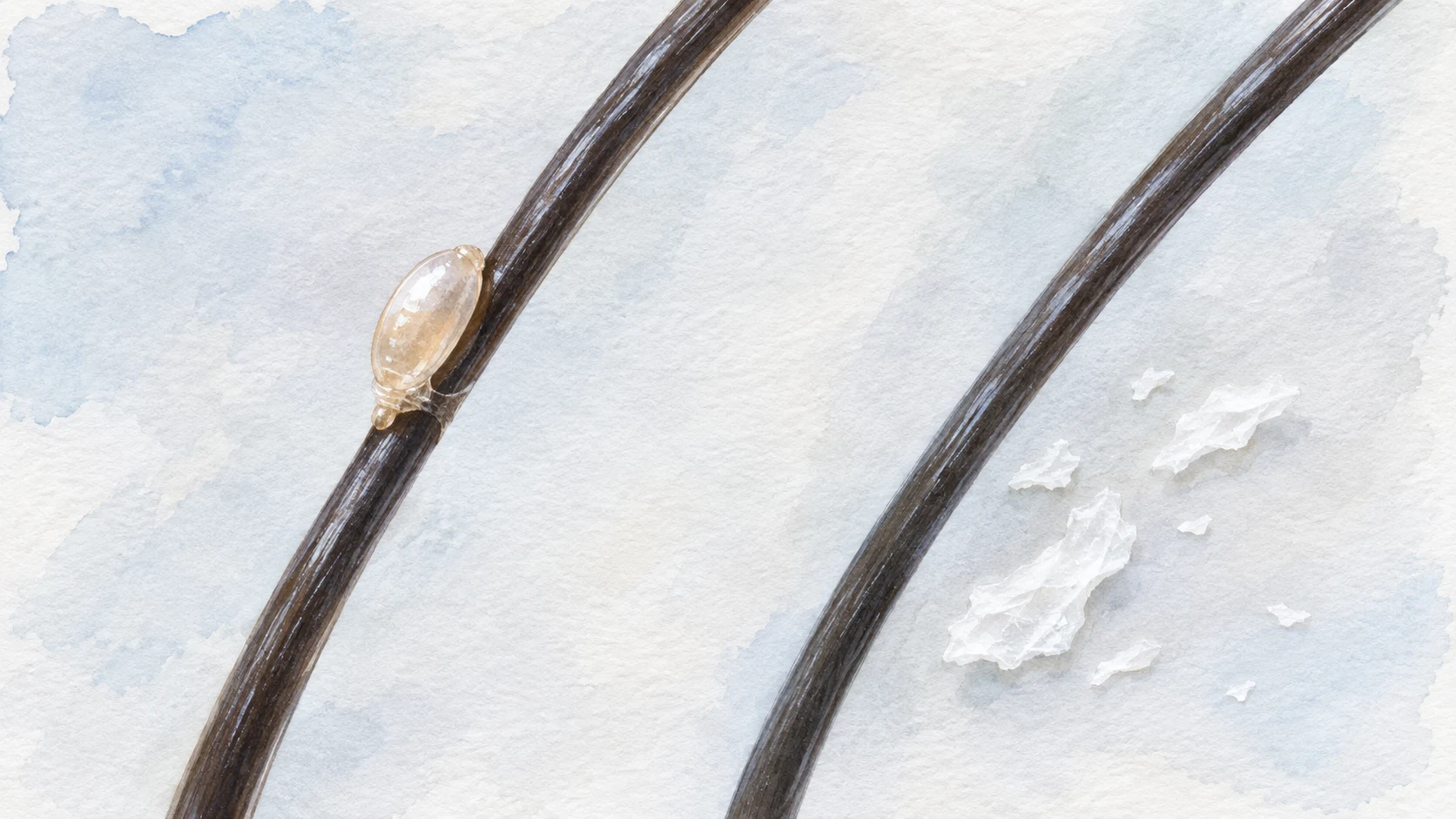
The easiest way to tell head lice nits from dandruff is to look at how the white or yellowish specks behave on the hair. Nits are firmly attached to individual hair shafts, while dandruff flakes are loose and can usually be brushed, shaken, or lifted away. Although both can appear as tiny pale particles near the scalp, their attachment and movement provide much more useful clues than color alone.
A nit remains fixed to a particular strand of hair because it is secured by a cement-like substance. Dandruff consists of shed skin flakes that may rest on the scalp, become caught among strands, or fall onto clothing. The difference between attached nits and loose dandruff is one of the most practical visual distinctions, especially when the two look similar at first glance.
What Is the Main Difference Between Head Lice Nits and Dandruff?
Nits are the eggs or remaining egg cases of head lice. They are deposited directly onto hair shafts and held in place by a strong adhesive. Dandruff is made up of flakes shed from the scalp’s outer skin layers. It is not deposited onto hair by an insect and does not have the same cemented attachment.
A nit typically appears as a tiny, oval or teardrop-shaped structure attached alongside a single hair. A dandruff flake is more likely to be flat, irregular, and variable in size. It may lie against the scalp or become caught between several strands without being bonded to any of them.
These differences are especially noticeable when the surrounding hair moves. A nit travels with the hair shaft because it is fixed to it. A loose dandruff flake may shift position, become dislodged, or fall away.
The firm attachment of lice eggs to hair is produced by an adhesive that hardens around the hair shaft. Ordinary scalp flakes lack that structure, which explains why the two materials behave differently despite sometimes sharing a similar color.
Do Nits Move When You Touch or Shake the Hair?
A nit does not move independently. It is an attached structure, not a crawling insect. When the hair strand bends or swings, the nit moves with it while maintaining its position along the shaft.
Dandruff behaves differently because it is loose material. Some flakes may fall when the hair is disturbed, while others shift between strands or remain temporarily caught near the scalp. Their position is not secured by the same adhesive bond.
For example, a pale speck attached halfway along a hair may remain in exactly the same place relative to that strand as the hair moves. That behavior is consistent with a nit. A flake that slides, falls, or changes position independently of the strand is more consistent with dandruff.
Not every dandruff flake falls immediately. Larger or slightly oily flakes may cling to the scalp or become tangled in hair. However, remaining temporarily caught is different from being cemented to a single shaft.
The way nits remain attached while dandruff can be displaced makes movement a useful clue, but it should be interpreted alongside the particle’s shape and position.
Why Are Nits So Much Harder to Dislodge Than Dandruff?
Head lice eggs are secured by a specialized adhesive deposited during egg laying. The material hardens around the base of the egg and the hair shaft, forming a durable bond that ordinary hair movement does not easily break.
The adhesive can continue holding the shell in place after the developing insect is no longer inside. Consequently, an empty nit may remain attached even though it has no living contents.
Dandruff flakes have no comparable cemented attachment. They originate from the scalp’s surface and may become caught in hair, but their presence does not involve an egg-like structure glued to a strand.
The distinction between nits and loose scalp flakes is therefore based on a physical difference, not merely on how firmly a particle seems to be resting against the scalp.
A flake can sometimes feel resistant because it is trapped between hairs or adheres to the skin’s surface. This is why attachment is best understood as a combination of clues: a consistent oval shape, a fixed position on one hair, and resistance to ordinary displacement.
What Do Nits Look Like Compared With Dandruff Flakes?
Nits tend to have a compact, regular outline. They are usually oval, sometimes resembling a tiny elongated bead or seed. Dandruff flakes are generally flatter and more irregular, with edges that may appear jagged, uneven, or thin.
A nit is also extremely small, typically around 0.8 millimeters long. Dandruff flakes vary considerably. Some are barely visible, while others are large enough to be noticeable on the hair or shoulders without close examination.
The physical appearance of head lice eggs and nits includes their oval shell and the point where they attach to the hair. Dandruff lacks this organized egg structure.
Under magnification, the distinction may become clearer. A nit can appear as a defined oval attached alongside the shaft, while a dandruff flake is more likely to resemble a thin, uneven fragment of skin.
Nevertheless, a tiny particle viewed without magnification may not reveal enough detail to establish its shape. A pale dot can look rounded simply because it is too small for its edges to be seen clearly.
Are Nits and Dandruff the Same Color?
Nits and dandruff can overlap in color, which makes color an unreliable way to distinguish them. Dandruff is commonly white or yellowish. Nits may appear white, cream-colored, yellow, tan, or brown, depending on the egg case and its contents.
An empty nit can look pale or translucent, making it especially easy to confuse with a small white scalp flake. An egg containing developing material may look darker, although that difference is not always visible without magnification.
Hair color also affects the comparison. White dandruff and pale nits may stand out against dark hair but become less conspicuous among blond, white, or gray strands. The background can change how light or dark either particle appears.
The appearance of attached eggs and empty shells explains why a white speck cannot automatically be classified as dandruff. Both an empty nit and a skin flake may appear similarly pale.
A useful comparison therefore gives greater weight to attachment and shape than to shade. A firmly fixed, oval structure is more consistent with a nit than a loose, irregular flake, regardless of whether both are white.
Where Do Nits and Dandruff Usually Appear in the Hair?
Head lice eggs are usually attached close to the scalp, often near the roots of individual hairs. Attached nits are commonly noticed behind the ears and near the nape of the neck. Empty shells may also be present farther along the hair shaft as the hair grows.
Dandruff originates from the scalp and can be distributed more broadly. Flakes may be visible at the roots, between strands, along the hairline, or on the shoulders after they become detached.
The distinction is not simply that nits occur near the scalp while dandruff occurs elsewhere. Both can be present close to the roots. Their relationship to the hair is more informative than their general location.
A nit appears fixed to a specific strand, while dandruff may rest against the scalp or become caught among several hairs. The common locations of head lice and attached eggs provide useful context, but location alone cannot separate the two.
A pale speck near the nape of the neck is not automatically a nit, just as a particle farther from the scalp is not automatically dandruff. The way it is attached remains the stronger clue.
Head Lice Nits vs. Dandruff at a Glance
| Feature | Head lice nits | Dandruff flakes |
|---|---|---|
| Shape | Small, regular oval or teardrop | Usually flat and irregular |
| Color | White, yellowish, tan, or brown | Usually white or yellowish |
| Attachment | Cemented to a single hair shaft | Loose or temporarily caught in hair |
| Movement | Remains fixed along the strand | May shift, slide, or fall |
| Position | Often near the scalp, but may occur farther along hair | On the scalp, among hair, or on clothing |
| Magnified appearance | Defined egg-shaped structure | Uneven fragment of shed skin |
| Effect of ordinary hair movement | Usually remains attached | More likely to become displaced |
The most useful distinction is the relationship between the particle and the individual hair. Shape and color provide supporting clues, but neither is sufficient on its own.
A pale oval that stays fixed to one strand is more consistent with a nit than a flake that shifts freely. Even so, an attached speck should not automatically be interpreted as evidence of a current infestation.
Can Dandruff Be Mistaken for Head Lice Eggs?
Yes. Dandruff is one of the common reasons that people mistake ordinary scalp material for head lice eggs. Both can appear as small, pale particles, and their differences may not be obvious when viewed quickly.
This confusion is particularly understandable when flakes are small and caught near the hair roots. The observer may see several white specks and assume that their number or location identifies them as nits.
The difficulty of distinguishing attached nits from scalp debris is well recognized in pediatric guidance. Mistaken identification can lead to unnecessary concern when the observed material is simply loose scalp scaling.
The reverse mistake is also possible. A firmly attached, pale nit may be dismissed as dandruff because it resembles a tiny white flake. This is especially likely when the observer relies entirely on color.
For a broader discussion of other materials and organisms that can be confused with lice, the range of things mistaken for head lice is a separate identification issue. The dandruff comparison is more specific: loose shed skin versus an egg case bonded to hair.
Does an Itchy Scalp Help Distinguish Head Lice From Dandruff?
Itching does not reliably distinguish the two. Dandruff can be associated with scalp itching, while head lice may cause itching through a reaction to their bites. The sensation alone does not reveal whether pale specks in the hair are flakes or attached nits.
Some people with head lice experience little or no itching, particularly before they develop a noticeable reaction. Others may have an itchy scalp for reasons unrelated to lice.
The possibility of having head lice without itching means that the absence of discomfort cannot settle the comparison. Likewise, an itchy scalp does not turn a loose flake into evidence of lice.
When the question concerns a visible white speck, the physical characteristics of that speck provide more relevant information than the presence or absence of itching.
Why an Attached Nit Does Not Automatically Mean Living Lice Are Present
An attached nit and a living head louse are not the same thing. A nit may be an egg containing developing material, a nonviable egg, or an empty shell remaining on the hair.
The adhesive can persist after the contents of an egg are gone. Consequently, an attached shell may remain visible without indicating that a living insect is currently occupying it.
This limitation is important when comparing nits with dandruff. The attachment clue helps distinguish an egg-like structure from a loose scalp flake, but it cannot establish whether the structure contains a developing louse.
The difference between living, dead, and empty lice eggs requires separate consideration. Likewise, the signs of an active head lice infestation involve evidence beyond the presence of an attached pale speck.
A visual comparison can establish that something resembles a nit more closely than dandruff without answering every question about its significance.
Common Questions About Head Lice and Dandruff
Can dandruff stick to hair like lice eggs?
Dandruff can become caught among strands or cling temporarily to the scalp, but it is not cemented to individual hair shafts like head lice eggs. Genuine nits typically remain fixed to one strand.
Do nits fall out when you shake your hair?
They generally do not. Nits are secured with a strong adhesive, whereas loose dandruff flakes may become displaced or fall away when the hair moves.
Are white specks in hair always dandruff?
No. Both dandruff and empty lice egg cases can appear white. Their shape, attachment, and movement provide more useful clues than color alone.
Can dandruff look like tiny lice eggs?
Yes. Small flakes can resemble pale nits when viewed without magnification. Dandruff usually has a flatter, more irregular outline and lacks the firm attachment characteristic of a nit.
Are nits always close to the scalp?
Nits are commonly attached near the scalp when deposited, but they can be found farther along the hair as it grows. Dandruff can also occur near the roots, so location alone is insufficient to distinguish them.
Can someone have dandruff and head lice at the same time?
Yes. Dandruff and head lice are separate conditions, and having one does not prevent the other. The presence of scalp flakes does not rule out attached nits, nor does finding nits mean every pale particle is an egg case.