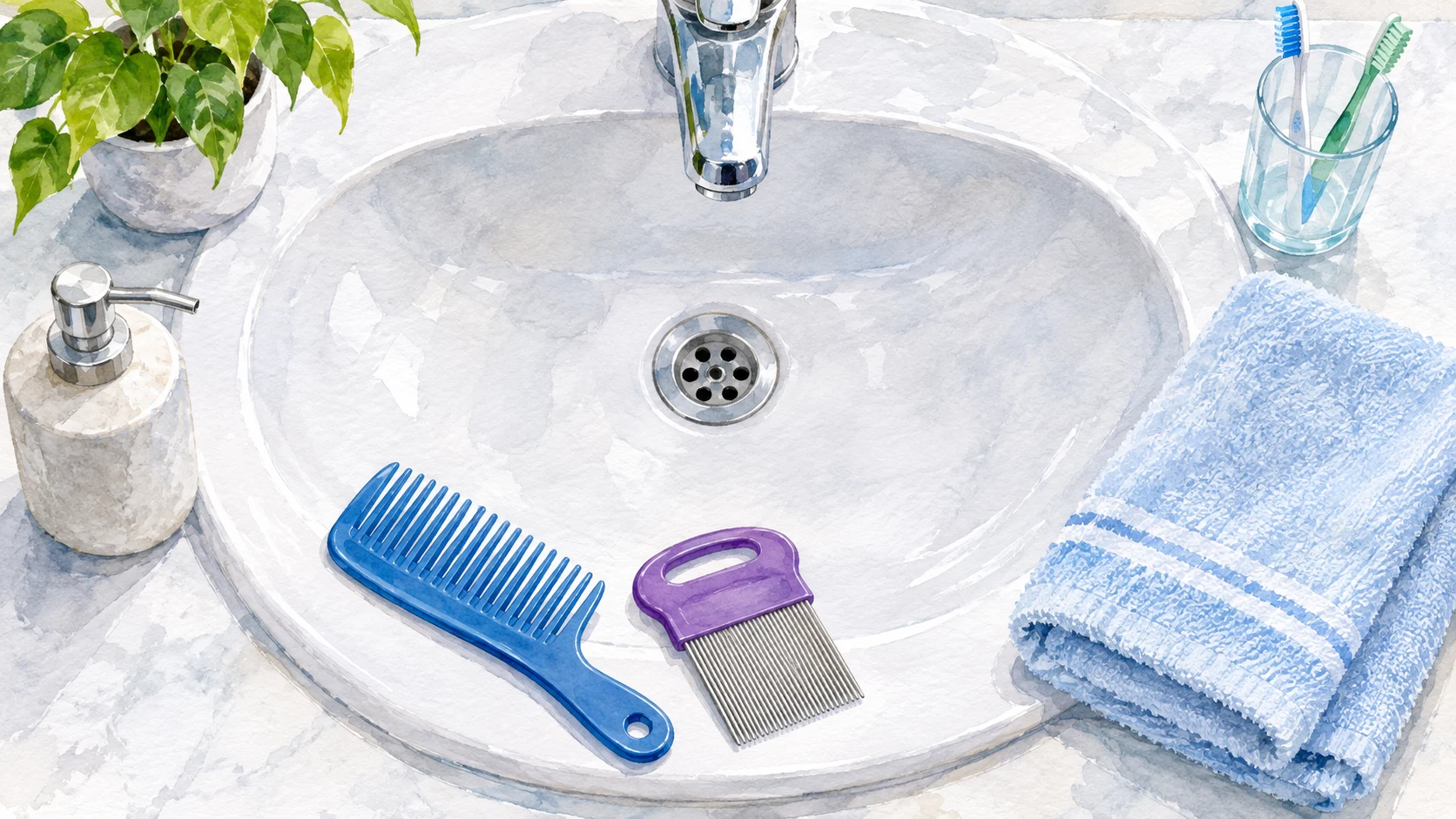
Head lice do not have a proven preference for clean or dirty hair. They can infest someone who washes their hair every day just as they can infest someone who washes it less frequently. Personal cleanliness is not a reliable predictor of whether a person will get head lice.
Two conflicting beliefs have contributed to confusion. One suggests that lice are attracted to dirty hair, while the other claims they prefer freshly washed hair because it is easier to grip. Neither explanation has convincing scientific evidence behind it. Head lice need access to human blood and hair they can hold onto. Their presence depends much more on opportunities to reach another person’s hair than on how recently that person used shampoo.
Do Head Lice Actually Prefer Clean Hair?
The claim that head lice prefer clean hair is common, but it goes beyond what scientific evidence establishes.
Head lice can certainly live in freshly washed hair. Washing does not remove the human blood supply on which they depend, and their specialized claws can still grip hair strands.
However, being able to live in clean hair is not the same as preferring it.
A clinical evidence review found no demonstrated preference for clean rather than dirty hair. That finding does not prove that every hair condition is biologically identical. It means the available evidence does not establish cleanliness as a meaningful preference.
Some explanations suggest that clean hair is less slippery because it has fewer oils. Others argue that oilier hair provides a better gripping surface. These competing claims are often repeated without controlled comparisons showing how much either condition changes the likelihood of infestation.
A louse’s ability to grasp a hair strand depends on its anatomy and the physical characteristics of the strand. There is no established rule that ordinary shampooing makes hair especially attractive to head lice.
Someone with freshly washed hair can acquire lice, but that does not mean the washing caused the infestation.
Do Head Lice Prefer Dirty Hair?
Dirty hair does not attract head lice in the way that food waste might attract certain household pests.
Head lice do not eat dirt, dandruff, or accumulated scalp oil. Their diet consists of human blood, which is available beneath the skin regardless of whether the hair has been washed recently.
The blood-feeding requirements of head lice explain why scalp cleanliness is not a food-related attraction.
A person with unwashed hair does not provide a fundamentally different diet from someone whose hair was washed that morning.
Head lice also do not need a buildup of debris to reproduce. Female lice attach their eggs to individual hair shafts using an adhesive secretion rather than relying on dirt to hold them in place.
The process by which female head lice attach their eggs works independently of ordinary scalp dirt.
The belief that dirty hair causes lice infestations is particularly harmful because it turns a common parasitic infestation into an accusation about personal hygiene.
Head lice can affect people across different living conditions and grooming routines. Their presence is not evidence that someone has neglected their hair.
Why Hair Cleanliness Does Not Determine Whether Lice Can Feed
The scalp provides a blood supply that remains available whether the surrounding hair is clean, oily, dry, or recently washed.
Head lice use specialized mouthparts to pierce the skin and obtain small blood meals. They do not depend on substances coating the hair shaft for nourishment.
This explains why removing dirt or oil from hair does not remove the insects’ underlying food source.
A person’s scalp continues to supply blood after shampooing. Similarly, a scalp with accumulated oil does not automatically offer more blood or better nourishment.
Head lice remain closely associated with the scalp because they need repeated access to living skin and suitable environmental conditions.
The reasons head lice stay close to the scalp involve feeding and warmth rather than a preference for unwashed hair.
It would also be incorrect to assume that an especially clean scalp is less suitable for lice because it lacks dandruff or other debris. Those materials are not essential components of the insect’s diet.
The basic feeding environment remains available across ordinary differences in personal hygiene.
Does Shampooing Change How Easily Head Lice Grip Hair?
Head lice hold onto hair using six legs with specialized claws. Their claws are adapted to grasping individual hair shafts, allowing them to crawl and remain attached as the hair moves.
Shampooing can temporarily change the amount of oil, residue, and moisture on the hair surface. It does not remove the anatomical structures that lice use for gripping.
A louse can still hold onto a strand after the hair has been washed.
There is an important difference between two questions: whether a particular hair surface affects an insect’s grip under experimental conditions, and whether people with that hair condition are more likely to acquire head lice.
Even if a laboratory experiment found a difference in gripping performance on certain surfaces, that result would not automatically establish a preference for clean or dirty hair in everyday life.
The crawling and gripping abilities of head lice allow them to navigate hair without jumping or flying.
The arrangement of neighboring hairs and opportunities for physical contact may influence movement, but those factors cannot be reduced to a simple cleanliness rule.
There is insufficient evidence to tell someone that washing more frequently makes their hair harder for lice to grip, or that washing less frequently provides protection.
What Actually Influences Which Person Head Lice Reach?
Head lice cannot identify a person’s hygiene routine from a distance and then fly or jump toward the preferred head.
They move by crawling. Their usual opportunity to reach another person occurs when hair comes into direct contact with hair already carrying living lice.
This means physical access is a much more established explanation for acquiring head lice than cleanliness.
A child with freshly washed hair who frequently has close hair-to-hair contact may have opportunities for exposure. Someone who rarely washes their hair but has no such contact may have fewer opportunities.
That comparison does not assign a numerical risk to either person. It illustrates why exposure and hygiene should not be treated as interchangeable factors.
The circumstances in which people acquire head lice are distinct from the question of whether lice prefer a particular level of cleanliness.
Clinical guidance confirms that getting head lice is unrelated to personal or environmental cleanliness.
An infestation therefore tells us that lice reached a suitable human host. It does not tell us how often that person washes their hair.
Do Head Lice Choose Their Hosts Based on Hair Smell?
There is no established evidence that head lice consistently select people according to the smell of clean shampoo or unwashed hair.
Odors may influence the behavior of some blood-feeding insects, but findings about mosquitoes, fleas, or other parasites cannot automatically be applied to head lice.
Human head lice are highly specialized insects that live in close contact with their hosts. Their normal movement between people does not require the long-distance host-seeking behavior seen in flying insects.
A shampoo fragrance may be noticeable to humans, but that does not demonstrate that lice find it attractive.
Likewise, the smell of sweat or natural scalp oil should not be presented as a proven lure for head lice.
Evidence of host preference would require controlled observations showing that lice consistently choose one condition over another when other factors are accounted for.
The clinical evidence on head lice and hair cleanliness does not establish such a preference.
Claims that a particular scent makes someone a lice magnet should therefore be treated cautiously unless they are supported by direct research on human head lice.
Does Washing Hair Every Day Make Someone Less Likely to Get Lice?
Daily washing does not make someone immune to head lice.
Ordinary shampoo is intended to clean hair and scalp. It removes oils, sweat, and accumulated material, but it does not make the scalp unsuitable as a source of blood.
The frequency of washing is also not a dependable measure of whether a person has been exposed to lice.
Someone may wash their hair daily and still encounter a living louse through direct contact. Another person may wash less frequently and never encounter one.
The medical understanding of head lice and personal hygiene is clear that infestation does not indicate dirtiness.
It is equally important not to reverse the myth by suggesting that frequent washing increases the risk. The evidence does not establish a reliable preference in either direction.
Ordinary washing habits and the likelihood of exposure are separate issues. Neither clean nor dirty hair provides a guarantee about whether lice will be present.
Can Head Lice Live in Hair That Has Not Been Washed for Weeks?
Yes. Head lice can live in hair that has not been washed recently, provided they have access to the conditions needed for survival.
The absence of frequent shampooing does not prevent them from feeding, moving, or attaching eggs to hair.
However, their ability to survive in unwashed hair should not be interpreted as evidence that they prefer it.
A parasite may be capable of living under several different conditions without actively favoring one of them.
The same distinction applies to clean hair. Successful infestation demonstrates that the environment was suitable, not that it was preferred over every alternative.
A person’s washing schedule also does not reveal how many lice are present or how long an infestation has existed.
The difference between mild and heavy head lice infestations cannot be determined from hair cleanliness alone.
The condition of someone’s hair may affect how easily an observer examines it, but it is not a reliable substitute for evidence of living insects.
Why the Clean-Hair and Dirty-Hair Myths Both Persist
The two myths appear contradictory, yet both survive because they offer simple explanations for an event that often feels unexpected.
The dirty-hair belief comes from associating parasites with poor sanitation. The clean-hair belief may arise as a reaction to that stigma, with people replacing one unsupported explanation with another.
Neither explanation is necessary.
Head lice are human parasites that require blood and access to hair. They can infest people who maintain very different grooming routines.
The distinction between a suitable host and a preferred host is particularly important. A person may be a suitable host because they have human hair and a living scalp. That does not mean lice select them because of their hygiene.
Medical guidance explicitly rejects the idea that head lice are caused by dirty hair.
A family discovering lice should not interpret the finding as evidence of inadequate bathing, and a person with an elaborate hair-care routine should not assume infestation is impossible.
The scientifically supported explanation is less judgmental and more useful: cleanliness does not determine whether head lice can establish themselves on a human head.
Can Hair Cleanliness Tell You Whether Someone Has Head Lice?
No. Hair appearance cannot reliably establish whether living head lice are present.
Clean, shiny hair may contain lice. Oily or visibly unwashed hair may be completely free of them.
An observer cannot determine infestation status simply by examining how recently the hair appears to have been washed.
Nor can the absence of itching settle the question. Some people with head lice do not experience noticeable symptoms, particularly early in an infestation.
The possibility of having head lice without itching illustrates why assumptions based on appearance or comfort are unreliable.
Confirmation depends on identifying actual lice rather than judging someone’s grooming habits.
The difference between head lice and material mistaken for nits is another reason visible hair condition alone should not be treated as proof.
Dandruff, hair products, and other particles may be present with or without lice. They do not establish whether a living infestation exists.
Questions About Head Lice and Hair Cleanliness
Are head lice attracted to freshly washed hair?
There is no convincing evidence that head lice prefer freshly washed hair. They can live in clean hair, but that does not establish that washing makes a person more attractive to them.
Do lice like greasy hair?
Head lice can survive in oily hair, but scalp oil is not their food. There is no established evidence that ordinary greasiness makes hair a preferred host environment.
Can someone with excellent hygiene get head lice?
Yes. Head lice can affect people with excellent personal hygiene. Their presence does not indicate poor washing habits or an unclean home.
Does dirty hair help head lice lay eggs?
Head lice use a specialized adhesive to attach eggs to hair shafts. They do not need dirt or accumulated scalp oil to hold their eggs in place.
Do Head Lice Prefer Clean or Dirty Hair? The Bottom Line
Head lice do not have a scientifically established preference for clean or dirty hair. They can feed, crawl, and reproduce on people with different hair-washing routines because their essential requirements are human blood and access to suitable hair.
The idea that dirty hair attracts lice is unsupported. So is the opposite claim that freshly washed hair is especially attractive.
Getting head lice is not a reflection of personal hygiene. Hair cleanliness does not reliably predict exposure, infestation, or the presence of living lice. The evidence supports separating a person’s grooming habits from the biology of these human parasites.
2 thoughts on “Do Head Lice Prefer Clean or Dirty Hair?”