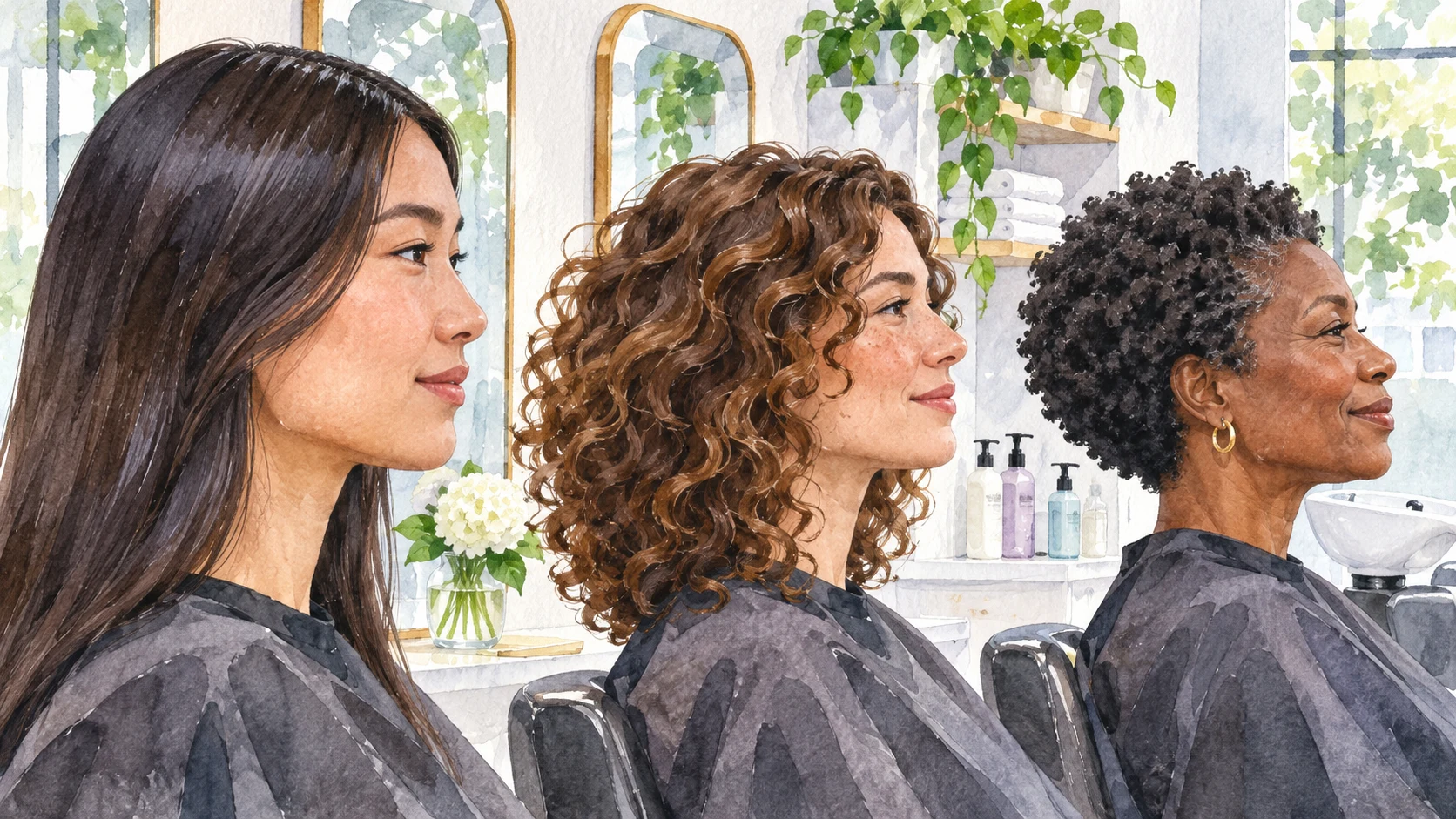
Head lice can infest every hair type, including straight, wavy, curly, coily, fine, thick, short, and long hair. No natural hair texture makes someone completely immune. Head lice are human parasites that live close to the scalp, feed on blood, and use specialized claws to grip individual hair strands.
Hair characteristics may affect how easily lice move or attach themselves, but they do not determine whether an infestation is possible. The American Academy of Pediatrics identifies all hair types as susceptible and reports that hair length has not been shown to significantly influence infestation.
A person with tightly coiled hair can get lice, just as someone with fine, straight hair can. Actual exposure to an infested person’s hair is a more useful consideration than appearance, hairstyle, or assumptions about someone’s background.
Can Head Lice Live in Straight, Wavy, Curly, and Coily Hair?
Head lice have six legs, each ending in a claw that helps them hold onto hair. They use these claws to crawl between strands and remain attached while the person moves.
Straight hair provides accessible strands for lice to grip. Wavy hair can also support lice, even where individual strands curve or change direction. Neither texture prevents the insects from reaching the scalp.
Curly and coily hair can support an infestation as well. Differences in hair curvature, diameter, and cross-sectional shape may affect how easily particular lice grip individual strands. However, the anatomy of head lice allows them to attach to human hair, and natural curl pattern alone cannot reliably predict who will become infested.
A tightly curled strand may present a different surface from a relatively straight strand. That physical difference should not be confused with protection against lice. A louse that successfully transfers onto someone’s hair may still be able to feed, survive, and reproduce.
The practical difficulty often comes later, when someone tries to find the insects. Dense curls and overlapping strands can make small lice harder to spot. That affects detection rather than establishing immunity.
Does Hair Length Affect Your Chances of Getting Lice?
Long hair is often blamed for head lice because it can come into contact with another person’s hair during play, hugs, or other close activities. Yet research has not established that long hair consistently produces higher infestation rates.
The clinical evidence on head lice recognizes direct contact as the main transmission route. A person’s hair length alone cannot tell us how frequently that contact occurs.
Someone with waist-length hair who rarely has close hair-to-hair contact may have fewer opportunities for exposure than someone with a short haircut who regularly touches heads with other people.
Short hair offers no guaranteed protection. Even a relatively close haircut can leave enough hair for lice to grasp and for females to attach eggs near the scalp.
Very short buzz cuts may change how much hair is available for attachment, particularly when only tiny stubble remains. There is no reliable universal haircut length that guarantees protection, however. Completely shaving the scalp is a different situation because it removes the hair that head lice normally require for attachment.
We would not recommend cutting someone’s hair simply because lice have appeared in a classroom or household. The decision to change a hairstyle should not rest on the assumption that shorter hair cannot become infested.
Can People With Thick or Fine Hair Get Head Lice?
Both fine and thick hair can support head lice. Individual hair diameter may influence how well a louse’s claw fits around a strand, but hair thickness is not a dependable way to classify someone as safe from infestation.
There is also a difference between having thick individual strands and having a high density of hair follicles. Someone can have fine strands growing densely across the scalp, while another person has thicker individual strands with fewer hairs overall.
Neither characteristic establishes whether lice are present.
Dense hair may make visual examination more difficult because strands overlap and obscure the scalp. Fine hair may allow greater visibility in some areas, although lice can still be difficult to locate because they are small and move away from light.
The CDC’s head lice guidance describes adult lice as approximately 2 to 3 millimeters long. At that size, a few moving insects can easily escape notice regardless of hair thickness.
The question of whether head lice are visible to the naked eye therefore involves more than the thickness of someone’s hair. Lighting, movement, hair density, and the number of lice present all affect what a person can see.
Are Certain Hair Textures Less Likely to Get Head Lice?
Some studies and surveillance observations have reported different head lice infestation rates among population groups. These findings are sometimes explained through differences in hair shape and the ability of local louse populations to grasp particular hair shafts.
In the United States, lower reported infestation rates among African American people have been discussed in connection with the claws of commonly encountered head lice and differences in hair-shaft shape.
Those observations need careful interpretation.
Hair texture varies substantially among individuals, including people who share the same racial or ethnic background. Population-level infestation rates also reflect contact patterns, sampling methods, and other circumstances that cannot be determined by looking at someone’s hair.
The American Academy of Pediatrics has noted that medical research does not show consistent findings about race or ethnicity as predictors of infestation.
It would therefore be inaccurate to claim that Black people cannot get head lice, that tightly coiled hair is lice-proof, or that a particular ethnic background guarantees susceptibility.
No racial or ethnic group is immune to head lice. A person with any hair texture who has relevant exposure should be assessed on the evidence of an infestation, rather than assumptions about ancestry.
Do Braids, Cornrows, Locs, and Protective Styles Prevent Head Lice?
Braids, cornrows, twists, and locs do not provide guaranteed protection against head lice. These styles change how hair is arranged, but they leave hair and scalp available for lice to occupy.
A louse does not need a loose curtain of hair to survive. It needs access to its human host and enough suitable hair to hold onto.
With cornrows, some sections of the scalp may be more visible because the hair is organized into defined rows. Other sections may be harder to examine near the roots or beneath closely arranged strands.
Box braids and twists may reduce the amount of freely moving hair, depending on the style. However, a person’s scalp and natural hair remain accessible. It would be speculative to assign a specific reduction in infestation risk to these styles without reliable supporting evidence.
Locs present a different examination challenge. Their compact structure can make it difficult to see individual hair shafts or distinguish attached material from other debris. A suspected infestation may require careful assessment without pulling apart or damaging the hairstyle.
Protective styles can also remain in place for extended periods. Someone should not assume that a hairstyle is free of lice simply because it has not been disturbed.
The appropriate response to a suspected infestation is to establish whether live lice are present. The signs of a head lice infestation are more informative than the hairstyle itself.
Can Head Lice Live in Hair Extensions or Wigs?
Hair extensions can be part of a hairstyle affected by head lice, particularly when they are attached close to the person’s natural hair and scalp.
Lice feed on human blood, so the scalp remains their main living area. Synthetic extensions do not provide food, and human-hair extensions cannot sustain lice independently of a living host.
Attached extensions may nevertheless create additional surfaces around which lice can crawl. The natural hair underneath remains available for feeding-related movement and egg attachment.
Wigs are somewhat different because they can be removed from the head. Head lice are poorly adapted to surviving away from a human host, and transmission through a wig or hairpiece is considered extremely unlikely, particularly when it has not been worn recently by an infested person.
A wig should therefore not be treated as an independent breeding environment. The relevant concern is whether it has had recent contact with a person carrying live lice.
The same principle applies to other hair accessories. The main route of getting head lice remains direct contact with infested hair, rather than contact with every object that touches someone’s head.
Does Hair Color Make a Difference?
Blonde, brown, black, red, gray, and dyed hair can all support head lice. There is no established evidence that a particular natural hair color provides reliable protection.
Hair color can influence how easily lice or eggs are noticed. A pale insect may stand out against dark hair but blend into lighter strands. Conversely, darker-looking lice or attached debris may be easier to notice against pale hair.
Head lice also vary in appearance. Their bodies may look grayish, tan, or darker depending on the insect and its condition. For this reason, the color of head lice cannot be reduced to one shade that always contrasts with a person’s hair.
Hair dye does not make someone permanently resistant to infestation. Even when cosmetic treatments change the appearance or condition of individual strands, there is no reliable basis for assuming that lice can no longer attach themselves.
Someone who regularly colors their hair can still encounter lice through close contact with an infested person.
Does Wearing Your Hair Up Reduce Lice Exposure?
A bun, ponytail, or braid may help keep loose hair from brushing against another person’s hair. That makes wearing hair up a reasonable precaution during activities involving close contact.
However, the benefit depends on how people interact.
Two children with tightly secured hairstyles can still touch heads while looking at a phone or playing together. Lice can crawl between hair strands when suitable contact occurs.
The California Department of Public Health identifies head-to-head contact as the usual route of transmission. Keeping hair contained may reduce some opportunities for contact, but it cannot prevent every possible transfer.
There is no reliable percentage showing how much a ponytail, bun, or particular braid style reduces infestation risk.
Hair accessories should also be considered separately from the hairstyle. Sharing recently used accessories can create an additional, less common opportunity for transfer. The circumstances surrounding lice spreading through hats and hair accessories deserve attention when several people regularly share personal belongings.
Common Questions About Hair Types and Head Lice
Can head lice live in 4C hair?
Yes. Tightly coiled 4C hair can support head lice. Its curl pattern does not create immunity, although dense coils may make the insects harder to find during an examination.
Are head lice more attracted to straight hair?
There is no reliable evidence that head lice actively seek straight hair over every other texture. Differences in how their claws grip particular hair shafts may influence attachment, but infestation also depends heavily on exposure.
Can someone with a buzz cut get head lice?
Yes, provided enough hair remains for lice to grip. Very short hair may limit attachment opportunities, but a buzz cut should not be considered guaranteed protection.
Do dreadlocks make head lice impossible to remove?
No. Locs can complicate examination and removal because individual strands are difficult to separate. They do not automatically make an infestation impossible to manage, and cutting locs should not be assumed necessary.
What to Do if You Suspect Lice in Any Hair Type
A person’s hair texture should never be used to rule out an infestation when there has been a plausible exposure or a suspected louse has been found.
Look for reliable physical evidence rather than relying on hair length, curl pattern, or hairstyle. A live crawling louse is the strongest confirmation of an active infestation. Small particles attached to hair can be mistaken for eggs, so identification should come before treatment.
For children, a careful head lice examination can help establish whether treatment is warranted. Dense curls, locs, or extensions may require additional care during examination, but they do not change the basic evidence needed to confirm lice.
There is no reason to cut, straighten, chemically process, or permanently change someone’s natural hair simply because head lice are suspected. Confirm the infestation first, then choose an appropriate response that respects the person’s hair and scalp.
2 thoughts on “What Hair Types Can Get Head Lice?”