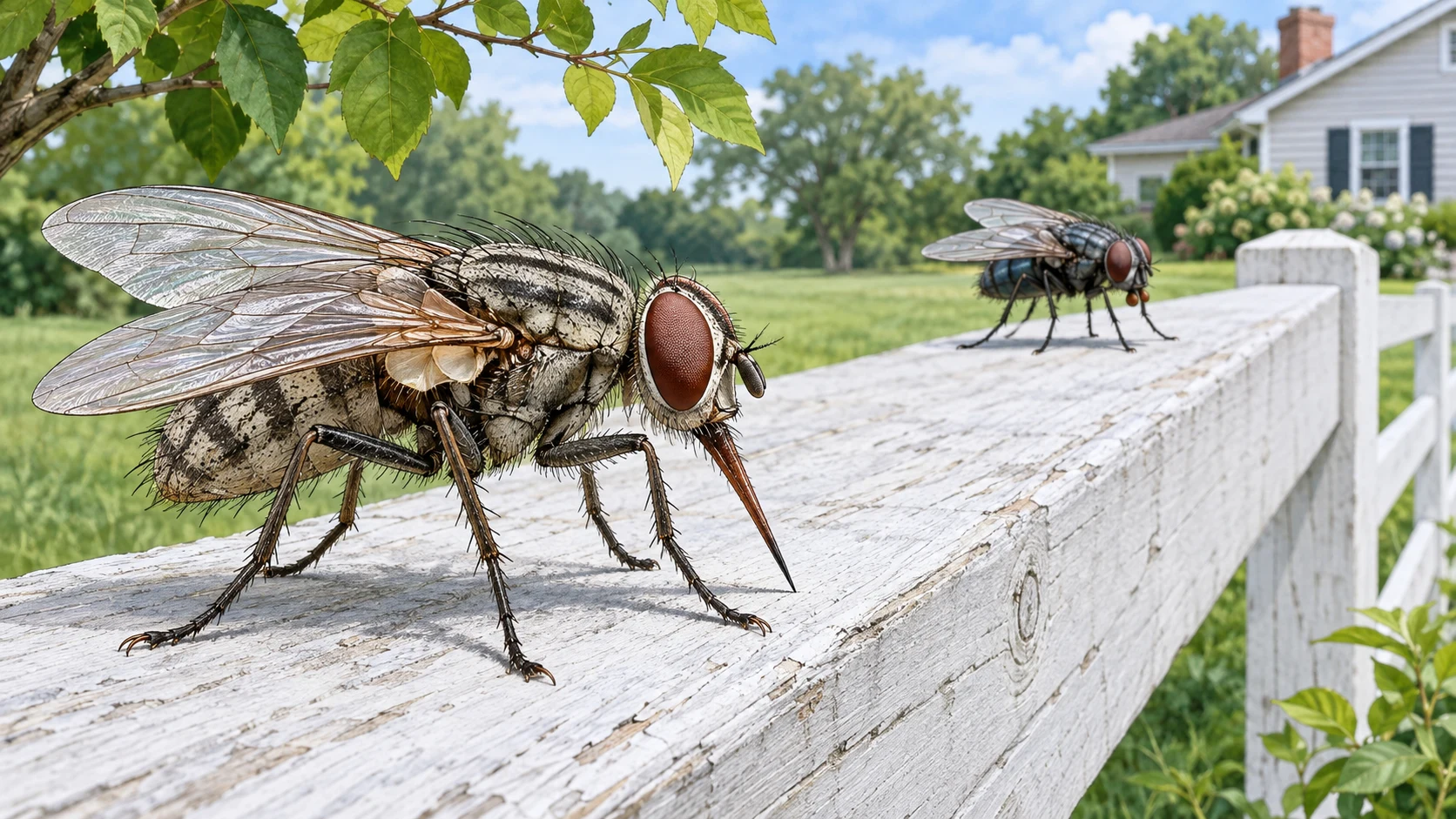
House flies do not bite, but stable flies do. Although these two insects look remarkably similar, their mouthparts are different. A house fly has a soft, sponging mouthpart used to consume liquid food, while a stable fly has a rigid, pointed proboscis that projects forward from its head and pierces skin to draw blood.
Their resting posture offers another useful clue. House flies generally hold their bodies relatively parallel to the surface beneath them. Stable flies often rest at an angle, with their heads raised and abdomens positioned lower. This difference is particularly helpful when the insect is too small to examine closely.
Both species occur around homes, farms, and animal facilities. However, a gray fly repeatedly biting someone’s ankles outdoors is much more likely to be a stable fly than a common house fly.
House Fly vs. Stable Fly: Main Differences
|
Feature |
House fly |
Stable fly |
|---|---|---|
|
Scientific name |
Musca domestica |
Stomoxys calcitrans |
|
Family |
Muscidae |
Muscidae |
|
Typical length |
Approximately 5–8 mm |
Approximately 5–8 mm |
|
Body color |
Dull gray |
Gray to brownish gray |
|
Thorax markings |
Four dark lengthwise stripes |
Four stripes, with the outer stripes often interrupted |
|
Abdomen |
Grayish or yellowish, sometimes patterned |
Gray with darker spots or checkered markings |
|
Mouthparts |
Soft, sponging, directed downward |
Rigid, pointed, projecting forward |
|
Bites humans |
No |
Yes |
|
Adult feeding |
Liquids and softened organic material |
Blood from warm-blooded animals |
|
Resting posture |
Body usually more parallel to the surface |
Head often raised, body angled |
|
Common exposure |
Food, garbage, kitchens, animal facilities |
Livestock areas, yards, kennels, and outdoor resting sites |
The two species overlap considerably in size and coloration. Their mouthparts are the most dependable feature for separating them, particularly when an adult specimen can be examined from the side.
The Biggest Difference Is Their Mouthparts
House flies have sponging mouthparts rather than piercing ones. The lower part of the mouthpart expands into fleshy structures called labella, which allow the insect to take up liquid food from a surface.
When a house fly encounters suitable solid food, it may release digestive fluids that help soften or dissolve material before ingestion. It cannot puncture intact human skin to obtain a blood meal. This explains why common house flies do not bite humans, even though they may repeatedly land on exposed skin.
Stable flies possess a very different feeding structure. Their proboscis is stiff, narrow, and pointed, extending forward from beneath the head. It resembles a short, dark needle or beak.
During feeding, the stable fly uses specialized structures at the tip of its proboscis to penetrate the skin and obtain blood. Both males and females feed this way, unlike some other blood-feeding insects in which only females take blood meals.
The piercing mouthparts of stable flies are visible in close-up photographs and provide the clearest anatomical distinction from house flies.
How to See the Difference on a Resting Fly
A side view is particularly useful. Look directly beneath the insect’s head without touching it.
On a stable fly, the proboscis projects forward as a relatively straight, rigid structure. It remains visible when the insect is resting rather than feeding.
A house fly’s mouthparts point downward and appear softer and less needle-like. Depending on the viewing angle, the structures may be partially concealed beneath the head.
The forward-projecting proboscis used to identify stable flies is more reliable than judging whether the fly looks aggressive or whether it is hovering near a person.
A photograph taken from the side can reveal this feature without requiring the insect to be handled.
House Flies and Stable Flies Rest Differently
Resting posture is one of the most practical identification clues when the mouthparts cannot be seen clearly.
House flies generally rest with their bodies relatively level or parallel to the surface. Their heads do not typically appear strongly elevated above the abdomen.
Stable flies often adopt a more angled position. Their heads are raised, and their abdomens sit lower, giving the body a slightly tilted appearance.
The difference is easiest to observe when both species are resting on a wall, fence, or another relatively flat surface. Stable flies may also hold their wings somewhat more widely apart at the tips.
These differences in resting posture are useful supporting characteristics, but they are not absolute. An insect’s position can change as it walks, feeds, or adjusts to an uneven surface.
For identification, the strongest combination is a forward-pointing proboscis and a raised-head resting posture. A fly displaying both characteristics is much more consistent with a stable fly than a house fly.
Can You Distinguish Them by Their Body Markings?
Both insects have gray bodies and dark stripes along the thorax. Their resemblance is close enough that stable flies are sometimes called biting house flies, although they are a separate species.
The common house fly has four dark longitudinal stripes on its thorax. Its abdomen may appear grayish or yellowish, with markings that vary according to the individual and viewing angle.
Stable flies also have thoracic stripes, but the outer stripes are often interrupted. Their abdomens commonly display distinct dark spots or a checkered pattern.
These features can help when examining the appearance of a house fly alongside a suspected stable fly. However, the patterns are less decisive than the mouthparts because markings can be difficult to interpret under poor lighting.
Size is similarly unreliable. Both species are commonly around a quarter-inch long, and their measurements overlap substantially.
A gray fly should not be identified as a house fly merely because it is small or has four dark stripes. Stable flies can share both characteristics.
Why Stable Flies Bite Around the Ankles
Stable flies frequently attack the lower legs of people, particularly around the ankles. Their bites can produce an immediate, sharp pain because the insect physically penetrates the skin.
The fly may land briefly, begin feeding, and leave if disturbed. A person standing or sitting outdoors may experience repeated attacks, especially when stable flies are abundant nearby.
Stable flies also bite through some clothing, including thin socks. Covering the ankles does not necessarily prevent exposure when the material is thin enough for the proboscis to penetrate.
The ankle-biting behavior of stable flies is well documented and can help distinguish them from nonbiting house flies during an outdoor encounter.
House flies may land on a person’s legs or arms, but they are not feeding on blood. Their contact can feel irritating or ticklish without producing a true puncture wound.
A painful bite attributed to a house fly therefore deserves a closer look at the insect’s identity. The broader question of flies that resemble house flies but bite involves several possible look-alikes, with stable flies being one of the closest.
Where You Are More Likely to Encounter Each Fly
House flies are strongly associated with human activity. Kitchens, garbage containers, outdoor dining areas, and animal facilities can attract adults searching for food or suitable organic material.
Stable flies are more closely associated with outdoor animal exposure. They frequently occur around cattle, horses, livestock facilities, and places where damp bedding or decaying vegetation accumulates.
Their presence is not restricted to farms. Residential yards, parks, and other outdoor areas may experience stable fly activity, especially when suitable breeding material exists nearby.
Stable flies can travel considerable distances from their developmental sites. A homeowner may encounter biting flies even when there are no livestock or obvious breeding materials on the property.
The type of organic material present can still provide a clue. House flies commonly develop in manure and moist garbage. Stable flies favor various moist, decomposing plant materials, particularly mixtures containing straw, hay, manure, or animal urine.
Wet grass clippings, deteriorating hay, and soiled animal bedding can support stable fly development around animal facilities. These materials explain why stable flies may be present near yards and agricultural properties without behaving like ordinary kitchen flies.
The species’ breeding environments overlap, so finding an adult near manure or garbage does not establish its identity.
How Their Behavior Around Animals Differs
Stable flies feed on the blood of warm-blooded animals. Cattle and horses are common hosts, but dogs and other mammals can also be bitten.
On larger animals, stable flies frequently target the legs and lower body. Animals may stamp their feet, switch their tails, or move away in response to painful feeding attempts.
On dogs, the ears and other accessible areas can be vulnerable. Repeated biting may cause irritation or injury, particularly when animals remain outdoors during heavy fly activity.
House flies behave differently around animals. They may visit moist areas, food, manure, or other organic material, but they do not pierce the skin to obtain blood.
The effects of house fly exposure on dogs and cats therefore involve different concerns from the painful blood-feeding behavior of stable flies.
Repeated bites, bleeding, swelling, or wounds on a pet warrant veterinary advice. Identifying the insect can help explain the exposure, but it does not replace an examination of an injured animal.
Do Stable Flies Enter Houses Like House Flies?
Stable flies can enter buildings, but they are primarily outdoor blood-feeding insects. They are more commonly encountered around livestock, yards, fences, and other outdoor locations than around kitchen food.
House flies readily enter occupied rooms while searching for food, resting places, or escape routes. Their frequent movement between kitchens, windows, and garbage areas makes them a familiar indoor nuisance.
A stable fly may occasionally enter through an open door or window. However, finding gray flies indoors does not automatically suggest stable flies, even when the insects are similar in size.
A useful approach is to combine the location with the fly’s behavior. An insect repeatedly landing on food without biting is more consistent with a house fly. One that produces a sharp bite on an ankle and has a forward-projecting proboscis is more consistent with a stable fly.
The general entry routes used by house flies help explain why ordinary house flies are so frequently encountered indoors.
Why Biting Behavior Is More Useful Than Fly Size
A homeowner may describe a stable fly as a small house fly that suddenly started biting. The description is understandable because the species are similar in appearance.
Yet the bite reveals a biological difference that size cannot. Stable flies are blood feeders equipped with specialized piercing mouthparts. House flies lack those structures.
Biting behavior alone is not enough to identify every fly species, since other insects also bite. It becomes particularly informative when the insect has the general size and gray appearance of a house fly.
The strongest identification uses three observations together: a house-fly-sized gray body, a rigid proboscis extending forward, and a tendency to bite exposed skin or animals.
When these features agree, stable fly identification is much more dependable than assuming the insect is a house fly based on its color.
Common Questions About House Flies and Stable Flies
Are stable flies a type of house fly?
Stable flies and house flies are different species within the same fly family, Muscidae. Their similar appearance and shared family relationship explain why they are frequently confused. Stable flies are sometimes called biting house flies, but that name does not make them the same insect.
Can both male and female stable flies bite?
Both sexes of the stable fly feed on blood and can inflict painful bites. This differs from the common house fly, whose males and females have nonpiercing, sponging mouthparts.
Why does a fly that looks like a house fly keep biting my legs?
A stable fly is one possibility, particularly when the bites occur around the ankles outdoors. Its pointed proboscis allows it to pierce skin, while an ordinary house fly cannot. A clear view of the mouthparts is needed to support the identification.
Can you tell a stable fly from a house fly by its wings?
Wing position may help, but it is not the best identifying feature. Stable flies often rest with their wing tips spread more widely, while house flies tend to hold their bodies relatively level. The forward-projecting proboscis is more dependable than wing position alone.
The Clearest Way to Identify the Fly
A house fly has downward-facing, sponging mouthparts and cannot bite through intact skin. A stable fly has a rigid proboscis extending forward from its head and uses it to obtain blood from people and other mammals.
Resting posture provides another clue. House flies generally hold their bodies relatively parallel to a surface, while stable flies often raise their heads and angle their bodies.
Both insects are gray, similarly sized, and capable of occurring around animal facilities or residential properties. Their markings and breeding habitats overlap enough that neither should be used as the sole identification feature.
For a fly that resembles a house fly but delivers painful bites, examining the mouthparts and observing its resting posture will usually provide the most useful evidence.