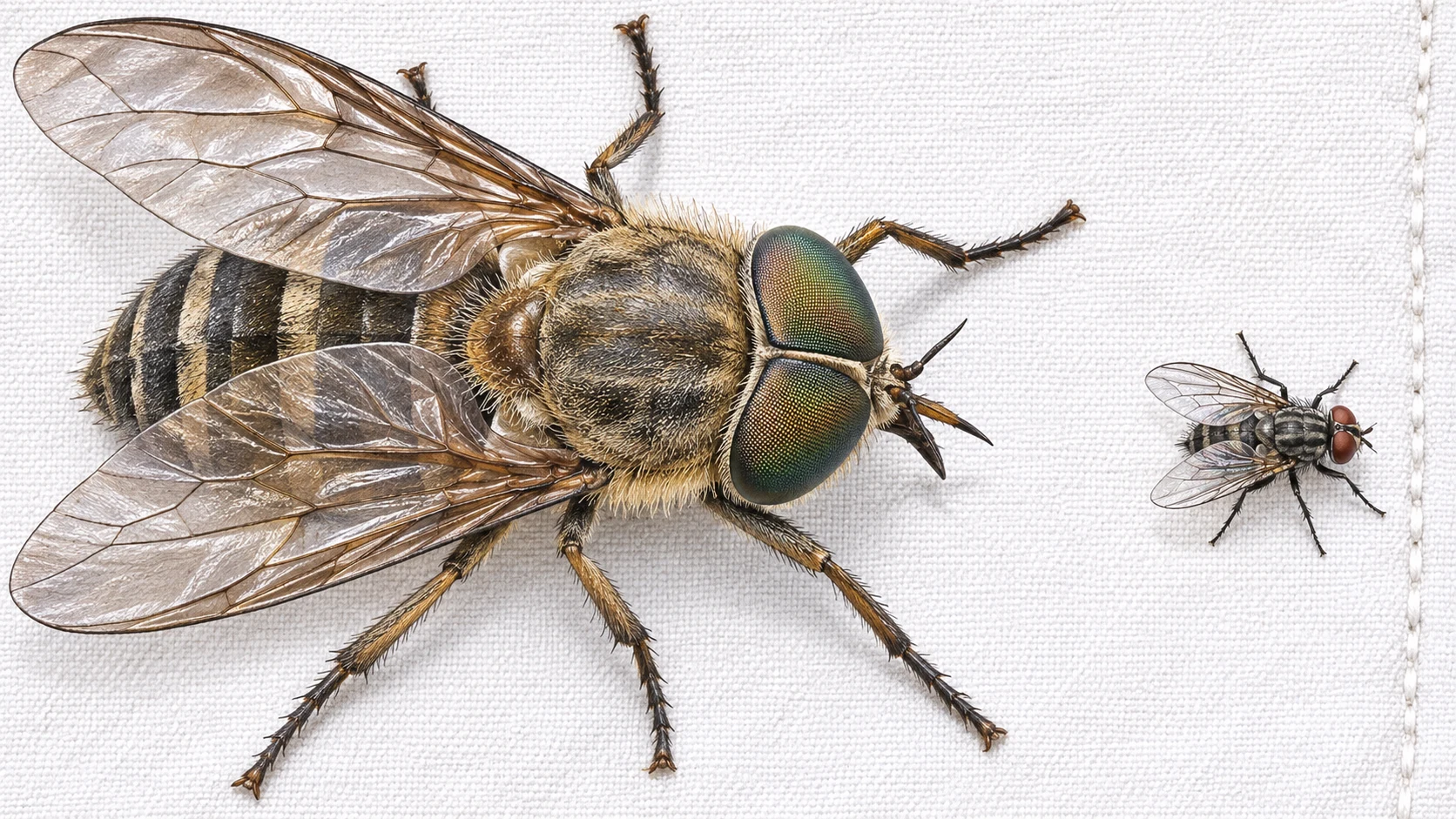
House flies are small, gray insects that cannot bite, while horse flies are generally much larger, heavier-bodied insects whose females can deliver painful bites. A house fly has four dark stripes along its thorax and soft, sponging mouthparts. Horse flies have broad heads, exceptionally large compound eyes, and, in females, cutting mouthparts used to feed on blood.
The two insects also belong to different families. The common house fly, Musca domestica, belongs to Muscidae. Horse flies belong to Tabanidae, with familiar species occurring in genera such as Tabanus and Hybomitra. A large fly circling a person near a pasture or wetland may be a horse fly, especially if it attempts to bite. A smaller gray fly repeatedly landing on kitchen surfaces is more consistent with a house fly. Size, head shape, and feeding behavior together provide a much stronger identification than location alone.
House Fly vs. Horse Fly: Quick Comparison
|
Feature |
House fly |
Horse fly |
|---|---|---|
|
Classification |
Musca domestica, family Muscidae |
Family Tabanidae, including Tabanus and Hybomitra |
|
Typical adult length |
About 6–8 mm |
Commonly around 10–25 mm, with some species larger |
|
Body shape |
Relatively small and compact |
Broad, stout, and often heavy-bodied |
|
Color |
Dull gray with four dark thoracic stripes |
Brown, gray, black, or patterned, depending on species |
|
Eyes |
Large compound eyes, usually reddish |
Very large eyes, sometimes iridescent or banded |
|
Mouthparts |
Soft, sponging structures |
Females have cutting mouthparts for blood feeding |
|
Biting behavior |
Neither sex bites |
Females of blood-feeding species bite; males do not |
|
Common feeding activity |
Liquids and softened organic material |
Females may take blood meals; both sexes can use nectar and other sugars |
|
Common setting |
Kitchens, garbage areas, animal facilities |
Pastures, wooded edges, wetlands, and other outdoor habitats |
|
Immature habitat |
Moist manure, garbage, and decomposing organic matter |
Wet soil, mud, and aquatic or semiaquatic habitats in many species |
The size ranges are not universal because horse flies comprise numerous species. A small horse fly can be closer in size to a large house fly than the table might suggest.
Why Horse Flies Look So Much Bigger
A typical house fly is approximately one-quarter to five-sixteenths of an inch long. Its narrow thorax, relatively modest abdomen, and compact proportions give it a familiar appearance. The normal size of an adult house fly varies, but most individuals remain noticeably smaller than the large horse flies encountered around livestock.
Many horse flies measure approximately half an inch to an inch long, with some species exceeding that range. Their thoraxes are broad, their abdomens are substantial, and their heads can appear disproportionately large. Even without a ruler, the heavier body and wider head often separate them from house flies.
The size and physical variation of horse flies also explain why not every horse fly looks identical. Some are nearly black, others are brown or gray, and certain species have conspicuous abdominal patterns.
Size is a useful starting point, but a fly should not be identified solely because it looks unusually large. Blow flies, flesh flies, and other insects can also exceed the size of a typical house fly.
The Difference in Their Eyes and Body Markings
A house fly has large compound eyes, but they do not dominate the head to the same extent as those of many horse flies. Its thorax bears four dark longitudinal stripes against a dull gray background, making the pattern useful for recognizing a common house fly.
Horse flies have very large compound eyes that occupy much of the head. In some species, the eyes display striking green, blue, violet, or coppery reflections. Horizontal bands or other colored patterns may also be visible, particularly in living specimens.
Eye color is not identical across the family. Some horse flies have relatively plain dark eyes, and the brighter patterns can fade after death or become difficult to see in photographs. Their broad head and large eyes are therefore more dependable characteristics than any particular color.
The large, sometimes iridescent eyes of horse flies provide a useful comparison with the smaller head proportions of a house fly. Horse flies also lack the characteristic four-stripe thoracic pattern used to identify Musca domestica. Their bodies may have different stripes, patches, or contrasting colors depending on the species. A brown horse fly with a patterned abdomen should not be mistaken for a house fly simply because both insects belong to the order Diptera.
House Flies Cannot Bite, but Female Horse Flies Can
The feeding structures of these insects are fundamentally different.
House flies possess sponging mouthparts that allow them to consume liquids and food softened by digestive secretions. They do not have the cutting structures required to break intact human skin and obtain blood. Their repeated landings may be irritating, but ordinary house flies do not bite people.
Female horse flies of blood-feeding species have sharp, blade-like mouthparts that cut the skin. They then take up blood from the resulting wound. This differs from the narrow piercing mechanism used by some other blood-feeding insects.
The bite can be immediately painful and may produce local bleeding, swelling, or itching. Horse flies are strong fliers, and a female seeking a blood meal may return after being disturbed.
Male horse flies do not feed on blood. Their mouthparts are not adapted for cutting skin, and they obtain nourishment from nectar and other sugary sources. Females also use plant sugars, but blood meals support egg development in many species.
The blood-feeding anatomy and behavior of female horse flies explain why a painful bite is such a useful clue when separating them from house flies. A painful reaction does not identify a horse fly by itself. If the insect was not seen clearly, its identity remains uncertain.
Where You Are Most Likely to Encounter Each Fly
House flies are closely associated with people, food, waste, and animal facilities. They commonly enter homes through open doors, windows, or other accessible openings. Once indoors, they may move between food preparation areas, garbage containers, and windows.
Horse flies are primarily outdoor insects. They are frequently encountered around livestock, pastures, wooded areas, and wetlands. Their immature stages often develop in wet soil or aquatic and semiaquatic habitats, which helps explain their association with ponds, marshes, and similar environments.
Adult horse flies can travel away from their developmental sites, so a biting encounter does not establish that they are breeding on the property. They may also appear in residential yards without any nearby livestock.
The outdoor habitat and host-seeking behavior of horse flies differ considerably from the familiar food-seeking activity of house flies. House flies may be present around livestock too, particularly where manure and feed residues provide attractive conditions. Finding flies in a stable or pasture therefore does not mean every insect present is a horse fly.
The type of contact is more informative. A small gray fly visiting feed, manure, or exposed food may be a house fly. A large, broad-headed fly persistently approaching an animal and attempting to take blood is more consistent with a female horse fly.
Why Horse Flies Chase People and Animals
Horse flies use visual cues to locate potential hosts. Movement, contrast, and the appearance of large objects can help attract females searching for blood meals.
They are powerful fliers and may approach people walking through open fields, along woodland edges, or near wet areas. Some follow moving animals or vehicles, although not every fly following a person is necessarily a horse fly.
Horses and cattle are common hosts. Their size makes them conspicuous targets, and repeated feeding attempts can cause animals to stamp, twitch, or move away. Female horse flies may land on the legs, abdomen, neck, or other accessible body regions.
House flies also respond to movement and may repeatedly land on people or animals, but their feeding interests are different. A house fly investigating moisture or organic residue on skin is not trying to obtain a blood meal.
A large fly that persistently approaches a person outdoors, lands firmly, and produces an immediate painful bite fits the behavior of a female horse fly. When the insect is visible, its large eyes and heavy body can help confirm the identification.
Can House Flies and Horse Flies Breed in the Same Places?
Their usual larval habitats are quite different.
House flies develop in moist, decomposing organic materials, including manure, suitable garbage, and other waste. The female deposits eggs in material that can provide food for the emerging larvae. The range of house fly egg-laying sites helps explain why populations can develop around homes and animal facilities.
Many horse flies lay their eggs on vegetation or other surfaces near water or wet ground. Their larvae typically inhabit aquatic or semiaquatic environments, including mud and saturated soil. Many are predators of small invertebrates rather than consumers of household garbage.
These differences mean that removing household food waste does not address the typical developmental habitat of horse flies. Conversely, a nearby pond does not establish that the gray flies around a kitchen trash can are horse flies.
For identification, the habitat offers supporting evidence rather than a substitute for examining the adult.
What to Look for in House Fly and Horse Fly Photos
The most useful comparison photographs show the entire adult insect clearly, preferably from similar angles. A house fly photographed at extreme magnification can appear larger than a horse fly photographed from farther away, making an unscaled comparison misleading.
A photograph from above should show the thorax, abdomen, wing position, and overall body proportions. On the house fly, look for the four dark thoracic stripes and relatively narrow body. On the horse fly, look for the broad head, large eyes, and heavier body.
A frontal or three-quarter view is particularly helpful for examining the horse fly’s eyes. In some species, their colored bands or iridescent surfaces are immediately apparent. The same view of a house fly shows a smaller head relative to the rest of its body.
Photographs can also help distinguish the mouthparts, although these may be difficult to see without a detailed close-up. Horse fly females have cutting mouthparts, while house flies have softer sponging structures.
The body should be identifiable without relying entirely on the photograph’s caption. A generic image labeled simply “fly” may show another species, particularly when the head or thorax markings are obscured.
Why a Large Fly in Your House Is Not Automatically a Horse Fly
A large insect buzzing against a window can easily be mistaken for a horse fly. However, several kinds of flies are larger than ordinary house flies, and many share dark or gray coloration.
Horse flies may occasionally enter buildings, but they are not typical indoor garbage-breeding insects. Their outdoor habitat associations make them less likely to be responsible for persistent kitchen fly activity.
A metallic blue or green body points more toward a blow fly. A large gray insect with three bold thoracic stripes and a strongly checkered abdomen may be a flesh fly. Those characteristics differ from the broad head and enormous eyes of a horse fly. The difference between house flies and blow flies is particularly relevant when the insect looks much larger than an ordinary house fly but has a shiny body.
For a suspected horse fly, inspect the head before drawing conclusions from its size. A clear photograph of the eyes, thorax, and abdomen is more useful than a description such as “a giant house fly.”
Common Questions About House Flies and Horse Flies
Are horse flies related to house flies?
Both are true flies in the order Diptera, but they belong to different families. House flies are members of Muscidae, while horse flies belong to Tabanidae. Their different mouthparts and feeding behavior reflect this separation.
Can a house fly bite like a horse fly?
A common house fly cannot cut or pierce intact skin to obtain blood. Female horse flies of blood-feeding species possess specialized cutting mouthparts and can deliver painful bites. A fly that looks like a house fly but bites may be another species.
Are horse flies always larger than house flies?
Horse flies are generally larger, but their sizes vary by species. Many are considerably longer and broader than house flies, while smaller horse flies may overlap with unusually large house flies in length. Head proportions and eye size remain useful identification clues.
Do male horse flies bite humans?
Male horse flies do not take blood meals. They feed on nectar and other plant-derived sugars. Females of blood-feeding species use blood meals to support reproduction, although their feeding patterns vary.
The Most Reliable Way to Identify Them
A house fly is usually a small, dull gray insect with four dark thoracic stripes and nonbiting mouthparts. A horse fly is generally larger and heavier, with a broad head, exceptionally large eyes, and, in blood-feeding females, mouthparts capable of cutting skin. The surrounding environment helps explain which insect is more likely. House flies commonly visit food, garbage, and animal waste, while horse flies are more strongly associated with outdoor hosts and wet habitats. When a large fly approaches you outdoors and delivers a painful bite, horse fly identification becomes more plausible. When a small gray fly repeatedly lands on kitchen surfaces without biting, a house fly is more likely. Checking the adult’s body shape and head features provides the strongest confirmation.