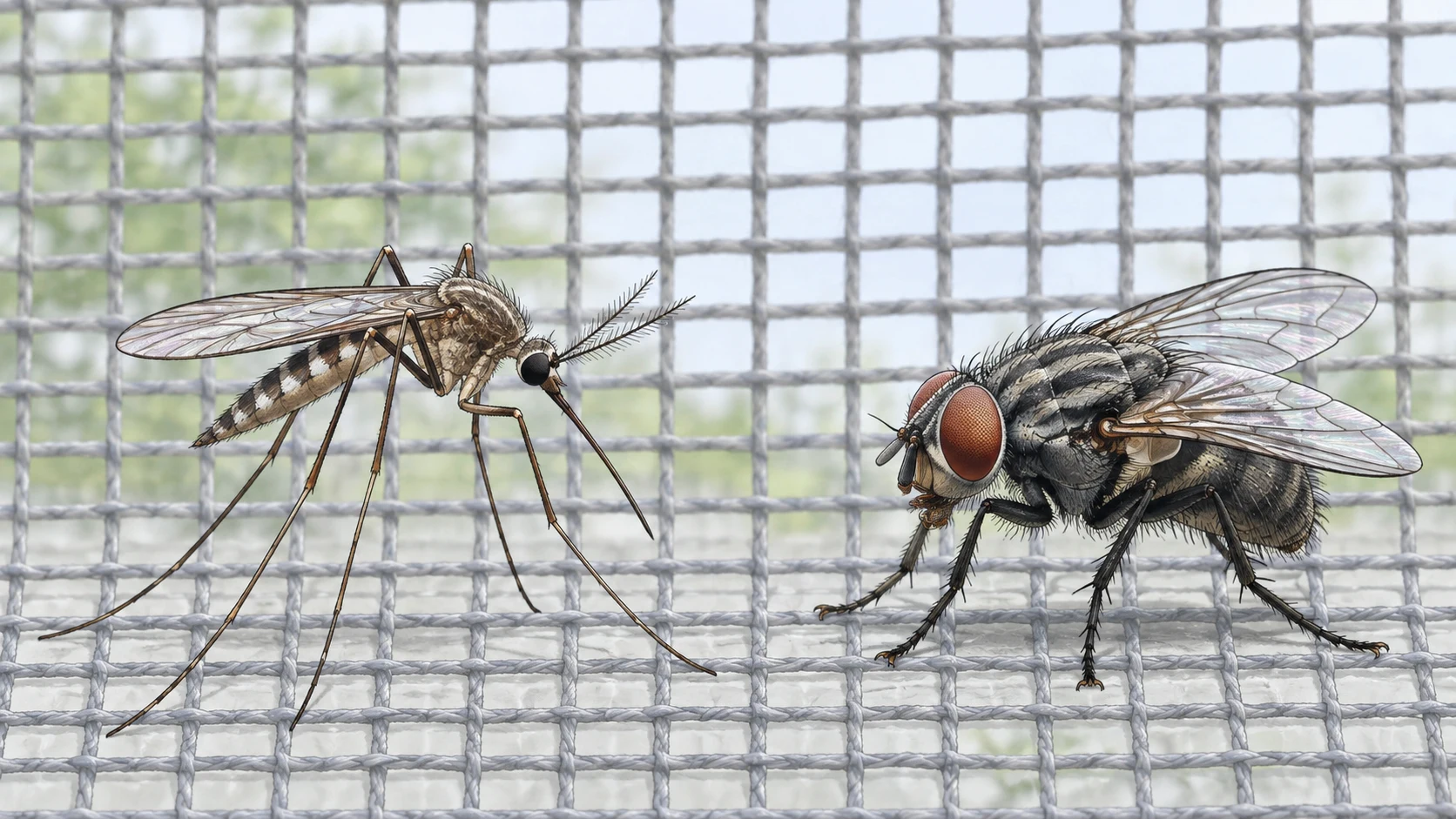
A house fly and a mosquito may both buzz around a room, land on walls, and approach people, but their bodies and feeding habits are quite different. House flies are stocky, gray insects with short antennae and sponging mouthparts. Mosquitoes are slender insects with long legs, narrow bodies, and a prominent needle-like proboscis. Female mosquitoes of blood-feeding species can pierce the skin, while common house flies cannot bite.
Their resting posture provides another useful identification clue. House flies usually rest with their bodies relatively flat against a surface and their wings folded back over the abdomen. Mosquitoes stand on long, delicate legs, with a slender abdomen that may be held nearly parallel to the surface or raised at an angle, depending on the species.
Although both belong to the order Diptera, the common house fly (Musca domestica) belongs to Muscidae, while mosquitoes belong to Culicidae. The difference is usually easy to recognize once the insect stops moving long enough to examine its body shape.
House Fly vs. Mosquito: Quick Comparison
|
Feature |
House fly |
Mosquito |
|---|---|---|
|
Classification |
Musca domestica, family Muscidae |
Family Culicidae |
|
Typical adult length |
Approximately 5–8 mm |
Often 3–6 mm, varying by species |
|
Body shape |
Broad, compact, and stocky |
Narrow, slender, and elongated |
|
Color |
Dull gray with four dark thoracic stripes |
Brown, gray, black, or patterned |
|
Legs |
Relatively short and sturdy |
Long, thin, and delicate |
|
Antennae |
Short, with a bristle-like arista |
Longer and segmented, often noticeably feathery in males |
|
Mouthparts |
Soft, sponging structure |
Long proboscis; females of blood-feeding species can pierce skin |
|
Biting |
Neither sex bites |
Females of blood-feeding species bite; males do not |
|
Wings |
Clear, relatively broad |
Narrow, covered with tiny scales |
|
Resting posture |
Body usually close to the surface |
Body supported on long legs, sometimes angled upward |
|
Common indoor activity |
Visiting food, garbage, and windows |
Resting in sheltered areas or seeking hosts |
|
Typical immature habitat |
Moist decomposing organic matter |
Water or water-associated habitats |
Size alone is unreliable because some mosquitoes overlap with house flies in body length. Their proportions, mouthparts, and legs provide much stronger identification evidence.
House Flies Have Broad Bodies, While Mosquitoes Are Slender
The body silhouette is usually the first noticeable difference.
A common house fly has a broad thorax, a rounded or slightly elongated abdomen, and a relatively large head. Its gray thorax bears four dark longitudinal stripes, and its abdomen may have yellowish areas along the sides. These markings are characteristic of the appearance of an adult house fly.
A mosquito has a much narrower thorax and abdomen. Its body looks elongated rather than compact, and the legs extend well beyond the body’s outline. The abdomen consists of visible segments and may expand considerably after a female takes a blood meal.
Mosquitoes vary in coloration. Some are mostly brown, while others have contrasting white markings on the legs or body. Those markings are useful for identifying particular mosquito groups, but they are not necessary for distinguishing a mosquito from a house fly.
The slender body and long-legged anatomy of mosquitoes make them recognizable even when their color is difficult to see.
A dark insect should not automatically be called a mosquito. Its overall shape is more informative than its color, especially in poor lighting.
Their Legs and Antennae Look Different
Mosquito legs are conspicuously long and thin. When one rests on a wall, its legs hold the body away from the surface and create a delicate outline. The legs may appear disproportionately long compared with the insect’s narrow abdomen.
House flies have shorter, sturdier legs. They can walk quickly across countertops, walls, and other surfaces without displaying the same long-legged silhouette.
Their antennae also differ. House flies possess short antennae with a bristle-like structure called an arista. These sit close to the face and may be difficult to distinguish without magnification.
Mosquito antennae are longer and consist of multiple segments. Males commonly have conspicuously bushy or feathery antennae, while females generally have much less feathery antennae.
The difference between male and female mosquito antennae is useful when examining a clear photograph. However, a female mosquito can still be identified by its long legs, narrow abdomen, and projecting proboscis without determining its sex.
A close side-view photograph is particularly helpful because the antennae and legs stand out against the background.
House Flies Have Sponging Mouthparts; Mosquitoes Have a Proboscis
The mouthparts provide one of the most decisive physical differences between these insects.
A house fly has a soft, sponging structure at the end of its mouthparts. It uses this structure to take up liquids and food that has been softened or liquefied. It cannot pierce intact human skin to obtain blood.
The structure of house fly mouthparts explains why the insect may land on skin without being capable of delivering a bite.
A mosquito has a long, narrow proboscis projecting forward from the head. Both males and females use their proboscis to feed on plant sugars, including nectar. In blood-feeding mosquito species, females possess specialized internal mouthpart structures that can penetrate skin and draw blood.
The proboscis is not a single hollow needle. It contains several specialized components, including structures involved in piercing, feeding, and delivering saliva.
The feeding anatomy of male and female mosquitoes explains why their behavior differs despite their broadly similar external mouthpart shape.
A long, straight projection extending from the head is a strong mosquito clue. House flies do not have that conspicuous forward-pointing feeding structure.
Why Mosquitoes Bite but House Flies Do Not
Female mosquitoes of blood-feeding species obtain blood to support egg production. They use their specialized mouthparts to pierce skin, introduce saliva, and draw blood from a host.
A mosquito bite may initially go unnoticed. The itching, redness, or swelling that develops afterward is primarily associated with the body’s reaction to substances in mosquito saliva.
Male mosquitoes do not take blood meals. They feed on nectar and other plant-derived sugars. Some mosquito species have females that do not require blood meals, so biting behavior is not universal across the family.
House flies feed differently. They consume liquid or softened material, including substances associated with food, waste, and animal secretions. Their mouthparts cannot puncture skin.
The nonbiting feeding behavior of common house flies is consistent with their sponging mouthparts and familiar activity around food.
A house fly landing on an arm may cause a tickling sensation, particularly as it walks across the skin. That sensation is not evidence that the insect has bitten.
Can a bite mark tell you which insect was responsible?
A bite mark cannot reliably identify the insect responsible. Mosquito bites often produce itchy, raised areas, but similar skin reactions can result from other insects and non-insect causes.
If a slender, long-legged insect was actually observed piercing the skin, a mosquito becomes a strong possibility. If a stocky gray fly merely landed nearby, it should not be blamed for a bite without additional evidence.
The distinction between house flies and biting insects depends on identifying the insect and its mouthparts rather than interpreting the skin reaction alone.
Resting Posture Can Help Identify a Mosquito
A resting mosquito often looks quite different from a house fly.
House flies generally keep their bodies close to the surface. Their legs support a relatively horizontal body, and the wings extend backward over the abdomen. From the side, the insect looks compact rather than elevated.
Mosquitoes rest on long legs that hold the body away from the surface. Their abdomen may extend backward almost parallel to the surface or rise at an angle.
The angle depends partly on the mosquito group. Many Anopheles mosquitoes rest with their abdomen raised, producing a distinctive diagonal posture. Common Culex mosquitoes more often hold the abdomen closer to parallel with the resting surface.
The raised-abdomen resting posture of Anopheles mosquitoes is a useful example of how mosquito posture varies.
It would therefore be inaccurate to say that all mosquitoes rest with their rear ends pointing upward. A horizontal abdomen does not rule out a mosquito.
The more dependable comparison is the overall posture: a mosquito has long legs, a narrow body, and a projecting proboscis, while a house fly has a compact body supported by comparatively short legs.
How Their Wings Look When They Are Resting
Both house flies and mosquitoes have one pair of functional wings. Their second pair of wings has evolved into small balancing organs called halteres, a characteristic of true flies.
House fly wings are relatively broad and transparent. When resting, they usually extend backward over the abdomen, often held slightly apart.
Mosquito wings are narrower and covered with tiny scales. These scales may contribute to subtle dark or pale markings, depending on the species.
The wing structure and body anatomy of true flies explain why mosquitoes and house flies share a basic two-winged body plan despite their obvious differences.
Wing details can be difficult to see on a moving insect. In ordinary household situations, the shape of the legs, abdomen, and mouthparts is generally more useful than examining individual wing scales.
Why a House Fly May Land on You Without Biting
House flies sometimes land on exposed skin to investigate moisture, sweat, or other available substances. Their mouthparts allow them to take up suitable liquids, but not to cut or pierce the skin.
They may also repeatedly land on nearby surfaces while exploring their surroundings. This can make their behavior seem persistent or aggressive, even though they are not attempting to obtain blood.
Mosquitoes approach people for different reasons. Blood-seeking females use several sensory cues, including carbon dioxide, body odors, heat, and visual information, to locate potential hosts.
The two insects may therefore approach the same person without having the same feeding objective.
A house fly walking across an arm is usually easy to recognize by its broad gray body. A mosquito preparing to feed is more likely to settle on its long legs and position its proboscis against the skin.
Where You Are More Likely to Find Each Insect Indoors
House flies commonly move between kitchens, garbage containers, windows, and other surfaces. They are attracted to suitable food sources and can enter buildings through open doors, windows, and gaps.
Their larvae develop in moist organic material such as manure, garbage, and decomposing vegetation. The usual egg-laying sites of house flies explain why adults may originate outside the home and later appear indoors.
Mosquito larvae develop in water or closely associated aquatic habitats. Adult mosquitoes may enter homes and rest in sheltered areas, including dark corners and other relatively undisturbed locations.
A mosquito resting on a bedroom wall does not establish that it developed inside the house. Likewise, a house fly found in a bathroom does not necessarily have an indoor breeding source.
The surroundings are supporting evidence. A gray, stocky insect repeatedly visiting food is more consistent with a house fly. A slender insect resting on long legs and possessing a projecting proboscis is more consistent with a mosquito, regardless of which room it occupies.
Can You Tell Them Apart From a Photograph?
A clear side-view photograph can reveal most of the important differences without needing to handle the insect.
Look first at the legs and abdomen. House flies have relatively short legs and a broad abdomen. Mosquitoes have thin legs and a much narrower, segmented abdomen.
Next, examine the head. The house fly’s short antennae and sponging mouthparts contrast with the mosquito’s longer antennae and prominent proboscis.
A photograph taken from above can also show the four dark stripes on a house fly’s thorax. Mosquitoes lack this characteristic house fly pattern, although some have other distinctive markings.
A photo of a mosquito resting at an angle can be particularly informative, but its posture should be interpreted alongside its body features. The abdomen’s angle alone is not sufficient to identify a mosquito or determine its genus.
Common Questions About House Flies and Mosquitoes
Are mosquitoes a type of house fly?
No. Mosquitoes belong to Culicidae, while common house flies belong to Muscidae. Both are true flies in the order Diptera, but they have different body proportions, mouthparts, and feeding behavior.
Are mosquitoes always smaller than house flies?
Not always. Many mosquitoes are slimmer and lighter-looking than house flies, but their body lengths can overlap. Some mosquito species are relatively large. Leg length and overall body shape are better clues than length alone.
Do male mosquitoes have the same long proboscis as females?
Male mosquitoes also have a proboscis, which they use to feed on nectar and other sugars. They do not use it to pierce skin for blood meals. Their more feathery antennae can help distinguish them from females.
Does a mosquito always rest with its abdomen raised?
No. Anopheles mosquitoes commonly rest with the abdomen angled upward, while many other mosquitoes, including Culex, rest with the abdomen closer to parallel with the surface. The long legs and narrow body remain more consistent mosquito features.
Identifying the Insect on Your Wall or Skin
A house fly has a stocky gray body, four dark thoracic stripes, relatively short legs, and sponging mouthparts. A mosquito has a slender abdomen, long delicate legs, longer antennae, and a projecting proboscis.
If the insect is resting, a side-view photograph will usually show the difference more clearly than watching it fly. Check the body proportions and mouthparts first, then use its resting posture and behavior as supporting evidence.