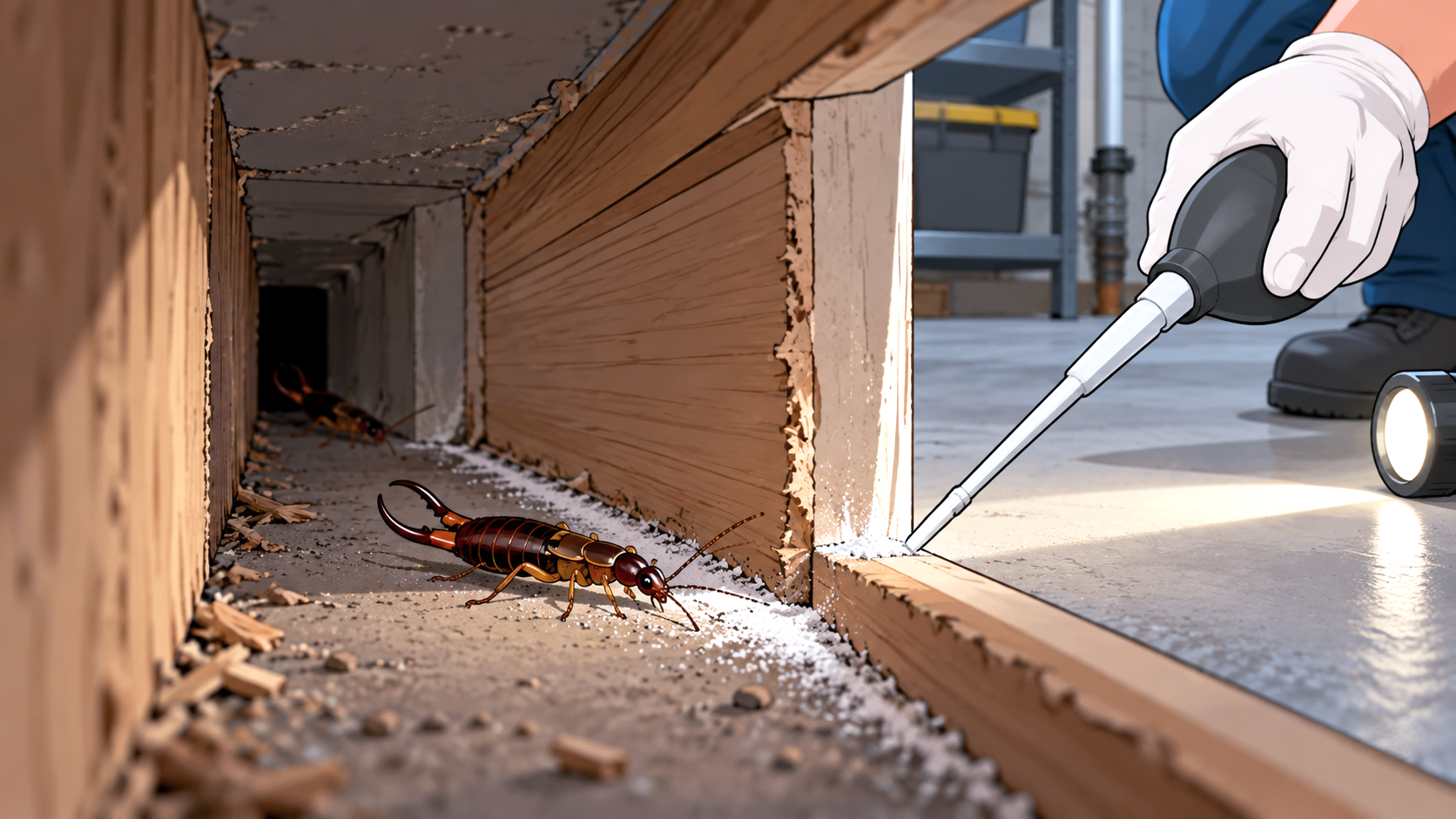
Borax and boric acid often get treated as interchangeable home remedies. They are related boron compounds, but they are not the same substance. That distinction becomes important when someone wants to use either one against earwigs. Boric acid can kill earwigs when it is formulated in a pesticide product labeled for earwig control. Registered boric acid products have specifically listed earwigs among the insects they control. Borax also has insecticidal properties, but ordinary household borax should not be treated as a homemade substitute for an earwig pesticide.
The useful question, then, is not simply whether boron compounds can kill insects. It is whether the particular product in your hand is actually designed and labeled for the job.
Borax and Boric Acid Are Related, but They Are Not the Same Thing
The names are similar enough to invite confusion. Boric acid is a boron-containing compound used as an active ingredient in various pesticide products. Borax is sodium tetraborate decahydrate, one of several sodium borate salts.
Both belong to the broader family of boron compounds, and both have insecticidal properties. However, that does not make a box of laundry borax equivalent to a registered boric acid insecticide. The compounds differ chemically, and commercial pesticide formulations also differ in concentration, form, other ingredients and directions for use.
This matters because boric acid pesticides are sold in several forms, including dusts, baits, granules and other formulations. Some registered products containing orthoboric acid specifically list earwigs as a target pest.
That is much stronger evidence for an earwig treatment than the general observation that borax can affect insects.
How Boric Acid Kills Insects
Boric acid does not work exactly like the diatomaceous earth used against earwigs.
Diatomaceous earth primarily acts on an insect’s protective exterior and promotes water loss. Boric acid can act after an insect consumes it. It disrupts the insect’s stomach and can affect its nervous system. Boric acid can also damage the exterior of insects.
The formulation changes how that insecticidal action is delivered. A bait is designed around the insect encountering and consuming the product, while another registered formulation may have different directions. This is why we would not reduce boric acid treatment to the common online advice of simply sprinkling powder wherever an earwig was seen.
There are registered orthoboric acid products designed specifically to kill earwigs. For example, an Environmental Protection Agency-registered 5% orthoboric acid bait lists earwigs among its target insects. That establishes the important point: boric acid can be an effective earwig insecticide when delivered through an appropriate product.
Why We Would Not Use Laundry Borax as an Earwig Pesticide
This is where the distinction in the title becomes practical.
Borax has insecticidal properties. It is also found in ordinary non-pesticide products such as household cleaners and laundry products. The fact that the active chemical family has pesticidal uses does not turn every borax-containing household product into a pesticide.
We would not take laundry borax, invent an application rate and spread it around the house or garden for earwigs. Doing that bypasses one of the most useful things a registered pesticide gives you: instructions specifying its target pests, permitted locations, application method and safety precautions.
The same principle applies to homemade borax bait recipes. Mixing borax with sugar, food or another attractant creates a pesticide mixture without label directions telling you whether the concentration is appropriate for earwigs, where the mixture can be placed or how exposure should be controlled.
For earwigs specifically, there is no reason to improvise when registered pesticide formulations containing boric acid already exist.
Boric Acid Still Has to Reach the Earwigs
A product can be capable of killing earwigs and still perform badly when placed in the wrong location.
Earwigs spend daylight hours concealed in protected places and become more active at night. Around a property, they can shelter beneath debris, mulch, boards and other dark areas. Indoors, the earwig walking across a bathroom floor may simply be a wanderer that entered from outside.
That behavior should influence the control method. Finding one earwig in the middle of a room does not mean spreading boric acid across the entire floor is useful. Instead, persistent sightings should prompt you to determine why earwigs are entering the house and where they are moving.
A boric acid pesticide can only be used in the places and manner permitted by its label. Some formulations are intended for cracks, crevices, voids or other specific treatment areas. Others are baits. The product label, rather than a generic boric acid recipe, determines the correct placement.
Boric Acid Is Not a Good Substitute for Fixing the Earwig Source
This is the limitation we think matters most for homeowners.
Killing individual earwigs and reducing the conditions supporting them are two different jobs. Earwigs favor protected locations, particularly where suitable shelter and moisture coincide. If large numbers are living around the exterior of a house, killing the insects that encounter a pesticide does not remove the conditions that made the property favorable.
That becomes particularly obvious with repeated indoor sightings. European earwigs do not establish reproducing populations indoors. When they keep appearing inside, the more useful long-term response is usually to address exterior habitat and entry routes rather than continually treating rooms where the insects happen to appear.
Sealing gaps around likely entry points is part of that approach. Removing unnecessary shelter near the structure and correcting persistent moisture problems can also help. Our guide to keeping earwigs out of the house covers that side of control separately.
We would therefore treat a boric acid product as one possible control tool, not as the solution to every earwig problem.
Be Especially Careful With Boric Acid Around Children and Pets
The word “boric” may sound less intimidating than the name of a conventional insecticide, but boric acid is still a pesticide when it is being used for pest control.
Exposure can occur through ingestion, inhalation, the eyes or skin. Children and pets can also encounter products that have been placed where they can reach them. The safest assumption is never that a powder is harmless simply because it is commonly sold or derived from naturally occurring boron.
Boric acid can cause adverse effects when swallowed, while borax dust can irritate the respiratory tract and eyes. Pesticide labels therefore include precautions governing how and where the particular formulation can be used.
Do not place loose pesticide dust in locations accessible to children or pets unless the label expressly permits the application and its directions are followed. Likewise, do not transfer pesticide products into unlabeled food containers or leave homemade mixtures where someone or an animal could mistake them for food.
For households with animals, our separate guide to choosing an earwig killer around pets deals with that decision more directly.
Boric Acid in the Garden Is a Different Decision
The garden is one place where casually scattering borax or boric acid makes particularly little sense.
Boron is a plant micronutrient, but the difference between enough and too much matters. Boric acid and borax can damage plants by causing them to dry out. Using a household borax product as an improvised garden insecticide therefore introduces a problem that has nothing to do with whether it can kill an earwig.
Earwigs also are not automatically garden enemies. They feed on plant material but can consume aphids and other small organisms as well. Treatment makes more sense when nighttime inspection confirms that earwigs are causing unacceptable damage rather than simply because you found them under mulch.
Where plants really are being damaged, our approach to getting rid of earwigs in the garden starts with targeted habitat changes and trapping around affected plants. Those methods avoid turning an entire garden bed into a treatment zone unnecessarily.
Any pesticide considered for an edible or ornamental plant should specifically permit that site and use on its current label.
Choose the Product Before Choosing the Ingredient
The easiest mistake with boric acid is deciding that because the ingredient works, any form of it will work in any location.
Reverse that thinking.
First identify the actual earwig problem. A few insects wandering indoors may need nothing more than physical removal and exclusion. A concentrated outdoor population may respond to earwig trapping, shelter reduction and moisture management. Confirmed plant damage calls for a garden-specific approach.
If pesticide treatment is warranted, choose a registered product labeled for earwigs and the location where you intend to use it. Then follow that product’s directions exactly.
That approach is less improvised than sprinkling household borax around the property, but that is precisely why we prefer it. Boric acid can kill earwigs. The fact that borax is chemically related does not make household borax an interchangeable DIY earwig pesticide.
Other Questions About Borax, Boric Acid and Earwigs
How quickly does boric acid kill an earwig?
There is no useful universal kill time to apply to every boric acid product. Formulation, concentration and how the insect encounters the pesticide differ among products. Use the performance claims and directions on the particular earwig-labeled product rather than expecting an immediate knockdown.
Can I mix boric acid with sugar to attract earwigs?
We would not improvise a sugar-and-boric-acid earwig bait. Registered boric acid baits already specify their formulation and directions for use. If bait is the method you want, choose a product whose current label includes earwigs instead of inventing a concentration at home.
Can I put boric acid around doors to stop earwigs coming inside?
Only when the label of the specific product permits that location and application method. More importantly, a pesticide barrier does not physically close an entrance. Sealing the gaps earwigs use to enter addresses the route itself.
Should I use boric acid or an oil trap for earwigs?
They do different jobs. A registered boric acid product is a pesticide, while an oil-based earwig trap captures earwigs attracted into the container. For a garden population concentrated around particular plants, trapping can be useful without applying pesticide across the surrounding area.
Is boric acid the same thing as borax?
No. Borax is sodium tetraborate decahydrate, a sodium borate salt. Boric acid is a different boron compound. Both have pesticidal properties, but they should not be treated as interchangeable products or substituted for one another when a pesticide label specifies what must be used.