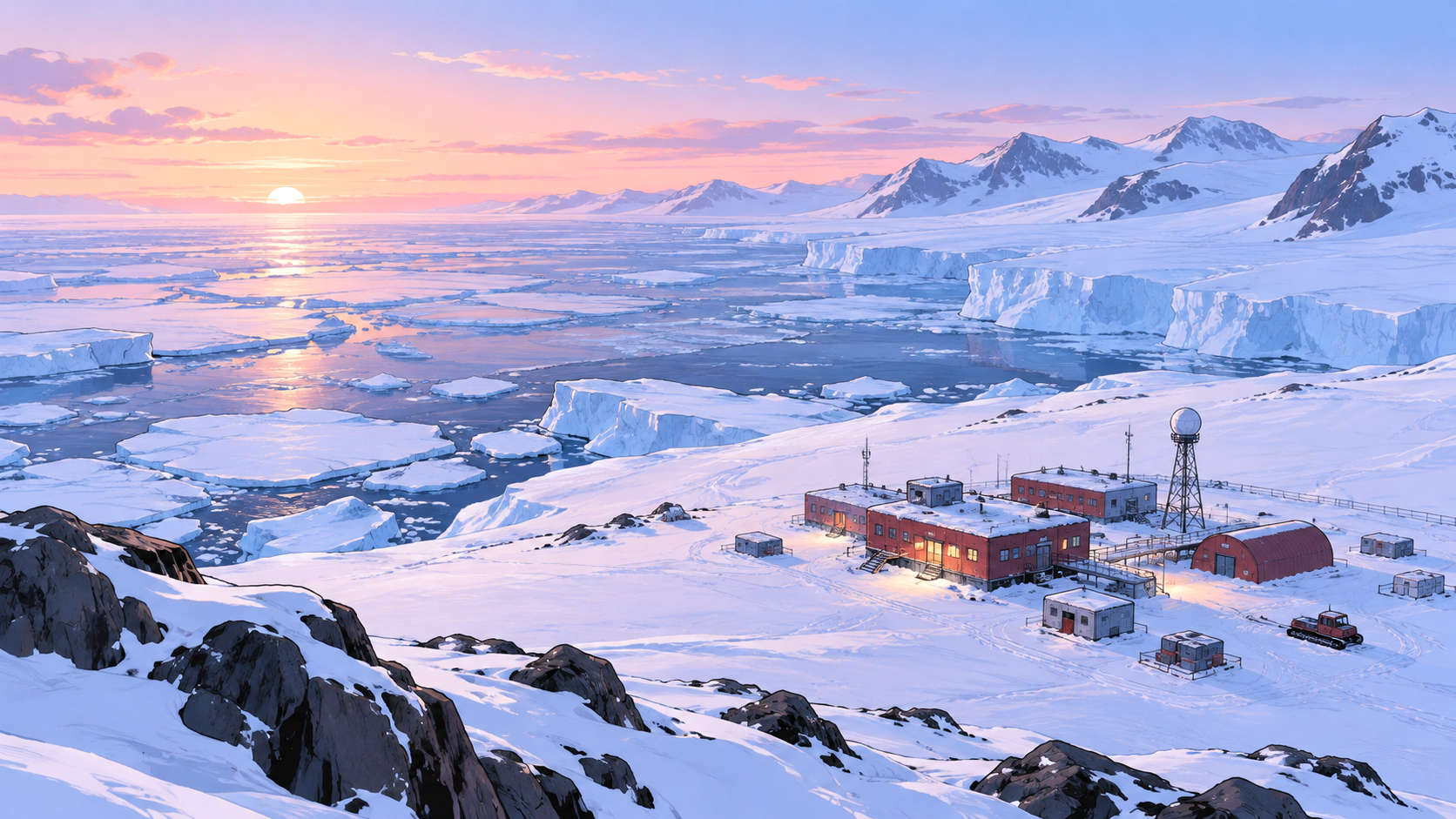
Antarctica has no established native, free-living cockroach populations, making it the clearest example of a continent without wild cockroaches. Other extremely cold, ice-covered, or environmentally isolated locations may also lack resident populations, although confirming that an entire island or region contains none is more difficult.
Cockroaches are found on every continent except Antarctica, but they are not distributed evenly across the planet. Tropical and subtropical regions support particularly diverse populations, while extreme cold, permanent ice, limited vegetation, and geographic isolation restrict where they can establish themselves. There is also a difference between a place without native cockroaches and one where cockroaches cannot appear at all.
Species transported inside heated buildings may survive in locations that would otherwise be unsuitable for them outdoors.
Antarctica Is the Clearest Example of a Cockroach-Free Continent
Antarctica’s extreme climate prevents cockroaches from establishing natural populations across its ice-covered landscape. The continent has limited ice-free ground, prolonged freezing conditions, and very few of the terrestrial habitats that support cockroaches elsewhere.
The British Antarctic Survey’s account of Antarctic land animals explains that the continental interior lacks higher insects and that its terrestrial animal communities are dominated by organisms such as nematodes and microscopic arthropods. Even in the less severe coastal environments, native insect diversity remains exceptionally limited.
Cockroaches need suitable conditions for feeding, growth, and reproduction. Antarctica does not provide the combination of accessible shelter, resources, and sustained temperatures required by the familiar wild species found on other continents.
However, Antarctica’s surrounding islands and research facilities introduce an important complication.
Scientists have documented insects accidentally transported into Antarctic environments through human activities. The British Antarctic Survey’s dataset of non-native species introductions records introduced organisms across the Antarctic region, including species associated with human infrastructure.
A historical example involved German cockroaches surviving around active whaling stations on South Georgia, a subantarctic island. A 2006 scientific review of introduced Antarctic organisms reported that these cockroaches disappeared after the stations were abandoned.
South Georgia is not part of mainland Antarctica, but the example demonstrates how human-created environments can temporarily support insects outside their normal climatic range.
There is no basis for describing Antarctica as a continent with established wild cockroach populations simply because insects can occasionally be transported into polar facilities.
Can Cockroaches Live in the Arctic?
The Arctic is not uniformly free of cockroaches, although its coldest environments are unsuitable for most species.
Northern regions include several distinct habitats, from relatively mild coastal settlements and boreal forests to tundra, glaciers, and permanently frozen ground. These environments cannot be treated as biologically identical.
Cockroach diversity generally declines toward colder latitudes, particularly where temperatures remain too low for successful outdoor reproduction. However, the geographic boundary varies among species.
German cockroaches illustrate how human infrastructure changes the picture. They are strongly associated with heated buildings and have been introduced far beyond their original geographic range. The University of Michigan’s Animal Diversity Web account identifies cold temperatures as a major limitation on their distribution while describing their widespread establishment in human environments.
A northern settlement may therefore have occasional or established indoor pest populations despite lacking suitable outdoor conditions for those same insects.
The different cockroach species encountered around buildings have substantially different environmental requirements. A species capable of surviving in a heated apartment is not necessarily capable of reproducing in the surrounding tundra.
What About Iceland and Greenland?
Iceland and Greenland are often mentioned as places without cockroaches, but describing either as absolutely cockroach-free is misleading.
Iceland’s cool climate and geographic isolation limit opportunities for many terrestrial insects to establish wild populations. Nevertheless, accidental introductions occur through international transportation and imported goods.
The Icelandic Institute of Natural History explains that non-native invertebrates regularly arrive in the country, particularly through human activities. Some survive only temporarily, while others establish populations.
Cockroaches have also been documented in Icelandic buildings. In 2006, Icelandic reporting described cockroaches associated with imported goods at the former U.S. naval base in Keflavík. Their presence did not establish that Iceland supported widespread wild cockroach populations.
Greenland presents similar climatic limitations, with extensive ice cover, Arctic tundra, and relatively few suitable natural habitats. Its remoteness makes permanent outdoor establishment difficult for typical pest cockroaches.
However, the absence of widespread wild populations cannot guarantee that an insect will never arrive in a heated building through transported materials. Neither location should be advertised as completely immune to cockroach introductions.
Can Cockroaches Survive in Deserts?
Deserts are not automatically cockroach-free. Some cockroach species are specifically adapted to dry landscapes, including sandy and sparsely vegetated environments.
Desert-adapted cockroaches may spend much of their time underground or beneath protected surfaces, where temperature and moisture conditions differ from those of exposed ground. Their survival depends on finding suitable microhabitats rather than tolerating every condition present in an open desert.
The Australian Museum’s description of native cockroaches documents their occupation of diverse terrestrial habitats, including underground environments and protected areas beneath vegetation and debris.
Australia’s arid and semiarid regions contain native cockroaches, demonstrating that a dry climate alone cannot establish their absence.
Their distribution also depends on available resources. A bare expanse of shifting sand may support fewer species than nearby rocky ground, vegetated drainage channels, or protected burrows.
Cockroaches are capable of surviving under difficult conditions, but the length of time they can live without water is limited and varies with species and environmental conditions.
Extreme aridity therefore restricts populations without necessarily excluding all cockroaches from an entire desert.
Are High Mountains and Caves Cockroach-Free?
High elevations can impose climatic barriers similar to those found at northern latitudes. Freezing temperatures, limited vegetation, and short periods suitable for reproduction reduce the number of cockroach species capable of occupying exposed alpine environments.
A high mountain is not uniformly unsuitable, however. Lower forested slopes, sheltered valleys, and warmer rock crevices may support insects absent from the summit.
Caves demonstrate why location alone is an unreliable predictor. Although some underground environments appear inhospitable, specialized cockroaches can inhabit caves where organic material and suitable environmental conditions are available.
The Australian Museum’s identification guide describes cave-dwelling cockroaches with reduced eyes or no eyes, reflecting adaptation to environments without ordinary daylight.
The same mountain range can therefore contain cockroaches in its lower forests or caves while having none on exposed, permanently frozen peaks.
Are There Islands With No Cockroaches?
Some small, remote islands may lack native cockroach populations, especially when they offer limited freshwater, vegetation, or suitable shelter. Geographic isolation can also make natural colonization difficult.
However, isolation does not guarantee absence. Cockroaches have reached islands through natural dispersal as well as human transportation.
A phylogenomic investigation of global cockroach distribution found evidence that dispersal across oceans helped establish lineages in geographically separated regions, including Australia, Madagascar, Africa, and parts of Southeast Asia.
Even an island without native cockroaches may acquire introduced populations if transported insects encounter favorable conditions.
This is particularly relevant to inhabited islands with ports, airports, warehouses, and heated buildings. The ability of cockroaches to enter otherwise clean homes illustrates why local housekeeping or geographic remoteness cannot guarantee complete exclusion.
A credible claim that an island has no cockroaches should specify whether it means no native species, no established wild populations, or no recorded individuals.
Which Parts of the World Have the Most Cockroaches?
Cockroach species richness is generally greatest in warm regions with diverse vegetation, suitable moisture, and plentiful protected habitats.
Tropical forests in South America, Central Africa, Southeast Asia, and Oceania support numerous native species. Many occupy leaf litter, rotting wood, tree canopies, and other natural environments rather than buildings.
The Australian Museum reports approximately 450 cockroach species in Australia, with relatively few considered household pests. Such diversity illustrates why cockroach distribution cannot be judged solely by how frequently people encounter insects in kitchens.
A tropical forest may contain many wild species while having comparatively little human-associated cockroach activity. Conversely, a cold city can support a persistent German cockroach population inside buildings despite having relatively few suitable wild habitats.
The seasonal behavior of household cockroaches also differs from the broader geographic distribution of wild species. A temporary decline in sightings during cold weather does not establish that a region has no cockroaches.
Can Any Country Guarantee That It Has No Cockroaches?
No country can reasonably guarantee that cockroaches will never be found within its borders.
Geographic isolation, harsh temperatures, and strict biosecurity can substantially reduce introductions and establishment. However, international transportation provides opportunities for insects to arrive in cargo, equipment, and other materials.
The important categories are:
- No known native species: Cockroaches are not recognized as part of the area’s original fauna.
- No established outdoor populations: Cockroaches have not formed self-sustaining populations in natural habitats.
- Occasional introductions: Individual insects arrive but fail to establish lasting populations.
- Indoor establishment: Cockroaches survive and reproduce in suitable human-maintained environments despite an unfavorable outdoor climate.
These situations describe different biological realities. An insect discovered in a warehouse does not establish that the surrounding landscape supports cockroaches, just as the absence of recorded outdoor populations does not guarantee pest-free buildings.
The geographic limits affecting cockroach survival also cannot be reduced to food availability alone. Temperature, moisture, species characteristics, and protected shelter all influence whether a population can persist.
For someone seeking a place without wild cockroaches, Antarctica offers the clearest continental example. For someone seeking a home where cockroaches are impossible, geography alone cannot provide that certainty.