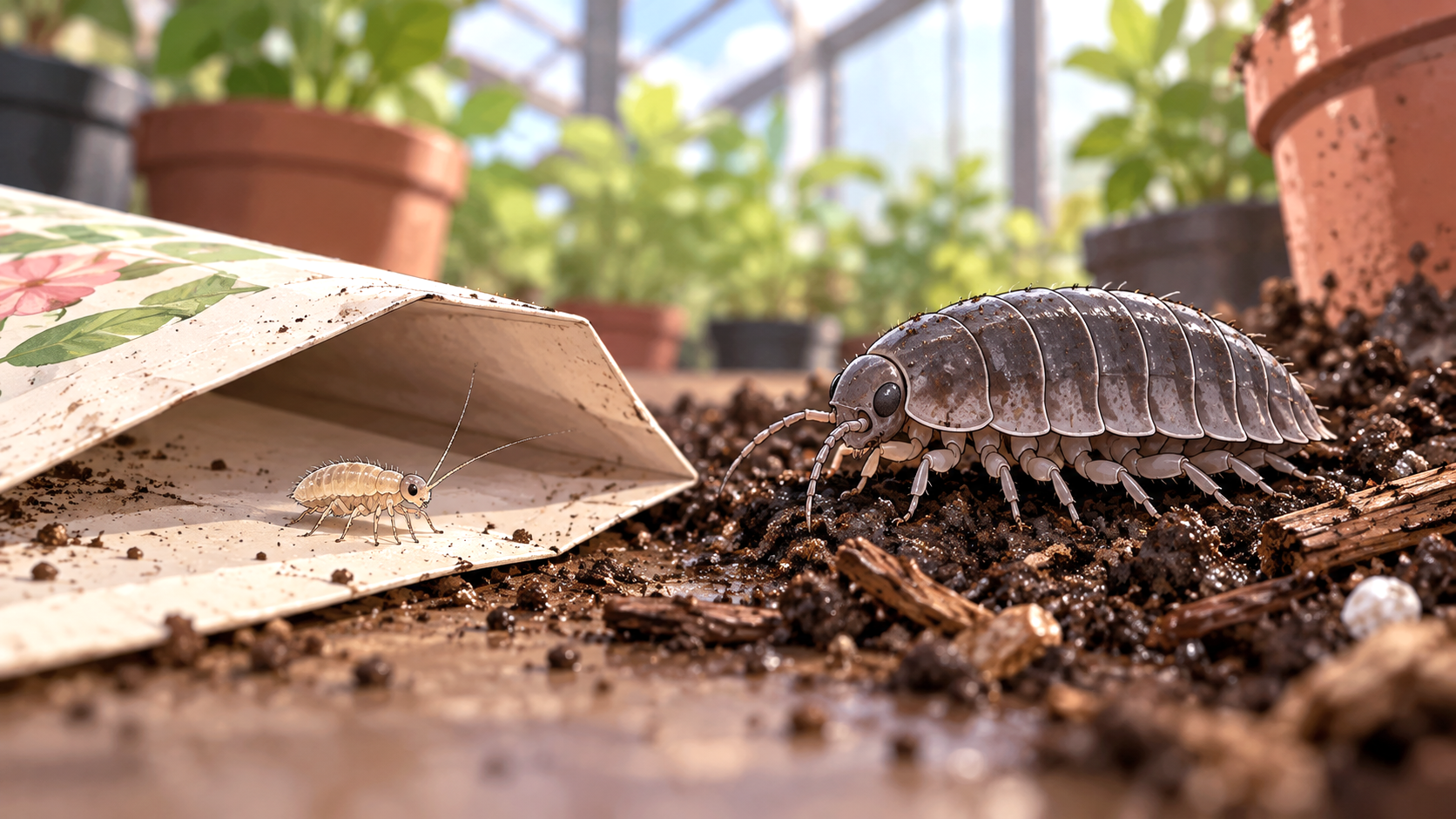
Booklice and woodlice are not closely related pests. Booklice are tiny six-legged insects, while woodlice are terrestrial crustaceans with seven pairs of legs and a hard, segmented body. Woodlice are also much larger. The shared “lice” ending in their common names reflects naming tradition, not biology.
Counting the Legs Gives You an Immediate Answer
Booklice have six legs because they are insects. Their bodies consist of the usual insect regions, and common indoor species also have long threadlike antennae and a disproportionately broad head. The characteristic appearance of household booklice becomes easiest to see under magnification because many specimens are barely more than a moving speck.
Woodlice have 14 walking legs, arranged as seven pairs. They belong to the terrestrial isopods, a crustacean group rather than an insect order. Utah State describes sowbugs and pillbugs as soil-dwelling crustaceans with seven pairs of legs and segmented armor, making their body plan fundamentally different from that of booklice.
That difference remains reliable across life stages. Young woodlice emerge looking like smaller versions of adults and acquire the full complement of visible body segments as they mature. A clearly segmented animal with many more than six legs cannot be a booklouse.
Their Size Difference Is Usually Obvious Without Magnification
Common indoor booklice are often only about 1 to 2 millimeters long, and some stored-product psocids measure 1 millimeter or less. Canadian grain identification material describes booklice as minute, soft-bodied insects with long antennae. Their tiny dimensions explain why booklice may be visible only as moving dots from normal viewing distance.
Woodlice are far larger. Many common terrestrial isopods reach roughly 5 to 20 millimeters, while some sowbugs and pillbugs reach 12 to 25 millimeters depending on species. Penn State describes terrestrial isopods as small but readily visible animals with hard segmented shells. Even a modestly sized woodlouse is therefore several times longer and dramatically heavier-bodied than a typical indoor booklouse.
A phone photograph can hide that difference if each animal fills the entire frame. Including a ruler, coin, or another fixed scale prevents a magnified booklouse from appearing artificially comparable in size to a woodlouse.
One Is Soft-Bodied; the Other Looks Armored
A booklouse has a delicate appearance. Common indoor forms are soft-bodied, lightly built, and often pale, gray, tan, brown, or nearly translucent. Their long antennae can be almost as visually prominent as the body itself.
Woodlice have overlapping dorsal plates that create an armored look. Their body is broad, oval, and divided into obvious segments, commonly in gray, slate, brown, or darker tones. Some species, especially pillbugs in the family Armadillidiidae, can roll into a tight ball when disturbed. Penn State notes that only certain terrestrial isopods are capable of this defensive curling behavior, so an animal that cannot roll up can still be a woodlouse.
Booklice do not curl into balls. They also lack the rigid plates and strongly segmented appearance of isopods. When those structural differences are visible, color becomes almost irrelevant.
Both Like Damp Places, but They Use Moisture Differently
Moisture is one reason the two can occasionally be found in the same general part of a building. Indoor booklice depend strongly on humid conditions. Dampness helps them maintain water balance and supports the microscopic fungi and molds that form an important part of their diet. Canadian conservation guidance treats psocids as a useful warning sign of excessive dampness, while the underlying reason booklice depend so heavily on humidity explains why populations often collapse when an indoor space stays dry.
Woodlice also require moist conditions, but their biology is tied to their crustacean ancestry. Terrestrial isopods lose water readily and favor cool, shaded, damp places such as beneath logs, stones, mulch, leaf litter, flowerpots, and decaying wood. Penn State describes them as moisture-dependent animals commonly found in cool, protected outdoor habitats.
Indoors, woodlice often indicate that individuals have wandered in from a damp exterior area, crawlspace, basement edge, or foundation perimeter. Booklice can establish much more discreet populations inside cupboards, cardboard storage, bookshelves, wall voids, and other humid indoor microhabitats.
What They Eat Explains Where You Find Them
Booklice feed primarily on microscopic molds, fungi, fungal spores, and suitable starchy or organic material. Stored-food species may also exploit broken grain and exposed food material. Their broader booklice diet fits the small-scale environments in which they occur, including damp paper, cardboard, packaged foods, and surfaces carrying microscopic fungal growth.
Woodlice are decomposers. They feed largely on dead and decaying plant material and other organic debris, contributing to nutrient recycling outdoors. They are therefore much more at home beneath rotting wood, fallen leaves, compost, mulch, and similar material than inside a book binding or cupboard.
Neither animal normally treats people or pets as food. Booklice are not blood-feeding lice, and woodlice are not parasitic at all. Their common names can sound alarming, but the biology behind each is far removed from human lice.
A Bathroom Sighting Can Still Be Misleading
A damp bathroom can potentially produce sightings of either organism, but the pattern usually differs. Booklice may appear as numerous tiny specks on walls, around windows, inside cupboards, or near condensation because a concealed humid area supports a breeding population. The usual signs of an established booklice problem tend to involve repeated sightings around moisture-affected materials rather than one large wandering individual.
Woodlice are more likely to appear as isolated, easily visible animals moving across a floor, especially in ground-level rooms or basements. Their presence may point toward damp exterior conditions, foundation gaps, or moisture immediately around the structure. They are not small enough to resemble a dust-like infestation spread across a wall.
A room being damp therefore does not identify the pest. Body size, leg count, segmentation, and the number of animals present provide much stronger evidence.
Other Questions About Booklice and Woodlice
Are pillbugs a type of woodlouse?
Yes. Pillbugs are terrestrial isopods commonly grouped under the broad name woodlice. They are distinguished from many sowbugs by their ability to roll into a ball when disturbed.
Can woodlice climb walls like booklice?
Woodlice can climb some rough surfaces, but they are primarily ground-associated animals. Tiny booklice can move across walls, shelves, cupboards, and other vertical surfaces more inconspicuously because of their much smaller size.
Do woodlice infest books?
No. Woodlice are not book pests. Finding one beside a bookshelf would usually indicate a wandering moisture-loving isopod rather than an organism living within the books.
Can booklice roll into a ball?
No. A small animal that curls into a compact armored ball is consistent with a pillbug or another roll-forming isopod, not a booklouse.
Can both live in the same damp basement?
Yes. A damp basement could support booklice around mold-prone stored materials while also allowing woodlice to enter from wet exterior soil or foundation areas. If several small arthropods appear together, each specimen should be identified separately rather than assuming they belong to one species.