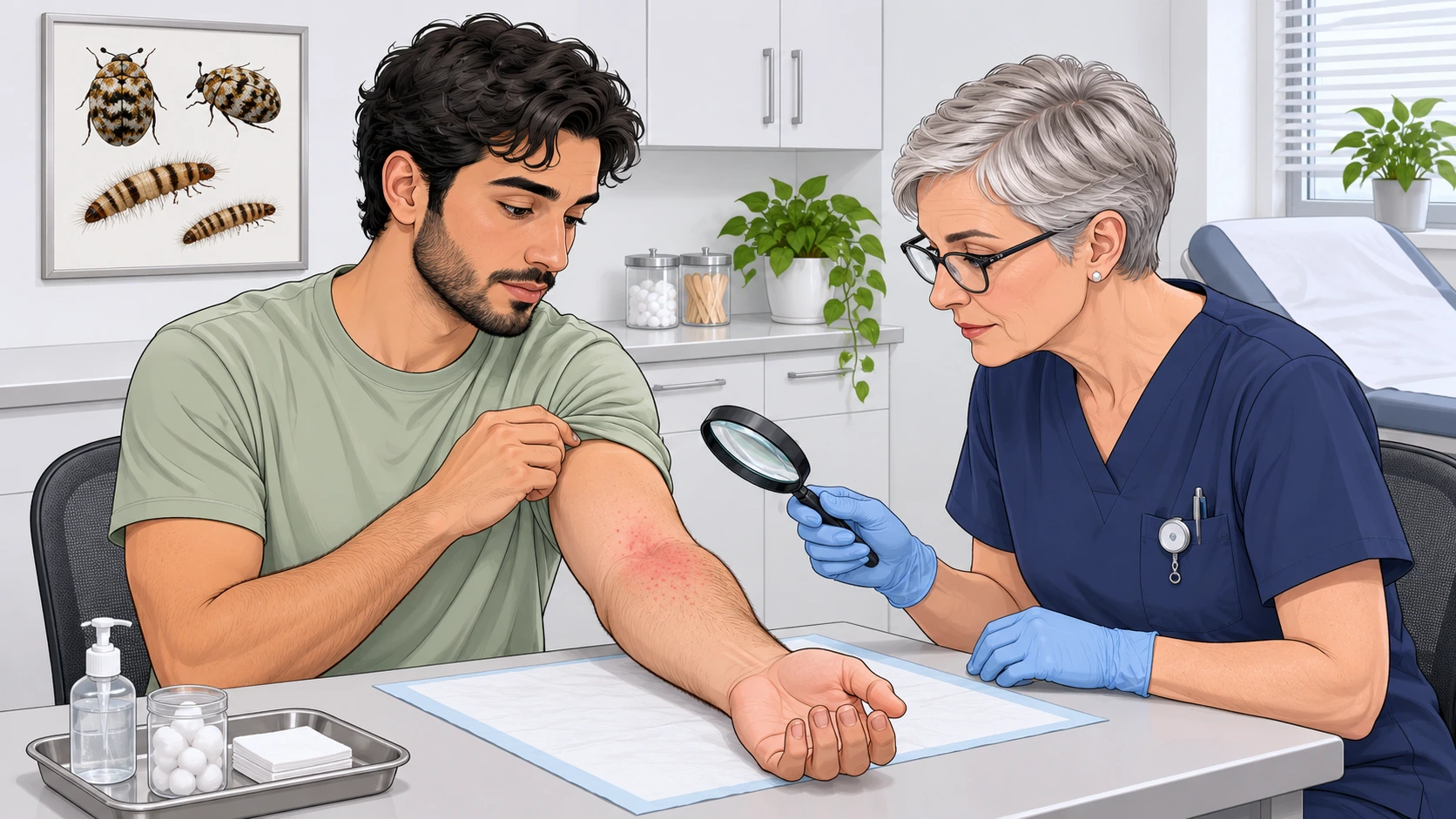
Carpet beetles can cause allergic reactions in susceptible people. The best-documented reactions involve contact with microscopic hairs from carpet beetle larvae, which can trigger itchy skin inflammation. Medical reports also describe eye irritation, nasal symptoms, and occasional asthma associated with dermestid beetle exposure, although respiratory reactions are much less extensively documented than skin reactions.
The major thing you need to know is that carpet beetles do not bite or feed on people. Their larvae can release specialized hairs into the surrounding environment, and some individuals develop hypersensitivity reactions after coming into contact with those hairs. The adult beetles commonly found on windowsills are not the principal source of these reactions.
Not everyone exposed to carpet beetles becomes allergic. Some households contain the insects without anyone developing noticeable symptoms, while other households have one affected person and several unaffected occupants.
If someone develops difficulty breathing, significant wheezing, swelling of the tongue or throat, or faintness, seek emergency medical care immediately. These symptoms can indicate a serious reaction or another urgent medical condition. They should not be assumed to have been caused by carpet beetles simply because the insects are present.
What Kind of Allergic Reactions Can Carpet Beetles Cause?
Documented reactions associated with carpet beetles range from localized skin inflammation to less commonly reported respiratory symptoms.
The strongest clinical evidence concerns dermatitis caused by larval hairs. Other medical publications describe eye and airway involvement, including rhinoconjunctivitis and asthma, but the available evidence does not establish that these are common consequences of ordinary household carpet beetle exposure.
A 2024 dermatology review describes both immediate and delayed hypersensitivity associated with dermestid larval hairs. It also identifies respiratory manifestations as possible consequences of exposure.
The different manifestations should not be treated as equally likely or equally well established.
| Possible reaction | What has been documented | Important limitation |
|---|---|---|
| Allergic or hypersensitivity-related dermatitis | Itchy skin inflammation associated with larval hairs | The appearance is not unique to carpet beetles |
| Immediate skin reactions | Rapid hypersensitivity responses in some susceptible individuals | Not everyone reacts, and timing alone cannot establish the cause |
| Delayed contact reactions | Inflammation appearing after an interval following exposure | Sensitization and individual immune response affect the outcome |
| Eye and nasal irritation | Reports of irritation or rhinoconjunctivitis associated with dermestid exposure | Other indoor allergens and irritants can produce the same symptoms |
| Asthma-related symptoms | Published case reports and reviews describing respiratory allergy | Evidence is limited; carpet beetles are not a routine explanation for asthma |
| Anaphylaxis | Not established as a characteristic response to common household carpet beetle exposure in the sources reviewed | A suspected severe systemic reaction requires emergency care regardless of its cause |
This comparison reflects the published evidence, not a prediction of what will happen in a particular household. The presence of carpet beetles cannot determine whether a person has become sensitized or whether their symptoms are related to the insects.
Why Carpet Beetle Larvae Can Trigger Allergies
Certain carpet beetle larvae have specialized body hairs called hastisetae. These hairs are particularly associated with larvae in the genus Anthrenus, which includes the varied carpet beetle.
Hastisetae are extremely fine, with structures that can catch on other materials. Some have spear-shaped or barbed tips that allow them to become lodged against skin or mucous membranes.
The hairs can detach from larvae and remain among fabrics, household dust, or other materials in which the insects have developed.
In susceptible people, contact may produce inflammation through an allergic or hypersensitivity response. Physical irritation from the hair structures may also contribute to the experience.
This does not mean all carpet beetle hairs are identical or that every dermestid species produces the same level of exposure.
The hairs are different from a bite
A carpet beetle larva has chewing mouthparts used for feeding on suitable organic materials. It does not use those mouthparts to obtain blood from living people.
The skin reaction is associated with irritating larval hairs, which may remain in contact with skin after the insect itself has moved away.
This distinction explains why a person might report being bitten without ever observing a biting insect. A fine hair can be present even when the larva is no longer visible.
The biological difference between larval feeding and human biting is important because the sensation of itching does not establish that an insect punctured the skin.
Detached hairs can remain in the environment
Living larvae are not the only possible source of exposure.
Carpet beetle larvae shed their outer skins repeatedly as they grow. These discarded skins can retain hairs, and additional detached hairs may remain in fabrics or surrounding debris.
Consequently, a person could encounter irritating material without seeing a live larva at the point of contact.
A 2021 clinical investigation documented hypersensitivity reactions involving fine hairs from Anthrenus larvae. Microscopic examination showed hair structures that could lodge against skin or respiratory mucosa.
The finding explains a plausible exposure mechanism. It does not mean every carpet beetle infestation releases enough hairs to cause respiratory or skin symptoms.
Can You Become Allergic to Carpet Beetles After Repeated Exposure?
Sensitization is one explanation for why a person may begin reacting to an exposure they previously tolerated.
In allergic disease, sensitization means the immune system has developed a specific response to a substance. A later exposure may then produce symptoms.
Carpet beetle-associated hypersensitivity can involve more than one immune mechanism. Some reported cases are consistent with delayed, T-cell-mediated contact allergy, while other observations support immediate hypersensitivity mechanisms.
Delayed allergic contact dermatitis typically requires prior sensitization. Once a person has become sensitized, inflammation may develop after subsequent exposure rather than appearing immediately.
The mechanism of delayed allergic contact dermatitis commonly involves symptoms developing within approximately 24 to 72 hours after contact. That is a general clinical description of delayed contact allergy, not a proven timing rule for every carpet beetle reaction.
Carpet beetle-specific observations also do not support a fixed number of exposures needed for sensitization.
Does it take years to develop a reaction?
Some clinical descriptions suggest that prolonged exposure may be relevant to the development of carpet beetle hypersensitivity. Earlier case reports have included people who became symptomatic after extended contact with larval material.
However, there is no established universal period of months or years after which someone becomes allergic.
A person reporting symptoms soon after discovering carpet beetles cannot use that timing to confirm or exclude an allergy. The actual duration of exposure may also be unknown because larvae and their hairs can remain concealed.
The important conclusion is that sensitization varies among people, and the published evidence is insufficient to predict when a particular individual might develop symptoms.
Can Carpet Beetles Cause Respiratory Allergies or Asthma?
Respiratory reactions associated with dermestid beetles have been reported, but the evidence is more limited than the evidence for contact dermatitis.
Fine larval hairs may become dispersed into the surrounding environment and potentially reach the nose, eyes, or respiratory tract. Some reports describe irritation or hypersensitivity involving these tissues.
A 1997 case report published in the Journal of Allergy and Clinical Immunology described asthma associated with a black carpet beetle allergen in house dust. This provides evidence that respiratory sensitization to dermestid material is possible.
It does not establish that carpet beetles commonly cause asthma, that all affected homes contain airborne allergens at clinically important levels, or that an asthma episode can be attributed to them without investigation.
Many other exposures can contribute to respiratory symptoms, including dust mites, pollen, mold, animal allergens, irritants, and respiratory infections.
Sneezing and nasal irritation
Nasal irritation and rhinoconjunctivitis have been described in association with dermestid exposure.
These symptoms may involve sneezing, nasal discomfort, or irritation of the eyes and nose.
However, such symptoms are highly nonspecific. Finding carpet beetles indoors does not establish that larval hairs are responsible for sneezing or congestion.
A person who repeatedly develops nasal symptoms in a particular room may have several possible environmental triggers. Identifying carpet beetles is only one piece of information, not proof of an allergic cause.
Wheezing and breathing difficulties
Wheezing, cough, or chest tightness warrants more careful attention than a minor localized skin complaint.
A person with known asthma may experience symptoms from several different triggers, and carpet beetle involvement should not be presumed from the discovery of a beetle.
New, recurrent, or worsening respiratory symptoms deserve evaluation by a healthcare professional. Significant breathing difficulty requires emergency assessment.
The distinction is important because focusing on an unconfirmed pest explanation could delay recognition of another medical problem.
How Severe Can a Carpet Beetle Allergy Become?
The severity of a reaction cannot be predicted from the number of adult beetles seen in a room.
A few adults on a windowsill may have no meaningful relationship to larval-hair exposure. Conversely, irritating hairs may be present in fabrics even when no living insects are visible.
The symptoms experienced by a susceptible person also depend on factors that are not apparent from an ordinary pest inspection.
The most commonly documented clinical problem is localized dermatitis. Respiratory reactions have been described, including asthma, but the available literature does not justify treating severe systemic allergy as an expected outcome of household carpet beetles.
A useful way to interpret symptoms is to separate their urgency from the certainty of the suspected trigger.
| Situation | Appropriate urgency | What can be concluded about carpet beetles |
|---|---|---|
| Mild localized itching without other concerning symptoms | Non-emergency assessment if symptoms persist or the cause is unclear | Carpet beetle hairs are one possible explanation |
| Recurrent skin inflammation associated with suspected larval material | Medical evaluation is reasonable | Exposure evidence may help, but does not confirm allergy |
| Persistent eye or nasal symptoms | Clinical assessment if recurrent or troublesome | Multiple indoor allergens and irritants remain possible |
| New or worsening wheezing | Prompt medical assessment; severe breathing symptoms require emergency care | Do not assume carpet beetles are the trigger |
| Tongue or throat swelling, difficulty breathing, faintness, or suspected anaphylaxis | Immediate emergency care | Identifying the allergen must not delay treatment |
A medical emergency remains a medical emergency even when its cause is unknown.
The recognized warning signs of anaphylaxis include serious breathing problems, throat swelling, dizziness, and loss of consciousness. These signs require immediate action rather than further investigation of household insects.
There is no basis for assuring someone that severe symptoms are harmless merely because carpet beetles are usually considered minor household pests.
Why Some People React and Others Do Not
People exposed to the same environment may have different immune responses.
One person may develop intense itching while another experiences little or no discomfort. Differences in sensitization and individual susceptibility can help explain this variation.
In the 2021 Anthrenus investigation, affected households sometimes included people without symptoms despite sharing the same living environment.
The researchers documented seven households and 11 patients with dermatitis. Their observations supported a relationship between the reactions and carpet beetle larval hairs, but the study was not designed to determine how common such reactions are across the general population.
That distinction matters. A clinical case series can establish that a reaction occurs without providing the percentage of exposed people who will develop it.
There is no reliable population-wide probability that a homeowner can apply to an individual carpet beetle sighting.
It would also be incorrect to assume that everyone who has itching in an affected household must share the same cause.
How Exposure Can Happen Without Seeing a Carpet Beetle
A person does not need to see a larva touching their skin for contact with larval material to be possible.
Hairs and shed skins may remain in textiles, upholstery, or debris associated with previous larval activity. Fine hairs can also become dispersed through environmental disturbance or air movement, although the extent of airborne exposure in a particular home cannot be determined from a few beetle sightings.
A folded garment containing old cast skins presents a more direct potential contact route than an adult beetle on a distant windowsill.
Similarly, a heavily used upholstered item containing confirmed larvae may deserve consideration when a person repeatedly experiences symptoms after contact with it.
Still, association is not causation. A person may be exposed to detergents, fragrances, dust mites, or other irritants through the same fabrics.
The presence of an adult beetle by itself is particularly weak evidence of exposure to irritating hairs.
Our guide to what finding one carpet beetle actually means distinguishes an incidental sighting from evidence of developing larvae. That distinction matters when evaluating whether a medically relevant exposure is even plausible.
Can Allergy Tests Confirm a Carpet Beetle Reaction?
Clinical evaluation can sometimes support suspected hypersensitivity to dermestid materials, but testing is more complicated than simply requesting a standard carpet beetle allergy test.
Published cases have involved skin testing and other allergy investigations. Those reports show that clinicians can investigate relevant immune responses, but they do not establish that a widely available, standardized carpet beetle test exists for routine diagnosis.
Testing methods may differ depending on the suspected mechanism. Immediate allergy and delayed contact allergy involve different immune pathways, and a test suited to one mechanism may not answer questions about the other.
For example, delayed contact dermatitis may be investigated with patch testing when clinically appropriate, while immediate hypersensitivity is assessed through a different diagnostic framework.
A positive sensitization result also needs to be interpreted in the context of actual symptoms and exposure. Detecting an immune response to a substance does not automatically prove that it caused every reported symptom.
There is no reliable home test that can diagnose carpet beetle allergy by counting insects or examining an unexplained rash.
If the connection remains uncertain, a dermatologist or allergist can determine whether further evaluation is appropriate.
How to Tell Whether Carpet Beetles Are a Plausible Trigger
The most useful evidence connects symptoms with a credible source of larval material rather than simply confirming that adult beetles are present.
For example, correctly identified larvae and cast skins within a garment that repeatedly contacts the affected skin provide a more plausible exposure history than one adult beetle resting on a window.
The following distinctions help keep the interpretation proportionate.
A person with unexplained itching and no identified insects has an undetermined cause. A person with an adult carpet beetle on a windowsill has evidence of the insect’s presence, but not necessarily evidence of exposure to larval hairs. A person with confirmed larvae in a frequently used textile has a more plausible contact route, although the medical cause still requires evaluation.
The same principle applies to respiratory complaints. An insect specimen can help establish that carpet beetles occupy the environment, but it cannot prove that their hairs or allergens are responsible for wheezing.
When investigating a possible connection, preserve clear photographs or an insect specimen and describe the actual exposure circumstances to the healthcare professional.
A reliable home inspection for carpet beetles can help identify environmental evidence, but it should not be treated as a substitute for allergy testing or medical evaluation.
What If You Suspect a Carpet Beetle Allergy?
If symptoms are mild and there is credible evidence of carpet beetle larvae in affected belongings, reducing contact with that material is a reasonable precaution while the cause is assessed.
The immediate goal is not to declare every symptom a carpet beetle allergy. It is to avoid unnecessary exposure to suspected material and obtain appropriate evaluation when symptoms persist.
Photographs or preserved insect specimens can help confirm whether carpet beetles are present. A clinician can then consider those findings alongside the person’s symptoms and other possible exposures.
For people with ongoing or recurrent skin complaints, the clinical appearance of carpet beetle-associated dermatitis is relevant background, but visual similarity alone does not establish the diagnosis.
Avoid indiscriminate pesticide application, especially on bedding, clothing, or other items that contact the skin. Chemicals used unnecessarily can introduce additional irritants and may not address an incorrectly identified source.
The response to a suspected carpet beetle skin reaction should account for symptom severity, medical uncertainty, and the actual evidence of insect exposure.
If symptoms are escalating, especially when breathing is affected, medical care takes priority over any household pest investigation.
Common Questions About Carpet Beetle Allergies
Can you suddenly develop an allergy to carpet beetles?
A person may develop symptoms after previous exposures that did not cause a noticeable reaction. Sensitization can help explain this, but the evidence does not establish a predictable exposure period or prove that suddenly appearing symptoms are caused by carpet beetles.
Can carpet beetles cause an allergic reaction without biting?
They can. Reactions associated with carpet beetles are linked primarily to larval hairs rather than bites. A bite is not required for an immune response to occur.
Can carpet beetle allergies affect your eyes?
Eye irritation and rhinoconjunctivitis have been described in medical literature involving dermestid exposure. Those symptoms are nonspecific, so an eye complaint should not be attributed to carpet beetles without considering other possible causes.
Can carpet beetles trigger asthma?
Published case reports associate dermestid allergens with asthma, establishing that respiratory sensitization is possible. The evidence does not show that carpet beetles are a common asthma trigger, and a person’s breathing symptoms require clinical evaluation.
Does everyone exposed to carpet beetle larvae develop an allergy?
No. Documented households have included both symptomatic and unaffected individuals. Exposure does not guarantee sensitization or a noticeable reaction.
Can carpet beetle allergy be diagnosed with a blood test?
Specialized investigations involving immune responses to dermestid material have been described, but there is no established universally available blood test that independently confirms carpet beetle allergy in ordinary clinical practice. Test selection and interpretation belong with a qualified clinician.
Can carpet beetle hairs remain irritating after the larvae die?
Potentially. Detached hairs and discarded larval skins can remain in the environment after a living larva is no longer present. Their presence may support a possible exposure route, but does not prove that they are causing current symptoms.
The Bottom Line
Carpet beetle larvae can trigger hypersensitivity reactions, with contact dermatitis being the most clearly documented manifestation. Less commonly, medical literature describes eye, nasal, and respiratory involvement, including asthma associated with dermestid allergens.
The presence of carpet beetles does not establish that a person is allergic to them. Sensitization varies, exposure may be difficult to confirm, and the symptoms overlap with many unrelated conditions.
The evidence is strongest when a medically compatible reaction is supported by confirmed exposure to larval material. Severe respiratory or systemic symptoms require immediate medical attention regardless of whether carpet beetles are suspected.