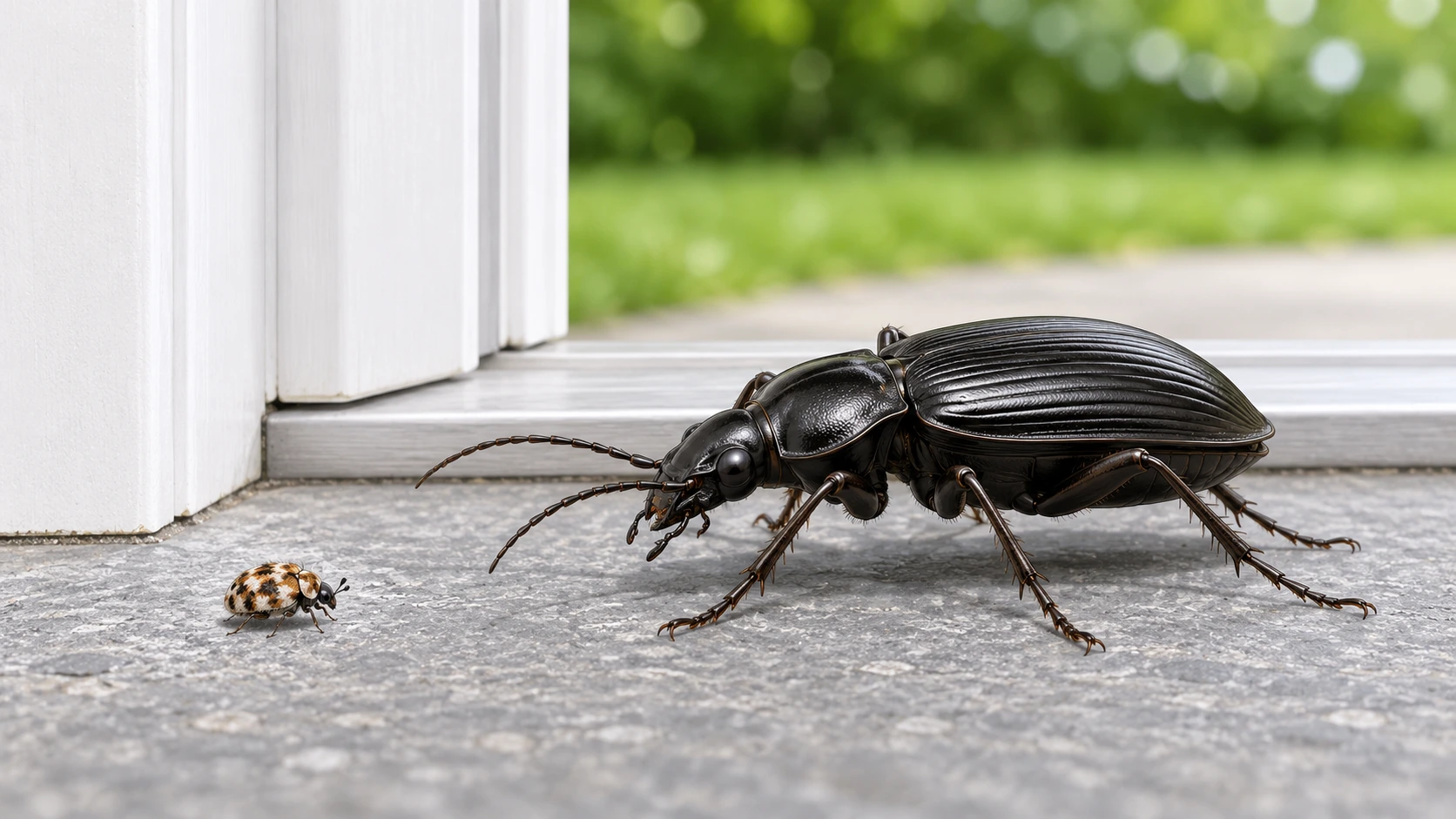
The main difference between a carpet beetle and a ground beetle is body structure. Carpet beetles are typically small, compact insects with rounded or oval bodies and relatively short legs and antennae. Ground beetles usually have flatter, more elongated bodies, prominent heads, longer legs, and slender antennae that are easier to see.
The confusion is most likely when someone finds a small black beetle inside a house. Black carpet beetles can resemble miniature ground beetles, particularly when the insect is moving quickly or the lighting makes its body shape difficult to see. Both groups have hardened wing covers, and some ground beetles are small enough to overlap with carpet beetles in size.
Ground beetles are also a large and diverse family, not a single species with one appearance. Some are small and dark, others are large and metallic, and their body proportions vary. The useful comparison is therefore between common household carpet beetles and the types of ground beetles a homeowner might realistically encounter indoors.
Carpet Beetle vs. Ground Beetle at a Glance
Several features can help narrow the identification before you attempt to determine the exact species.
| Feature | Carpet beetles | Ground beetles |
|---|---|---|
| Beetle family | Dermestidae | Carabidae |
| Typical adult size | Common household species approximately 2–6 mm | Many approximately 3–13 mm, but the family ranges from about 2 mm to over 35 mm |
| Overall shape | Compact, convex, rounded or oval | Often elongated, relatively flattened, with a distinct head and thorax |
| Color | Mottled, brown, dark brown, or black | Often black or brown, sometimes metallic green, blue, bronze, or other colors |
| Legs | Usually short relative to the body | Often long, slender, and conspicuous |
| Antennae | Generally short, often clubbed | Usually longer and threadlike |
| Head | Small, often less conspicuous from above | Usually more exposed, with prominent jaws in many species |
| Movement | Typically crawl; adults can fly | Many run quickly; flight capability varies |
| Common indoor location | Windowsills, closets, rugs, upholstered furniture | Basement floors, garages, entryways, ground-level rooms |
| Main food association | Larvae feed on suitable organic materials, including animal-derived fibers | Many hunt insects and other invertebrates outdoors |
| Typical household consequence | Potential damage to textiles and stored materials | Usually an accidental indoor nuisance |
These differences are tendencies, not universal rules. Some ground beetles are exceptionally small, and a black carpet beetle may look more elongated than the familiar round, mottled carpet beetle.
A combination of body proportions, antennae, and leg length is more dependable than any single feature.
Why Small Ground Beetles Are Mistaken for Black Carpet Beetles
The strongest resemblance usually involves the black carpet beetle, Attagenus unicolor, rather than the distinctly patterned varied carpet beetle.
Adult black carpet beetles are approximately 3 to 5 millimeters long and have dark brown to black, elongated oval bodies. Their compact form and relatively uniform coloration make them resemble several other small household beetles.
The varied carpet beetle, Anthrenus verbasci, is generally smaller, around 2 to 3 millimeters long, and has a more rounded body decorated with irregular patches of white, brown, yellowish, and black scales.
Those markings often make a varied carpet beetle easier to recognize. However, its scales can wear away, leaving an older beetle darker and less distinctive.
The documented differences between black and varied carpet beetles help explain why identifying every carpet beetle as a tiny, spotted insect leads to mistakes.
Ground beetles present the opposite problem. The family Carabidae contains thousands of species worldwide, with substantial variation in size, color, and body shape. A small, dark species may initially resemble an elongated carpet beetle.
An adult ground beetle is generally recognizable by its more exposed head, longer legs, and a body with clearly differentiated sections. Many have a pronotum, the shieldlike structure immediately behind the head, that is narrower than the wing-covered abdomen.
When a beetle is viewed from directly above, that narrower middle section may make the body appear less continuously oval than a carpet beetle.
The shape is especially helpful when comparing an intact specimen with a black carpet beetle. Instead of relying on darkness or size, examine how the head, thorax, and abdomen fit together.
Ground Beetles Have More Prominent Legs and Antennae
Leg length is one of the most practical features for separating these insects.
Ground beetles are often active hunters or fast-moving ground dwellers. Many have long, slender legs that extend noticeably beyond the sides of the body. Their antennae are generally threadlike and project forward from the head.
Carpet beetles have a more compact appearance. Their legs are relatively short, and their antennae are usually small and clubbed, although their exact structure varies among species.
This difference may be visible in an ordinary photograph, even when the beetle’s color is unclear.
A ground beetle standing on a garage floor often appears to have a distinct head, a narrower thorax, and several long appendages surrounding the body. A black carpet beetle usually looks more like a compact, dark oval with comparatively inconspicuous legs.
The identifying structures of ground beetles include long legs, conspicuous jaws, and adaptations associated with moving across the ground.
There are limitations. Some ground beetles are stockier than others, and photographs can hide legs beneath the body. A beetle seen at an angle may appear shorter or rounder than it really is.
For this reason, a clear overhead image and a side view are often more useful than several photographs from the same position.
If the specimen is preserved, the antennae are worth examining under magnification. Threadlike antennae support ground beetle identification, while shorter, clubbed antennae are more consistent with common carpet beetles.
Neither observation should override contradictory anatomical evidence.
Body Shape and Wing Covers Provide Additional Clues
Adult carpet beetles tend to have convex bodies. Viewed from the side, the back often forms a smooth, rounded dome over the relatively short legs.
Ground beetles are commonly flatter and more elongated, with a broader exposed head and a more recognizable separation between the thorax and the wing covers.
Their hardened wing covers, called elytra, may have visible lengthwise grooves or ridges. Some species also display a metallic sheen that changes depending on the angle of the light.
Carpet beetles can have dark or shiny surfaces as well, but the familiar mottled species are covered in fine colored scales rather than the prominent lengthwise sculpturing seen on many ground beetles.
A black carpet beetle with worn surface hairs may appear almost glossy. Consequently, shininess by itself is not a useful identification test.
The shape of the pronotum can be more informative. In many ground beetles, it is visibly narrower than the combined wing covers and creates a distinct section between the exposed head and abdomen.
A carpet beetle generally has a more compact, continuous oval outline.
The distinction becomes less obvious with very small ground beetles, particularly those with unusually rounded bodies. When the structures are not clearly visible, a confident identification may require magnification or specialist assistance.
Do Ground Beetles Move Faster Than Carpet Beetles?
Movement can provide a useful supporting clue because many ground beetles run rapidly when disturbed.
A ground beetle discovered beneath a flowerpot, board, or garage storage box may immediately race toward the nearest dark space. Its relatively long legs help it cover ground quickly while pursuing prey or escaping danger.
Adult carpet beetles also walk and can move away when disturbed, but they generally do not display the same conspicuous, long-legged running style associated with many ground beetles.
This behavioral difference is well established in descriptions of ground beetles that enter homes and seek shelter.
Movement is still a weak basis for identification when used alone. A cold ground beetle may move slowly, while a disturbed carpet beetle may crawl briskly. The walking surface, temperature, light, and condition of the insect can all influence how it behaves.
Flight is not definitive either. Adult carpet beetles can fly, and many species are frequently observed near windows. Some ground beetles can fly, while others have reduced wings or rarely use them.
A beetle that runs quickly across the basement floor is worth examining for ground beetle features. However, it should not be identified as a carabid solely because it moved faster than expected.
Where Are Ground Beetles Most Likely to Enter a House?
Ground beetles normally live outdoors, where they occupy soil surfaces, leaf litter, gardens, lawns, fields, and sheltered spaces beneath logs or stones.
Many species are active at night and hide during daylight hours. Some are attracted to artificial lights, which can bring them close to doors, windows, and exterior walls.
A ground beetle discovered beside a garage door or in a basement may have entered through a small gap at ground level. The insect may then hide beneath boxes, furniture, or other objects until it is disturbed.
In North American homes, these encounters are often more noticeable during the warmer months, particularly in mid-to-late summer. Species, weather, and regional climate affect the timing.
A ground beetle in a basement does not necessarily mean the basement contains an infestation. It may simply have wandered inside while searching for shelter or moving along the exterior foundation.
Repeated sightings near one doorway can indicate an entry point rather than a breeding source.
A useful example is a homeowner who finds three dark beetles on the basement floor after leaving a ground-level door open on a warm evening. If the beetles have exposed heads, long legs, and threadlike antennae, outdoor ground beetles become a reasonable possibility.
The location and timing support the identification, but the physical characteristics remain the deciding evidence.
Where Are Carpet Beetles More Likely to Be Found?
Adult carpet beetles are frequently found near windows, curtains, and other sunlit areas. Some may have flown in from flowers outdoors, while others may have emerged from concealed larval development sites inside the building.
Carpet beetle larvae occupy a different range of locations. They often develop in protected areas containing suitable food, including wool clothing, natural-fiber carpets, upholstered furniture, lint accumulations, pet hair, feathers, and dead insects.
This separation between adults and larvae is important. A carpet beetle on a windowsill may be far from the material that supported its development.
The feeding habits and indoor locations of carpet beetle larvae explain why an apparently tidy room can still contain larvae beneath heavy furniture or in an undisturbed storage area.
A ground beetle does not normally create the same pattern of household textile infestation.
Suppose you find a black oval beetle near a wool rug. The location alone cannot establish that it is a carpet beetle or that the rug is damaged.
If you also find elongated, hairy carpet beetle larvae, shed skins, and damage to the wool fibers, the evidence becomes much stronger.
If the insect instead has long legs and a distinctly exposed head, and no textile-associated larvae are found, a ground beetle or another outdoor beetle may be responsible for the sighting.
The reasons adult carpet beetles appear around windows are different from the usual ground-level entry patterns of many outdoor beetles.
Can Ground Beetles Damage Carpets or Clothes?
Ground beetles are not recognized as ordinary household carpet or clothing pests.
Many feed on insects, insect larvae, and other small invertebrates. Some species consume seeds or other plant materials, so ground beetles should not be described as exclusively predatory.
Their usual diets do not involve feeding on wool sweaters, carpets, fur accessories, or stored household textiles.
Carpet beetle larvae, by contrast, are adapted to feeding on certain dried organic materials, including animal-derived fibers. This is the basis of their importance as household fabric pests.
Adult carpet beetles do not normally damage fabrics. The feeding damage occurs during the larval stage.
The difference between adult carpet beetles and their damaging larvae matters when someone finds an unfamiliar beetle beside a hole in a sweater.
A ground beetle wandering across a damaged rug is not evidence that it chewed the fibers. The hole may have been caused by carpet beetle larvae, clothes moth larvae, ordinary wear, or another source.
Likewise, a carpet beetle adult resting on a garment does not establish that larvae are feeding there.
If textile damage is present, investigate the material directly for larvae, cast skins, and recognizable feeding evidence rather than assigning responsibility to the nearest adult beetle.
Carpet Beetle Larvae and Ground Beetle Larvae Look Different
A comparison of the immature stages can resolve confusion when adults are not available.
Carpet beetle larvae are typically elongated and visibly hairy or bristly. Depending on the species, they may have brown bands, a tapered body, or a tuft of long hairs at the rear.
Ground beetle larvae have a different general body plan. They are often elongated, relatively flattened, and more visibly armored, with a distinct head and prominent jaws. Many have three pairs of well-developed legs and paired projections at the rear of the abdomen.
Their bodies do not normally have the dense, brushlike covering associated with familiar carpet beetle larvae.
These are broad family-level distinctions because ground beetle larvae vary considerably among species.
The most useful context is where the immature insect was discovered.
A bristly brown larva among stored wool and accumulated lint is consistent with a carpet beetle, particularly when matching shed skins are present.
An elongated, active larva with prominent legs and jaws beneath a damp outdoor stone is more suggestive of a predatory ground beetle or another soil-dwelling insect.
Finding a larva inside a home does not automatically place it in either family. Other beetles and household insects have elongated larvae, and a damaged specimen may lack the features needed for identification.
The recognizable features of carpet beetle larvae are particularly useful when distinguishing their hairy bodies from other immature insects.
Why Identifying a Ground Beetle Is Not the Same as Identifying One Species
Carabidae is a large beetle family containing many different genera and species. The term “ground beetle” does not describe one animal with a fixed body size, color, or behavior.
For example, ground beetles in the genus Pterostichus include dark, relatively flattened species that may occasionally enter buildings. Some Harpalus species are also dark and frequently associated with ground-level habitats.
Both groups include insects that may be encountered around homes, but not every member looks alike.
A beetle approximately 10 millimeters long with a dark, flattened body and long legs is more consistent with many typical ground beetles than with a common household carpet beetle.
A beetle only 3 millimeters long may require closer examination because it falls within the size range of carpet beetles and some small ground beetles.
Ground beetle coloration also varies. Although many species are black or brown, others have metallic green, blue, coppery, or multicolored surfaces.
Those brighter insects are generally less likely to be confused with a typical black carpet beetle. The dark, relatively small ground beetles create the more realistic identification challenge.
The presence of an elongated body and long legs can support a family-level identification, but identifying a particular ground beetle species may require examination of fine structural details.
For homeowners, a reliable identification to family level is often sufficient to determine whether the insect is likely to be a fabric pest or an accidental outdoor visitor.
A Practical Identification Check for Small Black Beetles
When you find a small black beetle on the floor, focus on four observations that can be made without specialized equipment.
First, examine its overall outline. A carpet beetle is usually compact and oval, sometimes with a smoothly rounded back. A ground beetle often has an elongated body with more distinct divisions between the head, thorax, and abdomen.
Next, look at the legs and antennae. Long, slender legs and threadlike antennae favor a ground beetle. Shorter legs and relatively compact, clubbed antennae favor a common carpet beetle.
Then compare the surface and shape. A seedlike, convex body is more suggestive of a carpet beetle, especially if small scales or mottled markings are visible. A flatter body with prominent jaws and visibly structured wing covers is more suggestive of a ground beetle.
Finally, consider where the insect appeared and whether other evidence is present. A long-legged dark beetle running across a garage floor is consistent with an outdoor ground beetle. A tiny beetle near stored wool, accompanied by bristly larvae and shed skins, points toward carpet beetles.
The following examples show how these clues work together.
| Observation | More likely identification | Important limitation |
|---|---|---|
| Tiny rounded beetle with white and brown mottling | Varied carpet beetle | Several small beetles have patterned bodies |
| Small black oval beetle with short legs | Black carpet beetle possible | Other small dark beetles may resemble it |
| Long-legged dark beetle with exposed head and threadlike antennae | Ground beetle | Identification to species may require magnification |
| Beetle running beneath boxes on a basement floor | Ground beetle possible | Movement and location alone are not conclusive |
| Beetle on a sunny window with no larvae or damaged material | Adult carpet beetle possible | An isolated visitor does not establish infestation |
| Bristly larvae and shed skins in wool or fur | Carpet beetle infestation possible | Confirm the larvae rather than relying on damage alone |
The strongest decisions are based on several matching features. When the insect contradicts the expected description, do not force it into either category.
What If the Beetle Is Too Small or Damaged to Identify?
Identification can be difficult when an insect is moving rapidly or when the photograph shows only a dark silhouette.
Capture the specimen carefully in a small clear container if possible. Taking a photograph against a plain background makes the body outline easier to see, especially if you include a ruler or another reliable scale reference.
An overhead photograph can show the head, thorax, and wing covers. A side view may reveal whether the beetle is compact and convex or relatively flattened.
Try to capture the antennae and legs clearly. These features are often more useful than a close-up of a uniformly black back.
If the insect is already dead, avoid crushing it further. Damaged antennae or missing legs may remove the features necessary to distinguish a small ground beetle from other beetles.
A local cooperative extension service or insect diagnostic laboratory may be able to identify a preserved specimen. This is particularly helpful when several different small beetles are appearing in the same building.
The broader range of bugs that resemble carpet beetles includes other dark household beetles, so an identification that does not fit either carpet beetles or ground beetles should remain open.
Does Finding a Ground Beetle Indoors Mean You Have an Infestation?
An isolated ground beetle indoors usually does not indicate that it is breeding in the home.
Most ground beetles live and reproduce outdoors, where soil, vegetation, prey, and suitable shelter support their development. Some occasionally wander indoors, especially around ground-level entry points.
They do not normally establish the kind of concealed feeding population associated with carpet beetle larvae in wool or animal-derived debris.
A few beetles found near a door or garage entrance can often be removed without extensive intervention. Repeated sightings suggest checking the entry conditions rather than assuming the insects are feeding on household materials.
Exterior light, gaps beneath doors, cracks around foundations, and nearby sheltered outdoor habitats may contribute to accidental entry.
If the insects are confirmed ground beetles, their outdoor role is also worth considering. Many are beneficial predators that consume other insects and small invertebrates.
By comparison, a repeated indoor discovery of carpet beetle larvae and recognizable shed skins warrants an investigation of potential food sources.
The distinction helps determine where to direct attention. For ground beetles, the central issue is usually how they are getting inside. For carpet beetles, the more important question is whether larvae are developing in susceptible materials.
Are Ground Beetles Dangerous to People or Pets?
Most ground beetles encountered around homes are not dangerous to people or pets. They do not normally infest human bodies, seek blood meals, or damage household fabrics.
Some species have substantial jaws and may pinch if grabbed or handled roughly. Certain ground beetles also release defensive chemicals that can irritate skin or eyes.
These possibilities do not make all ground beetles medically dangerous. The specific species and circumstances of contact matter, and most household encounters are minor.
The same distinction applies to carpet beetles, although their principal contact concern involves certain larval hairs rather than defensive chemicals from an adult ground beetle.
An unfamiliar beetle should not be crushed against bare skin, particularly when its identity is uncertain. A cup and a piece of stiff paper provide a simple way to contain it without unnecessary handling.
If an insect is associated with a significant skin reaction, eye exposure, or another medical concern, evaluate the symptoms appropriately rather than assuming that a visually similar beetle caused them.
Neither an itchy rash nor a brief crawling sensation can reliably distinguish a ground beetle from a carpet beetle.
Questions Homeowners Commonly Ask
Can a ground beetle be as small as a carpet beetle?
Yes. Although many familiar ground beetles are larger than common carpet beetles, some carabid species are only a few millimeters long. Their size can overlap with black carpet beetles, making antennae, leg length, body proportions, and head structure more useful than measurement alone.
Do ground beetles have hard shells like carpet beetles?
Both groups are true beetles with hardened forewings called elytra. The difference lies in their overall anatomy. Ground beetles often have flatter bodies, longer legs, and more exposed heads, while carpet beetles generally have compact, convex bodies.
Can a black carpet beetle run fast?
Adult black carpet beetles can walk and move away when disturbed. However, the rapid, long-legged running behavior common among many ground beetles is a useful supporting distinction. Speed by itself cannot confirm the family.
Are all ground beetles black?
No. Many species are dark brown or black, but some are metallic green, blue, bronze, or brightly patterned. The smaller dark species are more likely to be confused with ordinary household carpet beetles.
Do ground beetles eat carpet beetle larvae?
Many ground beetles are predators of insects and other invertebrates, so predation on exposed larvae is biologically possible. However, finding a ground beetle inside a home does not establish that it was hunting carpet beetles. It is not a dependable indication of a carpet beetle infestation or an effective household control method.
Can ground beetles fly into a house?
Some ground beetles can fly, while others have reduced flight capabilities or rarely fly. Many indoor encounters occur when beetles enter through openings near ground level. Flight behavior depends on the species, so it cannot reliably separate every ground beetle from an adult carpet beetle.
Why do I keep finding dark beetles in my basement?
Dark beetles on basement floors may be ground beetles entering from outside, but carpet beetles and other beetle groups are also possible. Look for prominent legs and antennae, determine whether insects are arriving near entry points, and check for larvae or material damage before treating the area as an infestation.
The Most Reliable Way to Make the Identification
A small black beetle is not automatically a black carpet beetle. Compare its body proportions first. Ground beetles often have a distinct exposed head, long legs, threadlike antennae, and a relatively flattened, elongated body. Carpet beetles are usually more compact and convex, with shorter appendages.
Then consider the setting. A fast-running beetle near a basement door may be an accidental outdoor visitor. Bristly larvae, shed skins, and damaged animal-fiber materials provide a very different kind of evidence, one that supports a possible carpet beetle problem.
If those clues do not agree, preserve the specimen and obtain a closer identification. Knowing whether the insect is a harmless ground-level visitor or a potential household fabric pest prevents unnecessary treatment and directs attention to the right part of the home.