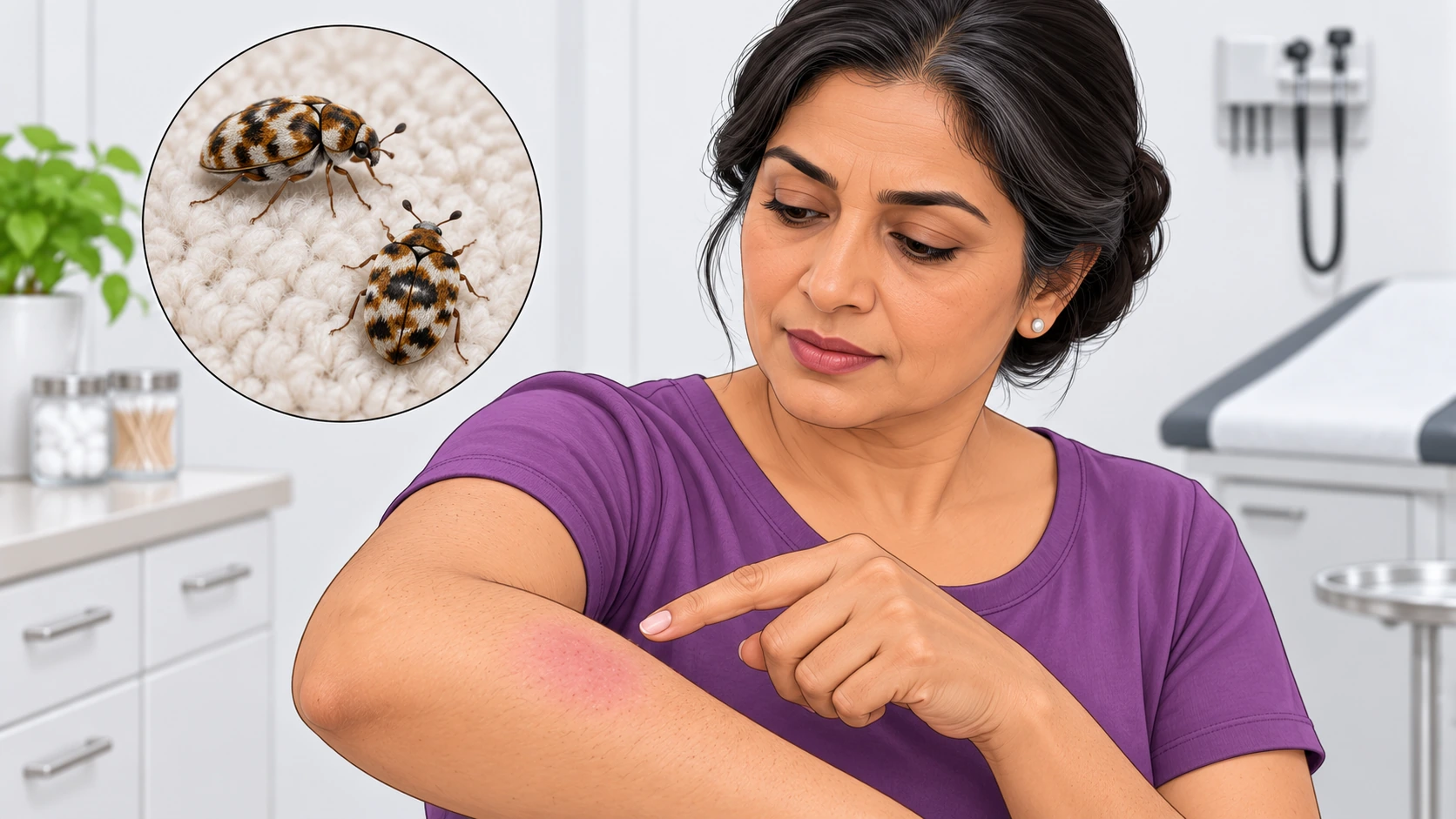
Carpet beetles are generally not dangerous to humans, but they are not completely harmless. They do not feed on human blood, do not normally bite people, and are not venomous. Their main human-health concern is irritation or an allergic skin reaction caused by contact with the tiny hairs of certain carpet beetle larvae.
For most households, carpet beetles are a bigger threat to wool clothing, rugs, upholstered furniture, and other vulnerable materials than to anyone living in the home. However, exposure to their larvae can produce uncomfortable symptoms in susceptible individuals. Their hairs may also irritate the eyes or respiratory tract under some circumstances.
Understanding what these insects actually do, which exposures matter, and when symptoms deserve medical attention makes it easier to respond without either dismissing a genuine reaction or exaggerating the danger.
How Dangerous Are Carpet Beetles Compared With Other Household Pests?
Carpet beetles belong to the insect family Dermestidae, a large group whose members feed on various dried animal and plant materials. Common household carpet beetles include the varied carpet beetle (Anthrenus verbasci), furniture carpet beetles, and the black carpet beetle (Attagenus unicolor).
Unlike mosquitoes, fleas, and bed bugs, carpet beetles do not seek out people as a food source. They are not blood-feeding insects, and their presence near a bed does not mean they are attempting to feed on a sleeping person.
Their health significance comes primarily from accidental exposure. Larvae often live in undisturbed areas where lint, hair, feathers, dead insects, or susceptible fabrics accumulate. When larval hairs come into contact with skin, some people develop irritation or a hypersensitivity reaction.
This is why describing carpet beetles as harmless is slightly misleading. They are usually a low direct-health-risk household pest, but the irritation they can cause is real.
The difference between the life stages also matters. Adult carpet beetles are typically the small, oval insects noticed near windows and lights. Larvae are elongated, often bristly, and responsible for most feeding damage and the best-documented contact reactions.
A few adult beetles indoors are not necessarily evidence of a developing infestation. Adults can fly in from outdoors, particularly around flowering plants. The more useful warning sign is finding larvae, shed skins, and damaged materials in places where the insects are reproducing.
Can Carpet Beetles Bite or Hurt Your Skin?
Carpet beetles do not normally bite humans. Their mouthparts are adapted to their food sources, not to piercing human skin or obtaining a blood meal.
This applies to both adult beetles and their larvae. Although larvae have chewing mouthparts, they are not human parasites and do not feed on living people.
The confusion comes from what happens when larval hairs touch the skin.
Certain carpet beetle larvae have bristles or specialized hairs that can produce an itchy reaction. A person may notice small red bumps, raised areas, or persistent itching and reasonably suspect that something has bitten them. In reality, the reaction may occur without any insect biting or feeding.
That difference is central to understanding whether carpet beetles bite people. The insects can be associated with skin symptoms even though biting is not their normal behavior.
The documented health effects of carpet beetle larval hairs include itchy skin eruptions that can be mistaken for bites. Some reported cases also involve irritation affecting the eyes or respiratory tract. extension.psu.edu+1
A larva crawling across a person’s arm does not guarantee that a reaction will develop. Susceptibility varies, and people living in the same household may respond very differently to similar exposures.
What Health Problems Can Carpet Beetles Actually Cause?
The most useful way to judge the risk is to separate the effects documented in humans from more alarming claims that lack good support.
Skin irritation and carpet beetle dermatitis
Skin irritation is the best-established human-health concern associated with carpet beetles.
Exposure to the hairs of certain larvae can cause itching, redness, and small raised skin lesions. These reactions are sometimes described as carpet beetle dermatitis. The appearance varies, and there is no single rash pattern that conclusively identifies carpet beetles as the cause.
A published investigation of 11 patients from seven households in France documented skin reactions associated with Anthrenus larvae. The researchers identified carpet beetles in the affected homes and described lesions resembling insect bites, although the insects had not bitten the patients. They also observed that some people sharing the same environment had no symptoms.
That case series provides concrete evidence that larval hairs can cause skin reactions mistaken for insect bites. It does not establish how frequently these reactions occur among all households with carpet beetles. CDC
The presence of an itchy rash and a carpet beetle in the same room is therefore suggestive in some circumstances, but it is not proof of causation. Eczema, contact allergies, actual insect bites, and other skin conditions can produce overlapping symptoms.
Recognizing this limitation is particularly important when trying to identify what carpet beetle dermatitis looks like.
Allergic reactions to larval hairs
Some people experience hypersensitivity reactions after contact with carpet beetle larvae or material associated with them. These reactions may be more noticeable following repeated exposure.
An important misconception is that every person exposed to carpet beetles will eventually develop an allergy. That has not been established. The evidence supports individual variation, including cases in which several people live in an affected household but only one experiences symptoms.
It is also inaccurate to assume that a severe-looking rash necessarily means a dangerous systemic allergic reaction. Skin symptoms can be intensely uncomfortable without indicating a life-threatening emergency.
The full distinction between irritation, hypersensitivity, and more significant symptoms is important when considering whether carpet beetles can cause an allergic reaction.
Eye and respiratory irritation
Carpet beetle exposure is not limited entirely to the skin. Larval hairs can also irritate the eyes or airways, particularly when contaminated dust or debris is disturbed.
The Illinois Department of Public Health’s description of carpet beetle hazards specifically identifies irritation of the skin and airways from larval hairs. dph.illinois.gov
For example, someone cleaning a closet containing old wool clothing, accumulated lint, and numerous shed larval skins may disturb material that was previously settled. That creates a different exposure situation from simply noticing an adult carpet beetle walking across a windowsill.
This does not mean carpet beetles routinely cause asthma or serious respiratory disease. Reports of respiratory allergic symptoms exist, but the evidence does not justify treating every carpet beetle infestation as a major breathing hazard.
Persistent coughing, wheezing, or eye irritation should be assessed on its own medical merits rather than automatically attributed to carpet beetles. Other household exposures, including dust, mold, cleaning products, and unrelated allergens, may be involved.
Can Carpet Beetles Live on Humans or Infest the Body?
Carpet beetles do not normally live on human bodies, establish colonies in skin, or reproduce on people.
Their larvae are scavengers. They develop where suitable food and shelter are available, such as beneath furniture, along carpet edges, inside stored textiles, or among accumulated animal-derived debris.
Human skin is not a normal breeding habitat for carpet beetles. Finding a larva on clothing or bedding generally means the insect has wandered from a nearby source or has been carried along with the material.
This is different from pests that depend on living hosts for their survival. Carpet beetles do not need to remain attached to a person, take blood meals, or occupy human hair to complete their life cycle.
A larva found on a sweater may be feeding on the wool or on associated debris. It is not evidence that the insect is feeding on the person wearing the sweater.
The distinction also explains why finding insects in a bedroom does not automatically establish a medical problem. Bedrooms may contain wool blankets, feather-filled items, natural-fiber rugs, lint beneath furniture, and other materials that attract carpet beetle larvae.
A recurring sensation of crawling, itching, or movement on the skin is not sufficient evidence of a carpet beetle infestation. When symptoms persist without a confirmed insect source, medical evaluation and careful pest identification are more useful than assuming insects are living on the body.
Does Finding Carpet Beetles in Your Bed Mean You Are at Risk?
Finding a carpet beetle in bed is understandably concerning, but the significance depends on what was found and whether larvae are developing nearby.
An isolated adult beetle on a pillow does not present the same exposure concern as repeated discoveries of hairy larvae and shed skins inside a blanket, beneath a mattress, or around furniture containing animal-derived fibers.
Larval hairs may remain in fabrics or household debris even when a live larva is not immediately visible. This helps explain why skin contact can sometimes occur without someone seeing an insect crawling directly on them.
However, a mattress does not automatically need to be discarded, and an itchy rash does not prove that the bed contains carpet beetles.
A useful inspection focuses on physical evidence: actual larvae, recognizable shed larval skins, or signs of feeding damage. If the concern involves recurring skin marks, it is also worth considering whether another insect is responsible.
For example, bed bugs feed on human blood, while carpet beetles do not. Their biology, evidence, and control needs are different. Comparing carpet beetle reactions with bed bug bites helps avoid treating one pest when the actual problem may be another.
The most important point is that skin symptoms alone cannot establish which pest, if any, is present.
Are Carpet Beetles Harmful if You Find Only One or Two?
One or two adult carpet beetles are usually a low-priority health concern, especially if they are found near a window in spring or summer.
Adults commonly visit flowers and may enter homes through open doors, windows, or other openings. Their appearance does not necessarily mean that eggs have been laid indoors or that anyone has been exposed to larval hairs.
Repeated discoveries of larvae, by contrast, deserve investigation. Larvae indicate that suitable material may be supporting development somewhere in the building.
The recommended approach to carpet beetle management distinguishes occasional adult sightings from situations in which larvae are developing indoors. It emphasizes finding the source, removing infested material where necessary, and using sanitation and exclusion before considering insecticides. ipm.ucanr.edu
For a homeowner, the practical distinction is straightforward. A single beetle on a windowsill calls for identification and observation. Several larvae beneath a wool rug, accompanied by shed skins and fabric damage, call for a more deliberate inspection.
Neither scenario, by itself, establishes that a person has developed a medical condition.
How Can You Tell Whether Carpet Beetles Are Responsible for Your Symptoms?
The strongest assessment combines the person’s symptoms with evidence from the surrounding environment.
A rash by itself provides weak evidence because numerous medical conditions and insect exposures can look similar. A confirmed population of carpet beetle larvae in clothing, bedding, or furniture makes larval-hair exposure more plausible, especially when symptoms occur after contact with those materials.
Even then, the association is not conclusive.
Consider three situations.
Situation 1: An adult beetle near a window and an itchy arm. The beetle may simply have flown indoors. Without evidence of larvae or contaminated materials, there is little reason to assume it caused the itching.
Situation 2: Multiple larvae and shed skins inside a stored wool blanket. If someone develops itching after handling that blanket, exposure to larval hairs is a reasonable possibility. The blanket and its storage area should be inspected and cleaned appropriately, but the skin symptoms still require separate assessment.
Situation 3: Repeated new marks after sleeping, but no carpet beetle larvae or shed skins. Carpet beetles have not been established as the cause. Looking for actual pest evidence, rather than choosing a treatment based on the rash, is the safer approach.
These distinctions matter because mistaken identification can lead to unnecessary pesticide applications while the actual cause of the symptoms remains unaddressed.
If larvae are suspected, identifying the signs of a carpet beetle infestation is more informative than relying on skin appearance alone.
A physician or dermatologist can evaluate persistent or unexplained symptoms. An extension service or qualified pest professional can help confirm the insect involved. The two assessments answer different questions and may both be necessary.
Can Carpet Beetles Make Your Home Unsafe?
Carpet beetles generally do not make a home unsafe in the way that a serious structural defect, hazardous chemical exposure, or uncontrolled environmental contamination might.
Nevertheless, an established infestation can create repeated opportunities for contact with larval hairs, particularly when the insects occupy clothing, bedding, upholstered furniture, or neglected storage areas.
The insects can also cause substantial material damage. Their larvae feed on susceptible natural fibers and other organic materials, including wool, fur, feathers, hair, and dead insects. Some species also infest certain stored products.
This means the most visible consequence of carpet beetles is often damaged belongings rather than human illness.
A wool rug with worn areas, damaged clothing, or an accumulation of larvae in an old storage box may indicate that the insects have been developing for some time. The extent of fabric damage does not reliably predict the severity of a person’s skin reaction.
A heavily infested closet may contain no symptomatic occupants, while a smaller localized exposure may bother someone who is sensitive to the hairs.
An additional safety concern arises when homeowners respond to the insects with excessive chemical treatments.
Applying insecticide to clothing, skin, mattresses, or sleeping surfaces without specific label authorization can create avoidable exposure hazards. Spraying every room also does little to address concealed larvae if their food source remains in place.
The safer priority is to identify the pest and its breeding material before choosing a control method.
What Should You Do if Carpet Beetles Are Causing Concern?
For someone without symptoms, finding a few adult beetles generally calls for monitoring rather than emergency action.
If larvae or shed skins are present, inspect likely food sources such as wool rugs, stored clothing, upholstered furniture, lint around baseboards, and areas containing hair or dead insects. Thorough vacuuming and appropriate laundering or dry cleaning can remove insects, debris, and potential sources of exposure.
Cleaning should be directed at the areas where evidence is found. An indiscriminate pesticide application is not a substitute for locating larvae and removing their food sources.
For an established household problem, the starting steps for getting rid of carpet beetles involve confirming the source and selecting control measures appropriate to the affected materials.
If skin irritation is already present, gently washing exposed skin, avoiding further contact with suspect materials, and monitoring symptoms are reasonable immediate steps. Persistent or worsening reactions require medical assessment, not increasingly aggressive insecticide use.
The separate considerations of skin relief and household pest control are both important. A clean room will not diagnose or automatically resolve every rash, and treating a rash will not remove larvae from contaminated fabrics.
For symptom relief, the guidance on treating a suspected carpet beetle skin reaction addresses appropriate measures without assuming the insect has been definitively identified as the cause.
When Should You Seek Medical Attention?
Most suspected carpet beetle skin reactions are not medical emergencies, but symptoms should never be dismissed solely because carpet beetles are usually considered a low-risk pest.
Seek medical advice if a rash is persistent, spreading, unusually painful, repeatedly recurring, or difficult to explain. A clinician should also evaluate symptoms suggesting a secondary skin infection, such as increasing warmth, swelling, tenderness, pus, or fever.
Breathing difficulties deserve particular attention. Sudden wheezing, throat tightness, facial or tongue swelling, faintness, or difficulty breathing may indicate a serious allergic emergency or another urgent medical condition. Seek emergency medical care immediately rather than attempting to determine whether carpet beetles were responsible.
Eye irritation that persists, significant respiratory symptoms, or worsening symptoms after cleaning a heavily infested area also warrant appropriate medical assessment.
A clinician does not need proof of carpet beetles to evaluate these symptoms. Conversely, finding carpet beetles does not exclude other medical causes.
The central safety principle is to judge the person’s condition on its own severity, not on the assumption that the household insect involved is harmless.
Common Questions About Carpet Beetles and Human Health
Are carpet beetles poisonous or venomous?
Carpet beetles are not venomous, and they do not inject toxins into humans through a sting or feeding bite. The principal documented skin concern is irritation or hypersensitivity associated with larval hairs. That does not make contact with every carpet beetle dangerous.
Can carpet beetles cause itching without biting?
Yes. Contact with the hairs of certain carpet beetle larvae can cause itching and skin lesions in susceptible individuals. A visible bite is not required because the reaction is not caused by blood feeding. Other causes of itching must still be considered.
Can carpet beetles cause a severe allergic reaction?
Allergic skin reactions are documented, and some exposure-related eye or respiratory symptoms have been reported. However, the available evidence does not support treating life-threatening reactions as a common consequence of ordinary household carpet beetle exposure. Any severe breathing or swelling symptoms need urgent assessment regardless of the suspected trigger.
Can carpet beetles get under your skin?
Carpet beetles do not normally burrow into living human skin or reproduce there. Certain larval hairs can become embedded superficially and cause irritation, which is different from an insect living beneath the skin.
Is it safe to sleep in a room with carpet beetles?
An occasional adult carpet beetle does not ordinarily make a bedroom unsafe. If larvae and shed skins are present in bedding or furnishings, exposure is more plausible, particularly for someone with an existing reaction. Identifying and removing the source is more useful than assuming the entire room is dangerous.
Do carpet beetles make everyone in the household itch?
No. People can have different responses to the same household exposure, and some may have no symptoms at all. Itching in several household members does not automatically prove carpet beetles are responsible, just as the absence of symptoms does not prove that larvae are absent.
Do carpet beetles carry diseases?
Carpet beetles are not established as important human disease vectors in ordinary household settings. That is different from claiming that every possible food-contamination or incidental microbial exposure has been ruled out. Those questions require a separate assessment of whether carpet beetles can make people sick or spread disease.
The Bottom Line
Carpet beetles are usually a minor direct threat to human health. They do not seek human blood, are not venomous, and do not normally infest people’s bodies. Their primary household impact is damage to susceptible fabrics and other materials.
The main exception is exposure to the hairs of certain larvae, which can produce itchy skin reactions and, in some circumstances, eye or respiratory irritation. These effects are documented, but they do not occur in everyone, and a rash alone cannot confirm carpet beetles as the cause.
If you find a single adult beetle, there is rarely a reason to panic. If you discover larvae, shed skins, or infested textiles, locating and addressing their source is sensible. If you develop significant or persistent symptoms, medical evaluation matters more than guessing which household pest caused them.
The appropriate response is neither to ignore carpet beetles completely nor to treat them as a serious human parasite. It is to recognize the limited but genuine exposure risks and act on the evidence present.