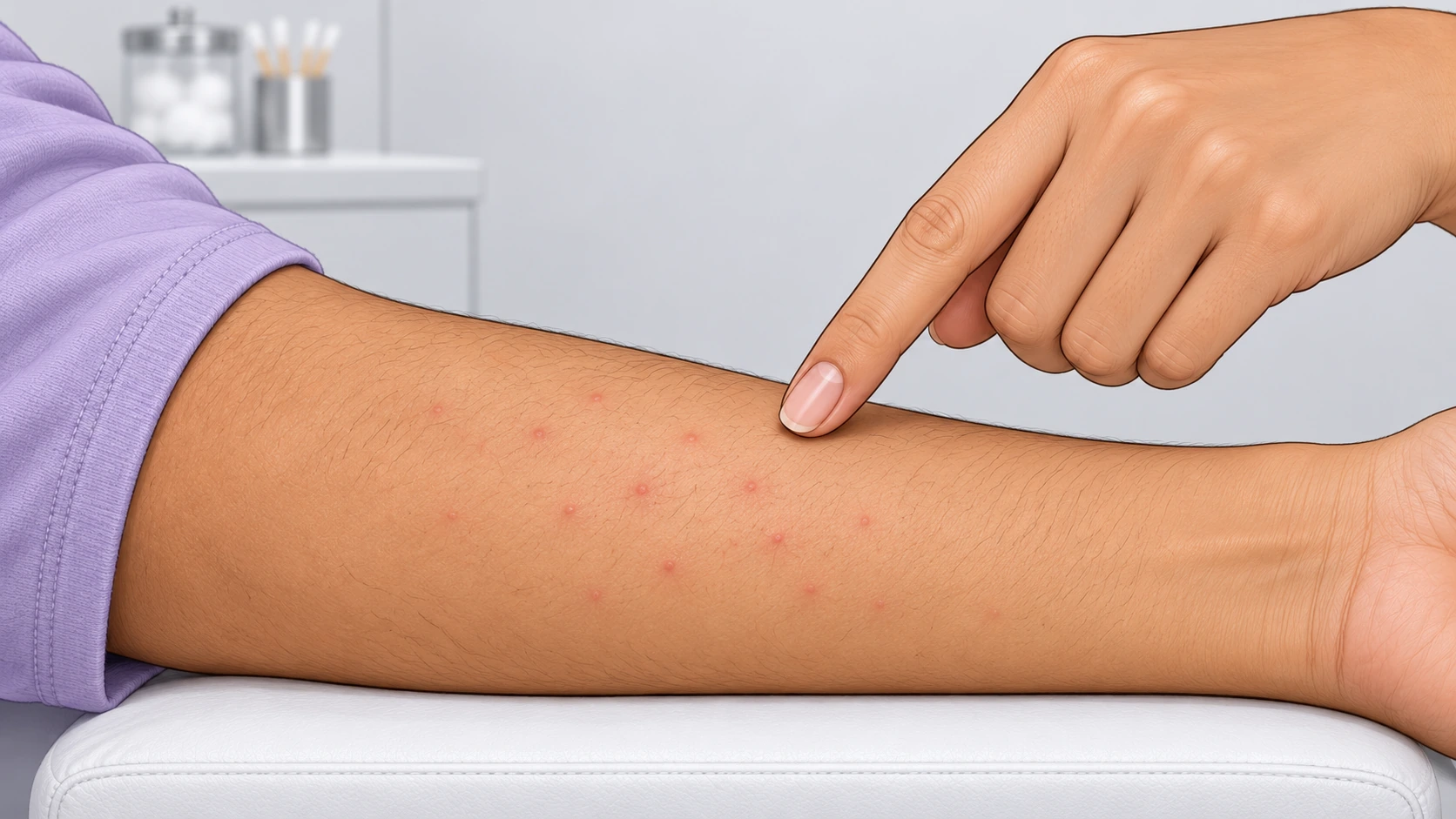
Carpet beetle dermatitis usually appears as itchy, raised bumps on the skin. The bumps may look red or pink, resemble small hives, or occasionally develop into tiny fluid-filled blisters. Some people develop scattered individual spots, while others have several lesions in the same general area. On darker skin, inflammation may look violet, brown, or darker than the surrounding skin rather than bright red.
The rash is associated with contact with irritating hairs from carpet beetle larvae. These insects do not bite people, but certain larval hairs can become caught against the skin and trigger an inflammatory or hypersensitivity reaction.
There is no unique rash pattern that proves carpet beetles are responsible. The same kinds of bumps can appear with other insect exposures, contact dermatitis, eczema, and several unrelated skin conditions.
A suspected carpet beetle rash becomes more plausible when compatible skin findings occur alongside correctly identified larvae or their shed skins in materials that have contacted the affected person. Even then, the connection may require medical evaluation.
The Most Common Appearance: Itchy, Raised Bumps
The typical skin finding associated with carpet beetle dermatitis is a papule, a small, raised bump that can be felt above the surrounding skin.
Papules may be pink or red, sometimes with a slightly swollen appearance. They can occur individually or in loose groups, and scratching may make the surrounding skin look more inflamed.
A clinical investigation published in the CDC’s Emerging Infectious Diseases journal documented itchy, raised, red, hive-like papules associated with Anthrenus carpet beetle larvae. The investigators examined 11 affected patients from seven households in southern France.
Patients in that report had between 7 and 35 visible lesions, with a median of 17. Those numbers describe that particular group, not a standard number of bumps caused by carpet beetles.
A person with three itchy spots is not excluded from having a contact reaction, and someone with twenty bumps cannot be diagnosed on that basis.
The individual lesions also may not be identical. Some can look more swollen, while others may be flattened or altered by scratching.
Small red or pink papules
A papular eruption can resemble numerous small insect bites. Each bump may stand slightly above the skin and have surrounding inflammation.
The size and color vary among individuals. A bump may be only a few millimeters across, but a lesion’s measurement does not identify the cause.
On darker skin, some inflammatory papules may appear less obviously red and instead look brown, purple, or darker than nearby skin. Lighting and photography can further change their appearance.
A diagnosis should not depend on redness being visible.
Hive-like welts
Some documented reactions are described as urticarial, meaning they resemble hives.
These lesions may look raised, swollen, and itchy. Their borders can be more apparent than those of a small papule.
A hive-like appearance does not establish that the reaction was caused by carpet beetles. Ordinary urticaria can have numerous triggers, and other insect-related reactions can also produce raised welts.
The appearance is a recognized possibility, but it is not specific to carpet beetle exposure.
Tiny blisters or blister-like bumps
Some cases involve papulovesicular eruptions, meaning that raised bumps are accompanied by small fluid-filled blisters.
These may be less familiar to someone expecting carpet beetle dermatitis to look like ordinary red spots.
A dermatology review published in Cutis describes itchy papules, small pustules, and vesicles among the documented skin manifestations.
The presence of a blister does not prove carpet beetle exposure. Blistering can occur with several other skin problems, some of which require prompt medical assessment.
What Carpet Beetle Dermatitis Can Look Like at Different Stages
The visible appearance may change as the skin reacts, becomes scratched, and eventually settles.
There is no established progression that every carpet beetle-associated rash follows. Some reactions begin as itchy raised spots, while other patients develop different forms of inflammation.
The following comparison describes observed appearances without presenting them as a diagnostic timeline.
| Skin appearance | Possible description | What it tells you |
|---|---|---|
| Small raised bump | Pink, red, violet, brown, or skin-colored papule | Compatible with many causes of skin inflammation |
| Puffy, raised welt | Hive-like or urticarial lesion | Carpet beetle dermatitis is one possibility among many |
| Raised bump with a tiny blister | Papulovesicular eruption | Documented in some cases but not diagnostic |
| Scratched or crusted bump | Surface disruption after itching or rubbing | Shows irritation or scratching, not the original cause |
| Darker spot after inflammation | Residual post-inflammatory color change | May remain after many kinds of skin reactions |
A useful distinction is between the original lesion and the changes caused by scratching.
A small itchy bump may develop a scab or darker mark after repeated rubbing. The final appearance may be quite different from the initial eruption, making photographs taken days apart difficult to compare.
For that reason, a scratched lesion is often less informative about its original cause than people expect.
Where Does Carpet Beetle Dermatitis Usually Appear?
Carpet beetle-associated reactions can occur on areas of skin exposed to larval hairs. The location depends on where the irritating material contacts the person, and published reports do not establish one universal distribution.
In the 2021 French investigation, lesions were found mainly on skin covered by clothing, including thighs, arms, the chest, and the abdomen.
That pattern made sense in the context of larvae and hairs associated with household clothing and furnishings. The researchers also observed that symptoms did not affect every household member equally.
However, a 2024 dermatology review describes reactions involving exposed skin, including the limbs and face. These reports show why it would be inaccurate to claim that carpet beetle dermatitis occurs only underneath clothing.
Arms and legs
Itchy papules on the arms or legs are compatible with documented carpet beetle dermatitis, especially where the skin has contacted affected textiles or other material carrying larval hairs.
The location alone does not distinguish this condition from insect bites, eczema, or unrelated contact reactions.
A row of spots on an arm is not a carpet beetle signature, and scattered bumps on the legs are not automatically flea bites.
Thighs, abdomen, and chest
Skin beneath clothing may come into contact with larval hairs present in fabrics.
In the CDC-published case investigation, the thighs, chest, arms, and abdomen were among the documented locations. Some lesions were discovered beneath clothing rather than on exposed skin.
This supports the possibility of fabric-associated exposure, but finding bumps in these areas does not prove that clothing contains carpet beetle hairs.
Detergents, friction, heat, other allergens, and unrelated skin conditions may affect the same regions.
Neck, face, and other exposed areas
Some documented reactions involve exposed areas, including the face and limbs.
The distribution can be influenced by how irritating material reaches the skin. Direct contact with affected belongings is one possibility, while detached larval hairs may also become dispersed in the surrounding environment.
An isolated facial rash, however, is not evidence that carpet beetles are living in someone’s hair or on their skin. Carpet beetle larvae are not parasites of the human scalp, even though incidental contact is possible.
The presence of lesions on exposed skin must therefore be interpreted alongside other possible causes.
Why Carpet Beetle Hairs Can Produce a Rash
The mechanism involves specialized hairs on the bodies of certain carpet beetle larvae.
Some of these hairs have fine, pointed structures that can become caught against skin or other surfaces. In susceptible people, contact may trigger an inflammatory or immune-mediated response.
The hairs can also remain in the environment after larvae have moved away or shed their skins.
The clinical investigation involving Anthrenus larvae identified fine, spear-headed hairs associated with human skin reactions. Microscopic examination showed structures capable of becoming lodged in the skin, providing a physical route for exposure.
This is why a person may experience symptoms without seeing a larva on their body.
The hairs can remain after the larva moves away
Carpet beetle larvae molt repeatedly during development, leaving behind cast skins.
Those discarded skins can retain hairs. Detached hairs may also be present among fabrics or other materials that have contained larvae.
A garment can therefore have evidence of past larval activity without a living larva being visible during inspection.
The bristly skins left behind by carpet beetle larvae can help establish environmental exposure, but their presence does not diagnose a person’s rash.
The skin reaction and the insect evidence must be evaluated separately before a causal connection is made.
The reaction is not caused by a bite
Carpet beetle larvae have chewing mouthparts for consuming suitable organic materials. They do not use those mouthparts to feed on living human skin or obtain blood.
The confusion arises because the resulting bumps can resemble the marks left by genuinely biting insects.
The distinction between larval mouthparts and irritating body hairs explains why the everyday description of these symptoms as carpet beetle bites is biologically incorrect.
A bite-like rash is not proof that any insect has bitten the person.
Can Carpet Beetle Dermatitis Look Different From Person to Person?
Yes. Documented reactions vary in appearance and intensity, and some people exposed to carpet beetle larvae may not develop visible symptoms.
In the 2021 investigation, certain household members developed itchy eruptions while others living in the same environment remained unaffected.
This difference matters when evaluating a suspected household exposure.
One person experiencing bumps while another reports no symptoms does not rule out carpet beetle dermatitis. Conversely, multiple people developing a similar rash does not confirm it.
Medical case reports have also documented different types of skin reactions. A 1981 case involving Anthrenus verbasci described recurrent hive-like and papulovesicular lesions linked to carpet beetle larval exposure.
The case was supported by environmental findings and clinical testing. The appearance of the lesions alone was not the full basis for attribution.
The broader range of allergic responses to carpet beetles requires separate consideration because skin appearance is only one aspect of a possible reaction.
Can You Diagnose Carpet Beetle Dermatitis From a Picture?
No. A photograph may show that skin is inflamed, but it cannot reliably establish carpet beetle larvae as the cause.
Red papules, small blisters, hive-like welts, and scratch marks are nonspecific findings. They occur in several dermatological conditions.
Even a photograph of a rash beside a carpet beetle specimen does not prove causation. A person can have carpet beetles in the home and an unrelated skin disorder at the same time.
The strongest interpretation comes from combining medical evaluation with relevant environmental evidence.
What makes a suspected case more convincing?
The evidence becomes more meaningful when several independent findings align.
| Observation | Diagnostic significance |
|---|---|
| Itchy papules or welts without insect evidence | Appearance is nonspecific |
| Carpet beetle adult found on a window | Confirms an adult beetle is present, not the cause of the rash |
| Correctly identified larvae among clothing contacting the affected skin | Supports a plausible exposure route |
| Larval hairs or shed skins found in associated material | Supports possible contact exposure but does not establish the medical cause |
| Similar symptoms in several household members | Suggests a possible shared exposure, which may have several explanations |
| Clinical assessment supported by relevant environmental identification | Provides a stronger basis for considering carpet beetle dermatitis |
This is an original evidence-strength comparison synthesized from published case reports and pest-identification guidance. It is not a validated medical scoring system and should not be used for self-diagnosis.
The distinction matters because a visually convincing rash can still have an entirely different cause.
Why finding an adult beetle is weak evidence
Adult carpet beetles are commonly found around windows and lights. They may arrive from outdoors or emerge from concealed locations within a building.
Their presence does not demonstrate that larval hairs have contacted anyone’s skin.
By contrast, correctly identified larvae or shed skins associated with a garment that contacted the affected area provide a more plausible exposure connection.
Even then, the exposure may be coincidental.
The meaning of finding a single carpet beetle indoors should not be extended into a medical diagnosis without further evidence.
How Is Carpet Beetle Dermatitis Distinguished From Other Rashes?
Carpet beetle dermatitis can resemble contact dermatitis, urticaria, insect-bite reactions, and other itchy skin eruptions.
Doctors generally need more than the appearance of the lesions to decide what caused them. The person’s history, possible exposures, evolution of symptoms, and relevant examination findings may all matter.
The presence of a suspected pest can provide useful context, but it can also introduce confirmation bias. Once a carpet beetle has been found, unrelated bumps may be attributed to it even when there is no evidence of exposure to larval hairs.
The same problem occurs when every itchy spot noticed after sleep is attributed to bed bugs.
A comparison of carpet beetle-associated rashes and bed bug bites requires attention to environmental evidence rather than relying on whether lesions appear in lines, clusters, or isolated spots.
Skin appearance alone is not a dependable method for distinguishing these causes.
What Should You Do if Your Rash Looks Like Carpet Beetle Dermatitis?
A compatible-looking rash should be treated as an unexplained skin reaction until its cause has been evaluated.
If you have found an insect, keep a clear photograph or specimen for identification. It is useful to distinguish an adult carpet beetle from a hairy larva, because the documented dermatitis mechanism concerns larval hairs.
You can also note which clothing or furnishings contacted the affected skin and whether larvae or shed skins have actually been observed in those materials.
Avoid assigning the diagnosis based on internet photographs. Clinical images show examples of confirmed cases, not a visual rule that applies to everyone.
If itching is persistent, the eruption is spreading, or the cause remains unclear, seek assessment from a healthcare professional. Prompt medical attention is warranted for a rapidly worsening or painful eruption, substantial blistering, fever, or signs of skin infection. Difficulty breathing or swelling involving the tongue or throat requires emergency care.
Do not apply insecticides to skin or assume pesticide treatment is appropriate simply because a rash resembles a published carpet beetle case.
The appropriate response to a suspected carpet beetle rash depends on the symptoms, the certainty of the exposure, and whether carpet beetle activity has actually been established.
Questions About the Appearance of Carpet Beetle Dermatitis
Does carpet beetle dermatitis look like mosquito bites?
It can. Raised, itchy bumps may resemble mosquito bites or other insect-related reactions. The resemblance does not identify the cause, because carpet beetle dermatitis results from contact with larval hairs rather than a feeding bite.
Can carpet beetle dermatitis appear as tiny blisters?
Yes. Papulovesicular eruptions, involving small raised bumps and fluid-filled lesions, have been reported in clinical cases. Blisters are not specific to this condition, and significant or unexplained blistering warrants medical assessment.
Does a carpet beetle rash always appear in clusters?
No. Published reports describe scattered individual papules as well as multiple lesions affecting the same body region. A cluster, line, or isolated bump is not a reliable diagnostic pattern.
Can carpet beetle dermatitis look like hives?
Yes. Urticarial, or hive-like, lesions have been documented. However, ordinary hives have numerous possible causes, so their appearance alone cannot establish carpet beetle exposure.
Does carpet beetle dermatitis always look red?
No. The visible color of inflammation depends partly on skin tone and other factors. On darker skin, inflamed areas may appear violet, brown, or darker than surrounding skin. Color alone is not sufficient for identification.
Can you have carpet beetle dermatitis without seeing larvae?
It is possible for a person to contact detached larval hairs or hairs retained in discarded skins without seeing a living larva at that moment. However, symptoms without confirmed exposure remain nonspecific and should not automatically be attributed to carpet beetles.
What the Appearance Can and Cannot Tell You
Carpet beetle dermatitis can appear as itchy papules, raised welts, or occasionally small blisters. Lesions may be scattered or concentrated in areas where the skin has contacted affected materials, but neither their appearance nor their location is unique to carpet beetles.
The documented mechanism involves irritating larval hairs, not bites from adult beetles or larvae. Environmental evidence of larvae or their shed skins can make exposure more plausible, while medical assessment helps evaluate the actual skin condition.
A rash photograph can show what happened to the skin. It cannot, on its own, tell you that carpet beetles caused it.
2 thoughts on “What Does Carpet Beetle Dermatitis (Rash) Look Like?”