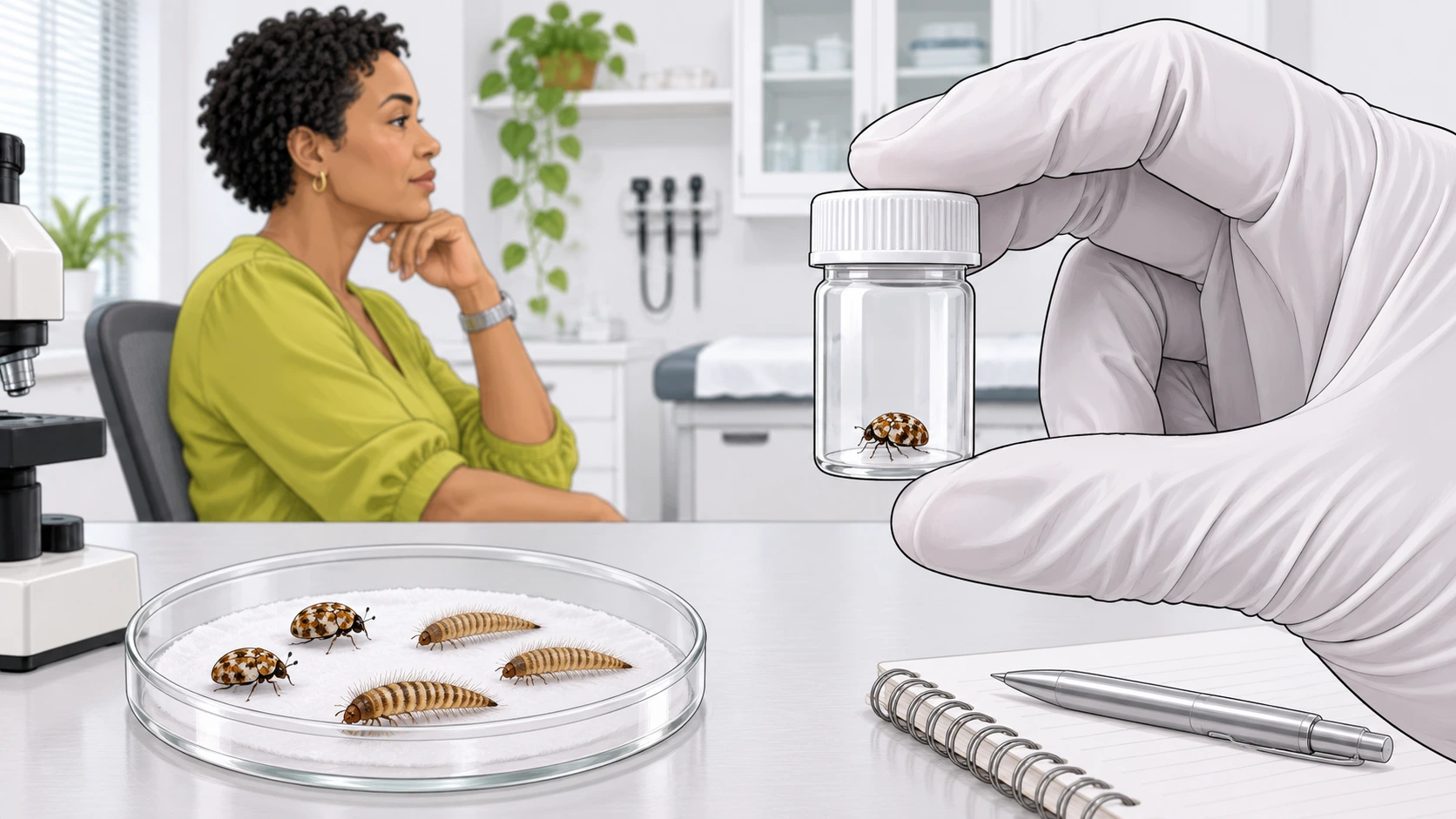
Carpet beetles do not bite humans. Adult carpet beetles do not feed on blood, attack people, or use their mouthparts to puncture human skin. Their larvae also do not bite people, although contact with certain larval hairs can cause skin irritation that looks and feels like insect bites.
This explains why someone may discover carpet beetles at home while also experiencing itchy red bumps. The insects themselves are not biting, but sensitive individuals can develop reactions to hairs associated with the larval stage. Finding a carpet beetle and having an itchy rash does not prove the two are connected. Bed bugs, fleas, other biting insects, contact dermatitis, and unrelated skin conditions can produce similar symptoms.
The most useful starting point is identifying the insect and separating a genuine bite from irritation associated with carpet beetles.
Why Adult Carpet Beetles Do Not Bite People
Adult carpet beetles are small, oval or rounded insects that belong to the family Dermestidae. Common household species include varied carpet beetles, Anthrenus verbasci, and black carpet beetles, Attagenus unicolor.
They have mouthparts, but they are not adapted to piercing human skin or obtaining blood meals. Unlike mosquitoes, fleas, and bed bugs, carpet beetles do not use people as feeding hosts.
Adult feeding habits also differ considerably from those of their larvae. Some adults visit flowers to consume pollen or nectar, while others feed little or not at all after emerging.
This difference is evident in the feeding habits and life stages of carpet beetles. Adults commonly appear near windows and lights, while the larvae develop on suitable organic materials.
An adult beetle crawling across your hand is therefore not trying to feed on you. It may be walking across an exposed surface, searching for another location, or responding to conditions in its surroundings.
The same applies if an adult appears on your arm, pillow, or clothing. Its presence does not make it a biting insect.
Understanding what adult carpet beetles eat helps explain why their ordinary feeding behavior has nothing to do with human skin.
Can a Carpet Beetle Bite You if You Pick It Up?
An adult carpet beetle is not known to deliver a medically significant bite when handled.
Its small size and feeding adaptations make it very different from insects that defend themselves by biting or that require blood meals.
This does not mean handling unidentified insects is always a good idea. Other small beetles can resemble carpet beetles, and some insects can pinch, sting, or release irritating substances.
If you find a suspected carpet beetle, a photograph or a specimen collected in a small container is generally more useful for identification than holding it against your skin.
A feeling of movement, tickling, or irritation while an insect crawls over you should not automatically be interpreted as a bite.
A crawling sensation is not evidence that the insect punctured your skin. Without direct observation or reliable insect identification, the cause of a sudden skin sensation may remain uncertain.
Why People Report Carpet Beetle Bites
The phrase carpet beetle bites is commonly used to describe itchy bumps that appear in a home where carpet beetles have been found.
The terminology is misleading because the irritation is not caused by a feeding bite.
Some carpet beetle larvae have irritating hairs that can trigger hypersensitivity reactions in susceptible individuals. Contact may occur with a larva or with hairs left in the surrounding environment.
These reactions can resemble insect bites even though no insect has pierced the skin to obtain blood.
The distinction is recognized in clinical descriptions of carpet beetle dermatitis, which document itchy skin eruptions associated with larval hairs.
That provides a plausible explanation for some reports of carpet beetle bites, but it should not be used to explain every unexplained rash.
A person can have carpet beetles in the home and an unrelated skin condition at the same time.
The adult beetle and the larva create different concerns
An adult carpet beetle on a windowsill is not the same exposure as a hairy larva associated with a textile.
Adults are usually the more visible stage because they may move toward windows and other illuminated surfaces. The larvae are often concealed in materials where they feed and develop.
If someone finds an adult on a pillow and later notices itchy bumps, the adult’s presence alone does not establish a cause.
A larva discovered in nearby fabric may make contact with larval hairs a more plausible possibility, but it still does not confirm the medical explanation for the symptoms.
The reason carpet beetle larvae are sometimes mistaken for biting insects involves their body hairs rather than blood-feeding behavior.
Carpet Beetle Bites Versus Larval-Hair Reactions
The most important difference is whether an insect has actually bitten the person or whether skin has reacted to an irritating material.
| Question | True insect bite | Carpet beetle-associated skin reaction |
|---|---|---|
| Does the insect puncture skin to feed? | Yes, for blood-feeding insects | No |
| Is blood a food source? | For biting insects such as bed bugs and fleas | No |
| What produces the reaction? | A bite and the body’s response to it | Contact with irritating larval hairs in susceptible people |
| Can red, itchy bumps appear? | Yes | Yes |
| Can appearance alone identify the cause? | Generally no | No |
| Does finding an adult carpet beetle confirm the cause? | No | No |
This distinction prevents a common identification mistake: treating the appearance of a skin mark as proof of a particular insect.
Skin reactions do not follow one exclusive pattern. Different causes can produce similar redness, bumps, itching, or inflammation.
A clinical investigation published in the CDC’s Emerging Infectious Diseases journal documented skin reactions associated with Anthrenus carpet beetle larvae. The reactions were linked to larval hairs, not biting, and symptoms differed among people living in the same household.
The findings establish that such reactions are possible, not that carpet beetles are the correct explanation whenever someone has itchy spots.
Do Carpet Beetles Bite at Night or While You Sleep?
Carpet beetles do not become biting insects at night.
An adult beetle found on a bed in the morning has not necessarily spent the night feeding on anyone. It may have crawled onto the bedding or arrived from another nearby location.
Carpet beetle larvae can also be present in or around household textiles, but they do not seek sleeping people for blood meals.
A person who wakes up with itchy marks should not conclude that carpet beetles caused them merely because one beetle was found near the bed.
The timing of symptoms does not reliably distinguish carpet beetle-associated irritation from genuine bites or unrelated dermatological conditions.
Bed bugs, for example, are blood-feeding insects and may bite sleeping people. Carpet beetles do not have that feeding relationship with humans.
Even then, skin marks alone cannot establish that bed bugs are present. A reliable comparison between carpet beetle reactions and bed bug bites depends on insect evidence and exposure circumstances, not just whether the bumps appeared overnight.
Can Carpet Beetles Leave Red Bumps Without Biting?
Yes. In susceptible people, exposure to larval hairs can produce itchy bumps or a rash even though no bite occurred.
The reaction may resemble the effects of biting insects, which helps explain why carpet beetles sometimes receive blame for unexplained skin symptoms.
However, not everyone exposed to carpet beetle larvae develops a reaction. People sharing a household can experience different symptoms, including no noticeable irritation at all.
A lack of symptoms in one person therefore does not rule out exposure, and a rash in another does not automatically confirm it.
The appearance of carpet beetle-associated dermatitis also overlaps with other skin conditions. Its color, shape, and location are insufficient to diagnose the cause without considering other evidence.
If symptoms are persistent, spreading, or unexplained, a healthcare professional can evaluate possible causes rather than relying on the presence of carpet beetles to make the diagnosis.
What If You Feel Something Bite You but Only Find Carpet Beetles?
The carpet beetle may be unrelated to the sensation.
Finding an insect after experiencing a sting, pinch, or sudden itch does not establish that the insect caused it. Small insects can be present in the same environment without having any connection to the symptoms.
A correctly identified adult carpet beetle should not be treated as the source of a blood-feeding bite.
There are several possible explanations for the combination of a biting sensation and carpet beetle sightings. Contact with irritating material may be one possibility, but another insect or a non-insect skin condition may also be responsible.
The important step is to avoid making a diagnosis from coincidence.
Guidance on mysterious insect bites and bite-like sensations emphasizes that many suspected bites are not caused by the insects found nearby. Identifying the actual organism and considering other explanations are essential.
If an unexplained reaction continues, preserving any insect specimen and documenting the symptoms can help a pest-identification specialist or healthcare professional assess the situation.
It is not useful to repeatedly apply insecticides without confirming a pest that requires treatment.
Does a Carpet Beetle Bite Mark Prove an Infestation?
No. There is no diagnostic carpet beetle bite mark because carpet beetles do not bite humans.
An itchy bump cannot establish that carpet beetles are present, much less that they are reproducing inside the home.
Even if an adult carpet beetle has been correctly identified, one sighting does not confirm an established infestation.
More relevant evidence includes living larvae associated with suitable materials, recognizable cast skins, and activity connected to plausible larval food sources.
The signs of a carpet beetle infestation are environmental and insect-related observations rather than a particular appearance of skin lesions.
This distinction matters because a household may have a genuine skin complaint and a few incidental adult carpet beetles without the two being causally related.
What Should You Do if You Think Carpet Beetles Bit You?
First, do not assume that the beetle caused the symptoms. Confirm whether the insect is actually a carpet beetle, and remember that adult carpet beetles do not bite.
If you find larvae or their shed skins, that information may be relevant to evaluating possible contact exposure. It still does not confirm the medical cause of a rash.
For mild skin symptoms, a healthcare professional or pharmacist can provide advice appropriate to the person’s age, medical history, and symptoms. Persistent or worsening reactions warrant medical evaluation.
Seek urgent medical attention for difficulty breathing, swelling of the tongue or throat, faintness, or other signs of a severe allergic reaction.
Avoid applying pesticides to skin, clothing being worn, or bedding in an attempt to prevent imaginary carpet beetle bites. Pesticides must be used only for their labeled purposes, and unnecessary exposure can create additional health risks.
The appropriate response to a suspected carpet beetle-related skin reaction is different from the response to a confirmed biting insect infestation.
Common Questions About Carpet Beetle Bites
Do black carpet beetles bite humans?
No. Adult black carpet beetles, Attagenus unicolor, are not blood-feeding insects and do not bite people. Their larvae may be associated with irritating hairs, but that is a different issue from an adult beetle biting.
Can carpet beetles bite through clothes?
No. Carpet beetles do not bite people through clothing or exposed skin. Larval hairs may come into contact with skin through contaminated fabrics, but a resulting reaction is not a feeding bite.
Do carpet beetles suck human blood?
No. Carpet beetles are not blood-feeding parasites. Adults may consume pollen or other floral resources depending on the species, while larvae use suitable dried organic materials.
Can carpet beetles bite more than one person in a household?
Carpet beetles do not bite any household member. However, more than one person may experience irritation associated with larval hairs, and sensitivity can differ among people. Similar symptoms in several people do not confirm the cause.
Can a carpet beetle bite cause an infection?
Carpet beetles do not create the puncture wound associated with a true bite. Broken or irritated skin from scratching can sometimes become infected regardless of the original cause of itching. Increasing pain, warmth, swelling, spreading redness, or drainage warrants medical assessment.
The Bottom Line
Carpet beetles do not bite people. Adults are not blood-feeding insects, and finding one on your skin, clothes, or bed does not establish that it caused an itchy mark.
What people call carpet beetle bites may sometimes be reactions to hairs from the larval stage. Those reactions can resemble true insect bites, but their appearance cannot identify the cause on its own.
The reliable distinction is between the insect’s biology and the person’s symptoms. Identifying a carpet beetle tells you what insect is present. It does not, by itself, diagnose a rash or prove that anyone has been bitten.
One thought on “Do Carpet Beetles Bite?”