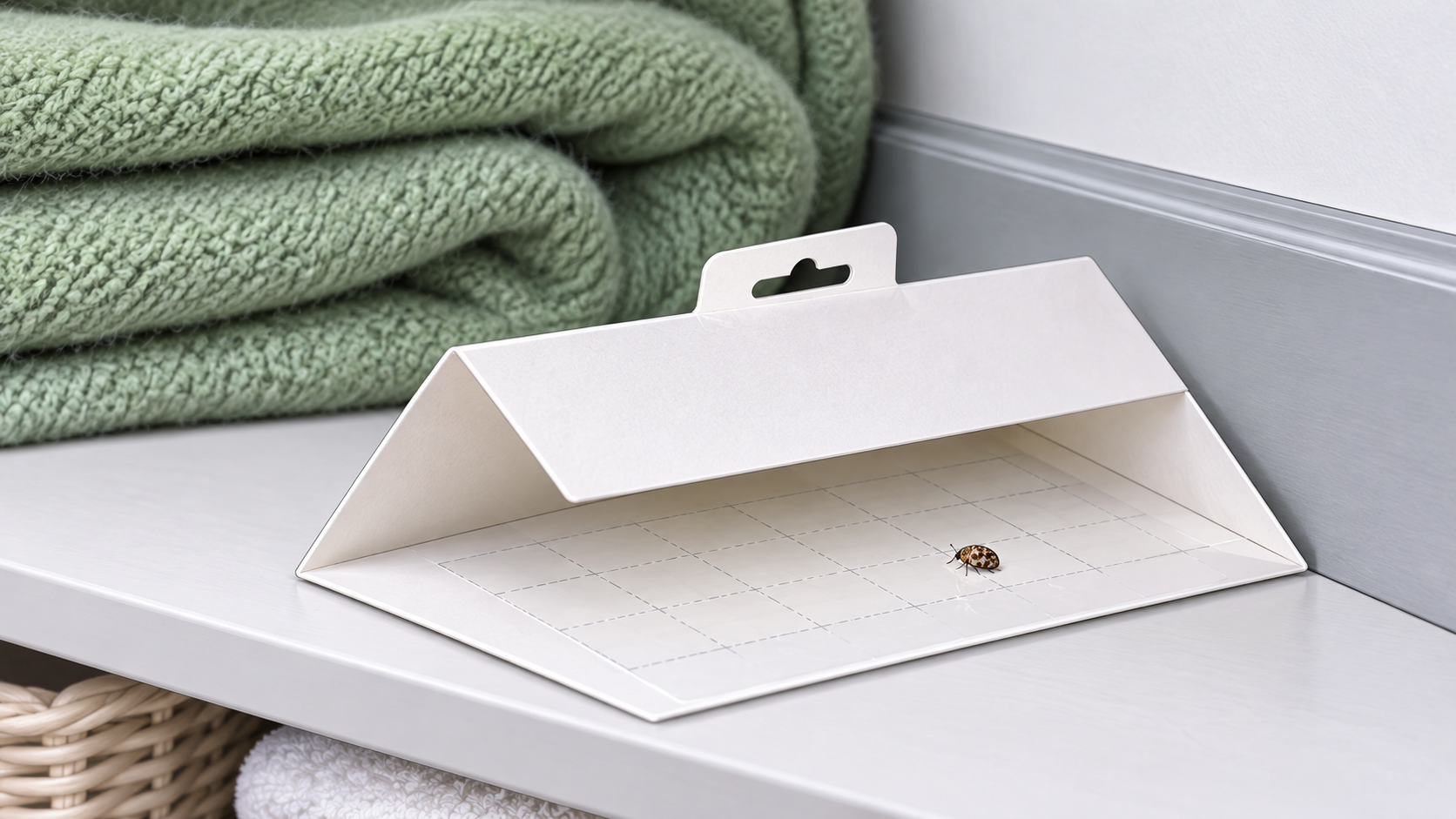
Pheromone traps really can attract and capture carpet beetles, but their effectiveness depends on the beetle species, the chemical lure, and the life stage being targeted. A properly matched trap can be a useful way to detect adult carpet beetles and monitor their activity. What it cannot reliably do is eliminate an established infestation on its own.
There is also no universal carpet beetle pheromone that works equally well on every species. A lure developed for varied carpet beetles may be ineffective against another species, even if both insects are commonly called carpet beetles.
We consider pheromone traps worthwhile when they answer a specific monitoring question: Is a particular carpet beetle species active here, and where should I concentrate my investigation? We do not consider them a substitute for locating and removing the infested material.
How Carpet Beetle Pheromone Traps Actually Work
Carpet beetles communicate through chemical signals called pheromones. These substances can influence behavior between members of a species, particularly during reproduction.
A sex pheromone is a chemical signal involved in attracting a potential mate. In the carpet beetle species for which commercial sex lures are available, the pheromone commonly imitates the signal released by females to attract males.
A commercial trap typically combines a synthetic pheromone lure with a sticky capture surface. The lure slowly releases its chemical attractant into the surrounding air. A responsive male beetle detects the signal and moves toward it. If it enters or lands on the adhesive area, it becomes trapped.
The sticky material itself does not produce the attraction. Its job is to retain insects that approach the lure. Without the appropriate pheromone, the same adhesive surface may capture only insects that happen to cross it.
That is why pheromone traps can be more effective than ordinary unbaited adhesive monitors for detecting certain adult carpet beetles. The attraction mechanism increases the chance that a responsive beetle will approach the monitoring station instead of relying entirely on accidental contact.
Pheromone attraction is also one reason a trap’s contents should not be interpreted as a complete sample of the insects in a room. A lure can selectively capture adult males while females, larvae, and beetles of other species remain elsewhere.
The distinction between attractant types, trap designs, and commercially available options belongs in our comparison of the best carpet beetle traps. The scientific question here is whether the pheromone itself produces a useful response and how much that response tells you.
Which Carpet Beetle Species Respond to Pheromone Traps?
Carpet beetles belong to the beetle family Dermestidae. Several species can infest homes, and they do not all respond to the same chemical cues.
The varied carpet beetle, Anthrenus verbasci, and the black carpet beetle, Attagenus unicolor, are important examples because species-targeted commercial pheromone lures have been developed for them. Other carpet beetles may have different pheromone chemistry, attraction patterns, or less readily available commercial monitoring options.
The presence of a lure marketed for one species does not establish that it works against the entire family.
|
Carpet beetle species |
Relevant pheromone-trap evidence |
Important limitation |
|---|---|---|
|
Varied carpet beetle (Anthrenus verbasci) |
Field monitoring has demonstrated attraction of adult males to a matching sex pheromone |
Catches do not directly measure larvae or total population size |
|
Black carpet beetle (Attagenus unicolor) |
Species-targeted commercial sex pheromone lures are available for adult-male monitoring |
Results depend on correct identification and suitable trap placement |
|
Furniture carpet beetle (Anthrenus flavipes) |
A recognized household pest, but effectiveness of a varied or black carpet beetle lure should not be assumed |
Requires evidence that the particular lure targets this species |
|
Common carpet beetle (Anthrenus scrophularia) |
Another household carpet beetle species |
The word “carpet beetle” on a package is not evidence of a matching pheromone |
This table is deliberately conservative. It distinguishes demonstrated species-specific attraction from the existence of other carpet beetle species. It does not imply that the latter species lack pheromone communication or that effective lures could not be developed for them.
The practical problem is identification. Someone who finds a small, dark beetle beside a window may reasonably assume it is a black carpet beetle, even though worn varied carpet beetles and other small beetles can resemble it.
Before relying on a specialized lure, check the differences between varied and black carpet beetles or compare specimens with the different types of carpet beetles.
A wrong identification can make a functioning pheromone trap appear ineffective.
Varied carpet beetles have direct experimental evidence
One of the more useful studies of carpet beetle pheromones was conducted in 1993 and 1994 in and around an entomology museum at the University of California, Berkeley.
The investigation compared pheromone-baited sticky traps with unbaited traps while monitoring Anthrenus verbasci. The lure contained synthetic components of the female varied carpet beetle’s sex pheromone.
In one indoor test room, the baited traps collected 11 adult male varied carpet beetles. The unbaited traps in that room caught none. The captures occurred during a short period in April, and the trap closest to a window collected the most beetles.
The same investigation used baited and unbaited traps outdoors. Adult male varied carpet beetles were captured in pheromone traps, while unbaited traps collected none of the target beetles.
Those observations provide direct support for the ability of a matching sex pheromone to detect varied carpet beetle males. cool.culturalheritage.org
The findings are important because they establish more than the manufacturer’s claim that a lure attracts beetles. They show a measurable difference between baited and unbaited traps under the conditions studied.
However, the research also identified a major limitation. The number of beetles caught indoors was relatively small, and the researchers could not establish how accurately trap catches reflected the size of the underlying population.
In other words, the study supports using pheromone traps to detect responsive adult males. It does not establish that a certain number of captured males corresponds to a certain number of larvae, females, or developing beetles.
Black carpet beetles need a different lure
Black carpet beetles are members of the genus Attagenus, rather than Anthrenus. That taxonomic distinction matters because pheromone responses can differ between species and genera.
Commercial black carpet beetle sex pheromone lures are intended to attract male Attagenus unicolor. Some manufacturers also offer combined formulations intended for more than one named carpet beetle species.
The existence of a combined lure does not mean that pheromones are universally interchangeable. A multi-species formulation may contain several attractant components, each aimed at a particular target. Its effectiveness still depends on which beetles the formulation was designed and evaluated to attract.
Black carpet beetle adults are capable of flying, and their activity can change with environmental conditions. Trap placement and the timing of adult emergence can therefore influence how many males encounter a pheromone signal.
If you are finding carpet beetle larvae in an area but capturing few adults, that does not automatically show that a pheromone product is defective. The beetles may still be in immature stages, the adult males may not be active, or the lure may not match the species.
Do Carpet Beetle Pheromone Traps Attract Males, Females, or Larvae?
For the common commercial sex pheromone traps discussed here, adult males are usually the intended target.
This is the central limitation of their effectiveness as a control method. A trap designed to imitate a female’s mating signal is not necessarily attractive to females, and there is no reason to assume that carpet beetle larvae respond to the same signal as adult males.
Carpet beetle larvae have different priorities and behavior. They spend much of their development feeding in protected material, often in dark, relatively undisturbed locations. Adult beetles, by contrast, may move toward light, windows, or outdoor flowers, and mating behavior becomes relevant after emergence.
The feeding and development of carpet beetle larvae explains why the insects responsible for fabric damage may remain far from a trap that is successfully attracting adult males.
A useful distinction is that pheromone traps and food-attractant traps do not always target the same insects.
|
Insect stage or group |
Typical sex pheromone response |
What this means for monitoring |
|---|---|---|
|
Adult males of the target species |
Intended primary response |
A catch confirms that responsive adult males encountered the trap |
|
Adult females |
Usually not the intended target of female-produced sex pheromone lures |
Female abundance cannot be inferred from male catches |
|
Larvae |
Not the intended target of adult sex pheromone lures |
A pheromone trap does not directly monitor hidden feeding larvae |
|
Eggs and pupae |
No active movement toward a trap |
They remain outside the trap’s direct capture mechanism |
|
Adults of other carpet beetle species |
Response uncertain unless the lure is validated for them |
Low catches may reflect a species mismatch |
Food-attractant monitoring systems can produce a different pattern. Some are designed to attract adult beetles of both sexes, while specialized dermestid larval attractants are intended to reveal feeding activity by larvae.
These products should not be described simply as pheromone traps unless they actually contain a pheromone. A food lure works through a different attraction mechanism, even when it is installed in a similar-looking monitoring station.
The distinction also matters for interpreting what gets caught. A food-attractant monitor may give information about the larvae closer to the feeding source, whereas a male-targeting sex pheromone trap principally provides information about adult activity.
How Effective Are Pheromone Traps Compared With Ordinary Sticky Traps?
A correctly matched pheromone trap can capture more of its target adult beetles than an otherwise comparable unbaited trap. The varied carpet beetle field study demonstrates this under its test conditions.
That does not mean every pheromone trap will outperform every sticky trap in every room.
An unbaited monitor placed directly along an active insect travel route can collect specimens without any chemical attraction. A pheromone trap located far from the beetles’ normal activity may catch fewer insects than expected.
Some household guidance recommends unbaited sticky traps near windowsills, where adult carpet beetles may gather. Other guidance supports food-baited monitors near floors and suspected larval activity.
These methods sample different aspects of an infestation.
There is also a difference between detecting an insect and estimating its abundance. A pheromone may attract beetles from a surrounding area, meaning that a large catch reflects both the insects present and the distance over which the lure influences their behavior.
A plain sticky monitor does not provide the same attraction, but it can still reveal beetles moving through a particular location.
We would not use a simple conversion such as “one beetle in a pheromone trap equals 10 beetles in the room.” There is no defensible universal formula of that kind.
The value of the trap is strongest when the target species, trap type, placement, and monitoring period are known.
Why a Working Pheromone Trap Sometimes Catches Very Few Beetles
Low catches can be frustrating when carpet beetle damage is obvious. But the number on a glue board depends on several biological and practical factors.
The wrong pheromone is being used
A lure can only attract insects that respond to its chemical signal. If the target species differs from the species actually present, the trap may catch little or nothing.
This is especially relevant when the original identification came from a blurry photograph or a small beetle found on a windowsill.
Correct identification is therefore part of measuring the trap’s effectiveness, not merely a preliminary shopping concern.
The infestation is dominated by larvae
Carpet beetles can spend a substantial portion of their life cycle in the larval stage. Their development time varies by species, food availability, and environmental conditions.
A room may contain larvae feeding in upholstery or stored clothing without many active adult males moving through it at that moment.
The trap can be operating as intended while the damaging insects remain concealed.
The adults are not active at that time
Pheromone traps rely on insect movement and responsiveness. Adult emergence and activity can vary with season, temperature, light, and indoor conditions.
In the varied carpet beetle museum study, captures were concentrated during a relatively short period. This is one reason its researchers emphasized timing as a factor in detection.
Carpet beetles are not all synchronized across every climate or heated building. Nevertheless, a short period without adult captures is not enough to make a pheromone trap an all-purpose test of whether a property contains developing larvae.
Trap placement is unsuitable
A trap must be accessible to responsive insects. Position, height, barriers, airflow, nearby windows, and the kind of room being monitored can all affect the opportunity for beetles to encounter it.
The museum study found a larger catch in the baited trap nearest a window. The researchers noted that attraction to light may have contributed to this difference, making placement an important part of interpreting the findings.
We would follow the trap manufacturer’s placement instructions rather than inventing one universal height or spacing for every carpet beetle lure.
In particular, changing several trap locations at once makes subsequent catch trends harder to interpret.
The lure or adhesive surface is no longer in suitable condition
Pheromone dispensers are designed to release attractant over a specified period, but that period depends on the actual product. A lure left in place beyond its intended service life may no longer perform as expected.
Heat, storage conditions, and handling can also affect some formulations. The glue surface introduces a separate maintenance issue because dust or accumulated insects may reduce its useful capture area.
A monitoring record becomes less reliable when an old lure is compared with a fresh one without accounting for the change.
Can Pheromone Traps Reduce Carpet Beetle Populations?
Capturing adult males removes those individual beetles from the population, and removing males could theoretically reduce mating opportunities under favorable conditions.
However, that possibility should not be confused with proven household eradication.
For adult-male trapping to substantially suppress a population, enough males would need to be captured before mating for the loss to affect reproduction. The outcome would depend on male abundance, mating behavior, trap density, and whether additional beetles continue entering from elsewhere.
A carpet beetle infestation may already contain fertilized females, eggs, and larvae when traps are installed. Capturing some adult males afterward cannot reverse eggs that have already been laid or remove larvae that are already feeding.
The evidence supporting pheromone traps is stronger for detection and monitoring than for eliminating an established household infestation.
The difference is reflected in carpet beetle management guidance, which treats pheromone traps as tools for monitoring and, in small confined areas, as a possible addition to other controls. It emphasizes sanitation, exclusion, and finding infested materials as the basis of effective management. ipm.ucanr.edu
We would not claim that a particular number of traps can reduce a household infestation by a particular percentage. The evidence reviewed does not establish a dependable residential population-reduction rate.
Why catching males does not guarantee mating prevention
A pheromone trap can capture a male that approaches the synthetic lure, but it cannot tell you whether that male previously mated.
Similarly, the trap does not establish that every receptive female in the building will remain unmated.
Males may mate before encountering the trap, and females may have already deposited eggs in concealed materials. The presence of other responsive males is another unknown.
This means that captures demonstrate attraction and physical removal, not necessarily successful interruption of reproduction.
A large catch can even be misleading. It may create the impression that the trap is removing the infestation while unseen larvae continue damaging textiles.
The better question is not simply how many males were caught. It is whether the material supporting larval development has been found and addressed.
Do Pheromone Traps Help You Find the Source of Carpet Beetles?
They can help narrow the investigation, although they cannot identify the infested item by themselves.
Consider a house with two bedrooms and a hallway closet. You find occasional adults near the upstairs windows but discover no larvae during a quick inspection. Species-matched pheromone traps could help establish whether adult males are being detected more consistently in one area.
If most captures occur near a particular storage space, that area becomes a sensible place to investigate more thoroughly.
You might inspect wool clothing, rugs, natural-fiber upholstery, accumulations of pet hair, or dead insects in protected corners. The concentrated catches would provide a reason to look there, rather than proof that a particular object is infested.
The interpretation becomes especially complicated near windows and outside-facing doors. Adult carpet beetles may enter from outdoors, so a trap close to a window can collect insects that did not develop inside that room.
In one museum investigation, the actual larval source was traced to old wasp nests even though the adults were being caught in nearby pheromone traps. That example is useful because it shows the difference between finding adult activity and physically establishing where larvae developed.
A systematic carpet beetle inspection or a focused investigation into where carpet beetles are coming from is still necessary.
Why location trends are more useful than one catch
Suppose the same type of lure is used in two comparable rooms over the same monitoring period. One trap collects several correctly identified males, while the other collects only one.
That pattern suggests different levels of detected adult activity. It provides a reason to investigate the first room more closely.
It does not establish that the first room contains several times as many larvae. The local airflow, trap position, and opportunities for adult movement may be different.
Monitoring works best when conditions are kept reasonably consistent. Changes in catches become more interpretable when you know which traps moved, which lures were replaced, and whether an important source of larval food was removed between inspections.
What Do Scientific Studies Actually Prove?
Carpet beetle pheromone trapping is supported by real entomological research, but the evidence needs to be separated into three different questions.
Can an appropriate sex pheromone attract target beetles?
Yes. Field observations and trapping studies demonstrate attraction in certain dermestid species, including varied carpet beetles.
Can trap catches monitor activity?
Yes, with qualifications. They can reveal the presence and changes in detected target-adult activity, but do not automatically provide an accurate measure of the total population.
Can pheromone trapping alone reliably eradicate a household infestation?
This has not been established by the evidence reviewed. Removing some adult males is not equivalent to eliminating females, eggs, larvae, or their food sources.
An early study published in 1976, Trapping Studies with Dermestid Sex Pheromones, found significantly greater captures of target insects in pheromone-treated traps than in controls at several locations. That experiment involved dermestids including a historically named black carpet beetle, Attagenus megatoma, and another dermestid, Trogoderma inclusum. It supports the wider principle that appropriately selected dermestid sex pheromones can improve target captures, but it should not be generalized to every modern carpet beetle product or species. academic.oup.com
The more directly relevant 1990s Anthrenus verbasci museum study confirmed male attraction in a practical monitoring setting, while explicitly acknowledging uncertainty about trap efficiency and population estimates.
That combination produces a clear conclusion: pheromone attraction is genuine, but a response to an attractant is not the same as demonstrated population control.
There is also an important distinction between a field experiment and a product advertisement. A manufacturer may describe a lure as effective for its intended species, but that alone does not establish how many beetles a homeowner should expect to capture or how much fabric damage trapping will prevent.
Our assessment gives the greatest weight to independently observed attraction and to recommendations that place trapping within an integrated pest management program.
When Is a Pheromone Trap Worth Using?
We think pheromone traps have their strongest role in three circumstances.
The first is when the carpet beetle species has been identified and adult activity needs to be monitored over time. A properly matched lure is more informative than an arbitrary sticky board if the question is specifically whether responsive adult males are present.
The second is when a property contains several valuable or vulnerable collections. Museums, archives, storerooms, and homes with substantial natural-fiber storage can benefit from consistently monitored traps because discovering an emerging problem early may prevent damage.
The third is after an infestation has been investigated and the material supporting larval development has been addressed. Continuing to monitor target adults can provide one piece of evidence about subsequent activity.
That last use should remain part of a broader assessment. We would not use a quiet trap alone to declare that the infestation has ended. The more complete interpretation of fresh evidence, old cast skins, and post-treatment findings belongs in how to tell if carpet beetles are gone.
In contrast, pheromone traps are unlikely to be the highest-value first response when you already have obvious larvae feeding inside a particular garment or cushion. The most urgent task is to deal with the infested material, not to capture males elsewhere in the building.
The inspection and control of carpet beetles centers on finding the larval source and using suitable cleaning, storage, and other control methods. It also distinguishes window-area sticky monitoring for adults from food-baited floor monitoring for larvae. Rutgers Cooperative Extension
What we would do in a house with confirmed larvae
If we found carpet beetle larvae among stored wool clothing, we would not start by filling the closet with pheromone traps.
We would first inspect the affected items and adjacent storage, identify the species as closely as practical, and address the accessible larval food sources. Appropriate cleaning or treatment of affected materials would be the central control measure.
A matching pheromone trap could then help monitor adult male activity in the area. It would serve as a supporting tool, not the main treatment.
If larvae continued to appear despite cleaning, we would investigate an overlooked source rather than assume more pheromone traps would solve the problem.
This follows the broader principle of integrated pest management: trapping can help identify and track the problem, while lasting control depends on disrupting the conditions that allow the pest to develop.
Are Carpet Beetle Pheromone Traps Safe to Use Indoors?
A typical adhesive pheromone-monitoring trap does not need a conventional insecticide spray to attract and capture its target. The pheromone acts as a chemical signal, while the adhesive holds insects after contact.
That reduces the need for broad insecticide exposure simply to collect specimens. It does not mean every trap is harmless in every setting.
Exposed adhesive surfaces can stick to pets, skin, clothing, or household objects. Traps should be positioned where children and animals cannot interfere with them. Their lures and adhesive components should be handled and disposed of according to the manufacturer’s instructions.
We would use appropriately sized insect-monitoring traps rather than large rodent glue boards. Rodent glue traps raise additional animal-welfare concerns because they can capture vertebrates and cause prolonged distress. Regulations affecting those products can also vary by state or locality.
A carpet beetle pheromone lure should not be sprayed onto fabrics, added to household cleaners, or used in a homemade formulation unless the product is specifically designed and instructed for that use.
And if the infestation requires chemical treatment, the pheromone trap does not change the legal requirement to follow the applicable pesticide label.
Our Verdict: Pheromone Traps Work, but Their Job Is Detection
Carpet beetle pheromone traps are not a gimmick. Properly matched sex pheromones can attract adult males, and the research on varied carpet beetles shows that baited traps can capture target insects that comparable unbaited traps miss.
Their usefulness becomes much narrower when the goal changes from detecting adult males to eliminating an infestation.
A pheromone trap does not directly kill the eggs, larvae, or pupae concealed in infested materials. A male catch is not a reliable count of the insects developing nearby. And a lure intended for one carpet beetle species cannot be assumed to attract all the others.
We would use species-matched pheromone traps as monitoring instruments within a larger inspection and control effort. We would not recommend them as a stand-alone solution for carpet beetles in clothing, carpets, or furniture.