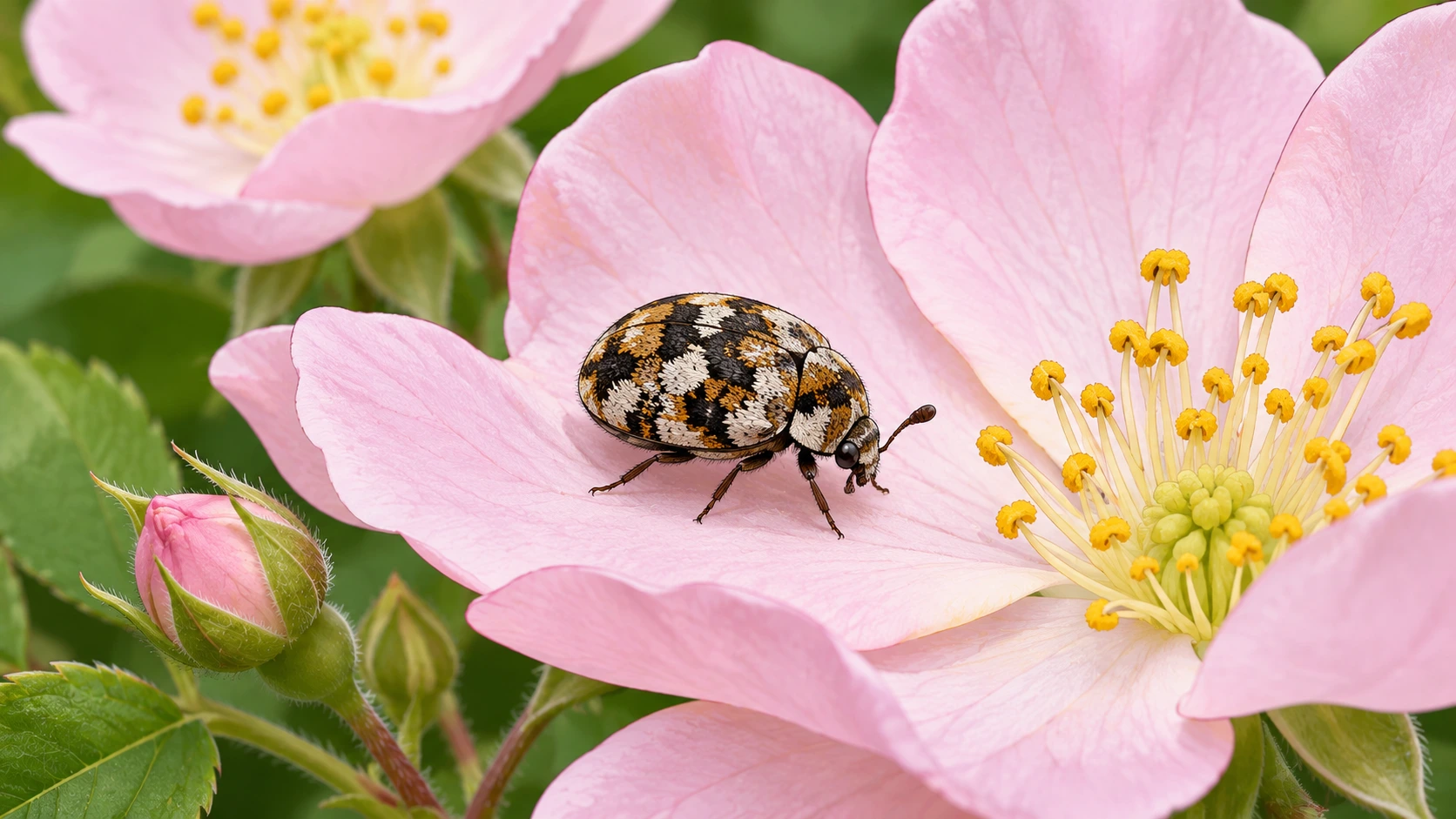
Carpet beetles can live outside your home. In fact, outdoor habitats are a normal part of life for several common carpet beetle species. Adults visit flowers, while larvae develop in sheltered places containing feathers, animal hair, dead insects, and other suitable organic material. Some carpet beetles can complete their development outdoors without ever entering a building. Despite their name, these insects did not evolve specifically to live in carpets. Their natural habitats include bird nests, abandoned insect nests, spider webs, and places where dried animal remains accumulate. Household carpets and clothing simply provide additional resources that certain species can exploit.
Where Do Carpet Beetles Live Outdoors?
Outdoor carpet beetles occupy different habitats depending on their life stage and species. Adults may be visible on flowering plants, while larvae generally remain concealed near suitable food.
The natural habitats of common carpet beetles include nests associated with birds, rodents, insects, and spiders. These places can contain feathers, fur, dried insects, and other materials that larvae can consume.
That gives carpet beetles opportunities to live in gardens, yards, wooded areas, and around buildings without depending on human belongings.
A flowering garden might support adult beetles even if no larvae are developing in the flower beds themselves. Conversely, an abandoned bird nest beneath a sheltered outdoor structure might support larvae without producing many visible adults.
For a homeowner, this means a beetle found outdoors should be interpreted in the context of its surroundings rather than automatically treated as a household pest.
Adult Carpet Beetles Commonly Visit Flowers
Adult carpet beetles are often found on flowers during warmer periods of the year. Many species feed on pollen or nectar, and flowering plants provide convenient gathering places.
Depending on the species, adults may visit daisies, wild asters, Queen Anne’s lace, spiraea, buckwheat, and other flowering plants that produce accessible pollen.
These flower-visiting habits of adult carpet beetles help explain why the insects may appear in gardens that contain no carpeting, stored clothing, or other household materials.
<AsyncImage query=”adult varied carpet beetle Anthrenus verbasci feeding on white daisy flower macro nature photograph” aspectRatio=”16:9″ width=”100%” maxHeight={280}/>
<caption>Adult varied carpet beetles are among the small beetles that may be seen visiting flowers outdoors.</caption>
The adult stage is especially easy to overlook because carpet beetles are small. A varied carpet beetle, Anthrenus verbasci, has a rounded body covered with irregular patches of light and dark scales. Against a pale flower, it may resemble a tiny mottled bead.
Not every adult carpet beetle species feeds in exactly the same way. Some adults feed on flowers, while others may feed little or not at all. The distinction matters when discussing what adult carpet beetles eat.
Finding a beetle on a flower also does not show where it developed as a larva. The adult may have emerged from an outdoor nest, a sheltered building space, or another source some distance away.
Where Do Carpet Beetle Larvae Live Outside?
The larval stage is less conspicuous because it typically develops in protected locations containing suitable food.
Unlike adults visiting flowers, larvae of common household carpet beetle species often feed on dried animal materials and organic remains. Outdoors, these resources may be concentrated in nests, webs, and sheltered spaces where insects or animals have lived.
Several environments are particularly relevant.
Bird nests
Bird nests are well-documented natural habitats for carpet beetles. They may contain feathers, shed skin material, dead insects, and other animal-derived debris that can support larvae.
A nest does not have to contain living birds to provide food. Old nesting materials can remain suitable for some scavenging insects after the birds have departed.
Carpet beetles are among the insects that may occupy bird nests, using organic debris rather than attacking the birds themselves.
The larvae of varied carpet beetles can occur in bird and mammal nests outside homes. These habitats help explain how the same species can exist naturally outdoors and also become associated with household fabrics.
Finding a carpet beetle near an outdoor nest does not prove that the nest contains larvae. Direct evidence, such as correctly identified larvae within the nesting debris, provides a stronger basis for that conclusion.
Abandoned bee and wasp nests
Some carpet beetles also develop in association with bee and wasp nests.
Old nests may contain dead insects, shed skins, wax, pollen, and other organic material. Certain carpet beetle larvae can use parts of this debris as food.
Varied carpet beetle females have been observed seeking sites such as bee and wasp nests for egg laying. Their larvae can then develop on materials associated with the nests.
This does not mean carpet beetles are social parasites that organize colonies inside wasp nests. They are scavenging beetles that exploit suitable resources when those resources are available.
An abandoned nest and an active nest also present different safety considerations. Never disturb a potentially active bee or wasp nest merely to look for carpet beetles. If a nest presents a genuine hazard, have it assessed by an appropriate professional.
Spider webs and accumulated insect remains
Spider webs can trap insects that eventually die and dry out. These remains may provide food for certain carpet beetle larvae.
Sheltered webs beneath outdoor structures, behind fixtures, or in protected crevices can collect insect remains over time.
The relevant resource is not simply the webbing itself. It is the collection of dead insects and associated organic debris.
A clean, recently constructed spider web may offer little food, while an older web containing numerous dried insects may support scavenging larvae.
Dead animals and animal-associated debris
Dried animal remains can also support dermestid beetles, including some carpet beetle species.
A dead bird or small mammal may provide different resources as it decomposes and dries. Certain dermestid larvae are especially well adapted to consuming dried animal tissue, skin, and hair.
However, not every beetle feeding on a carcass is one of the common household carpet beetles. Dermestidae is a much larger family containing many species with different feeding habits.
Identification matters before assuming an insect found on animal remains is a varied, furniture, or black carpet beetle.
The ability of some carpet beetle larvae to feed on animal-derived debris is part of the wider range of materials carpet beetle larvae consume.
Can Carpet Beetles Complete Their Entire Life Cycle Outside?
Yes. Suitable outdoor habitats can support egg laying, larval feeding, pupation, and adult emergence.
For example, a female varied carpet beetle may lay eggs in an animal nest containing suitable larval food. The larvae hatch and feed within that protected material. After completing their development and pupating, adults emerge and may visit nearby flowers.
The common carpet beetle, Anthrenus scrophulariae, provides another documented example. Its adults live outdoors and visit flowers, while females may deposit eggs in animal nests, bee hives, or on dead animals.
These behaviors show that outdoor reproduction is not merely a possibility inferred from adult sightings. At least some common carpet beetle species have well-established outdoor breeding habits.
Development does depend on conditions. Larvae need suitable food and an environment in which they can survive. Temperature, moisture, exposure, and the quality of the food source can all affect their success.
An exposed patio or patch of lawn is not automatically a breeding site just because a beetle passes through it.
Outdoor Habitat Versus Breeding Site: How to Tell the Difference
One of the most useful ways to interpret outdoor sightings is to separate locations where adult beetles are active from locations where larvae can actually develop.
The following comparison summarizes that distinction using documented carpet beetle behaviors.
| Outdoor location | What may be happening | Evidence of breeding |
|---|---|---|
| Flowering garden | Adult beetles visiting flowers | Adults alone do not establish local breeding |
| Old bird nest | Larvae feeding on feathers, insect remains, or other debris | Larvae or cast skins associated with nesting material |
| Abandoned bee or wasp nest | Some species exploiting insect and nest debris | Correctly identified larvae within the material |
| Sheltered spider web | Larvae using accumulated dead insects | Larvae feeding among insect remains |
| Dried animal remains | Suitable food for certain dermestid larvae | Larvae identified at the remains, with species confirmation where necessary |
| Clean exterior wall or patio | An adult resting or moving across a surface | No breeding evidence from location alone |
This distinction prevents two opposite mistakes. The first is assuming every outdoor beetle is a sign of a problem. The second is assuming that outdoor carpet beetles never reproduce near buildings.
An adult visiting a daisy may be doing nothing more than feeding. Several larvae within an old nest show a much closer association with a potential breeding source.
Still, finding larvae in an outdoor nest does not prove that your house is infested. The outdoor and indoor environments must be assessed separately.
Do Carpet Beetles Live in Grass, Soil, or Garden Beds?
Carpet beetles can occur in gardens, but ordinary grass and soil are not their principal documented food sources.
Adult beetles may rest on plants or travel over the ground while moving through their environment. That does not mean they are feeding on grass roots, eating living leaves, or tunneling through soil like certain other insects.
Likewise, a larva might pass through leaf litter or a sheltered garden area without using the surrounding material as its main food.
The most convincing outdoor breeding locations are those containing suitable dried organic resources, especially animal-derived debris.
Some carpet beetle species can also use certain dried plant products, but that should not be expanded into a claim that they commonly breed throughout healthy lawns or ordinary garden soil.
If you find a hairy larva in a flower bed, identification is important. Numerous unrelated beetles, caterpillars, and other insects have larvae that may appear fuzzy or bristly.
Can Carpet Beetles Live Around Porches, Sheds, and Garages?
Yes. Outdoor-adjacent structures can provide suitable habitats when they contain the right materials.
A shed may hold an abandoned bird nest, old animal-associated debris, or a collection of dead insects. A covered porch may contain spider webs filled with insect remains. An outbuilding may provide sheltered nesting locations for birds or other animals.
The structure does not create a carpet beetle food source by itself. Its importance comes from the materials that accumulate there and the protection it offers.
This is especially relevant to rarely disturbed spaces. Suitable organic debris may remain in place long enough for larvae to feed and develop.
A beetle on an exterior wall is much less informative than a larva found among dried insects beneath a sheltered ledge.
These situations are also distinct from the question of carpet beetles living inside wall voids, where concealed food resources may be associated with the building itself.
Do Carpet Beetles Survive Outdoors During Winter?
Outdoor survival depends on the species, developmental stage, climate, and protection offered by the habitat.
Carpet beetles are not limited to warm indoor environments. Some species have life cycles adapted to seasonal conditions outdoors, with development or emergence timed in ways that help them survive periods when flowers and other resources are less available.
Varied carpet beetles, for example, can undergo a resting period during larval development that helps synchronize their seasonal life cycle.
That does not mean every carpet beetle remains active outside throughout winter. Freezing conditions, exposure, and the availability of protected shelter can limit survival.
A sheltered nest and an exposed surface are very different environments, even when both are outdoors.
Adult sightings also vary with the time of year. The relationship between outdoor conditions and the appearance of adult beetles is examined in when carpet beetle season occurs.
The key point is that a cold winter does not establish that all outdoor carpet beetles have died, particularly when suitable sheltered habitats remain.
Are Outdoor Carpet Beetles Harmful to Your Garden?
Carpet beetles are not generally considered pests of living garden plants in the same way that aphids, Japanese beetles, or leaf-feeding caterpillars are.
Adult flower visits are usually associated with pollen or nectar rather than destructive feeding on leaves, stems, or roots. Some species may contribute incidentally to pollen transfer while visiting blossoms, although their presence should not be interpreted as proof of an important pollination role.
The larvae also serve a natural scavenging function by consuming dried animal materials and insect remains.
That ecological role does not eliminate their potential to become pests when they develop on susceptible household belongings. It simply means their outdoor behavior is not inherently harmful.
We would not treat a garden merely because several adult carpet beetles were found on flowers. Those sightings alone do not establish plant damage or an indoor infestation.
Does Finding Carpet Beetles Outside Mean They Are Inside Too?
No. An outdoor population does not automatically indicate an indoor infestation.
Carpet beetles can reproduce in natural habitats without using a house as a breeding location. Similarly, adult beetles may be present on outdoor flowers even when no larvae are developing inside the building.
The evidence needed to establish an indoor problem is different. Larvae, shed skins, and damage associated with susceptible materials indoors are more meaningful than adults found outside.
Even a beetle discovered beside an exterior window cannot tell you where it developed. Adults can move between locations, so the visible sighting point is not necessarily the breeding site.
That is why carpet beetles appearing near windows should be interpreted differently from confirmed larvae feeding in household materials.
If you notice one adult indoors, its presence alone does not justify assuming the building contains a breeding population. The same evidence-based approach applies when only one carpet beetle has been found.
Should You Remove Outdoor Carpet Beetle Habitats?
Finding outdoor carpet beetles does not automatically require habitat removal.
Adult beetles visiting flowers are behaving normally, and there is generally no reason to spray flowering plants to eliminate them. Insecticide use on flowers can also expose pollinators and other beneficial insects.
When larvae are developing in an old nest attached to a building, the situation may deserve closer evaluation. The important questions are whether the nest is active, whether the insects have been correctly identified, and whether there is evidence of a building-related pest problem.
Do not disturb occupied bird nests or active bee and wasp colonies merely because carpet beetles may occur in similar habitats. Wildlife protections and nest-removal rules vary by location, and disturbing active nests can harm animals or expose people to stings.
An abandoned nest may eventually be removed where it is legal and safe to do so, but the presence of an outdoor beetle is not sufficient justification on its own.
Routine landscape-wide insecticide applications are not an appropriate substitute for identifying a specific problem and its source.
Frequently Asked Questions
Are carpet beetles naturally outdoor insects?
Yes. Several common carpet beetle species occupy natural outdoor habitats. Adults may visit flowers, while larvae develop in bird nests, insect nests, and other places containing suitable organic material.
Do carpet beetles live in trees?
They may occur in or around trees when suitable habitats are present, such as bird nests, sheltered crevices, or other accumulations of animal-associated debris. The presence of a beetle on a tree does not mean it is feeding on living wood.
Can carpet beetles lay eggs outside?
Yes. Females of some species lay eggs in outdoor animal nests, bee and wasp nesting areas, or other protected places containing larval food. Not every adult seen on a flower is laying eggs there.
Are carpet beetles found on flowers dangerous?
Adult carpet beetles on flowers are not normally a danger to people, pets, or living garden plants. They do not sting, and the adults are not the stage responsible for typical carpet beetle fabric damage.
Can carpet beetle larvae live outdoors without carpet?
Yes. Carpet is not a requirement for their survival. Depending on the species, larvae can develop on feathers, dried insects, animal hair, and other materials found in natural outdoor habitats.
Does seeing carpet beetles in my yard mean I need pest control?
Usually not. Adult beetles visiting flowers are not sufficient evidence of a pest problem. Intervention becomes more relevant when correctly identified larvae are associated with damage to susceptible materials or a confirmed source affecting the building.
The Bottom Line
Carpet beetles are not strictly indoor insects. Outdoor flowers provide resources for many adults, and natural nests or accumulations of dried animal material can support larvae through development.
The difference between an adult visiting a flower and larvae feeding inside a sheltered nest is essential. Both are normal possibilities, but only the second provides direct evidence of local development.
Seeing carpet beetles outdoors is therefore not a reason to assume your home is infested. What matters is the life stage you find, the material available nearby, and whether there is evidence of larvae developing where they could cause a problem.