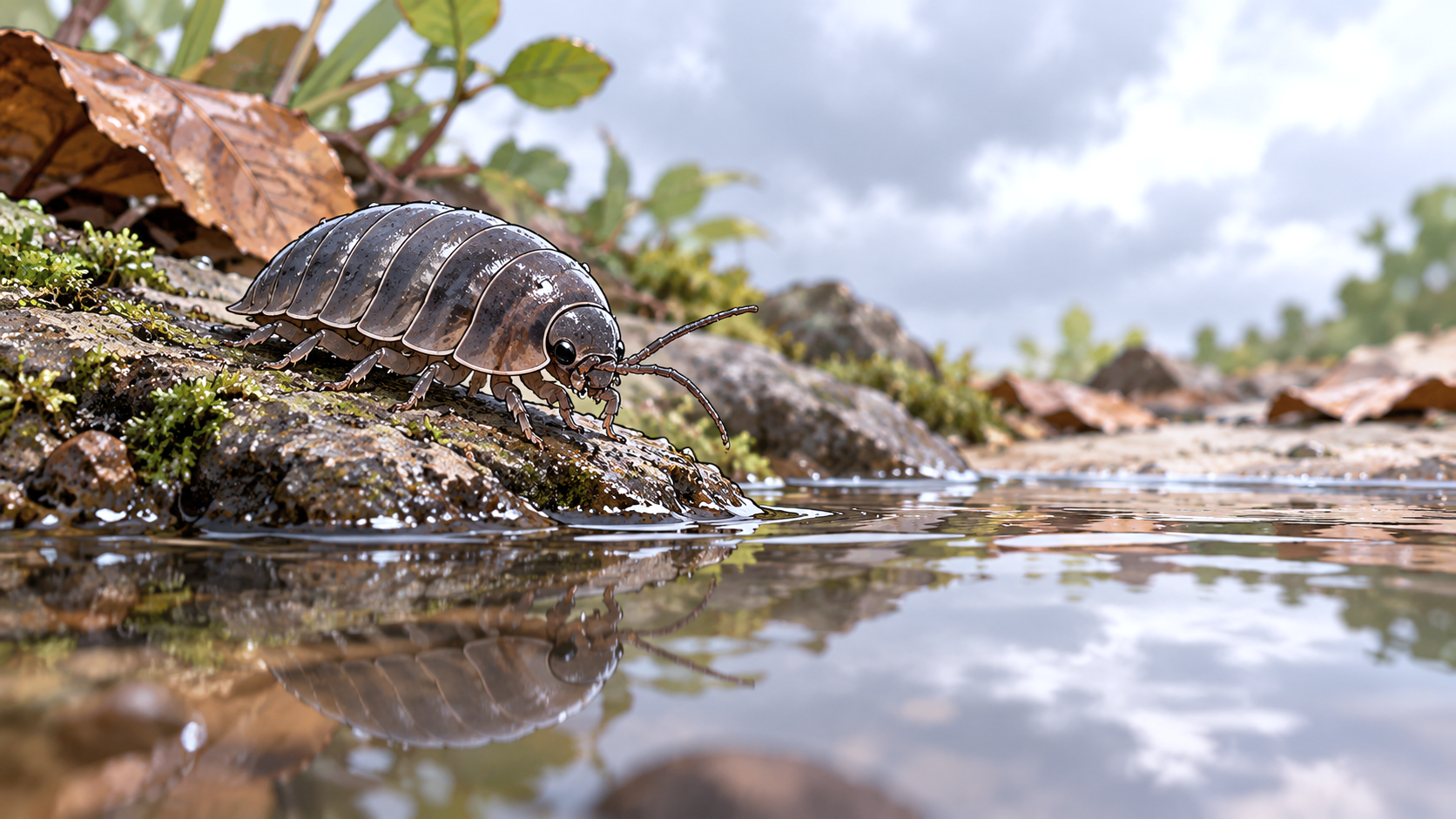
Common roly-polies such as Armadillidium vulgare cannot swim and are not adapted to breathe normally underwater. They can survive temporary submersion, but prolonged immersion interferes with gas exchange and can eventually cause death from oxygen deprivation. How long an individual survives varies with species, water conditions, temperature and duration of immersion. Their identity as terrestrial crustaceans rather than insects sometimes creates confusion. Crustacean ancestry does not mean a modern land-dwelling pillbug retains the aquatic abilities of crabs, shrimp or fully aquatic isopods.
A Roly-Poly in Water Is Not Swimming Like an Aquatic Isopod
An A. vulgare that falls into water may move its legs, struggle against the surface or be carried by currents. Those movements can resemble paddling, especially in a shallow container, but they do not amount to effective swimming. Behavioral descriptions of the common pillbug identify water as an obstacle and specifically note that A. vulgare cannot swim.
The distinction becomes clearer when terrestrial pillbugs are compared with genuinely aquatic members of the order Isopoda. Isopods include marine and freshwater species as well as the land-adapted suborder Oniscidea. Even within Oniscidea, the relationship with water varies considerably. Coastal forms such as Ligia retain much greater aquatic capability than fully terrestrial species, while the familiar garden pillbug has become strongly specialized for life on land.
A common roly-poly’s seven pairs of walking legs work effectively on solid surfaces but do not turn it into an efficient swimmer. If one is struggling in a bucket, pond or other body of water, reaching dry ground is more useful to it than remaining submerged.
Being a Crustacean Does Not Give a Pillbug Aquatic Respiration
The respiratory structures of terrestrial isopods evolved as their ancestors adapted to life outside water. In Armadillidium and several other land-adapted groups, specialized pleopodal lungs provide substantial surface area for gas exchange in air. Comparative work on Oniscidea describes A. vulgare as possessing highly developed pleopodal lungs with branching pseudotracheae.
Those structures still require appropriate moisture conditions, which contributes to the close association between pillbugs and humid, sheltered places. Moist respiratory surfaces and an ability to function while completely submerged are different adaptations. Recent research on the evolution of terrestrial-isopod respiratory organs describes pleopodal lungs as innovations that facilitated gas exchange on land, with different lineages retaining different combinations of ancestral gill-like and derived lung structures.
Submerging a common pillbug therefore changes the medium across which respiratory gases must move. Water contains far less available oxygen per unit volume than air, and oxygen diffuses much more slowly through water. A structure that performs effectively in air does not automatically continue exchanging enough oxygen when surrounded by water.
Experiments Show a Sharp Loss of Aquatic Performance in Fully Terrestrial Species
Direct immersion experiments provide stronger evidence than assumptions based on crustacean ancestry. Researchers compared oxygen uptake and survival in A. vulgare, Porcellio scaber, Oniscus asellus and the shoreline species Ligia pallasii. The three fully terrestrial species had much lower oxygen uptake in water than in air, while Ligia performed far better under aquatic conditions. For the terrestrial species, aquatic oxygen uptake was only 44% to 66% of their rate in air.
The survival results were equally revealing. Most submerged A. vulgare, P. scaber and O. asellus were dead by 18 hours under the experimental conditions, whereas L. pallasii survived much longer. The authors concluded that the fully terrestrial species had undergone an evolutionary reduction in both aquatic gas-exchange ability and immersion tolerance.
Another physiological study found differences in lactate accumulation when terrestrial and shoreline isopods were immersed, again demonstrating that species adapted to periodically submerged coastal environments respond differently from fully terrestrial forms. Tolerance of immersion varies substantially across Oniscidea, so results from a sea slater cannot be used to predict how long a garden pillbug will survive underwater.
Short Submersion Does Not Mean Instant Drowning
A roly-poly that falls into water is not necessarily dead within minutes. Historical ecological experiments on A. vulgare placed animals in pond water for different periods. All individuals submerged for one hour or less survived that particular experiment, although animals removed after an hour were described as sluggish. Mortality appeared after longer exposures, with the results varying according to immersion duration. (porcellio.nl)
Those results cannot be converted into a universal rule such as “a roly-poly can survive underwater for one hour” or “it drowns after 18 hours.” Experimental temperature, dissolved oxygen, water chemistry, species, physiological condition and recovery conditions can all affect the outcome. Research comparing terrestrial and littoral isopods found that some shoreline forms tolerate prolonged immersion far better than fully terrestrial species.
The practical conclusion is narrower: brief accidental immersion can be survivable, while extended submersion presents a serious respiratory challenge. A living pillbug found in water is best removed rather than left submerged to test its tolerance.
Moisture Is Essential Without Making Water an Appropriate Habitat
Roly-polies face an unusual balance on land. They need humid conditions and lose water readily, yet too much water in the form of prolonged complete submersion can prevent normal respiration. Research comparing terrestrial isopods has found major species differences in desiccation resistance and respiratory adaptations, helping explain why some tolerate relatively dry environments while others remain closely restricted to damp refuges.
The common pillbug is particularly successful at conserving water for a terrestrial isopod. It can also reduce water loss when it rolls into a defensive ball. Neither adaptation turns standing water into suitable habitat. The conditions that keep a roly-poly hydrated are normally damp soil, humid air and protected surfaces rather than continuous immersion.
Water exchange itself differs among terrestrial-isopod species. Experiments comparing several woodlice found A. vulgare at the lower end of measured water influx from moist surroundings, illustrating how extensively this species has shifted toward terrestrial water regulation. Water exchange changes according to both species and environmental moisture, so “they need moisture” cannot be translated into “they belong underwater.”
Questions About Roly-Polies in Water
What should you do if you find a roly-poly in a pool or bucket?
If it is still alive, lift it from the water and place it on damp ground beneath suitable cover. There is no advantage in keeping it submerged, even if it continues moving underwater.
Can heavy rain drown roly-polies?
Flooding can submerge terrestrial isopods, but the outcome depends on how long they remain underwater and the conditions there. Short immersion can be survivable, while sustained flooding can exceed the tolerance of fully terrestrial species.
Why are roly-polies often found near damp soil if they cannot live underwater?
Damp terrestrial refuges help limit dehydration without forcing the animal to remain submerged. Moisture availability is one reason roly-polies concentrate beneath leaves, logs, stones and other ground cover.
Can roly-polies live in an aquarium?
A conventional water-filled aquarium is unsuitable for common terrestrial pillbugs. They require a terrestrial enclosure with appropriate substrate, moisture and access to air rather than permanent submersion.
Are water lice the same animals as roly-polies?
No. Aquatic isopods and terrestrial pillbugs belong to the broader order Isopoda, but they represent different groups with different adaptations. Their shared crustacean ancestry does not make their environmental requirements interchangeable.