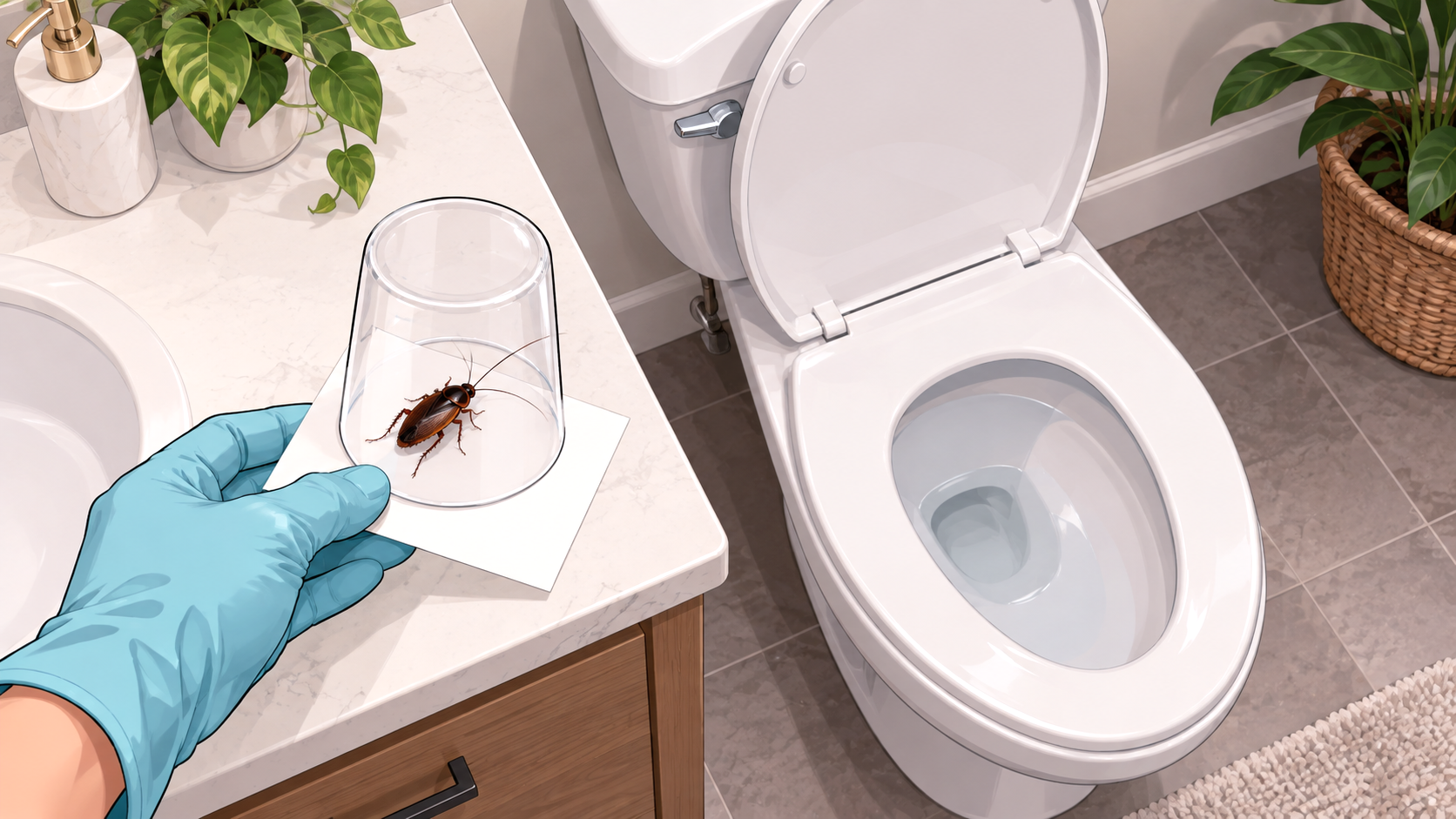
A cockroach dropped into a toilet may float, struggle at the surface, or disappear when the water is flushed. Once it vanishes, there is no easy way to know whether it drowned, survived the journey through the pipes, or became trapped somewhere in the wastewater system. You can physically flush a cockroach down the toilet, but flushing does not guarantee that it dies. The force of the water may carry it beyond the toilet, while the insect’s ability to survive brief water exposure means that disappearance is not proof of death. Capturing and disposing of the cockroach in a sealed bag is a more controlled alternative.
A single cockroach is unlikely to block a properly functioning toilet, but plumbing systems are designed to carry human waste and toilet paper, not serve as a general pest-disposal method.
Does Flushing a Cockroach Actually Kill It?
The flush creates a sudden movement of water that may submerge, tumble, and transport the cockroach through the toilet’s internal trap and connecting drainage pipes. None of those actions guarantees immediate death.
Cockroaches are terrestrial insects, but brief immersion is not necessarily fatal. Their response depends on the species, the duration of submersion, access to air, and whether the insect becomes physically trapped.
A 2026 study published in Nature Communications compared ordinary cockroaches with experimental cockroaches fitted with specialized underwater breathing equipment. The unprotected control insects became incapacitated within minutes of complete submersion. However, those laboratory conditions differ from a household toilet, where an insect might remain at the surface, encounter air pockets, or experience only intermittent immersion.
The ability of cockroaches to survive in water therefore does not translate into a fixed survival time after flushing.
A cockroach that passes through the toilet may subsequently drown, suffer mechanical injury, or survive temporarily farther along the drainage system. There is no reliable household observation that can distinguish those outcomes once the insect disappears.
Can a Flushed Cockroach Crawl Back Up the Toilet?
A cockroach successfully carried beyond the toilet’s internal trap would have to navigate the plumbing system and pass through the toilet’s water seal to return by the same route.
Modern toilets incorporate a curved trap containing water. Its primary purpose is to prevent sewer gases from entering occupied rooms, but the water seal also provides a physical barrier to pests.
The International Association of Plumbing and Mechanical Officials explains that properly maintained plumbing traps help prevent vermin from entering buildings through drainage systems. Toilets contain integral traps, unlike fixtures that require separate traps beneath them.
A cockroach that has passed completely through a functioning trap is therefore unlikely to return through the same toilet. The immediate possibility is different when the insect was never carried beyond the bowl or remains on an accessible surface.
If a cockroach appears near the toilet after an earlier flushing, it does not prove that the same insect returned. Another cockroach may have been present in the bathroom.
The movement capabilities of different cockroach species also mean that a bathroom sighting cannot establish the route an insect used to reach that location.
What Happens to a Cockroach After It Goes Down the Pipes?
In a property connected to municipal sewers, flushed material travels from the toilet through the building’s wastewater piping and eventually toward the sewer network. Where a septic system is installed, it travels toward the septic tank instead.
The precise outcome for a cockroach cannot be predicted from the flushing action alone. The insect may be carried into wastewater, trapped in accumulated material, or killed by conditions encountered along the way.
According to the EPA’s explanation of residential toilet performance, toilets are tested for their ability to transport waste through the fixture and connected drainline. Successfully clearing the bowl establishes that material has been transported, not that any living organism within it has died.
The American cockroach and certain other species can occupy sewer-associated environments. However, a flushed individual surviving somewhere in the wastewater system would not necessarily establish a new population.
The differences between cockroach species influence which environments are suitable for their survival. A German cockroach originating in a heated kitchen does not have the same environmental preferences as an American cockroach associated with damp utility infrastructure.
Is Flushing One Cockroach Bad for Your Plumbing?
A single cockroach is generally too small to obstruct an otherwise functioning toilet. The greater plumbing risk comes from the materials people sometimes flush with it.
Paper towels, disposable cleaning wipes, plastic bags, cotton products, and similar objects may fail to break down in wastewater systems. The EPA advises flushing only human waste and toilet paper to protect household plumbing, sewer systems, and septic installations.
Do not wrap a cockroach in a thick paper towel and flush the entire bundle. Similarly, plastic containers and bags used to capture insects belong in the rubbish, not the toilet.
The EPA’s septic-system guidance also warns against flushing pesticides, solvents, and other household chemicals. These substances can interfere with biological wastewater treatment and create environmental hazards.
Adding insecticide, bleach, or another chemical to the toilet specifically to kill a cockroach is unnecessary. Mixing toilet-cleaning products can also produce dangerous reactions, particularly when bleach contacts incompatible chemicals.
Is It Better to Flush a Dead Cockroach?
A cockroach that has already been killed presents no uncertainty about surviving the flush, but ordinary rubbish disposal is still preferable.
Collecting the insect with a tissue, placing it in a small disposable bag, and sealing the bag avoids introducing additional material into the wastewater system. It also allows any associated debris to be removed from the original surface.
The practical considerations involved in squishing a cockroach include cleaning away bodily fluids and fragments. Flushing the remains does not remove contamination left where the insect was killed.
If the cockroach was found on a countertop or another frequently touched surface, clean the affected area with detergent and water. The CDC’s household cleaning guidance explains that routine cleaning removes dirt and many germs without requiring additional disinfectants in every situation.
Avoid handling dead cockroaches with bare fingers, and wash your hands after disposal.
What if the Cockroach Is Already Floating in the Toilet?
An insect floating in the bowl is not necessarily dead. It may be struggling, temporarily immobilized, or resting at the water surface.
If it remains accessible and you want to avoid flushing, use a disposable container or another suitable tool to collect it without touching the toilet water. Keep the container above the bowl while transferring the insect into a secure disposal bag, taking care to avoid splashing.
A cockroach that is completely motionless should not automatically be assumed dead. The difference between rapid incapacitation and confirmed cockroach death is particularly relevant when an insect has been exposed to water or another stressful condition.
If the cockroach has already been flushed, there is no reason to dismantle the toilet or introduce chemicals into the plumbing to determine its fate.
Does Flushing a Cockroach Get Rid of the Problem?
Flushing removes one visible insect from the bathroom, but it cannot establish whether additional cockroaches remain elsewhere.
If that cockroach entered accidentally, the sighting may be isolated. Repeated appearances, particularly involving small nymphs, suggest activity that requires assessment beyond disposing of individual insects.
The EPA’s integrated pest management principles emphasize pest identification and monitoring rather than assuming that removing visible insects resolves their source. The signs used to determine whether cockroaches are actually gone include sustained absence of live activity and captures, not merely the disappearance of one insect into a toilet.