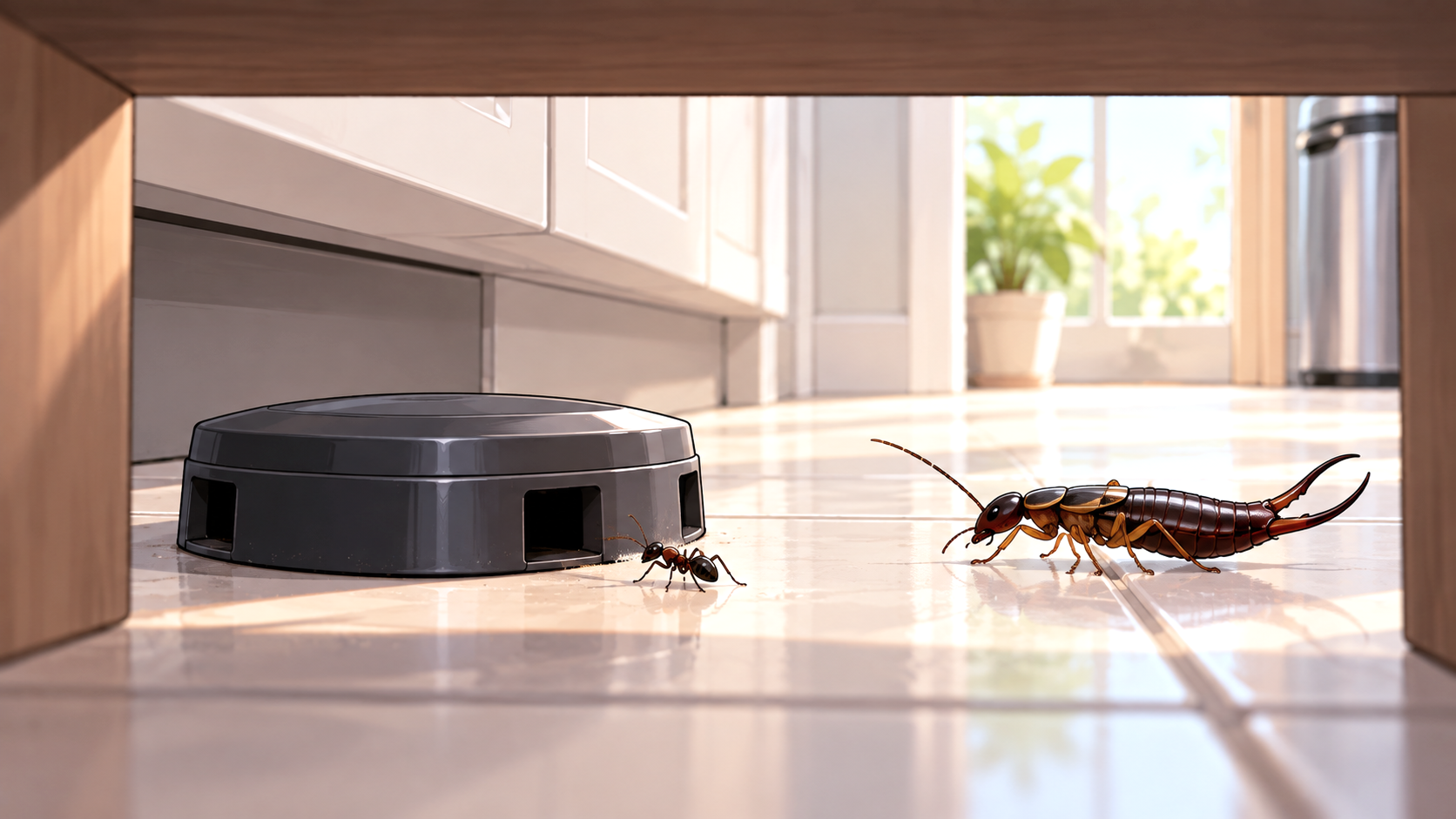
You can use certain sticky insect traps to catch earwigs, but ordinary ant bait stations are generally unreliable for controlling them. Products such as TERRO Liquid Ant Baits and Combat Max Ant Bait are designed around ant feeding behavior, not earwig activity. An earwig might encounter the insecticide inside a station, but there is no dependable evidence that these ant-specific products attract or control earwigs.
The type of trap makes a considerable difference. A sticky trap captures an insect that walks onto its adhesive surface, while a poisoned bait station requires the insect to enter and eat the bait. Earwigs can be caught by the first mechanism without responding to the food attractants used in the second.
Why Liquid Ant Bait Stations Are Unreliable for Earwigs
TERRO Liquid Ant Bait stations contain a sweet liquid formulated to attract certain household ants. Worker ants consume the bait and share it with other members of their colony, eventually delivering the insecticide to individuals that never visited the station.
The TERRO T300 Liquid Ant Bait contains 5.40% sodium tetraborate decahydrate, commonly called borax. Its published target list includes numerous sweet-feeding ants but does not include earwigs.
An earwig may be physically capable of encountering the liquid, but several uncertainties remain. It must discover the station, fit through the entrance, find the bait attractive, and consume enough to be affected. The product’s performance against ants does not establish that those conditions will occur with earwigs.
Earwigs are opportunistic feeders rather than insects specializing in the sweet liquid diets targeted by many household ant stations. Their varied indoor food sources include decomposing plant matter and small arthropods. That dietary flexibility does not establish that they will accept an ant bait at a useful rate.
There is also a difference in how the poison spreads. Ant bait stations are designed partly around colony feeding and food sharing. European earwigs do not have the same social food-distribution system as ants, so the advertised colony-elimination mechanism cannot be transferred to them.
An ant station sitting beside an earwig entry point is therefore not evidence that earwigs entering the area will consume its contents.
What About Combat Ant Bait Stations?
Combat Max Ant Bait uses fipronil, an insecticide capable of killing various susceptible arthropods. The Combat Max Ant Bait manufacturer’s information identifies household ants as the target and describes how workers transport the bait back to their colony.
Fipronil’s insecticidal activity alone does not establish that Combat stations work against earwigs. The bait mixture must be accepted by the insect, and the station’s physical design affects access.
Combat describes its ant stations as having small entrances suited to ants. An adult earwig is substantially larger than many household ant species, so it may be unable to enter a particular station or feed comfortably inside it. Access depends on the exact station design and the insect’s size.
Even if an earwig enters, the manufacturer does not provide an earwig-specific mortality rate for the identified Combat Max Ant Bait. Its advertised protection period concerns ant control rather than sustained earwig reduction.
The Combat Max 2-in-1 Ant Bait Station likewise targets ants, despite containing an insecticide capable of affecting other insects under suitable exposure conditions.
Breaking open a bait station to make its contents accessible is not an appropriate workaround. It defeats the station’s protective design, can expose children and pets, and may violate the product’s application instructions.
Are Ant Bait Stations Legally Usable Against Earwigs?
In the United States, pesticide labeling governs where and how a product can be applied. However, the absence of a particular insect from the target list does not automatically make every use against that insect illegal.
Under FIFRA Section 2(ee), certain applications against pests not named on a label may be permitted when the pesticide is used at an approved site and no other restrictions prohibit the use. The EPA’s interpretation of unlisted target pests explains this exception.
That legal distinction does not make ant stations effective against earwigs or permit modifying their design. A product restricted to particular insects, locations, or application methods must still be used according to those restrictions. State requirements and regulations outside the United States may differ.
The EPA’s pesticide-label guidance also makes clear that the label determines permissible handling, placement, and application.
For practical earwig control, choosing a product that explicitly lists earwigs avoids uncertainty about manufacturer-supported performance. An ant bait station whose instructions focus entirely on ant feeding is a poor choice when an earwig-specific option is available.
Can Sticky Ant Traps Catch Earwigs?
Sticky traps are more promising because they do not require the insect to consume a specially formulated bait. An earwig that walks onto an exposed adhesive surface may become trapped regardless of whether it finds the product attractive.
For example, TERRO Spider & Insect Traps are adhesive boards intended to capture various crawling insects, including ants, cockroaches, crickets, and spiders. Earwigs are not specifically listed in the manufacturer’s principal examples, but their crawling behavior makes incidental capture possible.
This product differs from TERRO Liquid Ant Bait despite sharing the same brand. The sticky trap relies on physical entrapment; it does not contain the same liquid insecticide or use an ant colony’s feeding behavior.
A sticky board positioned across an established earwig travel route may catch individuals passing through that location. However, it will not reliably attract earwigs from distant shelters, and a trap collecting nothing does not prove that the surrounding area is free of them.
There are also welfare and safety concerns. Adhesive traps can capture spiders and other non-target organisms, and exposed glue may contact pets or wildlife. Use enclosed designs where appropriate, inspect traps frequently, and dispose of captured insects responsibly. Where insects can be removed without adhesive, a nonsticky collection method avoids prolonged entrapment.
Ant Traps vs. Earwig-Specific Baits
The strongest reason to avoid ordinary ant stations is the existence of products whose formulations actually include earwigs in their intended pest lists.
| Product type | Earwig suitability | Main consideration |
|---|---|---|
| TERRO liquid ant bait | Unreliable | Sweet liquid formulated for particular ants |
| Combat ant bait station | Unreliable | Ant-oriented food mixture and restrictive station entrances |
| General crawling-insect sticky trap | Possible physical capture | Earwig must walk onto the adhesive |
| Earwig-labeled granular insecticide bait | Specifically intended for earwig control | Insects must encounter and consume the granules |
| Removable nonadhesive shelter trap | Established earwig trapping method | Requires regular inspection and emptying |
An example of a purpose-made pesticide bait is Niban Granular Bait, which lists earwigs among its targets. Its formulation, placement directions, and intended pests differ from those of enclosed household ant stations.
The Nisus manufacturer’s information confirms that Niban is marketed for earwigs alongside cockroaches, ants, and several other pests. Nevertheless, its label governs where the bait may be placed, and granules must not be left accessible to children or pets.
Physical traps provide another option when insecticide exposure is unnecessary. Earwigs seek sheltered locations during daylight, and research on European earwig trapping supports the usefulness of appropriately designed cardboard shelters for monitoring populations.
The relevant comparison is therefore between a product whose attractant has been designed for ants and a method that takes advantage of earwig behavior.
Can You Tell Whether Earwigs Are Using an Ant Bait?
A bait station placed near earwigs is not enough to demonstrate consumption. Even when insects disappear after the station is installed, the change may be unrelated to the bait.
Direct observation would provide stronger evidence, but many enclosed stations conceal the feeding area. An earwig crawling across the exterior of a station does not establish that it entered or consumed insecticide.
The same problem affects interpretation of dead insects nearby. Earwigs may die for unrelated reasons, and a body found beside an ant station cannot identify the cause of death.
An ant colony responding to bait may also create a misleading impression that the product is controlling multiple pests. The manufacturer’s ant-specific results should remain separate from any unsupported assumptions about earwig mortality.
If you already have ant bait stations installed for an actual ant problem, there is no need to remove them solely because an earwig appears nearby. Continue using them according to their labeling for the intended pest. However, do not purchase additional ant stations specifically to address earwigs without evidence that the exact product is suitable.
When Should You Choose a Different Trap?
A few earwigs occasionally appearing indoors rarely justify purchasing poisoned bait stations. Collection is usually sufficient, while recurring activity is better evaluated by observing where fresh insects appear.
For example, an earwig repeatedly discovered beside a doorway may have entered through an accessible opening. An ant station beneath nearby furniture cannot determine whether the insect came from outdoors or was already inside. A physical monitoring trap may help identify movement, but it will not prevent future entry.
The use of removable shelters and other nonchemical earwig traps avoids relying on ant-specific attractants. Such methods are particularly useful when only a small number of insects need to be collected.
For persistent outdoor activity, trapping is most informative when positioned near the locations where earwigs have actually been observed. Their movement around lawn edges and garden shelters can help determine where monitoring is worthwhile.
Avoid placing several different pesticide baits in the same location without evidence that the products are needed. Additional stations can increase unnecessary pesticide use without providing meaningful information about earwig control.
The most useful purchasing decision is straightforward: do not rely on TERRO or Combat ant bait stations to control earwigs. If a sticky trap is needed, choose a suitable crawling-insect design and accept that capture depends on contact. If insecticidal bait is justified, select a product explicitly intended for earwigs and follow its specific placement restrictions.