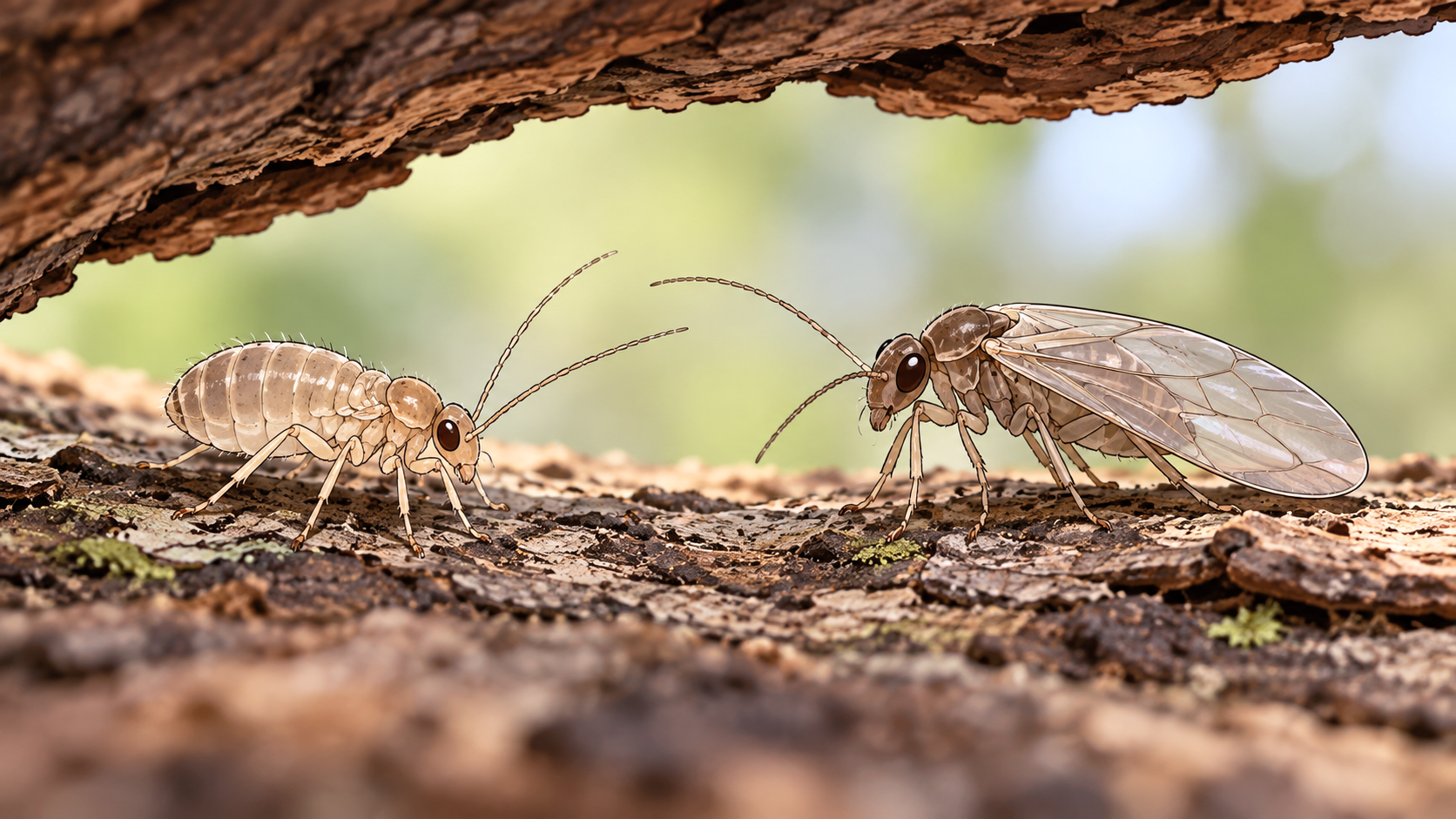
Seeing a tiny insect disappear across a wall can make it hard to tell whether it crawled, jumped, or flew. With booklice, the answer depends partly on which psocid you are looking at.
The booklice commonly found inside homes are wingless and cannot fly. However, booklice belong to a larger group of insects called psocids, and some psocid species have wings and can fly. Winged species are more commonly encountered outdoors and are often called barklice rather than booklice. So, if the tiny insects around your books, walls, or cupboards never take flight, that fits the usual indoor booklouse very well.
Do Booklice Have Wings?
Most booklice that become household pests do not have wings. Common indoor booklice include species in the genus Liposcelis, which are wingless psocids found inside buildings.
These insects have a soft, flattened body with long antennae and a relatively large head. Their lack of wings contributes to the simple body outline you see under magnification. A closer look at what booklice look like makes that wingless shape easier to recognize.
This is also useful when examining insects around paper, cardboard, or stored food. You should not expect to find folded wings hidden against the body of a typical indoor Liposcelis booklouse. They simply do not have functional wings.
Some Psocids Do Have Wings
The confusion starts because “booklice” and “psocids” are sometimes used as though they mean exactly the same thing.
Booklice belong to the insect order Psocodea. The broader psocid group contains both wingless and winged forms. Identification guidance therefore describes psocids as insects that may have four wings or be wingless.
Habitat helps make sense of the difference. The small wingless psocids commonly encountered indoors are called booklice. Many psocids that live outside have wings and are commonly called barklice.
That is why photographs labeled “psocid” can be confusing. One image might show something that looks exactly like a familiar wingless booklouse. Another might show an insect with obvious wings.
Both can belong to the broader psocid group without being the same kind of insect you are finding beside your books.
Can Booklice Fly?
The common wingless booklice found indoors cannot fly.
Without wings, they move across surfaces by walking or running on their six legs. A booklouse may move surprisingly quickly relative to its tiny body, which can make its movement difficult to follow with your eyes.
Still, rapid movement is not flight. A booklouse disappearing into a crack or behind a piece of paper has probably crawled out of sight rather than flown away.
Their size makes this easy to misread. Indoor booklice are commonly around 1 to 2 millimeters long, so even a short movement can be difficult to track. Understanding how small booklice are helps explain why they sometimes seem to vanish.
Can Winged Psocids Fly?
Yes. Winged psocids can fly.
Many of these insects live outdoors on trees, shrubs, bark, leaves, and similar surfaces. They are commonly called barklice. Most outdoor psocids have wings and are known as barklice, although the terminology used for psocids can vary.
Winged forms look noticeably different from the tiny booklice people usually discover indoors. Their wings alter the outline of the body and make them easier to recognize as winged insects when viewed closely.
Some outdoor psocids can occasionally end up indoors. A winged psocid inside your house therefore does not contradict the fact that the household booklice responsible for typical indoor infestations are usually wingless.
What Do Booklouse Wings Look Like?
For a typical indoor Liposcelis booklouse, there are no wings to inspect.
Winged psocids are different. Psocids as a group can possess two pairs of wings, giving a winged adult four wings. The wings are generally held over the body when the insect is resting.
The difference can be striking enough that someone familiar only with household booklice might not immediately recognize a winged psocid as a relative. Outdoor barklice are described as small, often winged, soft-bodied insects and may enter homes accidentally on materials brought indoors.
When identifying an insect from a photograph, therefore, the presence of obvious wings should make you consider a winged outdoor psocid rather than assuming you have found an unusual form of the indoor booklice living around your shelves.
Do Baby Booklice Have Wings?
The immature stages of booklice are called nymphs. They resemble smaller versions of the adults rather than passing through a wormlike larval stage.
For the wingless household species, the nymphs remain wingless as they develop into wingless adults. Their changing size and sometimes paler coloration are more noticeable than any change involving wings.
Booklice undergo simple metamorphosis, and nymphs resemble adults except for being smaller. Common building species usually pass through several nymphal stages before reaching adulthood.
The progression from egg to nymph to adult is covered separately in the booklice life cycle, while booklice nymphs focuses on recognizing the immature stages.
Booklice Do Not Jump Either
A tiny insect that suddenly launches itself away from you probably deserves another look.
Common indoor booklice crawl. They do not have the specialized jumping structure that gives springtails their characteristic escape movement. That difference can be extremely helpful because both pests can occur in moisture-prone areas.
Springtails can propel themselves away when disturbed, making them appear to disappear almost instantly. Booklice remain surface crawlers. Watching the insect move can therefore provide more useful identification evidence than trying to judge its exact color from a distance.
The difference becomes especially useful when separating springtails from booklice. If repeated attempts to approach your supposed booklice result in the insects springing through the air, booklice are unlikely to be the correct identification.
Why Do Wingless Booklice Spread Around a House?
Flight is not necessary for booklice to turn up in multiple places.
Their extremely small bodies allow them to crawl through tiny gaps and move across walls, shelves, cupboards, stored materials, and other connected surfaces. They may also be transported with infested or damp materials.
More importantly, their distribution often follows suitable environmental conditions. Booklice favor warm, damp places where mold and fungi grow. When several areas provide those conditions, booklice can occur in more than one location even though they cannot fly between them.
That makes moisture more informative than flight when you are trying to understand an indoor population. Persistent booklice often point toward the conditions explored in booklice and humidity, especially when they keep appearing around the same damp area.
A Flying Bug Near Your Books May Be Something Else
Finding a flying insect near a bookshelf does not automatically make it a winged booklouse.
Location is supporting evidence, not an identification. Many tiny insects can wander toward windows, lights, bookshelves, or stored materials. The insect’s actual anatomy matters more than where it happened to land.
Typical indoor booklice are soft-bodied, wingless insects with long antennae and a wide head. If your insects repeatedly take off and fly around the room, they do not fit the usual household Liposcelis booklouse.
A winged psocid remains possible, particularly when outdoor insects have entered the building. However, several unrelated insects can also be tiny and winged. Comparing the specimen against bugs that look like booklice is more useful than treating proximity to books as proof.
Other Questions About Booklouse Wings and Flight
Can booklice glide through the air?
Wingless household booklice do not have wings for powered flight or gliding. Their normal movement is across surfaces.
Why did a booklouse seem to fly when I touched it?
At their tiny size, losing sight of an insect for a moment can make crawling movement look more dramatic than it is. If the insect actually launches itself away, compare it with a springtail. If you can clearly see it flying with wings, it may be a winged psocid or another small insect.
Can booklice grow wings later?
A wingless Liposcelis booklouse does not suddenly develop into a flying household form after you find it. Wing presence depends on the kind of psocid involved, rather than being a temporary feature of an ordinary indoor booklouse.
Are winged booklice more dangerous than wingless ones?
Wings do not make psocids dangerous to people. Psocids are considered harmless to people and pets, and indoor booklice are primarily nuisance pests associated with moisture and fungal growth.
What Flight Tells You About the Bug You Found
If you are watching tiny insects around books, walls, cardboard, cupboards, or another damp indoor area, pay attention to how they move before trying to catch one.
An insect that stays on the surface and crawls fits the usual household booklouse. One that jumps deserves comparison with springtails. An insect that repeatedly takes off on visible wings requires a different identification check, since the common indoor booklice are wingless.
Once you confirm booklice, their inability to fly does not mean you can ignore repeated sightings in different rooms. Look instead for the conditions supporting them. Booklice thrive around moisture and fungal growth, and reducing relative humidity below about 45 to 50 percent makes indoor conditions unfavorable for them.
That environmental clue is far more useful than worrying about where they might be flying. When booklice continue appearing, finding where the booklice are coming from is the next useful step.
2 thoughts on “Do Booklice Have Wings? Can They Fly?”