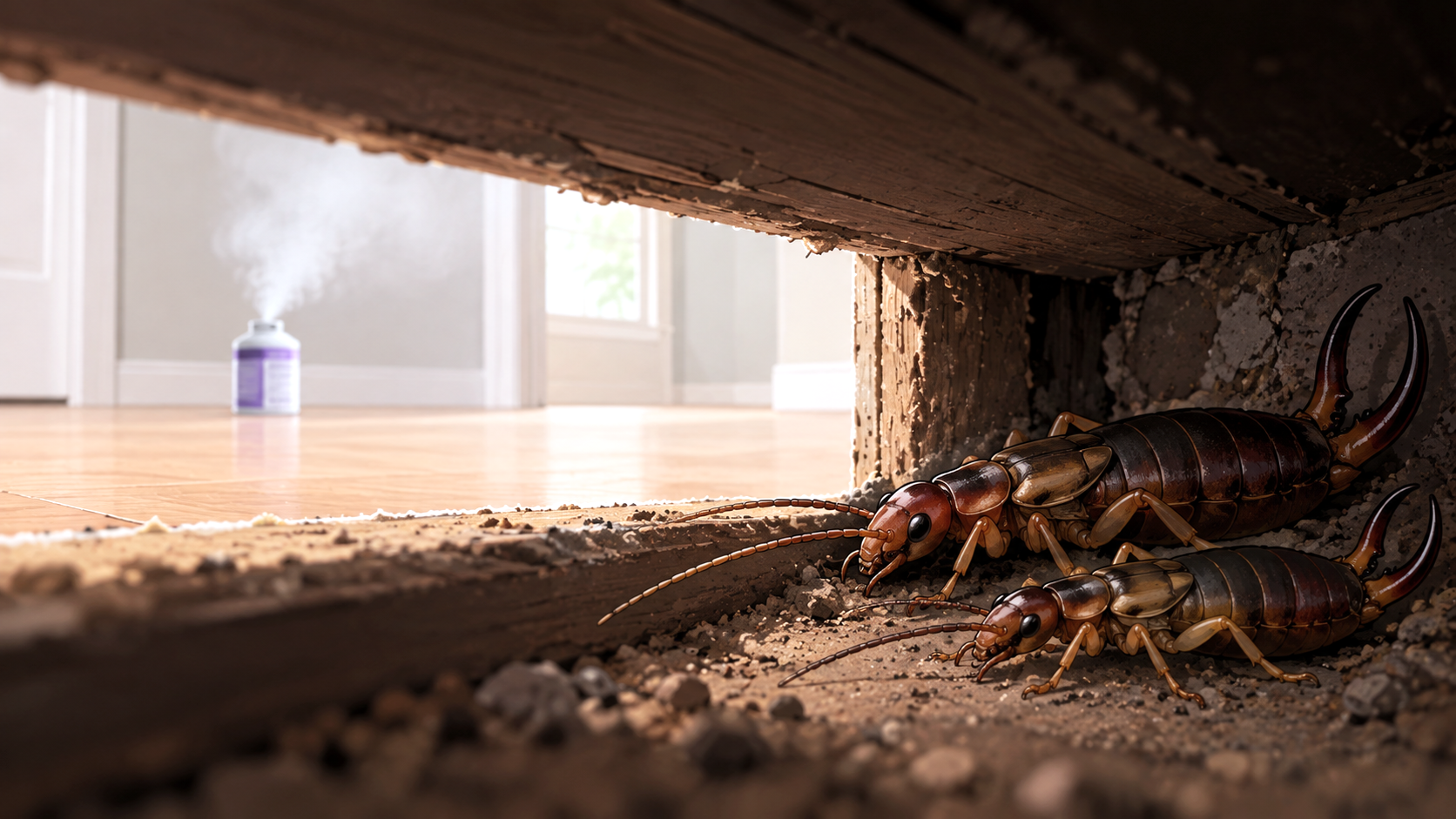
Bug bombs can kill earwigs, but they are generally a poor choice for controlling recurring earwig problems. Some total-release foggers, including Raid Max Concentrated Deep Reach Fogger, explicitly list earwigs among the insects they kill. However, the pesticide must reach the insects, and earwigs concealed in cracks, wall voids, or other protected spaces may escape exposure.
A fogger can kill some insects without resolving the original problem. Earwigs that remain outside the building can also enter after treatment. Because total-release foggers introduce insecticide throughout a room and carry significant fire and exposure hazards, they are rarely justified for occasional indoor earwigs.
Which Bug Bombs Are Labeled to Kill Earwigs?
Bug bombs are officially called total-release foggers. They contain an insecticide and a propellant that automatically discharge into an enclosed area after activation. Not every product has the same ingredients, target pests, or approved treatment locations.
Two Raid formulations explicitly include earwigs in their published pest lists.
| Fogger | Earwig claim | Important limitation |
|---|---|---|
| Raid Max Concentrated Deep Reach Fogger | Earwigs listed among insects killed | Cannot guarantee exposure inside protected spaces |
| Raid Flea Killer Plus Fogger | Earwigs listed among insects killed | Primarily marketed for flea control; its flea-specific residual claims should not be applied to earwigs |
The Raid Max Concentrated Deep Reach Fogger is sold as a concentrated indoor fogger for numerous crawling and flying insects. Its manufacturer states that one 2.1-ounce container treats up to 7,000 cubic feet, subject to the product’s detailed room-size restrictions.
Raid Flea Killer Plus Fogger also lists earwigs. Although it advertises extended flea control, that claim does not establish the same duration of protection against earwigs.
Product names and packaging can change, so the specific container’s label must be checked before purchase. An indoor fogger that lists cockroaches, ants, or spiders does not automatically have an approved earwig-control claim.
The EPA’s pesticide-use guidance recommends using fogging devices only when necessary. An earwig listed on a fogger label establishes an authorized target, not that fogging is the most suitable method for the infestation.
Why Foggers Often Miss the Earwigs You Want to Kill
A bug bomb releases pesticide droplets into the air. These droplets move through the exposed space and settle on accessible surfaces, but they do not behave like a gas that reliably penetrates every opening in the building.
The behavior of total-release foggers explains their principal weakness: the aerosol generally fails to reach insects deep inside cracks, crevices, and other concealed spaces.
Consider earwigs emerging from a narrow opening beneath a baseboard. A fogger may distribute insecticide throughout the surrounding room, but the insects concealed behind the wall may receive little or no exposure. The treatment can leave pesticide residues on exposed belongings while failing to reach the location responsible for the sightings.
Some manufacturers advertise foggers that penetrate cracks and crevices. Such claims do not mean the pesticide reaches every inaccessible cavity, particularly spaces that are physically separated from the treated room.
Earwigs also spend much of the day concealed. Their primarily nocturnal activity creates an additional challenge because a daytime fogging treatment may occur while many individuals occupy protected refuges.
The location of the insects therefore matters more than the total amount of aerosol released. Increasing the number of foggers beyond the label’s allowance does not reliably improve access to concealed insects and substantially increases the hazards.
Will a Bug Bomb Stop Earwigs From Coming Back?
A successful fogging treatment cannot prevent earwigs from entering the building afterward. Total-release foggers kill insects through pesticide exposure; they do not seal doors, repair window frames, or eliminate exterior entry routes.
An indoor fogger may kill exposed earwigs in a room while additional individuals remain outdoors. If an accessible opening continues connecting the room to their outdoor habitat, new sightings can occur without any insect having survived the original treatment.
This is particularly relevant because earwigs are generally outdoor insects. Their occasional movement into homes does not usually indicate a permanent breeding population indoors.
A fogger can therefore appear successful immediately after application but have little effect on the frequency of later encounters. The pesticide may have killed its exposed targets while leaving the source of new insects unchanged.
Persistent entry is one reason earwig control attempts can seem ineffective despite visible insect deaths. Repeating a fogging treatment does not necessarily improve the outcome if the insects continue arriving through the same opening.
Are Bug Bombs Dangerous to Use Indoors?
Total-release foggers create several hazards that deserve consideration before using them against a relatively low-risk pest such as an earwig.
Fire and explosion hazards
Many foggers contain flammable propellants. Their vapors can ignite when they encounter pilot lights, flames, sparks, or electrical appliances that cycle on automatically.
The EPA’s safety precautions for total-release foggers identify fires and explosions as documented consequences of improper use. Ignition sources can include water heaters, refrigerators, air-conditioning equipment, and other appliances.
Foggers must not be activated near an ignition source or used in enclosed spaces such as closets, cabinets, or beneath counters. The EPA recommends a distance of at least six feet from ignition sources, although the product’s own requirements may be stricter.
Using multiple containers in an undersized room can allow flammable propellants to accumulate at dangerous concentrations. Adding more foggers is not a safe way to compensate for insects hiding beyond the aerosol’s reach.
Exposure to people and pets
Everyone must leave the treated area immediately after activation, including pets. The required absence period depends on the exact product, followed by ventilation according to its label.
Entering too early can expose occupants to airborne pesticide residues. Possible effects depend on the insecticide and exposure, but inhalation or contact may cause irritation or more serious symptoms.
The EPA’s indoor fogging safety recommendations require attention to personal protection, ventilation, and reentry conditions.
Children’s toys, pet belongings, uncovered food, and other exposed items also require protection or removal according to the label. Aquariums and animal enclosures deserve particular care because insects are not the only organisms sensitive to pesticide exposure.
Unnecessary pesticide deposits
Foggers distribute insecticide over a broad area rather than concentrating treatment at one observed earwig location. Droplets can settle on floors, furniture, and other exposed surfaces.
Food-contact surfaces and utensils may require protection before application and cleaning afterward, depending on the product instructions.
A treatment that leaves residues throughout a room can introduce more chemical exposure than collecting a few visible earwigs. The EPA’s pyrethroid fogger-label requirements include warnings about food protection, evacuation, ignition sources, and ventilation.
Does Using a Fogger in a Basement or Garage Work Better?
A basement or garage may appear suitable for fogging because these spaces are less frequently occupied than bedrooms or kitchens. That does not necessarily make foggers more effective against earwigs.
Basements often contain enclosed structural gaps, stored materials, and utility penetrations. A fogger cannot be assumed to reach insects inside those spaces. Recurring basement earwigs may also be associated with moisture or foundation openings that fogging does not correct.
Garages introduce additional safety concerns because they may contain fuel, solvents, gas-fired appliances, vehicles, or equipment capable of producing sparks. The space may also be connected to occupied rooms.
A product labeled for use in garages is not automatically appropriate for every garage. Its instructions must be compatible with the actual equipment, ventilation, and ignition sources present.
The same applies to attics, sheds, and storage rooms. Being less frequently occupied does not remove the risk of fire or pesticide exposure, and a confined space may be expressly prohibited by the product label.
Why Bug Bombs Are Particularly Unsuitable for Apartment Earwigs
Apartment buildings present additional complications because individual units share walls, ventilation arrangements, utility spaces, and building systems.
A resident might release a fogger inside one apartment while the earwigs responsible for recurring sightings originate from a shared exterior entrance or concealed service area. The treatment affects the individual living space without addressing the building-related source.
Fogging can also expose other occupants if pesticide vapors move through interconnected spaces. Building fire-safety equipment, shared ventilation, and adjoining residences introduce risks that may not exist in an isolated structure.
Tenants should not independently activate a total-release fogger in a multifamily property without checking the applicable product instructions, lease requirements, and building-management procedures.
The coordination required for recurring apartment earwigs may involve inspecting shared entry points or arranging repairs. An insecticide released into one unit is not a substitute for those building-level responsibilities.
How to Judge Whether a Fogger Actually Worked
Finding dead earwigs after a fogger has been used shows that some insects received a lethal exposure. It does not establish that concealed individuals were eliminated.
A more useful assessment is whether fresh sightings decrease in the locations where earwigs were repeatedly appearing. If the same opening continues producing insects, further fogging is unlikely to address the reason they are entering.
The expected timeline for reducing earwig activity depends on the source of the problem and whether additional insects remain able to reach the affected space. An advertised fogger protection period cannot be treated as a guaranteed earwig-elimination date.
If a fogger has already been used, follow its ventilation, cleanup, and reentry instructions completely. Do not activate another container simply because one or two earwigs remain visible. Additional treatment should be based on an identified need and a product specifically suitable for that location.
Are Bug Bombs Worth Using for Earwigs?
For most household earwig problems, a bug bomb offers little advantage over targeted removal while introducing substantially greater exposure risks.
An occasional earwig can be collected without pesticide, while a recurring invasion is more likely to require investigation of the route allowing insects to enter. The EPA’s integrated pest management principles favor methods that address the source of pest activity and minimize unnecessary chemical exposure.
A fogger may be legally labeled to kill earwigs, but authorization does not establish that it will reach the insects responsible for the problem. Its broad distribution, limited access to concealed refuges, and documented safety hazards make it a poor default treatment.
Where earwig activity is extensive or persistent and the source cannot be identified, professional inspection is more useful than repeatedly releasing insecticide into occupied spaces. The need for professional earwig control is better determined by continuing nuisance and inaccessible activity than by the number of insects killed during one fogging treatment.