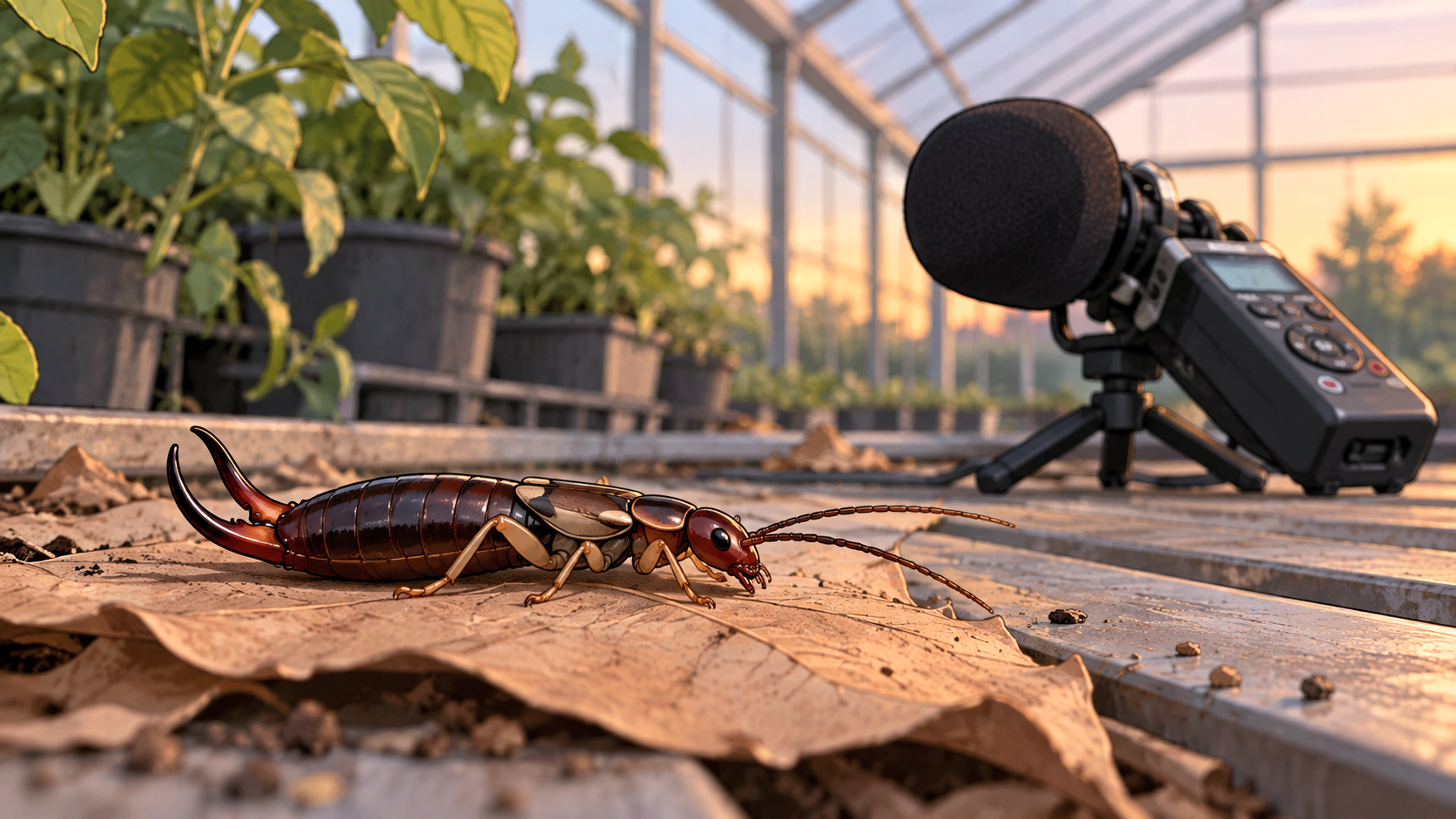
Earwigs are generally quiet insects that do not produce the familiar chirping, buzzing, or singing sounds associated with crickets and cicadas. A moving earwig might create a faint rustle or scratching noise when it brushes against dry leaves, paper, or another surface, but there is no well-established audible call associated with the common European earwig (Forficula auricularia).
Most earwig activity is too quiet to notice under ordinary household conditions. Hearing repeated clicking, chirping, or scratching does not reliably indicate that earwigs are present, even if the sounds occur at night.
What Does an Earwig Sound Like?
An earwig moving across a hard, smooth surface is unlikely to produce an obvious sound. Its small body and relatively light weight mean that ordinary footsteps generate little detectable noise.
Movement through loose material presents a different situation. An earwig crawling beneath dry leaves, through crumpled paper, or against a thin plastic bag could disturb the material enough to create a faint rustling sound. If the insect becomes trapped inside a container, its movements might also produce occasional taps or scratches against the surrounding surface.
Such noises come from contact with the environment rather than a distinctive earwig vocalization.
The Royal Entomological Society’s description of earwig anatomy identifies the insects by their flattened bodies, short wing covers, and abdominal pincers. None of these features functions like the specialized sound-producing structures responsible for cricket songs.
An individual earwig moving through a quiet enclosure might be audible at very close range, particularly if the surrounding material amplifies movement. That would not establish a recognizable acoustic signature that could be used to identify an earwig elsewhere in the house.
Do Earwigs Chirp Like Crickets?
No established evidence shows that European earwigs produce the rhythmic chirping calls characteristic of crickets.
Crickets generate their familiar songs through stridulation, a process involving specialized structures on their wings. One structure moves across another, producing vibrations that become audible sound.
The mechanisms of insect acoustic communication demonstrate how crickets, katydids, and other insects use specialized body parts to produce recognizable calls.
Earwigs belong to the order Dermaptera, whereas crickets belong to Orthoptera. Although these groups share some broader evolutionary relationships, their anatomy and behavior differ. The North Carolina State University identification guide for Dermaptera describes earwigs as predominantly nocturnal insects that shelter in dark spaces during daylight.
An earwig should not be identified as the source of a nighttime chirp simply because both insects are active after dark.
The nighttime activity of earwigs concerns when they forage and move between shelters, not an established period of acoustic calling.
Can Earwigs Communicate Through Vibrations?
Insects do not need to produce sounds audible to humans to exchange information. Some species use vibrations transmitted through leaves, stems, soil, or other surfaces.
A scientific review published in the Annual Review of Entomology explains that vibrational communication among insects can involve body movements, drumming, rubbing specialized structures together, and other mechanisms.
However, this general knowledge should not be interpreted as proof that European earwigs produce specific vibrational songs.
Research on the biology and social life of earwigs documents complex interactions among adults, mothers, and offspring. Earwigs also respond to chemical and tactile information, including signals involved in aggregation and family interactions.
These behaviors establish that earwigs communicate and respond to one another, but they do not demonstrate that ordinary European earwigs produce audible calls.
The distinction between airborne sound and substrate vibration is important. A vibration might be detectable with specialized equipment without being perceptible to someone standing nearby. Conversely, a rustling sound caused by an insect moving across paper does not necessarily function as communication.
There is no established European earwig sound frequency, calling rhythm, or acoustic recording standard that householders can use for reliable identification.
Do Earwigs Make Clicking Noises With Their Pincers?
The pincers at the end of an earwig’s abdomen are called cerci. Earwigs use them in defense, social interactions, and other physical activities, but they are not known to produce a characteristic clicking call.
A pair of cerci closing against another object could theoretically create a small mechanical sound. However, that possibility does not establish that earwigs deliberately click their pincers to communicate or warn predators.
The Royal Entomological Society’s anatomical account describes the forceps as distinctive modified appendages rather than an established acoustic organ.
The defensive pinching behavior of earwigs should therefore be distinguished from deliberate sound production.
Similarly, an earwig moving its abdomen while threatened is not evidence that it is preparing to hiss or chirp. Those actions may be defensive without producing a meaningful audible signal.
Can Earwigs Hiss or Buzz?
European earwigs are not known for producing audible hissing or buzzing sounds.
Some insects hiss by forcing air through specialized openings or by moving body structures that generate sound. The mechanisms differ considerably among insect groups, and a behavior documented in one species cannot automatically be attributed to another.
Earwigs also possess wings, although flight ability varies among species. The common European earwig has folded hind wings but seldom flies. When flight occurs, wing movement could theoretically generate a faint airborne sound, as with other small flying insects, but European earwigs are not recognized for a distinctive flight buzz.
The Royal Entomological Society’s classification of Dermaptera documents the characteristic wing structure, while the biology of the European earwig describes an insect that ordinarily travels by crawling.
Someone hearing sustained buzzing around a window or light fixture should not assume an earwig is responsible without seeing the insect.
Could Earwigs Be Making Scratching Noises in Your Walls?
Earwigs can enter existing structural gaps, but they are unlikely to produce scratching sounds loud enough to be heard through an intact wall.
Their small size limits the force they can exert against structural surfaces. They also do not excavate wooden galleries like termites or certain beetles.
The locations where earwigs hide in and around buildings include narrow cracks and protected spaces, but occupation of a cavity does not mean the insects are creating an audible disturbance.
Persistent scratching, tapping, or scraping inside a wall may have several explanations, including other animals, moving building materials, plumbing, or mechanical equipment.
A sound alone cannot distinguish among these possibilities. Even if an earwig is later discovered nearby, its presence does not establish that it produced the noise.
The absence of sound is equally uninformative. An earwig can remain concealed without making a detectable noise, so a quiet room cannot be regarded as evidence that no insects are present.
Why Other Insects Are More Likely to Be Heard
When a household noise is described as chirping, repeated clicking, or buzzing, the acoustic characteristics can help narrow the possibilities. They cannot identify a species without supporting observations.
| Sound | More plausible explanation | Earwig connection |
|---|---|---|
| Repeated rhythmic chirping | Crickets or other singing insects | Not characteristic of European earwigs |
| Sustained buzzing | Flying insects or electrical equipment | Not a recognized earwig signal |
| Faint rustling in paper or leaves | Small insects moving through the material | Earwigs could contribute |
| Repeated tapping inside wood | Other organisms or structural noises | Earwigs are not known for wood-boring activity |
| Scratching within a wall | Various animals or nonbiological sources | Too nonspecific to indicate earwigs |
Crickets provide a particularly useful comparison because their calls are well documented. Researchers can distinguish different cricket species by examining the structure and timing of their songs.
The acoustic behavior of field crickets has been studied through measurements of wing movement, sound production, and auditory responses. Comparable, routinely used acoustic identification information is not established for ordinary household earwigs.
If chirping continues from the same location night after night, a singing insect is a more plausible explanation than an earwig. Physical identification remains necessary before assigning the sound to a particular animal.
Do Large Groups of Earwigs Make More Noise?
A gathering of earwigs could create more incidental rustling than a single individual, particularly when many insects move through loose material simultaneously. However, no reliable threshold links the number of earwigs present to a detectable sound level.
European earwigs sometimes gather in substantial numbers beneath boards, stones, and other shelters. Their aggregation behavior does not establish that they collectively produce an audible signal.
The conditions that attract earwigs to particular locations can concentrate insects in small protected spaces. Even so, a crowded shelter may remain almost entirely quiet until disturbed.
Likewise, earwigs moving beneath carpets or nearby flooring cannot reliably be detected by listening. Soft materials may suppress the incidental noises caused by movement.
The number of earwigs present is therefore better established through direct observation than through assumptions about how loud their activity should be.
Can You Detect an Earwig Infestation by Listening?
Sound is not a dependable method of detecting earwigs. There is no validated household acoustic test for European earwigs, and ordinary earwig movement is not sufficiently distinctive to separate it from other small insects.
A homeowner who suspects earwigs should look for actual insects rather than interpret unfamiliar noises as proof of their presence. Observing the characteristic abdominal pincers provides much stronger identification evidence than a sound recording.
The identification and management information for earwigs emphasizes their appearance, habits, and physical presence rather than acoustic detection.
Repeated indoor sightings also need to be interpreted carefully. Earwigs appearing in basements may be moving through concealed gaps without producing any audible evidence.
If persistent sounds continue but no earwigs are observed, investigating other potential sources is more useful than assuming an insect infestation. Where noises are associated with electrical outlets, appliances, or wiring, electrical safety should take priority over pest inspection.
Earwigs are capable of creating incidental sounds through movement, but the common European earwig is not an established chirping, hissing, or buzzing insect. Claims that a particular nighttime noise proves earwig activity go beyond what the available evidence supports.