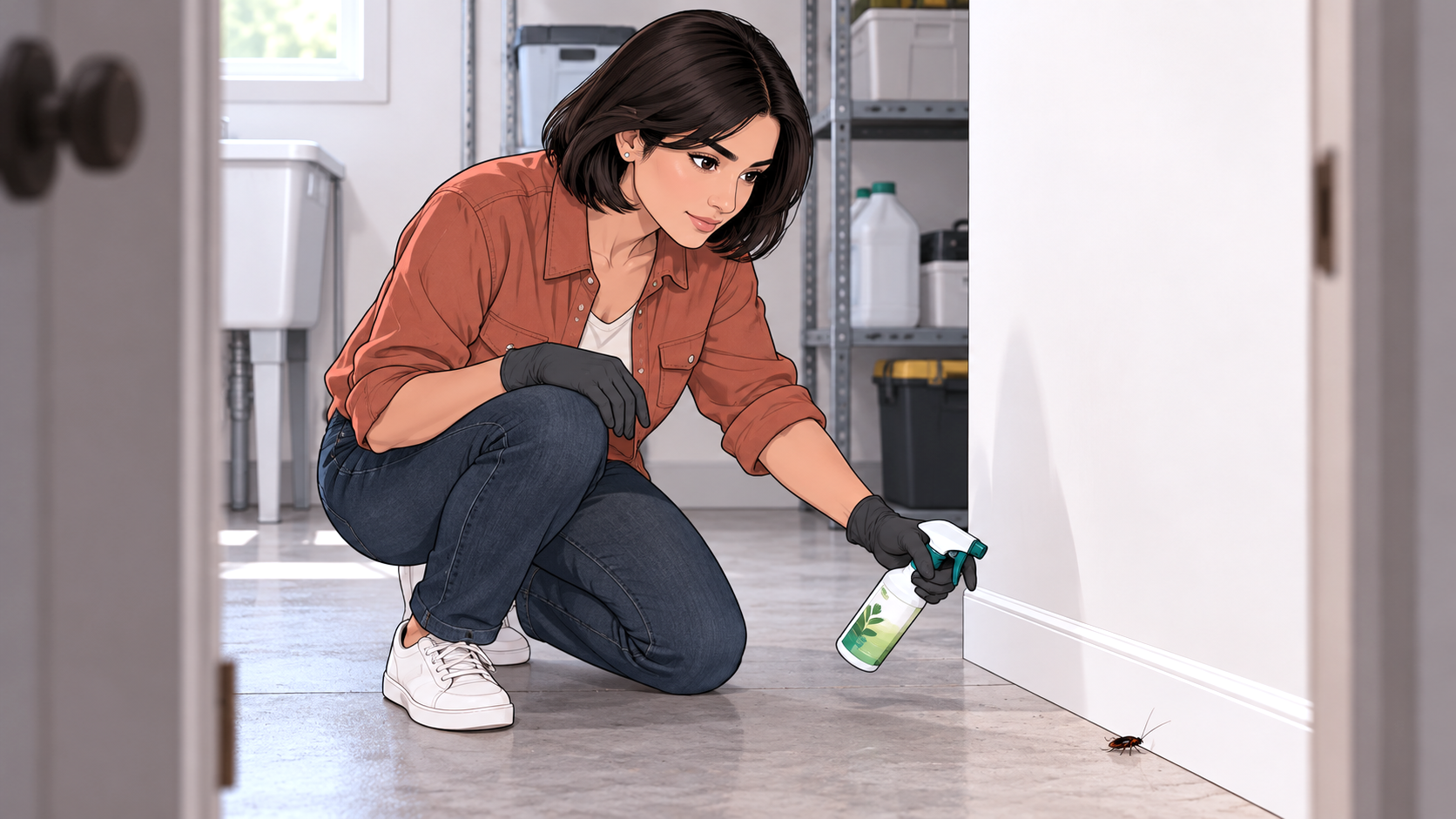
BugMD Essential Pest Control Concentrate can kill cockroaches through direct contact, using clove oil and cottonseed oil as its plant-derived active ingredients. Clove oil contains eugenol, a compound with demonstrated insecticidal activity against German cockroaches. However, evidence that these ingredients can kill exposed insects does not establish that the complete BugMD formulation reliably eliminates an established infestation. Its strongest supported role is treating accessible cockroaches, rather than providing dependable long-term population control.
BugMD advertises contact killing, activity against more than 40 pests, and suitability for indoor and outdoor applications. Some of those claims are broader than the published research on its individual ingredients. The relevant purchasing question is whether the spray can do more than kill a cockroach that receives a thorough application, particularly when others remain concealed inside kitchen appliances, cabinets, and wall openings.
Which BugMD Product Is Intended for Cockroaches?
The company’s main cockroach spray is BugMD Essential Pest Control Concentrate. It is a concentrated botanical pesticide mixed with water before use. The current product information identifies clove oil and cottonseed oil as its active ingredients and specifically lists cockroaches among the intended pests.
BugMD also markets several products to customers dealing with cockroaches, but they perform different jobs.
| BugMD product | Format | Cockroach-related function |
|---|---|---|
| Essential Pest Control Concentrate | Dilutable botanical spray | Direct-contact killing |
| Pest Blaster Kit | Spray application kit | Delivers the concentrate to accessible insects and surfaces |
| Cockroach Catcher | Trapping device | Attracts and captures cockroaches without spraying |
The Pest Blaster Kit should not be treated as a separate insecticide merely because it has a different product name. Its usefulness depends on the pesticide used with the application equipment. The Cockroach Catcher is likewise a different control method, relying on capture rather than the toxic action of clove and cottonseed oils.
The manufacturer’s concentrate instructions specify mixing one bottle with 27 fluid ounces of water in its reusable spray bottle. Its directions call for spraying exposed insects directly until wet and allowing treated areas to air-dry. That dilution instruction applies to the identified concentrate, not every product sold under the BugMD name.
What Clove Oil and Cottonseed Oil Actually Do to Roaches
Clove oil provides the stronger scientific basis for BugMD’s insecticidal claims. Its constituent eugenol can affect insect nervous-system function, and laboratory experiments have measured its toxicity against German cockroaches (Blattella germanica).
In a study comparing essential-oil compounds against German cockroaches, researchers measured the topical toxicity of eugenol alongside other plant-derived chemicals. The experiments included adult males, adult females, egg-carrying females, and several nymphal stages. Toxicity varied by compound and developmental stage, establishing that exposure conditions influence the resulting mortality.
A separate investigation involving insecticide-resistant German cockroaches found substantial insecticidal activity from eugenol against susceptible and resistant laboratory strains. The findings are relevant to BugMD’s active-ingredient choice, but they cannot establish that spraying BugMD overcomes cockroach resistance in an occupied home. An isolated compound administered under experimental conditions is not equivalent to a diluted commercial mixture contacting an insect on a kitchen floor.
Cottonseed oil has a different proposed action. Oil-based sprays can interfere with insects physically when they coat the body, and BugMD promotes cottonseed oil as an ingredient that affects respiration. However, the amount deposited, the formulation, and the insect’s exposure determine whether this produces a lethal effect.
A 2025 laboratory comparison of 16 essential oils against German cockroaches provides useful context. Under its experimental conditions, cottonseed oil produced 40% mortality after 24 hours, compared with 100% mortality for several other tested oils. Those figures describe direct application of the tested oils, not BugMD’s finished spray. They demonstrate why cottonseed oil’s presence cannot independently justify claims of universal cockroach mortality.
Can BugMD Kill Cockroaches Within Seconds?
BugMD advertises rapid contact action, including claims that certain insects die within seconds and that most targeted pests die within 30 minutes. Those statements should be interpreted as manufacturer performance claims rather than established killing times for German or American cockroaches.
Several outcomes can look similar immediately after spraying. An insect may become immobilized, lose coordination, or stop moving before death occurs. Temporary knockdown should not automatically be recorded as mortality, particularly when evaluating a botanical pesticide whose performance changes with the amount deposited.
The manufacturer’s directions require direct spraying of exposed insects. A cockroach running behind a refrigerator after receiving only a small amount of spray has experienced a different exposure from one thoroughly wetted on an open surface.
Research also demonstrates variation among botanical insecticides. In laboratory testing of plant oils against German cockroaches, insecticidal performance changed with the oil, application method, dose, and insect sex. Consequently, a short demonstration showing an individual cockroach dying after treatment cannot establish consistent mortality across an entire household population.
For occasional exposed insects, BugMD’s contact-based approach has a reasonable biological basis. The company’s broader claims concerning speed and complete infestation removal require more evidence than contact mortality alone.
Does BugMD Keep Killing Roaches After the Spray Dries?
BugMD’s promotional materials describe treating insect hiding places and potential entry routes, but they do not establish a dependable residual cockroach-killing period comparable to the specific residual claims carried by some registered conventional insecticides.
Clove oil contains volatile compounds, and their presence on a surface changes as a spray dries and its components disperse. Cottonseed oil is less volatile, but a remaining oil deposit does not automatically establish that the finished mixture retains a lethal concentration for cockroaches crossing it days later.
This limits the value of spraying empty cabinet corners and assuming they will remain protected. A product primarily supported by direct-contact activity should be judged on whether it reaches insects, not on an assumed invisible barrier around treated surfaces.
The same issue applies to repellency. Clove-related compounds can affect insect behavior, but the odors that discourage cockroaches have different evidentiary requirements from chemicals that kill through contact. A substance producing mortality during direct spraying does not necessarily prevent untreated cockroaches from entering the area later.
Can BugMD Kill Cockroach Eggs and Stop Reproduction?
BugMD’s advertising includes claims about eliminating pests at different life stages and disrupting reproduction. Its clove-oil and cottonseed-oil ingredients do not, by themselves, establish reliable destruction of protected cockroach eggs.
Cockroach eggs develop inside an egg case called an ootheca. Exposure of the outer case to an insecticidal spray does not guarantee that a lethal dose reaches every developing embryo.
Laboratory testing of essential-oil components against German cockroach egg cases found differences in hatching after exposure. None of the tested compounds completely prevented egg-case hatching under the reported conditions. These findings do not measure BugMD directly, but they demonstrate the difficulty of treating egg cases through botanical chemical exposure.
Existing eggs also present a different challenge from adults and nymphs that can be sprayed while moving. The appearance and protective structure of cockroach eggs make a contact-only treatment an incomplete measure of reproductive control.
We would therefore exclude claims that BugMD reliably sterilizes a cockroach population or prevents every subsequent hatch from our assessment of its effectiveness.
Is BugMD EPA-Approved?
Clove oil and cottonseed oil are permitted ingredients in certain minimum-risk pesticide products under U.S. federal regulations. Products qualifying for the exemption under 40 CFR 152.25(f) do not require ordinary Environmental Protection Agency (EPA) pesticide registration.
That exemption carries specific conditions. The EPA’s minimum-risk pesticide requirements address eligible ingredients, ingredient disclosure, product labeling, and permitted claims. A manufacturer must satisfy all applicable conditions for the exemption to apply.
Importantly, federal exemption does not mean the EPA has evaluated and approved a particular product’s claims about killing cockroaches. The agency generally does not review the efficacy or labeling of individual exempt products before they enter the market. State registration requirements can still apply, and products sold in other countries must comply with their respective pesticide regulations. BugMD’s plant-derived ingredients therefore provide no basis for assuming universal legal authorization or government-certified effectiveness.
Is BugMD Safe to Spray Around Children and Pets?
BugMD markets Essential Pest Control Concentrate as suitable for household use around children and pets when directions are followed. That marketing qualification is important because its ingredients remain biologically active substances.
Clove oil contains eugenol, which can irritate skin and mucous membranes and produce hypersensitivity reactions. The documented hazards of medicinal clove oil demonstrate that plant origin does not eliminate exposure concerns, although the risks from concentrated medicinal oil cannot be directly assigned to properly diluted BugMD spray.
Household use requires particular caution around animals that lick treated surfaces or groom residues from their fur. Pesticide exposure in pets can occur through ingestion, inhalation, or skin contact, so a spray’s advertised household suitability does not justify direct application to animals.
BugMD’s directions call for treated areas to dry. Keep children and pets away during mixing and spraying, remove exposed food and animal bowls from treatment areas, and observe the full product labeling before allowing contact with treated surfaces. Do not spray into electrical outlets, energized appliance compartments, or other equipment that could be damaged by liquid.
The precautions involved in choosing cockroach killers around pets are particularly relevant when using an oil-based spray near floors, feeding areas, and pet bedding.
Where BugMD Falls Short During a German Cockroach Infestation
A German cockroach infestation provides a more demanding test than spraying an isolated insect. Adults and nymphs occupy narrow spaces, and many remain concealed while the room is occupied. Direct-contact treatment leaves these insects unaffected unless the spray reaches them.
BugMD’s application method also differs from cockroach bait and gel treatments, which expose insects after they voluntarily consume poisoned material. A bait can potentially reach feeding cockroaches that remain inaccessible to direct spraying. The performance of either method depends on its actual formulation and the insects’ exposure.
Repeated applications of BugMD around visible activity may kill exposed cockroaches while leaving sheltered groups intact. Strongly scented residues can also complicate bait placement if they contaminate feeding locations or discourage cockroaches from approaching.
The University of California’s cockroach management guidance supports locating harborages, monitoring populations, restricting food and water, and using targeted controls. BugMD’s contact action does not replace those measures, particularly in apartments where cockroaches may travel between connected units.
Is BugMD Worth Buying for Cockroaches?
We would consider BugMD Essential Pest Control Concentrate for occasional exposed cockroaches when a buyer specifically wants a diluted botanical contact spray and can follow its application precautions. Clove oil has documented insecticidal activity, so the formulation has a plausible basis for its contact-killing purpose.
For recurring German cockroaches, we would put the money toward a treatment with stronger evidence for population reduction. Cockroach sprays and insecticides vary in residual action, application sites, and ability to reach insects away from exposed surfaces. Those properties become more consequential as the infestation spreads beyond a few visible individuals.
A sensible purchase decision also accounts for monitoring. If cockroaches continue appearing after direct spraying, the persistence of activity should trigger inspection for hidden harborages rather than an assumption that additional bottles will solve the problem. Persistent infestations warrant targeted treatment and, where necessary, professional assessment.
BugMD’s main weakness is the gap between demonstrated insecticidal activity of its ingredients and the broader promise of eliminating established cockroach populations. Its contact-spray role is credible; claims of dependable residual protection, complete egg destruction, and whole-home eradication should not drive the purchase.