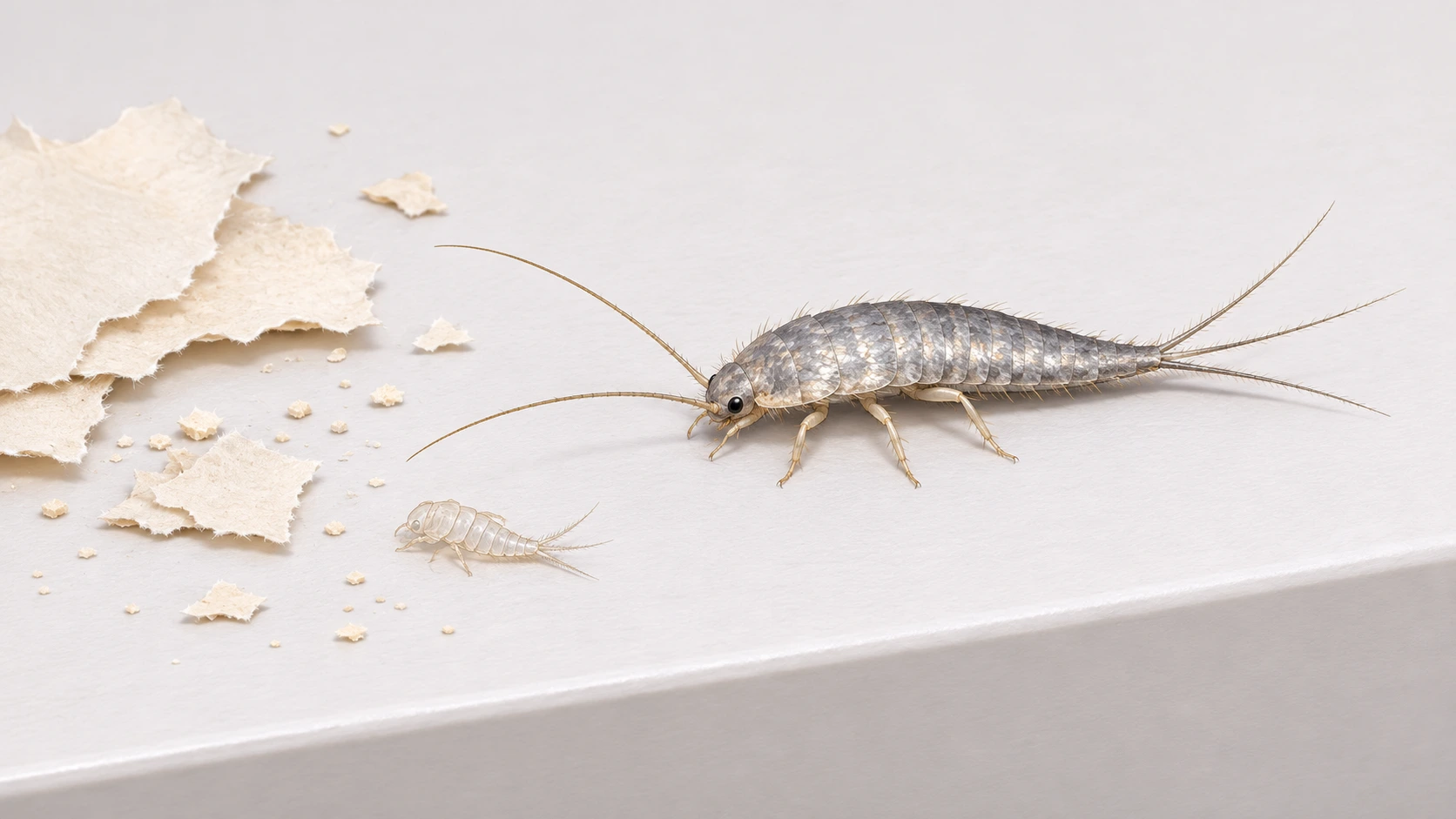
Silverfish eat dead insects and other insect remains, making them scavengers rather than conventional predators. They have also been documented feeding on dead and injured silverfish, including their own discarded skins. However, their known feeding behavior does not establish that they actively hunt healthy insects such as ants, cockroaches, or spiders.
This explains why silverfish may be discovered around dead insects without being responsible for killing them. An insect carcass can provide an additional source of protein, particularly in a sheltered location where silverfish already forage. The difference between scavenging and hunting matters when interpreting household pest activity. Finding a silverfish beside another dead insect is evidence of proximity, not proof that it attacked and killed the other insect.
Do Silverfish Eat Dead Insects?
Silverfish consume dead insects as part of their scavenging behavior. These remains provide animal-derived material alongside the carbohydrates and other substances found in their usual food sources.
The University of California’s silverfish feeding research and household pest guidance identifies dead insects among the materials these insects consume. Household dust, debris, certain fungi, and dry foods also provide feeding opportunities.
Dead insects can remain in locations where silverfish forage, particularly around concealed spaces and undisturbed surfaces. A small insect carcass beneath furniture or near a baseboard may therefore become an available food source.
Silverfish are opportunistic scavengers. They do not need to catch another insect to obtain the nutritional material from its remains.
Which dead insects might silverfish consume?
The available evidence establishes that silverfish feed on dead insects, although it does not provide a reliable ranking of which household insect carcasses they prefer.
Potentially accessible remains include:
- Dead flies and other small flying insects.
- Dead beetles and fragments of insect bodies.
- Small insects that have died inside cracks or concealed spaces.
- Remains of other silverfish.
These examples describe possible scavenging opportunities, not a verified list of preferred prey species.
The condition and accessibility of the remains matter more than the insect’s identity. A carcass that is readily accessible can provide food without requiring the silverfish to overcome or attack another living animal.
Do Silverfish Eat Other Living Insects?
Silverfish are not established household insect hunters. Their documented feeding behavior centers on scavenging and consuming accessible organic materials rather than pursuing healthy, moving insects.
They have relatively weak mouthparts adapted to scraping and feeding on suitable surfaces. This is consistent with their ability to consume insect remains rather than behaving like predatory insects equipped to capture and overpower prey.
The North Carolina State University entomology description of silverfish and related insects classifies them as scavengers or browsers that search for food after dark.
There is an important qualification. Researchers have documented silverfish feeding on dead and injured members of their own species. That behavior does not establish that they regularly attack unrelated living insects.
Will silverfish attack ants?
There is no established basis for treating silverfish as ant-hunting predators.
Silverfish may consume a dead ant if its remains are accessible, but that is different from chasing an ant, overpowering it, and feeding on it while alive.
Ants have their own defensive behaviors and can bite or sting depending on the species. Finding silverfish and ants in the same building does not establish a predator-prey relationship.
Do silverfish eat cockroaches?
A silverfish may scavenge a dead cockroach or accessible fragments of its body. However, the available feeding evidence does not establish that silverfish actively hunt healthy cockroaches.
Cockroaches are considerably different in size and physical structure from the small insects silverfish commonly encounter while foraging. A carcass can become a food source after death without the silverfish having played any part in killing it.
Can silverfish eat spiders?
Dead spider remains may provide accessible organic material, but this does not make silverfish spider predators.
Spiders actively capture and consume other arthropods, using specialized structures and hunting or web-based strategies. Silverfish have a different feeding ecology.
A silverfish discovered near a dead spider should therefore not be interpreted as evidence that it killed the spider.
Do Silverfish Eat Other Silverfish?
Silverfish can consume members of their own species. This behavior is called cannibalism, although the documented feeding generally involves dead or injured individuals rather than routine hunting of healthy adults.
Research on the feeding habits of Lepisma saccharinum identifies dead and injured silverfish among the materials they consume. They may also eat their discarded outer coverings after molting.
The University of Florida’s species-specific research on common silverfish documents feeding on dead insects and other silverfish, alongside its broader dietary preferences.
This behavior can provide additional protein when suitable material is available. It also explains why the discovery of a dead silverfish does not guarantee its remains will stay intact.
Cannibalism should not be confused with the organized hunting behavior of predatory insects. Silverfish do not need to form hunting groups or establish dominance over other insects to scavenge available remains.
Do Silverfish Eat Their Own Shed Skins?
Silverfish can consume their discarded exoskeletons after molting. The shed covering contains organic material that can be recovered rather than left unused.
Silverfish continue molting throughout their lives, including after reaching adulthood. This creates repeated opportunities for discarded skins to become available as food.
The University of California’s account of silverfish feeding and molting describes the insects’ feeding habits alongside their characteristic life stages.
Finding a damaged or partially consumed skin does not necessarily mean another pest ate it. A silverfish may have consumed some of its own discarded covering or another individual’s remains.
For identifying the actual appearance of discarded coverings, silverfish molting and shed-skin characteristics provide a separate identification question.
Why Would Silverfish Eat Insects Instead of Their Usual Food?
Dead insects contain proteins and other nutrients that differ from the starches and carbohydrates found in many common silverfish food sources.
Silverfish have a varied diet. Their feeding opportunities include plant-derived materials, starch-containing substances, and animal-derived organic matter.
The Penn State Extension discussion of silverfish and firebrats specifically identifies dried meat, beef extract, and dead insects among their preferred protein-rich foods. It also describes cannibalism involving dead and injured insects.
This helps explain why dead insect remains can be useful even in a house containing books, wallpaper, cardboard, and other susceptible materials.
Does a lack of dead insects make silverfish go hungry?
Dead insects are only one possible food source. Silverfish can obtain nutrition from many other materials around a home.
Available food may include paper products, adhesives, stored dry foods, and certain organic residues. Their ability to use different materials makes them adaptable household scavengers.
A property does not need to contain dead insects to support silverfish. The presence of a carcass simply adds another potential food source.
The wider range of foods silverfish consume helps explain why these insects can remain in buildings with very different household materials.
Does Finding Silverfish Near Dead Bugs Mean They Killed Them?
Finding a silverfish beside a dead insect does not establish that it killed the insect.
There are several possible explanations:
| Observation | Reasonable interpretation | What it does not prove |
|---|---|---|
| A silverfish near a dead ant | It may be investigating an accessible food source | That it attacked the ant colony |
| A silverfish beside a dead spider | The spider carcass may provide organic material | That the silverfish hunted the spider |
| Two silverfish near another dead silverfish | Both may be using the same accessible remains | That one necessarily killed the other |
| A partially damaged silverfish skin | Molting or scavenging may explain the condition | That another insect attacked the silverfish |
The timing of the discovery also matters. A silverfish may reach insect remains long after the other insect has died.
Without observing an attack or having reliable evidence of the cause of death, the carcass cannot establish predation.
Can Dead Insects Attract Silverfish to a House?
Dead insects can provide food, but their presence alone is not enough to explain why a silverfish population becomes established.
A dead fly beneath a windowsill may attract a foraging silverfish. Repeated activity around an undisturbed collection of insect remains may also indicate that the area provides accessible food and shelter.
However, the wider conditions supporting silverfish remain relevant. Their presence may be associated with moisture, concealed spaces, and other available food sources.
The relationship between shelter and suitable feeding material is particularly relevant when insects repeatedly appear in the same protected area. Silverfish harborage locations around a home can help explain why some sheltered spaces support recurring activity.
There is no reason to assume that every dead insect in a house will attract silverfish or that removing insect carcasses alone will eliminate an established population.
Are Silverfish Beneficial Because They Eat Dead Insects?
Scavenging dead insects gives silverfish a place in the processing of organic material. They consume animal remains and other debris rather than relying exclusively on fresh plant-based resources.
That feeding behavior has ecological relevance, particularly outside buildings where organic matter accumulates in natural habitats.
However, the presence of this behavior does not make household silverfish beneficial to valuable belongings. The same insects can damage susceptible paper, fabrics, and other materials.
Their broader ecological relationships are a separate subject from the immediate question of what they consume inside a house.
How to Interpret Dead Insects Found Around Silverfish
A dead insect beside a silverfish is a reason to examine the area, but the carcass should not be treated as proof of an attack.
Look for the actual condition of the remains and whether a silverfish is feeding on them. A photograph can document the insect’s position and the appearance of the carcass, although it may not establish what happened before discovery.
If the other insect is important to identify, preserve a clear photograph or specimen before disturbing it. A damaged carcass can be difficult to identify because other household insects, cleaning, and natural deterioration may alter its appearance.
Repeated silverfish sightings should be considered separately from the presence of dead bugs. Multiple confirmed silverfish activity signs can help determine whether the insects are repeatedly occupying the property.
The observation that matters most is whether the silverfish are scavenging available remains or whether someone has mistakenly interpreted an ordinary encounter as an insect attack.
The Difference Between a Silverfish Scavenger and a Predator
Silverfish eat dead insects and other animal-derived materials, and they can consume dead or injured members of their own species. Their feeding habits support the description of silverfish as scavengers.
The available evidence does not establish that they routinely hunt healthy living insects such as ants, cockroaches, and spiders. Finding a silverfish beside another insect’s remains therefore cannot establish that it was responsible for the death.
When examining an encounter, separate the insect’s presence from evidence of feeding and evidence of an actual attack. That simple separation prevents scavenging behavior from being mistaken for predation.