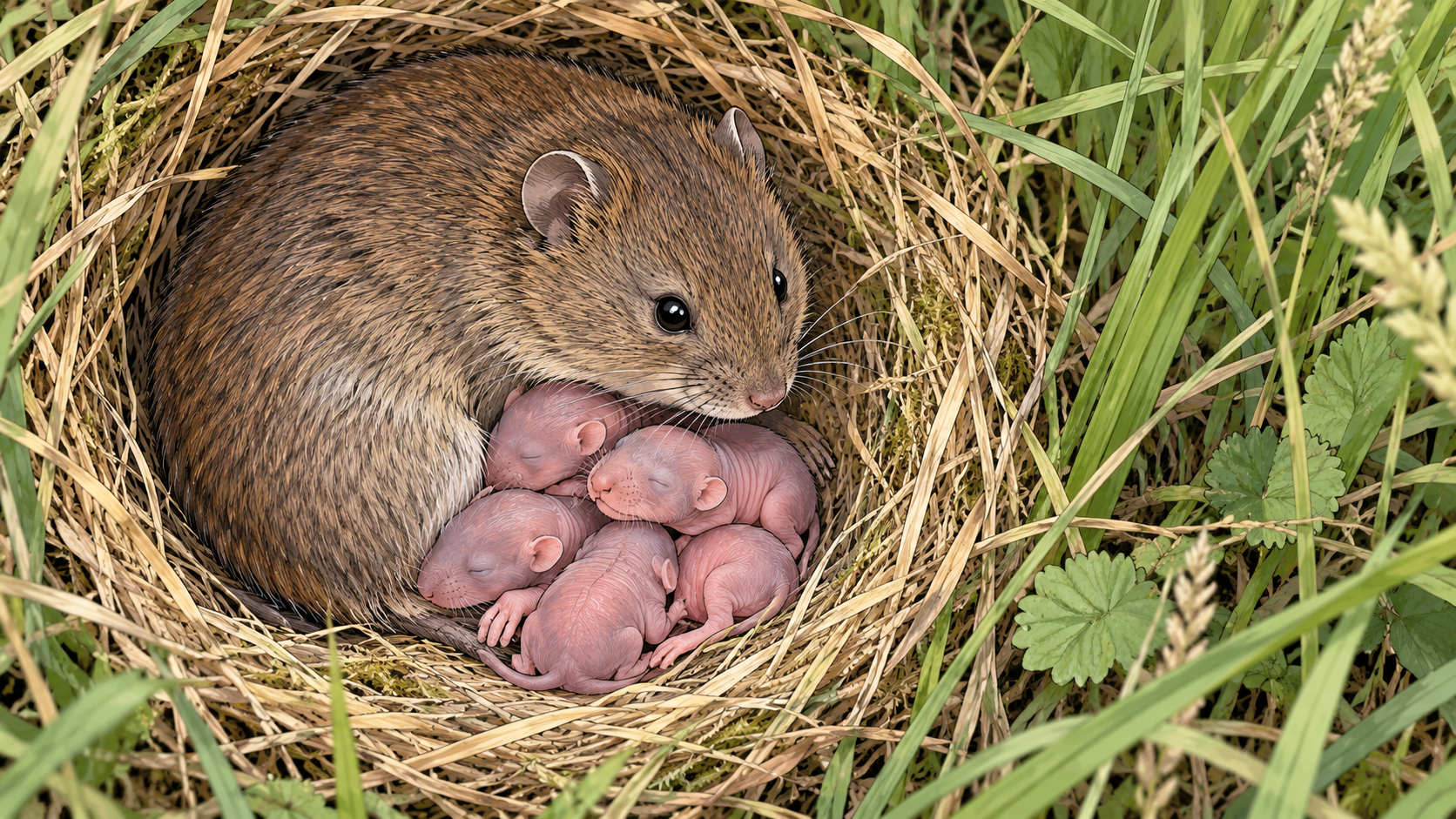
Voles reproduce rapidly, with many species reaching sexual maturity within weeks, completing pregnancy in about 21 days, and producing several litters each year. A female meadow vole can give birth to four to eight litters annually, averaging four or five young per litter. Under favorable conditions, multiple generations can reproduce during the same breeding season, allowing populations to increase sharply within a few months.
The speed varies among species. Meadow voles mature earlier than woodland voles, and reproductive output differs with food availability, temperature, season, and the age of the breeding female. A vole population’s potential growth is therefore much greater than the number of young produced by any single animal.
How Young Can a Vole Be When It Starts Reproducing?
Female meadow voles (Microtus pennsylvanicus) can become sexually mature at approximately 20–30 days old, with an average of 25 days. Males generally mature later, at 35–45 days. This means a female born early in a favorable breeding season can become pregnant before reaching two months of age, contributing offspring to the population during the same year she was born.
Prairie voles (Microtus ochrogaster) mature somewhat later. Females generally become reproductive at 30–40 days, while males reach maturity around 35–45 days. The prairie vole’s reproductive development illustrates how quickly breeding can begin despite a short juvenile period. Once mature, females can produce successive litters while environmental conditions remain favorable.
Woodland voles (Microtus pinetorum) follow a slower schedule, with female sexual maturity averaging approximately 98 days. The woodland vole’s reproductive characteristics therefore differ substantially from those of meadow voles. A homeowner cannot assume every vole species found in a garden begins reproducing at the same age.
Sexual maturity also differs from successful reproduction. An animal may be physiologically capable of mating before it has the body condition or access to a mate necessary to produce surviving offspring. Laboratory research on gray-tailed voles (Microtus canicaudus) found that females could reproduce as young as 18 days, but offspring survival was lower when females first mated at that age than when mating began at 28 days. The gray-tailed vole breeding study demonstrates why the earliest recorded reproductive age should not be treated as the normal breeding age of every individual.
How Many Babies Can Voles Have in One Litter?
Litter size varies with species, maternal age, and environmental conditions. Meadow voles commonly produce three to six young per litter, with an average near five. Prairie voles generally have smaller litters averaging approximately 3.8 offspring, while woodland voles commonly produce three to seven young.
| Vole species | Gestation period | Young per litter | Breeding frequency |
|---|---|---|---|
| Meadow vole | 20–23 days | Usually 3–6 | Commonly 4–8 litters annually |
| Prairie vole | Approximately 21 days | Usually 3–4 | Several litters annually |
| Woodland vole | 20–25 days | Commonly 1–6 | Approximately 1–4 litters annually |
| Common vole | Approximately 21 days | Average 5.1 | Average 5.5 litters annually |
| Tundra vole | 20–21 days | Usually 4–8 | Multiple litters during the breeding season |
These figures describe documented breeding patterns rather than guaranteed output from individual females. The common vole (Microtus arvalis), for example, averages 5.1 young per litter and 5.5 litters annually across studied populations. Its recorded reproductive rates provide a useful example of repeated breeding over a relatively short season.
The tundra vole (Microtus oeconomus) generally produces larger litters, averaging approximately 6.9 offspring. Older females can produce more young than females breeding for the first time. The tundra vole’s reproductive data also identify variation associated with geography and the timing of reproduction.
An unusually large litter is possible without representing the species’ normal output. Woodland voles have documented litters containing as many as 13 young, but their usual litter sizes are substantially smaller. Using an exceptional litter as the basis for annual population estimates would exaggerate ordinary reproductive performance.
How Soon Can a Female Vole Become Pregnant Again?
For several vole species, another pregnancy can begin shortly after a litter is delivered. This reproductive phenomenon is called postpartum estrus, a period of sexual receptivity following birth.
Female voles can therefore become pregnant while nursing their previous litter. The reproductive biology of arvicoline rodents includes postpartum mating and, in certain species, delayed embryo implantation while lactation continues. These processes allow successive reproductive events to occur without requiring a lengthy interval between weaning and the next pregnancy.
The timing should not be interpreted as one litter every 21 days for every vole. Although gestation lasts approximately three weeks in many species, successful mating, pregnancy, and birth depend on physiological and environmental conditions. Prairie voles have a documented maximum breeding interval of approximately one litter every six weeks. Other species have different intervals, and reproductive pauses can interrupt the sequence.
Pregnancy duration itself is comparatively consistent among many familiar voles. Meadow voles generally carry their young for 20–23 days, prairie voles for approximately 21 days, and woodland voles for 20–25 days. These short gestation periods help explain their reproductive potential, particularly when offspring from earlier litters become mature before the breeding season ends.
How Many Voles Can One Female Produce in a Year?
A female meadow vole producing four litters of five young would give birth to 20 offspring during a year. At eight litters of five young, the total would reach 40. Both calculations use reproductive figures documented for meadow voles, but they describe offspring born rather than animals surviving to adulthood.
| Annual litters | Average young per litter | Total offspring born |
|---|---|---|
| 4 | 5 | 20 |
| 5 | 5 | 25 |
| 6 | 5 | 30 |
| 8 | 5 | 40 |
The calculations exclude offspring produced by daughters from earlier litters. If a female born during spring reaches reproductive maturity while the breeding season is still underway, she can contribute another litter to the next generation. This overlapping reproduction allows growth to accelerate beyond the output of the original breeding females.
The theoretical result is not a prediction of how many voles will occupy a particular yard. Some females never produce the maximum number of litters, not every pregnancy results in the same litter size, and many young die before reproducing. The US Forest Service’s meadow vole research documents substantial juvenile mortality and major fluctuations in population density.
A population model that counts every newborn as a surviving breeding adult would therefore greatly overestimate growth. Reproductive output establishes how many animals can be born; survival and successful breeding determine how many contribute to the next generation.
When Is Vole Breeding Season?
Meadow voles can reproduce throughout the year, although breeding is most common from March through November. In colder regions, reproductive activity may decline or stop during winter. The meadow vole’s breeding biology in Newfoundland and Labrador identifies births throughout the year, with most occurring between May and September.
Prairie voles also have the physiological capacity to breed year-round, but their reproductive activity is highest between May and October. The lowest breeding activity occurs in December and January, with severe summer or winter conditions interrupting reproduction.
Woodland voles demonstrate particularly strong geographic variation. Their breeding season can extend from January through November in the northeastern United States, while some North Carolina populations reproduce throughout the year. Canadian populations are associated primarily with warmer-month breeding from May through October. The Canadian woodland vole assessment documents these regional differences and their relationship to environmental conditions.
Food availability, climate, and seasonal vegetation growth influence whether breeding continues. Consequently, reproductive potential calculated from a full year of uninterrupted breeding does not describe every wild population. A vole living in a cold northern habitat experiences different seasonal opportunities from one occupying a milder southern environment.
Why Do Vole Populations Sometimes Increase So Suddenly?
Rapid reproduction creates the potential for population growth, but actual increases depend on whether enough offspring survive and become reproductive. Suitable vegetation provides food and shelter, while weather, predators, disease, and population density influence survival. When conditions favor both reproduction and juvenile survival, a local population can expand substantially during a single breeding season.
Vole populations also undergo periodic fluctuations. Some meadow vole populations reach peak densities at intervals of two to five years, although these cycles are neither universal nor perfectly regular. The University of Idaho’s meadow vole information describes how favorable habitat conditions can support rapid population increases followed by declines.
A rise in vole activity around a yard does not establish how many animals were born there. New individuals may arrive from surrounding habitat, and changes in vegetation can make existing activity more visible. Similarly, the number of voles occupying a particular area cannot be calculated simply by multiplying a typical litter size by the number of adults seen.
Reproductive rates help explain why a previously quiet property can experience substantial feeding activity within one season. For homeowners monitoring vulnerable plantings, the useful evidence is continuing activity and fresh damage, rather than assuming that every visible vole represents a breeding adult.
Meta description: How fast do voles reproduce? Discover when voles reach sexual maturity, how long pregnancy lasts, how many babies they have, and how quickly populations grow.
Voles reproduce rapidly, with many species reaching sexual maturity within weeks, completing pregnancy in about 21 days, and producing several litters each year. A female meadow vole can give birth to four to eight litters annually, averaging four or five young per litter. Under favorable conditions, multiple generations can reproduce during the same breeding season, allowing populations to increase sharply within a few months.
The speed varies among species. Meadow voles mature earlier than woodland voles, and reproductive output differs with food availability, temperature, season, and the age of the breeding female. A vole population’s potential growth is therefore much greater than the number of young produced by any single animal.
How Young Can a Vole Be When It Starts Reproducing?
Female meadow voles (Microtus pennsylvanicus) can become sexually mature at approximately 20–30 days old, with an average of 25 days. Males generally mature later, at 35–45 days. This means a female born early in a favorable breeding season can become pregnant before reaching two months of age, contributing offspring to the population during the same year she was born.
Prairie voles (Microtus ochrogaster) mature somewhat later. Females generally become reproductive at 30–40 days, while males reach maturity around 35–45 days. The prairie vole’s reproductive development illustrates how quickly breeding can begin despite a short juvenile period. Once mature, females can produce successive litters while environmental conditions remain favorable.
Woodland voles (Microtus pinetorum) follow a slower schedule, with female sexual maturity averaging approximately 98 days. The woodland vole’s reproductive characteristics therefore differ substantially from those of meadow voles. A homeowner cannot assume every vole species found in a garden begins reproducing at the same age.
Sexual maturity also differs from successful reproduction. An animal may be physiologically capable of mating before it has the body condition or access to a mate necessary to produce surviving offspring. Laboratory research on gray-tailed voles (Microtus canicaudus) found that females could reproduce as young as 18 days, but offspring survival was lower when females first mated at that age than when mating began at 28 days. The gray-tailed vole breeding study demonstrates why the earliest recorded reproductive age should not be treated as the normal breeding age of every individual.
How Many Babies Can Voles Have in One Litter?
Litter size varies with species, maternal age, and environmental conditions. Meadow voles commonly produce three to six young per litter, with an average near five. Prairie voles generally have smaller litters averaging approximately 3.8 offspring, while woodland voles commonly produce three to seven young.
| Vole species | Gestation period | Young per litter | Breeding frequency |
|---|---|---|---|
| Meadow vole | 20–23 days | Usually 3–6 | Commonly 4–8 litters annually |
| Prairie vole | Approximately 21 days | Usually 3–4 | Several litters annually |
| Woodland vole | 20–25 days | Commonly 1–6 | Approximately 1–4 litters annually |
| Common vole | Approximately 21 days | Average 5.1 | Average 5.5 litters annually |
| Tundra vole | 20–21 days | Usually 4–8 | Multiple litters during the breeding season |
These figures describe documented breeding patterns rather than guaranteed output from individual females. The common vole (Microtus arvalis), for example, averages 5.1 young per litter and 5.5 litters annually across studied populations. Its recorded reproductive rates provide a useful example of repeated breeding over a relatively short season.
The tundra vole (Microtus oeconomus) generally produces larger litters, averaging approximately 6.9 offspring. Older females can produce more young than females breeding for the first time. The tundra vole’s reproductive data also identify variation associated with geography and the timing of reproduction.
An unusually large litter is possible without representing the species’ normal output. Woodland voles have documented litters containing as many as 13 young, but their usual litter sizes are substantially smaller. Using an exceptional litter as the basis for annual population estimates would exaggerate ordinary reproductive performance.
How Soon Can a Female Vole Become Pregnant Again?
For several vole species, another pregnancy can begin shortly after a litter is delivered. This reproductive phenomenon is called postpartum estrus, a period of sexual receptivity following birth.
Female voles can therefore become pregnant while nursing their previous litter. The reproductive biology of arvicoline rodents includes postpartum mating and, in certain species, delayed embryo implantation while lactation continues. These processes allow successive reproductive events to occur without requiring a lengthy interval between weaning and the next pregnancy.
The timing should not be interpreted as one litter every 21 days for every vole. Although gestation lasts approximately three weeks in many species, successful mating, pregnancy, and birth depend on physiological and environmental conditions. Prairie voles have a documented maximum breeding interval of approximately one litter every six weeks. Other species have different intervals, and reproductive pauses can interrupt the sequence.
Pregnancy duration itself is comparatively consistent among many familiar voles. Meadow voles generally carry their young for 20–23 days, prairie voles for approximately 21 days, and woodland voles for 20–25 days. These short gestation periods help explain their reproductive potential, particularly when offspring from earlier litters become mature before the breeding season ends.
How Many Voles Can One Female Produce in a Year?
A female meadow vole producing four litters of five young would give birth to 20 offspring during a year. At eight litters of five young, the total would reach 40. Both calculations use reproductive figures documented for meadow voles, but they describe offspring born rather than animals surviving to adulthood.
| Annual litters | Average young per litter | Total offspring born |
|---|---|---|
| 4 | 5 | 20 |
| 5 | 5 | 25 |
| 6 | 5 | 30 |
| 8 | 5 | 40 |
The calculations exclude offspring produced by daughters from earlier litters. If a female born during spring reaches reproductive maturity while the breeding season is still underway, she can contribute another litter to the next generation. This overlapping reproduction allows growth to accelerate beyond the output of the original breeding females.
The theoretical result is not a prediction of how many voles will occupy a particular yard. Some females never produce the maximum number of litters, not every pregnancy results in the same litter size, and many young die before reproducing. The US Forest Service’s meadow vole research documents substantial juvenile mortality and major fluctuations in population density.
A population model that counts every newborn as a surviving breeding adult would therefore greatly overestimate growth. Reproductive output establishes how many animals can be born; survival and successful breeding determine how many contribute to the next generation.
When Is Vole Breeding Season?
Meadow voles can reproduce throughout the year, although breeding is most common from March through November. In colder regions, reproductive activity may decline or stop during winter. The meadow vole’s breeding biology in Newfoundland and Labrador identifies births throughout the year, with most occurring between May and September.
Prairie voles also have the physiological capacity to breed year-round, but their reproductive activity is highest between May and October. The lowest breeding activity occurs in December and January, with severe summer or winter conditions interrupting reproduction.
Woodland voles demonstrate particularly strong geographic variation. Their breeding season can extend from January through November in the northeastern United States, while some North Carolina populations reproduce throughout the year. Canadian populations are associated primarily with warmer-month breeding from May through October. The Canadian woodland vole assessment documents these regional differences and their relationship to environmental conditions.
Food availability, climate, and seasonal vegetation growth influence whether breeding continues. Consequently, reproductive potential calculated from a full year of uninterrupted breeding does not describe every wild population. A vole living in a cold northern habitat experiences different seasonal opportunities from one occupying a milder southern environment.
Why Do Vole Populations Sometimes Increase So Suddenly?
Rapid reproduction creates the potential for population growth, but actual increases depend on whether enough offspring survive and become reproductive. Suitable vegetation provides food and shelter, while weather, predators, disease, and population density influence survival. When conditions favor both reproduction and juvenile survival, a local population can expand substantially during a single breeding season.
Vole populations also undergo periodic fluctuations. Some meadow vole populations reach peak densities at intervals of two to five years, although these cycles are neither universal nor perfectly regular. The University of Idaho’s meadow vole information describes how favorable habitat conditions can support rapid population increases followed by declines.
A rise in vole activity around a yard does not establish how many animals were born there. New individuals may arrive from surrounding habitat, and changes in vegetation can make existing activity more visible. Similarly, the number of voles occupying a particular area cannot be calculated simply by multiplying a typical litter size by the number of adults seen.
Reproductive rates help explain why a previously quiet property can experience substantial feeding activity within one season. For homeowners monitoring vulnerable plantings, the useful evidence is continuing activity and fresh damage, rather than assuming that every visible vole represents a breeding adult.