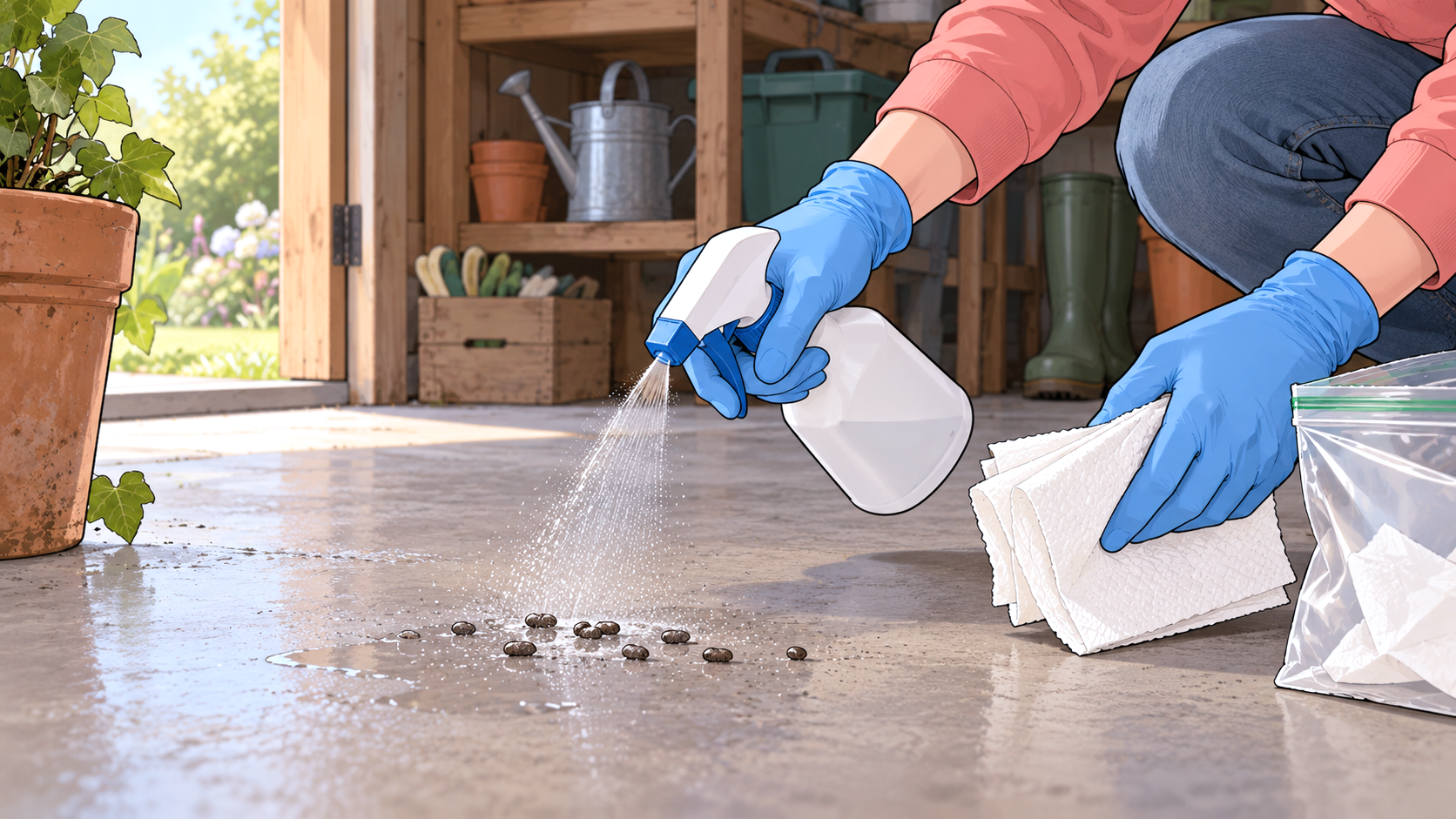
To clean up vole droppings safely, wear protective gloves, thoroughly wet the droppings with an appropriate disinfectant, allow the required contact time, and remove them with disposable paper towels. Never sweep, vacuum, or brush dry rodent droppings because these activities can release potentially contaminated particles into the air. Disinfect the surrounding surface afterward, dispose of contaminated materials securely, and wash your hands when finished.
These precautions apply even when the droppings appear old or the animal is no longer present. Rodent waste cannot be judged safe by its appearance, and potential health risks associated with contaminated rodent environments make controlled, wet cleanup preferable to ordinary dust removal.
Prepare the Area Before Touching Anything
A small amount of waste on an accessible surface usually requires fewer precautions than extensive contamination inside an enclosed building. Before cleaning a shed, garage, cabin, or similar outbuilding, open the doors and windows and leave the space for at least 30 minutes to ventilate. Ventilating enclosed rodent-contaminated spaces before cleanup reduces the chance of immediately disturbing accumulated airborne particles when work begins.
Keep children and pets outside the affected area. Gather rubber or plastic gloves, paper towels, plastic garbage bags, and an appropriate disinfectant before starting so you do not repeatedly move between contaminated and clean spaces.
For routine cleanup, gloves are the basic protective requirement. Canadian public-health guidance additionally recommends an N95-level respirator when cleaning rodent contamination in confined spaces. Extensive contamination may require professional assessment and more specialized protective equipment.
Do not shake contaminated objects, use compressed air, operate a leaf blower, or brush debris into piles. If you are unsure whether the waste belongs to a vole, use the same protective approach. The appearance of vole droppings cannot establish whether potentially infectious material is present.
Wet the Droppings With Disinfectant
Choose a household product specifically labeled as a disinfectant and suitable for the affected surface. Ordinary soap-based cleaners and products labeled only as sanitizers are not necessarily equivalent. The disinfectant’s approved uses and required contact time determine how it should be applied.
A freshly prepared bleach solution is another option. For rodent cleanup, the CDC recommends one part household bleach to nine parts water, equivalent to approximately 1½ cups of bleach per gallon of water. Use ordinary unscented household bleach suitable for disinfection, prepare the solution fresh, and never mix it with ammonia, acids, or other cleaning chemicals.
Spray the droppings, suspected urine-contaminated surfaces, and nearby debris until thoroughly wet. Avoid using a forceful spray that scatters loose material. The CDC recommends a five-minute soaking period for its specified bleach solution, while current Canadian hantavirus guidance specifies ten minutes. A ten-minute period is a conservative choice for that prepared bleach solution. For commercial disinfectants, follow the product’s stated contact time and keep the surface wet throughout.
Proper disinfection requires sufficient wet contact time. Spraying a surface and immediately wiping it dry may remove visible waste without completing the intended disinfection process.
Bleach can discolor fabrics, corrode certain metals, and damage some finishes. Check material compatibility before application, and avoid using it on surfaces where its use would create additional hazards.
Remove the Waste Without Stirring Up Dust
After the material has soaked, collect the wet droppings and debris with disposable paper towels. Work gently and avoid scraping or brushing dried residue into the air. Place used towels directly into a garbage bag rather than carrying them uncovered through the building.
For a small affected area, a sealed bag placed in a covered garbage container is generally appropriate, subject to local disposal rules. Canadian public-health guidance recommends double-bagging contaminated cleanup materials, including disposable gloves and nesting debris.
Once the visible contamination has been removed, clean and disinfect the surrounding hard surface. Pay attention to nearby corners, shelves, floor edges, and other places where urine or smaller particles may have accumulated. A disinfectant treatment should cover the affected surface rather than only the individual droppings.
Wash reusable cleaning equipment with disinfectant and soapy water as appropriate. Before removing your gloves, wash or disinfect their outer surfaces. Remove them without touching the contaminated exterior, then wash your hands thoroughly with soap and warm water.
Cleaning Vole Droppings From Different Surfaces
The material underneath the droppings affects what can be cleaned successfully. Hard, nonporous surfaces can generally be disinfected more thoroughly than absorbent materials containing contamination below their surfaces.
| Surface | Appropriate cleanup approach |
|---|---|
| Concrete, tile, or sealed flooring | Wet the waste, remove it with paper towels, then disinfect the surrounding surface |
| Plastic, glass, or metal containers | Remove contamination and disinfect using a compatible product |
| Unfinished wood | Minimize dust, remove wet waste, and assess whether the material can be adequately cleaned |
| Cardboard or contaminated paper | Discard heavily contaminated disposable items |
| Clothing or washable fabric | Launder with detergent using the hottest water permitted by the care instructions |
| Carpeting or upholstered material | Assess contamination and use a suitable cleaning method; extensive soiling may require professional treatment |
| Soil or loose outdoor debris | Avoid dry sweeping or disturbing suspected contaminated waste; use site-appropriate precautions |
For washable fabrics, hot-water laundering with detergent and thorough drying is preferable to spraying household bleach directly onto clothing. Delicate materials should be handled according to their care instructions and the extent of contamination.
Contaminated cardboard is particularly troublesome because urine can penetrate its fibers. Replacing a heavily soiled box is generally more practical than attempting to disinfect it. Nonporous contents may be retained after appropriate cleaning, while food or other materials contaminated by rodent waste should be discarded.
For carpeting, furniture, or other porous materials, avoid the assumption that a surface spray disinfects the entire affected depth. Substantial contamination may warrant professional cleaning or disposal.
What If Vole Droppings Are Outside on the Lawn?
Outdoor cleanup differs from disinfecting a garage floor. Scattered droppings in grass or soil cannot be treated like waste on a smooth, washable surface, and saturating large portions of a lawn with household bleach would risk damaging vegetation without providing a practical sanitation benefit.
If a small amount of suspected rodent waste is present on a patio or another nonporous outdoor surface, use the ordinary wet-cleaning procedure. When waste is mixed into soil, mulch, or vegetation, avoid creating dust or unnecessarily disturbing the area.
Where an outdoor location has been used repeatedly, look for recent signs of vole activity before undertaking extensive work. Old activity trails do not necessarily mean the same animals remain present. Heavy accumulations in a confined garden structure require more careful assessment than isolated pellets exposed to outdoor weather.
Keep pets away from concentrated waste, particularly where they may sniff, dig, or lick contaminated materials. Cleanup should reduce contact with waste without introducing hazardous concentrations of disinfectant into accessible outdoor areas.
When Is Professional Cleanup Necessary?
A few droppings on a hard floor and extensive contamination in a long-abandoned shed are not equivalent jobs. Large accumulations, numerous nests, contaminated insulation, inaccessible spaces, and visible evidence of prolonged rodent occupation can make ordinary household cleanup inappropriate.
Heavily infested buildings may require professional cleaning, especially when contaminated material must be removed from insulation, crawl spaces, or other difficult locations. In such circumstances, respirator selection, protective clothing, waste handling, and methods for containing disturbed material may require professional assessment.
Contamination inside heating or cooling ducts presents additional concerns. Do not operate equipment that could distribute contaminated debris through occupied rooms. A qualified professional should assess the affected system before cleaning proceeds.
If considerable waste repeatedly accumulates after cleanup, the underlying animal activity also needs attention. Removing droppings restores cleanliness but does not prevent further contamination. Continued vole activity around the property should be evaluated separately rather than responding with repeated disinfection alone.
What If You Already Swept or Vacuumed the Droppings?
Stop the activity immediately. Avoid further disturbance, leave the affected area, and ventilate it where appropriate. Do not empty a potentially contaminated vacuum canister indoors or shake out its contents.
For a limited exposure, carefully clean and disinfect the affected surfaces using the wet procedure. Where substantial material may have been aerosolized, especially inside an enclosed room, seek guidance from the local public-health authority before continuing.
An accidental exposure does not mean an infection will occur. Nevertheless, anyone who subsequently develops an unexplained fever, muscle aches, severe headache, or other concerning symptoms should seek medical assessment and report the rodent exposure.
The risk of hantavirus infection associated with voles depends on the species, geographic location, and virus involved. Cleanup precautions are appropriate without assuming every vole carries a human-pathogenic hantavirus.
For routine rodent contamination, the safest working principle is straightforward: keep the material wet until it has been removed, disinfect the affected surfaces properly, and avoid any cleaning method that sends dried waste into the air.
One thought on “How to Clean Up Vole Droppings Safely”