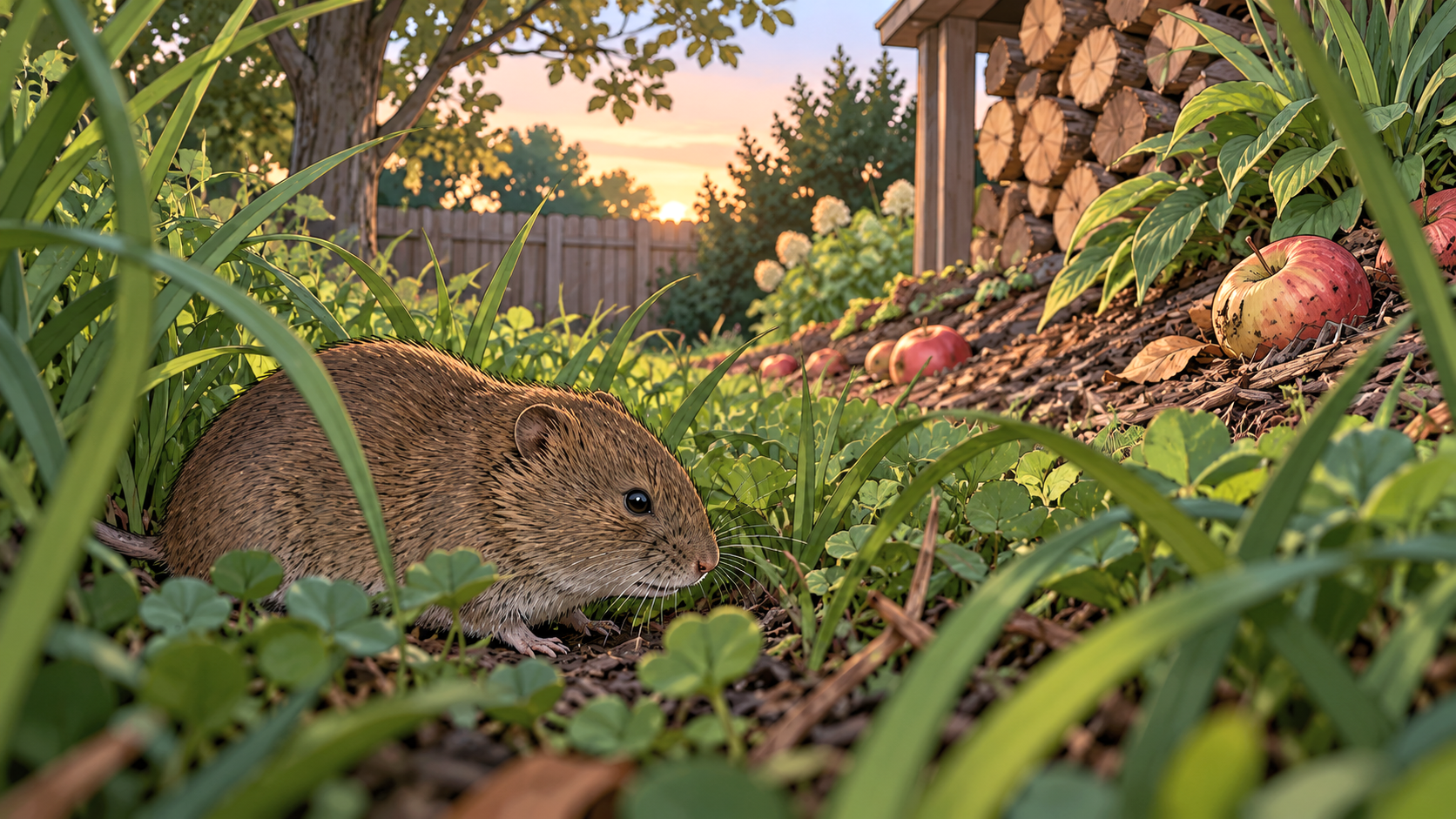
Voles are attracted to yards that provide abundant vegetation to eat, dense ground-level cover, and protected places to travel and nest. Tall grass, overgrown borders, thick mulch, sprawling groundcovers, brush piles, and neglected planting beds can make a property especially favorable. The combination of food and shelter is more important than any single plant or landscaping feature.
A yard does not need to be overgrown everywhere to support voles. A neatly mowed lawn beside an unmowed field, a dense ornamental planting, or a heavily mulched shrub border can offer enough connected shelter for animals to reach nearby grass, roots, and garden plants. Voles may also arrive from adjoining properties, so favorable conditions along a boundary can influence activity well beyond that particular strip of vegetation.
Tall Grass Offers Food and Protection at the Same Time
An overgrown lawn provides two things voles use continuously: edible vegetation and concealment from predators. Grasses and other herbaceous plants supply much of their food, while overlapping stems allow them to move near the soil without crossing large exposed areas.
Meadow voles establish pathways through vegetation, gradually wearing narrow routes between sheltered locations and feeding areas. These surface runways are usually concealed by surrounding grass, so an area that appears uniformly green from above may contain a network of regularly used passages underneath.
The most favorable places are often those that receive little maintenance. Grass along fences, drainage ditches, property boundaries, and the edges of fields can remain tall long after the main lawn has been cut. Where these strips connect directly to planted beds, voles can travel between food sources while remaining concealed.
Maintained lawns are not automatically unattractive, but regular mowing reduces both vole food and protective cover. This helps explain why activity may concentrate along unmowed edges even when the rest of the property appears suitable for feeding.
A homeowner who discovers narrow vole runways through lawn grass should pay particular attention to where those paths lead. The adjoining vegetation may be supporting the animals more effectively than the damaged turf itself.
Thick Mulch and Landscape Fabric Create Concealed Space
Mulch does not need to be edible to encourage vole activity. A deep layer of wood chips, shredded bark, leaves, or other organic material can conceal movement along the soil surface and provide shelter around plants.
Voles are particularly associated with landscapes containing heavy mulch, dense vegetation, and weed-control fabric. These materials can protect the animals from exposure while allowing them to reach nearby roots, stems, and other plant parts.
Mulch piled around the bases of trees and shrubs is especially significant because it places shelter directly beside vulnerable plant tissue. Voles can remain concealed while feeding close to the soil line, sometimes causing damage that becomes obvious only after the surrounding material is removed.
A thin, properly maintained mulch layer does not have the same implications as several inches of compacted material extending continuously through a planting bed. Deep mulch and spreading ornamental groundcovers favor vole activity, particularly where the surface underneath remains undisturbed.
Landscape fabric can create a similar problem even when it suppresses weeds successfully. Material laid flat against the soil may conceal travel routes beneath it, especially when covered with mulch or accumulated vegetation.
The risk of vole damage to trees and bark becomes more relevant when these protected spaces extend directly to trunks, but the attractive feature is the shelter created by the landscaping rather than the mulch’s smell.
Which Garden Plants Make a Yard Attractive to Voles?
A garden containing grasses, tender herbaceous plants, bulbs, roots, and other edible plant material offers potential feeding opportunities. The presence of vegetables or flowers does not guarantee an infestation, but vulnerable plantings become more accessible when voles can approach through nearby cover.
Voles feed on grasses, herbaceous plants, roots, bulbs, and tubers. A lawn bordering a densely planted vegetable garden may therefore offer food throughout the growing area rather than at one isolated location.
Ornamental beds can be particularly favorable when low vegetation forms an almost continuous canopy over the soil. Spreading junipers, dense groundcovers, and large clumps of ornamental grasses create protected routes that may remain usable after surrounding lawns have been cut.
The underground bulbs and tubers eaten by voles can also make particular planting areas valuable food sources. Tulips and potatoes are more susceptible than some less palatable plants, although food preference alone does not determine whether animals establish themselves nearby.
Voles do not necessarily enter a property because one attractive plant has been installed. Their continued presence is more plausibly supported by the combined availability of suitable vegetation, protected travel routes, and resting places.
Brush Piles, Fallen Leaves, and Stored Materials Provide Shelter
Piles of branches, dead vegetation, accumulated leaves, and materials stored directly on the ground can create sheltered spaces where voles are less exposed to predators and changing weather.
The condition of the ground underneath these objects is especially relevant. A pile resting on bare, exposed soil may provide a temporary hiding place, while the same pile surrounded by thick grass and spreading groundcovers becomes part of a larger protected area.
Voles may use sheltered vegetation and shallow underground nests rather than constructing conspicuous aboveground shelters. Objects resting on the ground can conceal those resting places without visibly containing a nest themselves.
The small grass-and-leaf nests used by voles are therefore more likely to remain unnoticed where vegetation and debris provide substantial cover.
Firewood, lumber, unused garden equipment, and similar materials can also create protected patches, particularly when left undisturbed for long periods. These objects are not specific vole attractants in the way edible plants are, but they can contribute to the shelter available across a property.
Why Voles Often Appear Along Property Boundaries
A yard bordering a meadow, vacant lot, orchard, field, or unmanaged grassy strip may experience vole activity even when its own landscaping is relatively tidy.
The adjoining land can support animals that subsequently move into nearby gardens. Backyards bordering fields, forests, and open grassland may experience substantial vole pressure, particularly during periods when surrounding populations are abundant.
A boundary becomes especially permeable when dense vegetation continues uninterrupted across it. Tall grass beneath a fence, for example, can connect an unmanaged neighboring area with ornamental beds or shrubs on the other side.
This pattern helps explain why vole activity can recur in the same part of a property. The yard may offer attractive plants, while the adjoining land supplies extensive cover and additional feeding areas.
The signs of voles occupying a yard can indicate where they are active, but those observations do not necessarily reveal where the animals originated. An opening beside a garden bed might connect with protected ground extending well beyond that bed.
Snow Can Temporarily Make Open Lawns More Accessible
A lawn that provides little shelter during summer may become accessible beneath a continuous winter snowpack. Snow creates an insulated space above the soil surface, allowing meadow voles to move through areas that would otherwise expose them to predators.
This is why winding grass pathways often become visible after snow melts. The animals may have crossed relatively open portions of the lawn while protected by snow, even though they would normally concentrate in denser vegetation.
Snow cover can also connect previously separated sheltered areas. A grassy border and a distant shrub bed may become linked by a protected route across turf during winter.
The resulting spring damage does not prove that the lawn supported the same level of vole activity throughout the growing season. Some animals may have used the area primarily while snow provided temporary concealment.
This seasonal effect helps explain why maintaining short grass does not completely eliminate vole activity in cold climates. The return of vole damage after winter can involve shelter supplied by snow rather than any permanent change in the lawn itself.
Do Bird Feeders, Compost Piles, or Water Features Attract Voles?
Spilled birdseed can provide an additional food source, particularly where it accumulates beneath feeders and remains accessible near vegetation. Reducing seed spillage around bird feeders is one way to avoid supplementing food available to voles.
A compost pile may provide both shelter and edible plant material, depending on its contents and construction. A contained compost bin is different from an open heap of vegetation resting directly on the ground. The latter can create protected space and accessible food, especially when surrounded by tall weeds.
Water features are less clearly implicated. Voles require water, but many obtain substantial moisture from fresh vegetation. A yard does not need a pond, fountain, or birdbath to support them, and the presence of standing water alone is not evidence that it attracted the animals.
For a suspected vole problem, food availability and ground-level concealment are more useful factors to examine than decorative water features.
Why Voles Keep Returning to the Same Parts of a Yard
Recurring activity often reflects landscape features that remain favorable from one season to the next. An established shrub border, unmowed fence line, or deeply mulched planting bed can continue providing food and cover even when the visible runways change.
The conditions supporting vole activity in landscaped areas are especially persistent where weeds, groundcovers, and accumulated litter remain undisturbed around desirable plants. New animals may use the same favorable locations after earlier occupants disappear.
This does not mean a particular yard contains a permanent or steadily growing population. Vole numbers fluctuate naturally, and activity can change substantially as conditions on neighboring land change.
The most useful assessment is therefore spatial rather than numerical. Identify where vegetation forms continuous cover, where food sources lie within that cover, and how those areas connect to surrounding land. A few isolated plants in an open lawn offer a different combination of resources from the same plants enclosed by thick mulch, tall grass, and dense shrubs.
One thought on “What Attracts Voles to Your Yard?”