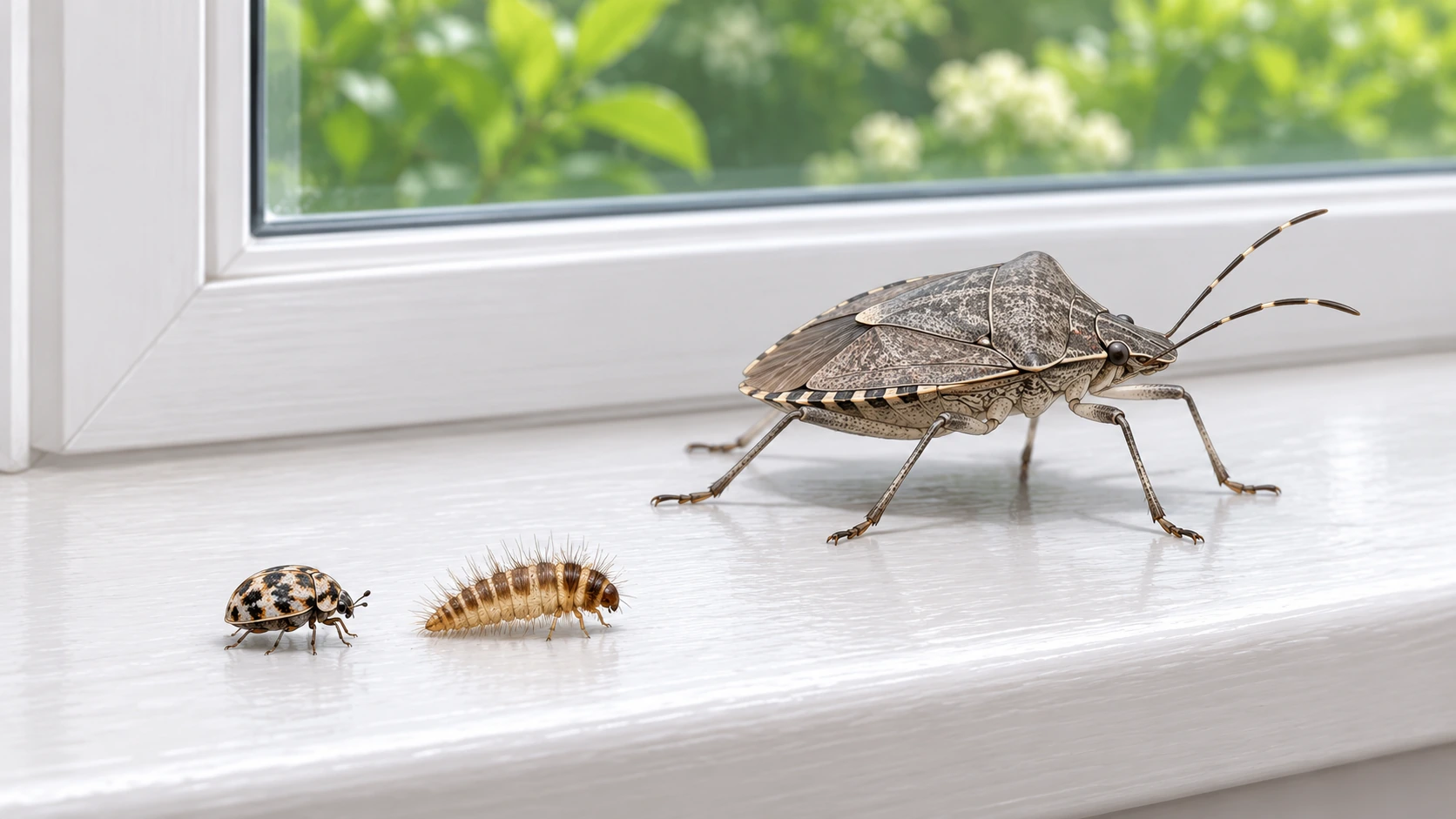
The easiest way to tell a carpet beetle from a stink bug is to compare their size and body shape. Common household carpet beetles are usually tiny, rounded or oval insects measuring approximately 2 to 5 millimeters long. The familiar brown marmorated stink bug is considerably larger, typically around 12 to 17 millimeters long, with a broad, shield-shaped body and noticeable shoulders.
Their markings also differ. A varied carpet beetle has irregular white, brown, yellowish, and black scales covering its rounded body. A brown marmorated stink bug has a larger, marbled brown body with alternating light and dark markings along the exposed edges of its abdomen. Its antennae also have distinctive pale bands.
The difference becomes less obvious when you find an immature insect. Young stink bug nymphs can be small, rounded, and dark, sometimes resembling a tiny beetle. Carpet beetle larvae, however, are elongated and hairy, while stink bug nymphs have a more compact body, visible legs and antennae, and no carpet beetle-style larval hair covering.
Where the insects appear can help with identification. Carpet beetle adults frequently turn up near windows in spring and early summer, while their larvae may be developing in wool, fur, feathers, or accumulated organic debris. Brown marmorated stink bugs are especially noticeable around buildings in fall, when adults seek sheltered places to spend winter.
These clues are useful, but no single observation should determine the identification. A small dark insect, a reported smell, or an autumn sighting does not establish which pest is present.
Carpet Beetle vs. Stink Bug at a Glance
The comparison is clearest when you examine intact adults. Because stink bugs include many species, the table uses the brown marmorated stink bug (Halyomorpha halys) as the principal household example.
| Feature | Carpet beetle | Brown marmorated stink bug |
|---|---|---|
| Insect order | Coleoptera | Hemiptera |
| Common household family | Dermestidae | Pentatomidae |
| Typical adult size | Approximately 2–5 mm for familiar household species | Approximately 12–17 mm |
| Body shape | Compact, rounded or elongated oval | Broad, angular, shield-shaped |
| Wing structure | Hardened wing covers meeting along the back | Forewings with leathery bases and membranous tips |
| Color and markings | Mottled scales or uniformly dark, depending on species | Marbled brown with alternating light and dark abdominal-edge markings |
| Antennae | Relatively short, often clubbed | Longer, segmented, with distinct pale bands in this species |
| Immature appearance | Elongated, hairy larvae | Smaller, often rounded nymphs without fully developed wings |
| Typical food | Larvae consume susceptible organic materials, including animal-derived fibers | Adults and nymphs feed on plants |
| Common indoor encounter | Windows, closets, rugs, furniture, storage areas | Windows, walls, attics, and sheltered building spaces |
| Seasonal clue | Adults often noticed in spring or early summer | Overwintering adults commonly appear around buildings in fall |
| Main indoor consequence | Potential damage to clothing, rugs, and other materials | Usually an overwintering nuisance rather than indoor fabric damage |
The differences in body form are more reliable than color. Several stink bug species are green, brown, or patterned, while carpet beetles can be mottled, black, or dark brown.
The comparison also changes when you examine young insects. A stink bug nymph is not shaped exactly like an adult, but it remains a true bug with piercing-sucking mouthparts. A carpet beetle larva is a completely different developmental form from its adult.
Why Carpet Beetles and Stink Bugs Can Look Similar
At first glance, both insects may appear to be small, brown, hard-bodied creatures crawling across a window or wall.
The resemblance comes partly from viewing them at a distance. When their legs, antennae, and wing structures are not visible, a rounded carpet beetle and a young stink bug may both look like dark moving specks.
Their mottled coloration can create additional confusion. A varied carpet beetle has a patchwork pattern formed by tiny colored scales. A brown marmorated stink bug has irregular brown markings across a much larger body.
In a photograph without a scale reference, these two patterns may look surprisingly similar. A close-up of a 3-millimeter carpet beetle can make it appear as large as a stink bug photographed from farther away.
The apparent resemblance usually disappears when the complete body outline becomes visible.
A carpet beetle has a rounded or smoothly oval back. A typical adult stink bug has a broad thorax with noticeable lateral shoulders and a body that narrows toward the rear.
The distinction is structural rather than simply a matter of size. Even when a stink bug species is smaller than Halyomorpha halys, its wing arrangement and true-bug anatomy differ from those of a beetle.
What Does an Adult Carpet Beetle Look Like?
Carpet beetles belong to the family Dermestidae. The common household species include the varied carpet beetle (Anthrenus verbasci), furniture carpet beetle (Anthrenus flavipes), and black carpet beetle (Attagenus unicolor).
These species do not all look alike.
Varied Carpet Beetles Are Small and Mottled
The adult varied carpet beetle is generally around 2 to 3 millimeters long. Its body is broadly oval, sometimes almost circular when seen from directly above.
The upper surface contains small, irregular patches of white, pale yellow, brown, and black scales. These scales give the beetle a speckled appearance rather than the large, marbled pattern seen on a typical brown stink bug.
The body is compact, with short legs that are often difficult to distinguish without magnification.
Another important feature is the shape of the wing covers. Like other beetles, carpet beetles have hardened front wings called elytra. These meet along a central line on the back and protect the folded flight wings beneath them.
The rounded body and patterned scales of adult carpet beetles are particularly useful when the specimen is intact.
However, the scales can wear away. An older varied carpet beetle may appear darker and less conspicuously patterned, so an insect without obvious white patches is not automatically another species.
Black Carpet Beetles Are More Elongated
Black carpet beetles are typically around 3 to 5 millimeters long and have elongated oval bodies.
Their upper surfaces range from dark brown to black. Unlike varied carpet beetles, they do not have the same obvious patchwork of colored scales.
This makes them less likely to resemble a large, patterned brown marmorated stink bug but potentially easier to confuse with some dark, small stink bug nymphs.
The appearance of black carpet beetles is useful because a carpet beetle does not need to be round and multicolored to belong to Dermestidae.
Even so, the adult’s body remains much more compact than that of a typical brown marmorated stink bug. It lacks the broad angular shoulders and exposed alternating abdominal-edge markings associated with that stink bug species.
A uniformly black insect should not be identified as either pest from color alone.
What Does an Adult Stink Bug Look Like?
Stink bugs belong to the family Pentatomidae, a group of true bugs within the order Hemiptera.
The brown marmorated stink bug, Halyomorpha halys, is a familiar household example because adults frequently seek shelter in buildings during colder months.
An adult is typically around 12 to 17 millimeters long, roughly half an inch to two-thirds of an inch.
Its body is broadly shield-shaped, with a wide thorax and a somewhat tapered rear. The shoulders, formed by the sides of the pronotum, are much more conspicuous than those of a typical carpet beetle.
The upper surface is mottled brown or grayish-brown, rather than covered with the fine, irregular scales of a varied carpet beetle.
The recognizable shield-shaped body of the brown marmorated stink bug is one of the most dependable ways to separate the two insects.
Two additional features help distinguish this particular stink bug from other shield-shaped insects.
First, the outer edges of the abdomen show alternating light and dark markings. These form a banded pattern around portions of the body visible beyond the wings.
Second, the antennae have distinct pale bands, particularly on the outer segments.
These markings are characteristic of the brown marmorated stink bug, not universal features of every stink bug species.
Some native stink bugs have similar body shapes but different antenna markings, shoulder structures, and abdominal patterns. Therefore, a shield-shaped insect can be identified as a probable stink bug without necessarily identifying it as Halyomorpha halys.
The Wing Structure Is a Major Difference
Carpet beetles and stink bugs belong to different insect orders, and their front wings are built differently.
An adult carpet beetle has hard wing covers called elytra. They form two protective halves over the back, usually meeting in a straight line along the middle.
These covers can give the insect a smooth, shell-like appearance.
A stink bug’s front wings are different. The basal portion of each forewing is thickened or leathery, while the rear portion is membranous. When folded, the wings overlap and create a pattern that includes a central triangular plate called the scutellum.
The resulting appearance is more complex than the simple paired wing-cover outline of a beetle.
From above, an adult stink bug often displays a conspicuous triangular area extending backward from the thorax. A carpet beetle does not have an equivalent large stink bug-style scutellum visible between its wing covers.
The distinction may require magnification on smaller specimens, but it is especially clear on a typical brown marmorated stink bug.
If you can see two hardened, matching wing covers forming a compact beetle shell, carpet beetles or another beetle group become more likely.
If you see an angular shield body with overlapping forewings and a prominent triangular scutellum, a stink bug becomes more likely.
Wing structure remains useful even when the insect’s colors have faded or the lighting is poor.
Are Stink Bugs Always Bigger Than Carpet Beetles?
The brown marmorated stink bug is substantially larger than the familiar small carpet beetles found in homes.
A varied carpet beetle measuring 2.5 millimeters long is approximately one-sixth the length of a 15-millimeter stink bug. That difference is readily noticeable when both specimens are viewed at their actual size.
Black carpet beetles are somewhat larger, but they are still much smaller than a typical adult brown marmorated stink bug.
However, stink bugs are a diverse family, and some species are smaller than others. Immature stink bugs are also much smaller than adults.
A newly hatched brown marmorated stink bug nymph may be only a few millimeters long, placing it within the size range of a carpet beetle adult.
This is why size cannot serve as the only identification criterion.
A 3-millimeter insect with a rounded, segmented abdomen, conspicuous antennae, and a true-bug body form may be a stink bug nymph rather than a carpet beetle.
A 3-millimeter insect with hardened beetle wing covers and a compact, scaled body is more consistent with an adult carpet beetle.
The measurement narrows the possibilities. Body structure resolves the comparison.
Carpet Beetle Larvae vs. Stink Bug Nymphs
The immature stages offer some of the clearest differences, but they also create a common identification mistake.
Carpet beetles undergo complete metamorphosis. Their development includes an egg, larva, pupa, and adult stage.
Stink bugs undergo incomplete metamorphosis. Their young are called nymphs, and they develop into adults through successive molts without a beetle-like larval or pupal stage.
As a result, a carpet beetle larva looks very different from an adult carpet beetle. A stink bug nymph, although smaller and sometimes differently colored than its adult, retains the general structure of a true bug.
Carpet Beetle Larvae Are Hairy and Elongated
Common carpet beetle larvae are usually brownish and visibly segmented, with dense hairs or bristles covering much of the body.
Depending on the species, they may be tapered, carrot-shaped, or somewhat wider toward the rear. Some have conspicuous tufts of longer hairs at the posterior end.
These hairs are especially useful for separating them from stink bug nymphs.
A carpet beetle larva often resembles a tiny hairy grub rather than a miniature adult beetle. It has no adult wing covers and does not have the broad, shield-shaped form of a stink bug.
The hairy bodies and characteristic tail tufts of carpet beetle larvae can be recognized when an intact specimen is examined closely.
Shed skins provide another clue. Carpet beetle larvae leave behind hollow, bristly outer coverings as they grow. These may accumulate around feeding sites even after the larvae have moved elsewhere.
A recognizable hairy cast skin in a wool blanket is very different from the smooth, non-bristly exoskeleton of a stink bug nymph.
Stink Bug Nymphs Are Smaller Versions of True Bugs
Young stink bugs do not resemble hairy carpet beetle larvae.
Brown marmorated stink bug nymphs pass through five immature stages. Their appearance changes considerably during growth.
Early nymphs may have a rounded body with a yellowish, orange, red, or dark-patterned abdomen. Some are predominantly dark and can initially resemble small beetles or ticks.
Later nymphs develop more recognizable stink bug features, including broader bodies, banded antennae, and patterned abdominal edges. Wing pads become apparent in the later stages.
The documented changes in brown marmorated stink bug nymphs explain why a young specimen should not be compared only with photographs of adult stink bugs.
The important distinction is that a stink bug nymph has visible legs and antennae, a comparatively smooth body surface, and piercing-sucking mouthparts. It does not have the dense, conspicuous larval hairs of a typical carpet beetle.
If the insect is small and rounded but lacks wing covers, it may be a nymph rather than an adult beetle.
If it is elongated and bristly, with a recognizable carpet beetle larval body, a stink bug nymph is unlikely.
Do Their Mouthparts Look Different?
Carpet beetles have chewing mouthparts, while stink bugs have piercing-sucking mouthparts.
The difference reflects what each insect eats.
Carpet beetle larvae consume suitable dried organic materials, including animal-derived fibers and other debris. Their mouthparts allow them to chew these substances.
Stink bugs use a specialized beak, or rostrum, containing piercing-sucking structures. In plant-feeding species, this apparatus penetrates plant tissues and withdraws fluids.
An adult brown marmorated stink bug may have its beak folded beneath the head and thorax while resting. This can make the structure difficult to see from above.
A carpet beetle does not have that same long, folded piercing beak.
This anatomical difference is useful when the insect is large enough to examine closely. On a tiny specimen, however, the mouthparts may be hidden, so body shape and wing structure are usually more practical for homeowners.
The fact that a stink bug has piercing mouthparts does not mean it ordinarily bites people. The brown marmorated stink bug is a plant-feeding insect and is not a typical human-biting household pest.
Why Carpet Beetles Often Appear Near Windows in Spring
Adult carpet beetles are commonly noticed near windows during spring and early summer.
Many adult Anthrenus species visit flowers outdoors and may enter homes through open windows, doors, or with cut flowers. Adults that developed indoors may also move toward light after emerging.
This can produce a familiar pattern: a homeowner discovers several tiny, rounded beetles on a sunny windowsill but has not noticed any larvae elsewhere.
The adults themselves do not establish that clothing or carpeting is infested. Some may simply be accidental visitors from outdoors.
Larvae, however, can develop inside suitable materials. Wool, feathers, fur, pet hair, dead insects, and similar debris may support feeding in concealed locations.
The reasons carpet beetles turn up near windows should therefore be considered separately from whether larvae are actually developing in the home.
An isolated adult in spring provides an identification opportunity, not proof of an established infestation.
Repeated larvae and recognizable shed skins in susceptible materials provide stronger evidence of indoor breeding.
Why Stink Bugs Often Appear Indoors in Fall and Winter
Brown marmorated stink bugs frequently enter buildings when outdoor conditions begin to cool.
Adults seek sheltered places to spend winter, and homes can provide suitable spaces around siding, window frames, attics, and wall cavities.
During fall, several stink bugs may gather on sunny exterior walls before entering through gaps.
Once indoors, they may remain concealed for long periods. Warm indoor conditions or sunlight can cause some adults to become active again, leading to sightings on windows and walls during winter.
This overwintering behavior differs from a carpet beetle population developing among stored fibers.
The seasonal movement of brown marmorated stink bugs into buildings helps explain why their sudden appearance does not necessarily indicate reproduction indoors.
In fact, brown marmorated stink bugs generally do not establish breeding populations inside ordinary homes. They reproduce on suitable plants outdoors.
That distinction matters if a homeowner finds several large shield-shaped bugs around an attic window in November. The insects may be overwintering adults that entered through exterior openings rather than a pest feeding on stored clothing.
The timing is not absolute. Carpet beetles may be encountered at other times of year, and stink bugs may enter houses outside fall. Seasonal context strengthens an identification only when the insect’s anatomy also matches.
Do Carpet Beetles and Stink Bugs Eat the Same Things?
No. Their normal feeding habits are quite different.
Carpet beetle larvae are scavengers that feed on particular dried organic materials. Common household species may consume wool, fur, feathers, dead insects, accumulated animal hair, and other suitable materials.
This is why carpet beetle infestations are associated with closets, natural-fiber rugs, upholstered furniture, and protected storage spaces.
Brown marmorated stink bugs feed on living plants. Both adults and nymphs use piercing-sucking mouthparts to obtain fluids from fruits, vegetables, and other plant tissues.
They are important agricultural and garden pests in places where established populations feed on susceptible crops and ornamentals.
A brown marmorated stink bug on a windowsill is not normally feeding on the curtain beside it. It may simply be resting or seeking a sheltered place.
A carpet beetle larva found among wool fibers presents a different situation because the material itself may support feeding.
The diet of carpet beetles and their larvae provides useful context when trying to determine whether insects are associated with actual household material damage.
If holes appear in a wool sweater, a stink bug should not be blamed merely because one was found nearby. Likewise, a small mottled carpet beetle adult on a houseplant does not prove it is feeding on the living leaves.
The actual feeding stage and source need to be identified.
Can the Smell Tell You Which Insect You Found?
A reported smell should not be used as the sole basis for identifying either insect.
Stink bugs are well known for releasing defensive secretions when disturbed or crushed. These can produce a noticeable odor, which is how the group acquired its common name.
However, the absence of an odor does not rule out a stink bug. An undisturbed individual may release little or no noticeable secretion, and people differ in their ability to detect particular smells.
The presence of an unpleasant odor also does not prove a stink bug is responsible. Household smells have numerous possible sources.
A crushed or disturbed stink bug can be associated with a characteristic defensive smell, but identification should still rest on the shield-shaped body, wing arrangement, antennae, and other physical features.
Likewise, a smell noticed in a closet should not be treated as evidence of carpet beetles without actual insects or associated material damage.
The practical lesson is simple: a specimen is stronger evidence than an odor description.
What If You Find a Small Dark Bug in Your Bedroom?
A small dark insect in a bedroom cannot be identified from the room alone.
A carpet beetle adult may have flown toward a window. A carpet beetle larva may be developing among animal-derived debris or vulnerable fabrics.
A brown marmorated stink bug adult may have entered through an exterior gap and settled around a window frame, ceiling corner, or wall.
A small stink bug nymph could also have arrived on a plant or other material brought indoors.
The first question is whether the specimen has a beetle’s compact body or a true bug’s broader, more angular form.
If it is elongated and hairy, determine whether it is a larva rather than an adult insect.
Next, check the surrounding evidence. Carpet beetle larval skins and feeding damage in natural-fiber fabrics suggest an entirely different situation from a large shield-shaped adult resting near a window.
The broader range of insects that resemble carpet beetles becomes relevant when the specimen lacks the expected features of either group.
There is no need to assume that an insect found on bedding is biting the occupant. Both carpet beetles and brown marmorated stink bugs may be present indoors for reasons unrelated to blood feeding.
How to Identify the Insect Without Relying on Color
A practical inspection should begin with a clear view of the entire specimen.
First, determine its approximate length. An adult around 15 millimeters long is much more consistent with a typical brown marmorated stink bug than with a common household carpet beetle. A beetle only 3 millimeters long may be a carpet beetle, but a young stink bug nymph can overlap in size.
Next, examine the body outline. A broad, angular shield favors an adult stink bug. A smooth, compact oval favors a carpet beetle.
Then look at the wings or immature body structure. Hardened beetle wing covers meeting along the back support adult carpet beetle identification. A prominent triangular scutellum and overlapping true-bug forewings favor an adult stink bug.
Finally, check the antennae, body covering, and context. Fine mottled scales support a varied carpet beetle. Pale-banded antennae and abdominal edges support brown marmorated stink bug identification. Dense larval hairs point toward a carpet beetle larva rather than a stink bug nymph.
The table below summarizes how several common observations should be interpreted.
| Observation | Stronger possibility | Important limitation |
|---|---|---|
| Tiny rounded insect with fine white, brown, and black scaling | Varied carpet beetle | Other small beetles may also be patterned |
| Small, elongated, uniformly dark beetle | Black carpet beetle possible | Many other beetle species are dark |
| Large brown insect with broad, shield-shaped body | Adult stink bug | Exact stink bug species still needs confirmation |
| Shield-shaped insect with pale-banded antennae and alternating abdominal-edge markings | Brown marmorated stink bug | Check other species-specific features |
| Brown, segmented, conspicuously hairy larva | Carpet beetle larva possible | Other dermestid larvae may resemble it |
| Small rounded, reddish or dark nymph with prominent antennae and no bristly covering | Stink bug nymph possible | Other true bug nymphs may be similar |
| Several large shield-shaped adults entering around windows in fall | Overwintering stink bugs possible | Location and season alone are not proof |
| Hairy shed skins and feeding damage among wool fibers | Carpet beetle infestation possible | Larval evidence should be identified |
If the insect contradicts the expected description, do not force it into either category.
For example, a 4-millimeter insect that looks shield-shaped but has conspicuous jumping hind legs may belong to another group entirely.
Accurate identification is more useful than choosing the closest match from two photographs.
What If the Bug Is Too Small to Identify Clearly?
Very small insects can be difficult to identify from ordinary phone photographs.
A close-up may exaggerate the apparent size, and a blurry image can conceal whether the body has beetle wing covers or the structures of a true bug.
Place the specimen in a secure, clear container if it can be collected safely. Photograph it against a plain background, preferably with a millimeter ruler for scale.
An overhead view is useful for examining body proportions and patterns. A side view may reveal whether the specimen is strongly domed, elongated, or relatively flattened.
Avoid crushing the insect before photographing it. Damage may remove the structures needed for identification.
If you suspect the insect is immature, look closely at the body covering. A bristly, elongated larva is different from a rounded stink bug nymph with visible antennae.
When identification remains uncertain, a cooperative extension insect diagnostic service or qualified pest professional may be able to examine the specimen.
Automated image-identification applications can suggest possibilities, but a confident result is not guaranteed when the insect is tiny, damaged, or photographed from an incomplete angle.
Does Finding One Mean You Have an Infestation?
One adult carpet beetle does not automatically establish an indoor infestation. It could have entered from outdoors, particularly during a period when adults are active around flowers and windows.
Finding larvae, shed skins, and damaged susceptible materials provides stronger evidence of an indoor carpet beetle population.
A single brown marmorated stink bug also does not establish an indoor breeding population. An adult may have entered a building while searching for an overwintering shelter.
Multiple stink bugs gathering in fall can be a significant nuisance, but their presence is not the same as larvae developing in household textiles.
The practical distinction is between breeding indoors and entering indoors for shelter.
For carpet beetles, an investigation may need to focus on the materials feeding the larvae.
For brown marmorated stink bugs, indoor appearances often relate to exterior access and seasonal sheltering rather than reproduction in the building.
The physical signs of an established carpet beetle infestation should therefore be assessed separately from the number of unfamiliar adults found near a window.
A homeowner who finds three shield-shaped insects in an upstairs room during autumn should not assume the insects are eating clothing. Equally, a homeowner who finds several hairy carpet beetle larvae beneath a wool rug should not treat the problem as ordinary stink bugs seeking shelter.
Do the Two Insects Cause the Same Household Problems?
No. Their household significance is different.
Carpet beetles are mainly pests of susceptible household materials. Their larvae can damage wool garments, natural-fiber rugs, upholstery, stored feathers, and other animal-derived products.
Brown marmorated stink bugs are principally plant-feeding insects that can become indoor nuisance pests during overwintering. Their agricultural impact can be important, but they do not normally consume household fabrics or establish breeding colonies in bedrooms.
Neither an adult carpet beetle nor a brown marmorated stink bug is a typical blood-feeding household parasite.
A nuisance insect found indoors should not automatically be linked to an itchy rash or unexplained skin marks. Environmental identification and medical symptom assessment are different questions.
Similarly, discovering a stink bug inside does not establish structural damage. Repeated sightings may point to exterior entry opportunities, but they are not proof that insects are consuming wood, drywall, or insulation.
For a homeowner, the first useful decision is whether the insect is a material-feeding larval pest or a seasonal visitor. That determines what evidence is worth looking for next.
Frequently Asked Questions
Is a carpet beetle smaller than a stink bug?
Common household adult carpet beetles are generally much smaller than adult brown marmorated stink bugs. Varied carpet beetles are usually about 2 to 3 millimeters long, while brown marmorated stink bug adults are typically around 12 to 17 millimeters. However, stink bug nymphs can overlap with carpet beetles in size.
Can a stink bug be round like a carpet beetle?
Some young stink bug nymphs are rounded or broadly oval, particularly early in development. Adults usually have a more recognizable shield-shaped outline. The insect’s antennae, mouthparts, wing development, and body covering help distinguish nymphs from carpet beetle larvae or adults.
Do carpet beetles have the same shield shape as stink bugs?
No. Carpet beetle adults generally have rounded or elongated oval bodies with hardened wing covers. The broad, angular shield shape of many adult stink bugs comes from their different thoracic and wing structures. Body proportions are usually more reliable than color.
Can a stink bug look like a tiny black beetle?
Yes. Some young stink bug nymphs are small and dark, and their immature appearance can initially resemble a tiny beetle. Unlike an adult beetle, a stink bug nymph lacks fully developed wing covers and has the body structure of a true bug.
Are stink bug babies hairy like carpet beetle larvae?
No. Typical stink bug nymphs do not have the dense, conspicuous bristles and hair tufts associated with common carpet beetle larvae. Their bodies may have other small surface structures, but their overall appearance is different from the elongated, hairy larval form of carpet beetles.
Why are stink bugs in my house during winter?
Brown marmorated stink bug adults may enter buildings during fall to overwinter. Warm indoor conditions or sunlight can reactivate them, leading to sightings around windows during winter. Their presence usually indicates shelter-seeking adults rather than a population reproducing inside the house.
Can carpet beetles and stink bugs live in the same house?
Yes. A house can contain carpet beetle larvae developing in suitable materials while also sheltering adult stink bugs that entered from outdoors. Their feeding habits and reasons for being indoors differ, so finding one does not rule out the other.
Can you identify the insects by their smell?
No. Some stink bugs release noticeable defensive secretions when disturbed, but the presence or absence of a reported smell cannot conclusively identify an insect. Body shape, size, antennae, wing structure, and a recognizable specimen provide stronger evidence.
The Bottom Line
Carpet beetles and stink bugs differ substantially in anatomy, development, and household behavior.
A typical carpet beetle adult is a tiny, compact beetle with hard wing covers and either mottled scales or a uniformly dark surface. A brown marmorated stink bug adult is much larger and shield-shaped, with a marbled brown body, pale-banded antennae, and alternating markings around the abdomen.
Their young stages are different as well. Carpet beetles develop through hairy larvae and a pupal stage, while stink bugs develop through nymphs that gradually acquire adult features.
The surrounding evidence helps explain why each insect is present. Carpet beetle larvae may develop among animal-derived fabrics or organic debris, while brown marmorated stink bug adults commonly enter buildings to spend winter in sheltered spaces.
Start with size and body structure, then use season and location as supporting clues. When the insect is too small or damaged to identify, preserve a specimen rather than relying on color, a reported odor, or where it happened to appear. Correct identification prevents unnecessary treatment and directs attention toward the actual household issue.