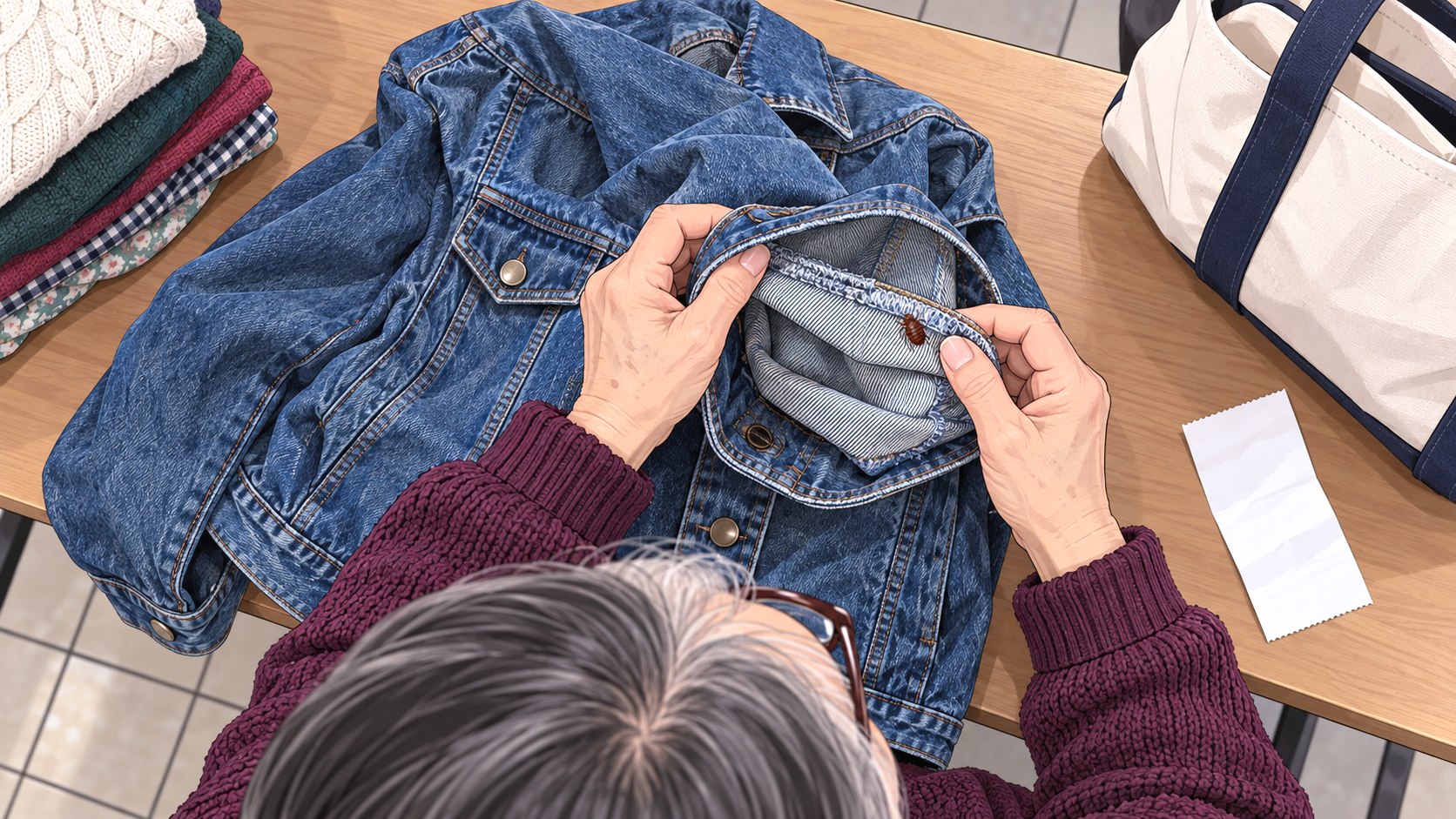
Bed bugs can occasionally come home on thrift-store clothes. Clothing can transport adults, nymphs, or eggs if it previously spent time in an infested home, donation bag, storage area, or other contaminated location. The risk is manageable because most washable or dryer-safe clothing can be heat-treated before it enters your closet.
Clothing Gives a Hitchhiking Bed Bug Several Places to Hide
Bed bugs do not normally live on the human body like head lice. They hide in protected gaps and move to new locations on belongings, including folded clothing, bedding, luggage, and furniture. A garment can therefore carry an insect without looking visibly infested from the outside.
Thrift clothing deserves inspection around pockets, cuffs, waistbands, collars, seams, hems, folds, linings, buttons, and zipper areas. Those structures create darker, narrower spaces than the middle of a smooth fabric panel. Public-health recommendations for donated textiles specifically advise checking pockets, seams, cuffs, folds, linings, and tufts before used clothing is distributed or worn.
Bed bugs can also travel on clothing without remaining attached to a person. The difference between hitchhiking on clothes and living on the body helps explain why finding one in a coat pocket is possible even though bed bugs are not clothing parasites.
Coats and Structured Garments Are Harder to Inspect Than T-Shirts
A simple cotton T-shirt offers comparatively few concealed spaces. A winter coat can contain a lining, inner pockets, cuffs, stitched insulation, a hood, zipper guards, decorative folds, and multiple fabric layers. Shoes, handbags, hats, costume pieces, and heavily constructed garments present similar inspection challenges.
Bed bug prevention advice for secondhand goods recognizes clothing as a potential introduction route and recommends careful inspection before items enter a home. Used clothing and upholstered goods should be examined for signs of infestation, particularly when their previous storage history is unknown.
The highest concern is not a specific fabric such as cotton, denim, wool, or polyester. Construction determines how many concealed spaces an item offers. A flat cotton sheet is easier to inspect than a lined wool coat, regardless of whether both came from the same store.
A Dryer Is the Most Useful Step for Dryer-Safe Thrift Clothes
For clothing that tolerates machine drying, heat gives you a practical way to kill hidden bed bugs rather than depending on visual inspection alone. EPA treatment guidance states that high dryer heat for 30 minutes can kill bed bugs and their eggs. The clothing should be loosely loaded enough for hot air to circulate and should remain in the dryer for the required treatment period after the machine reaches operating temperature.
Washing first is not required for the heat itself to work. In fact, high-temperature drying is more dependable than washing alone, because a cool or warm wash may not expose every life stage to a lethal temperature. You can wash afterward according to the garment’s care label if cleaning is needed.
The effectiveness of using a clothes dryer against bed bugs depends on heat reaching the garment for long enough, not simply running a brief wrinkle-release cycle.
Keep Untreated Clothes Separate Until They Have Been Processed
Bringing thrift purchases home and dropping them onto a bed, sofa, laundry pile, or bedroom carpet removes much of the benefit of treating them afterward. If a live insect leaves the garment before treatment, heating the clothing no longer addresses the bug that escaped.
Place newly purchased secondhand clothes into a sealed bag or closed container until you can inspect and, where appropriate, dry them. Clothes from potentially infested environments are commonly handled this way because sealed transport prevents insects from dropping into hallways, vehicles, or laundry areas. Potentially exposed clothing should remain bagged while being moved for treatment.
Once treated, transfer the clean clothing into a fresh bag, basket, or storage area rather than placing it back into the same untreated shopping sack. Similar containment principles are useful whenever you are trying to prevent bed bugs from entering your home on belongings.
Thrift Stores Do Not All Present the Same Risk
A store that accepts donations, sorts them, stores them densely, and places untreated fabrics together creates more opportunities for one contaminated donation to contact other goods than a retailer dealing only with newly manufactured clothing. Even so, finding bed bugs in used goods remains uncommon enough that buying secondhand clothing does not require treating every thrift shop as infested.
New York City guidance for donation centers notes that the chance of finding bed bugs in used goods is low, while still recommending screening and laundering because an occasional contaminated item can spread insects to other donations.
How a particular store processes clothing can reduce risk. Items that have been professionally dry-cleaned, commercially laundered, or subjected to adequate heat before sale are less concerning than unsorted donations placed directly onto racks. A store’s clean appearance alone cannot prove how the clothing was processed.
Bed Bug Eggs Are Easy to Miss During a Clothing Inspection
Adult bed bugs are several millimeters long and reddish-brown, but their eggs are much harder to notice. Eggs are roughly 1 mm long, pale, and attached to surfaces, so they can blend into stitching or light fabric. Bed bug eggs and young nymphs can be easily overlooked, especially when inspection relies only on room lighting.
The small, pale appearance of bed bug eggs is one reason a clean visual inspection should not be treated as equivalent to heat treatment. A garment can look completely normal while containing an egg inside a folded cuff or seam.
Dark spotting is another clue, but a random black speck is not diagnostic. Lint, ink, dirt, mold, dye, and other debris can all resemble pest evidence. Look for a combination of recognizable insects, shed skins, attached eggs, or characteristic spotting rather than condemning a garment because of one unexplained mark.
Wearing Thrift Clothes Before Treating Them Creates an Avoidable Risk
A person trying on a contaminated garment is unlikely to become permanently “infested” in the way someone can carry lice, but a bed bug can crawl from clothing into a handbag, car seat, coat, or another possession. Bed bugs are mobile hitchhikers and can be transported on clothing and personal belongings.
If you are especially cautious about a questionable item, avoid wearing it around the home until it has been treated appropriately. Trying clothes on briefly inside a thrift store does not mean you will get bed bugs, and ordinary shopping does not justify panic. The concern rises when you actually find a suspicious insect, know the garment came from an infested residence, or buy heavily layered items that cannot be easily inspected.
Dry-Clean-Only Clothes Need a Different Plan
Some wool coats, suits, silk garments, embellished clothing, and structured pieces cannot tolerate high dryer heat. Do not damage an expensive garment simply to apply a treatment method its care label prohibits.
Professional dry cleaning can be an option for appropriate fabrics. Tell the cleaner that the garment may have been exposed to bed bugs before handing it over so the item can remain contained until processing. Used-goods guidance recognizes dry cleaning and steam treatment as options for fabrics that cannot tolerate ordinary hot laundering.
Freezing is another possibility for suitable items, but casual exposure to winter weather or a cool household freezer is not enough. Effective cold treatment requires a verified temperature maintained throughout the item for sufficient time. Do not rely on leaving a coat outdoors overnight.
Spraying Thrift Clothes With Insecticide Is Usually the Wrong Approach
Do not spray ordinary household insecticide, outdoor pesticide, rubbing alcohol, or another improvised chemical directly onto clothing unless the product label specifically permits that use. Pesticides registered for bed bugs still have restrictions governing which surfaces may be treated, and applying a pesticide to clothing when the label does not permit it can expose the wearer unnecessarily.
Heat has the advantage of treating the fabric without leaving pesticide residue when the garment can tolerate it. If suspicious clothing has already introduced insects into the home, the issue has moved beyond treating the garment itself and may require the broader process for getting rid of bed bugs.
A Bed Bug on Thrift Clothing Does Not Prove Your Home Is Infested
Catching a hitchhiker while the garment is still contained can prevent an introduction entirely. Even after a piece has entered the home, finding one insect does not prove that a breeding population has become established elsewhere.
Preserve the specimen for identification if possible, treat or isolate the clothing, and inspect the places where the item was set down. Bed bugs often remain hidden enough that an early infestation can exist without obvious insects in the open, so monitoring makes more sense than immediately spraying every room.
If new evidence begins appearing around beds or upholstered furniture, such as additional live insects, shed skins, fecal spotting, or eggs, the situation has progressed beyond a single thrift-store garment.
Questions About Bed Bugs and Thrift Store Clothing
Should you wash thrift clothes before wearing them?
Yes, when the care instructions allow it. For bed bug prevention, an adequately hot dryer cycle is more dependable than washing alone.
Can bed bugs survive a normal washing machine cycle?
Some can survive washing conditions that are not sufficiently hot. Do not rely on washing alone when treating clothing for bed bugs.
Can bed bugs hide in jeans?
Yes. Waistbands, pockets, belt loops, folded hems, seams, and the zipper area can provide small protected spaces.
Are thrift-store coats riskier than shirts?
They can be harder to inspect because coats often contain linings, cuffs, interior pockets, padding, hoods, and multiple layers. That does not mean most used coats contain bed bugs.
Can bed bugs stay on clothes hanging on a rack?
A hitchhiking insect can remain hidden in a seam or fold for some time without feeding. Bed bugs can survive extended periods between blood meals, so simply leaving a garment unworn is not a dependable treatment.
Can you get bed bugs from trying on thrift-store clothes?
It is possible but unlikely. Risk would require a contaminated garment and an insect transferring onto you or your belongings during the fitting.
Should you throw away thrift clothes if you find one bed bug?
Usually not. Most washable or dryer-safe clothing can be treated effectively with heat. Contain the garment first so the insect cannot escape into the home.
What should you do with a thrift item that cannot go in the dryer?
Keep it sealed until you can choose a material-safe treatment such as professional dry cleaning or another validated heat or cold method. Do not improvise with pesticides or excessive heat that could damage the item.