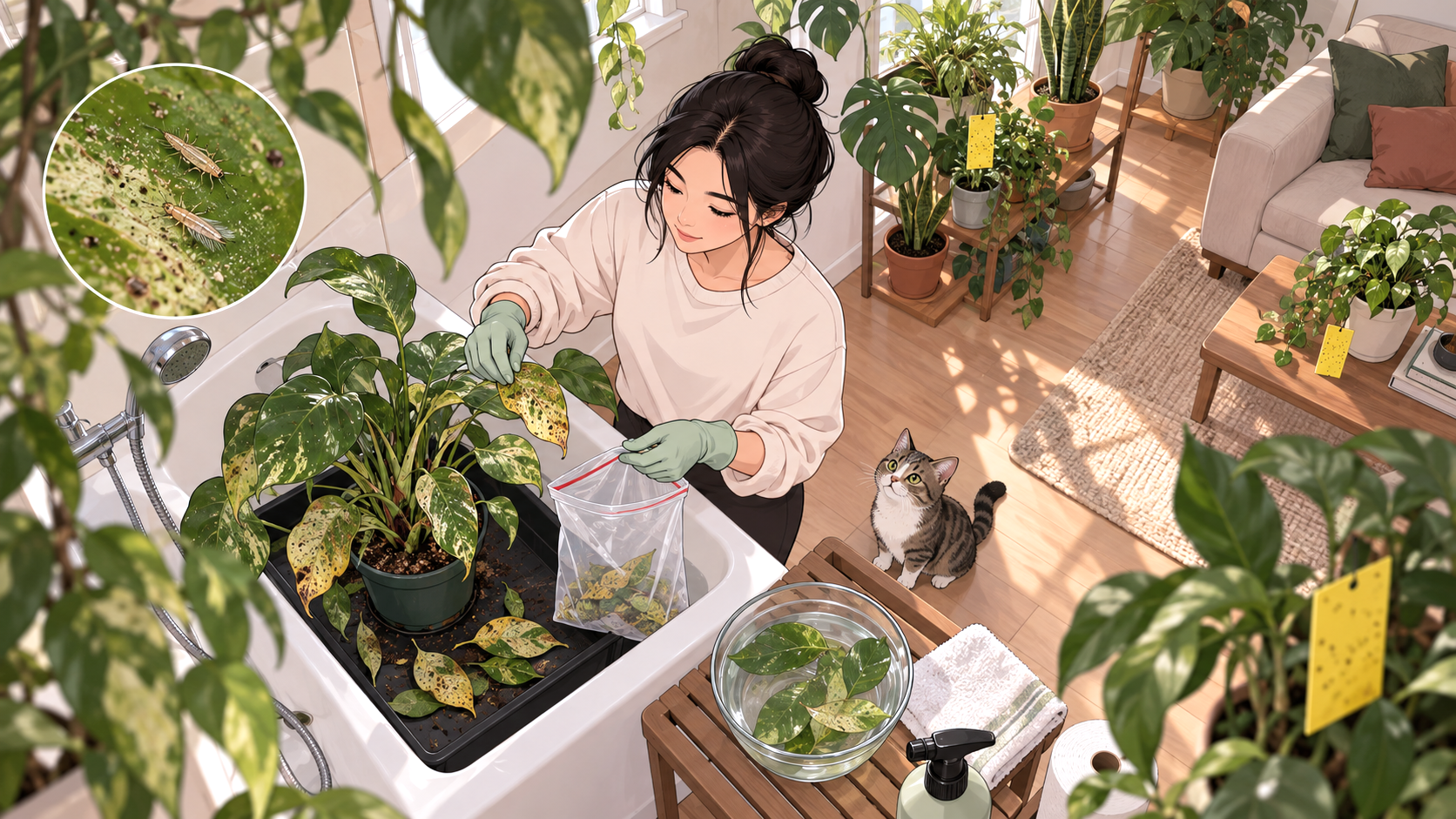
Finding tiny thrips crawling across a windowsill, wall, table, or other surface does not usually mean the house itself is infested. Indoors, the source is often a houseplant, cut flowers, or other plant material. Adult thrips can leave that source and turn up elsewhere in the room, so killing the insects you see without dealing with where they are coming from can leave the problem unchanged.
To get rid of thrips inside the house, find and remove or treat the plant source, vacuum or wipe up wandering thrips, clean the surrounding area, and monitor nearby houseplants. If an infested plant remains in the home, isolate it and control the thrips on the plant so new adults stop appearing around the room.
Find Where the Thrips Are Coming From
Start with the houseplants in and around the room where you are finding thrips. Examine the undersides of leaves, new growth, flowers, buds, and other protected areas. Thrips feeding can leave silvery or discolored patches, distorted growth, damaged flowers, and tiny dark fecal spots. Because the insects are so small, an infested plant may show recognizable signs of a thrips infestation before you notice the insects themselves.
If you cannot find them, hold white paper underneath suspicious foliage and gently tap the plant. Shaking or tapping foliage over a light-colored surface can make dislodged thrips easier to see. Inspect every nearby houseplant rather than assuming the plant closest to the window is responsible. Adult thrips can fly, so they may appear some distance from their original host.
Also think about anything recently brought into the house. Cut flowers, new houseplants, seedlings, herbs, and plants moved indoors from outside can carry thrips. If the insects appeared shortly after one of these arrived, inspect it carefully.
Make Sure They Really Are Thrips
Before treating your plants or home, confirm the identification. Thrips are tiny, narrow insects that can look like moving slivers. Adults have narrow fringed wings, although those details may require magnification to see clearly. Depending on the species and life stage, thrips can be pale yellow, tan, brown, or dark.
Fungus gnats, springtails, spider mites, and other tiny arthropods can also occur around indoor plants. Their control methods are not necessarily the same. Comparing the specimens with what thrips look like can help you avoid spending time treating the wrong pest.
Isolate Infested Houseplants
Move a confirmed infested plant away from apparently healthy plants if practical. This will not eliminate the thrips already on it, but it can make it harder for adults to move directly onto neighboring plants and gives you a contained area to manage.
Check every plant that was previously close to the infestation. Separating plants with pest problems and inspecting other indoor plants can help limit further spread. Do not automatically spray every plant in the room. Inspect them first and concentrate treatment where thrips are actually present.
Remove Thrips From the Infested Plants
For a sturdy plant that tolerates washing, take it to a sink or shower and thoroughly rinse the foliage. Concentrate on leaf undersides, new growth, and other places where you have actually found thrips. Water can physically remove many exposed adults and immature thrips without adding pesticide to the home.
Remove badly infested flowers, leaves, or shoots when the plant can tolerate pruning. Flowers can provide particularly protected places for thrips, so removing a heavily infested bloom may eliminate many insects at once. Put the removed material directly into a bag or waste container rather than leaving it around the house.
Physical removal may need to be repeated. Eggs of many plant-feeding thrips are inserted into plant tissue, while other stages can remain protected from a simple rinse. That is why a few insects may appear again even after the plant looked completely clean. The detailed process for getting rid of thrips on houseplants covers treatment of the plant itself more extensively.
Vacuum Thrips From Windows, Walls, and Floors
Once you are dealing with the source, remove the insects that have wandered into the rest of the room. Vacuum thrips from windowsills, window frames, floors, baseboards, curtains, furniture, and other accessible surfaces. Individual insects on hard surfaces can simply be wiped up with a damp cloth.
There is generally no reason to spray a wall or windowsill merely because a thrips landed there. Plant-feeding thrips are associated with suitable plant material, so the insects wandering around the room are not the part of the population you need to concentrate on. If you remove them but leave an infested plant untreated, more can appear.
Clean up fallen leaves, dead flowers, and other plant debris around infested pots at the same time. Then continue watching the area. A steady reduction in wandering insects after the plant has been treated is a good indication that you found the source.
Use Sticky Traps to Monitor Thrips Indoors
Place blue or bright yellow sticky cards close to affected houseplants. Adult thrips that fly away from the foliage can become trapped, making it easier to tell whether activity is continuing. Sticky traps can be used to monitor adult thrips, but they should not be expected to eliminate the infestation by themselves.
Watch the number of adults appearing on the cards over time. If trap catches remain high after one plant has been treated, inspect the rest of the collection again. Another plant may contain a population you initially missed.
Treat the Plant if Washing Is Not Enough
When washing, pruning, and isolation fail to control the infestation, an appropriately labeled houseplant treatment may be necessary. Insecticidal soaps and horticultural oils can kill exposed thrips when they contact them, although insects hidden in protected plant structures can escape treatment. Insecticidal soap and horticultural oil are among the options used for houseplant thrips.
Coverage matters with contact treatments. Follow the product label and reach the areas of the plant where thrips are actually present, including leaf undersides when directed. Do not increase the concentration or apply the product more frequently than allowed because another thrips appears a few days later.
If you prefer to minimize conventional pesticide use, washing, pruning, sanitation, monitoring, and appropriately selected lower-impact treatments can be combined as part of natural thrips control.
Do You Need to Spray the House for Thrips?
Usually not. A houseplant thrips problem should generally be addressed at the plant rather than by spraying rooms indiscriminately. Indoor thrips management focuses on controlling the insects on their host plants, while adults found elsewhere can usually be vacuumed or wiped away.
Avoid applying pesticides to carpets, bedding, sofas, walls, countertops, or other household surfaces unless a particular product is specifically labeled for that use and there is a legitimate reason to apply it there. Spraying the room does not solve the problem if eggs and immature thrips remain associated with an infested plant.
Why Do Thrips Keep Appearing in the House?
Seeing thrips again after cleaning does not necessarily mean they are entering from outside every day. The thrips life cycle includes protected stages that can survive your first attempt at control. Eggs inserted into plant tissue can later hatch, while prepupal and pupal stages of many species can develop away from exposed leaf surfaces.
Another infested plant can also keep supplying adults. If you repeatedly find thrips after treating one plant, inspect every other plant in the area again. Continue monitoring new plant growth and sticky traps rather than repeatedly treating household surfaces.
Should You Throw Away a Badly Infested Plant?
Sometimes removing the source is the fastest way to clear thrips from a house. A severely infested, inexpensive plant may not be worth weeks of repeated treatment, particularly when it is surrounded by healthy plants you want to protect.
Discarding severely infested houseplants can be a practical pest-management decision. Put the plant into a bag before carrying it through the house so fewer insects escape. After removing it, vacuum the surrounding area and continue inspecting the remaining plants for signs that thrips had already spread.
Prevent Thrips From Coming Back Inside
Inspect new houseplants carefully before placing them with your existing collection. Look beneath leaves, around new growth, and inside flowers. Keeping new plants separate temporarily provides additional time for a hidden population to become noticeable before it spreads.
Check plants that have spent time outdoors before bringing them back inside as well. Cut flowers can also carry thrips, particularly when insects are hiding between petals. These simple inspections are much easier than controlling an infestation after adults have dispersed among several indoor plants.
Once an infestation has been treated, keep checking the newest growth rather than relying on damaged old leaves. Old thrips scars will remain visible even after the insects are gone. Healthy new foliage, declining sticky-trap catches, and repeated inspections without living thrips provide much better evidence that the indoor problem has ended.
Pesticide disclaimer: Always use pesticides according to the current product label and confirm that the product is permitted for the plant, pest, and indoor location involved. Follow all directions concerning application rates, ventilation, protective equipment, reentry, children, and pets. Do not apply pesticides to household surfaces unless the label specifically permits that use.
More Questions About Getting Rid of Thrips Inside the House
Can thrips live in a house without plants?
Plant-feeding thrips may wander away from their hosts, but ordinary walls, floors, furniture, and other household materials do not provide the same resources as suitable plants. If thrips continually appear indoors, look for houseplants, cut flowers, or other plant material that may be supporting them.
Why are thrips gathering on my windows?
Adult thrips that leave plants can end up around windows while moving through a room. Vacuum or wipe them away and inspect nearby plants. Repeatedly finding adults around a window can help alert you that an active plant source remains indoors.
Will vacuuming get rid of thrips in the house?
Vacuuming is useful for removing wandering adults from household surfaces, but it cannot eliminate eggs and immature thrips developing on infested plants. The source must be controlled as well.
How do I know when the thrips are gone?
Look for healthy new plant growth, declining or absent sticky-trap catches, and repeated inspections without living adults or immature thrips. Old leaf damage can remain visible after successful control, so it should not be used by itself to decide whether thrips are still present.