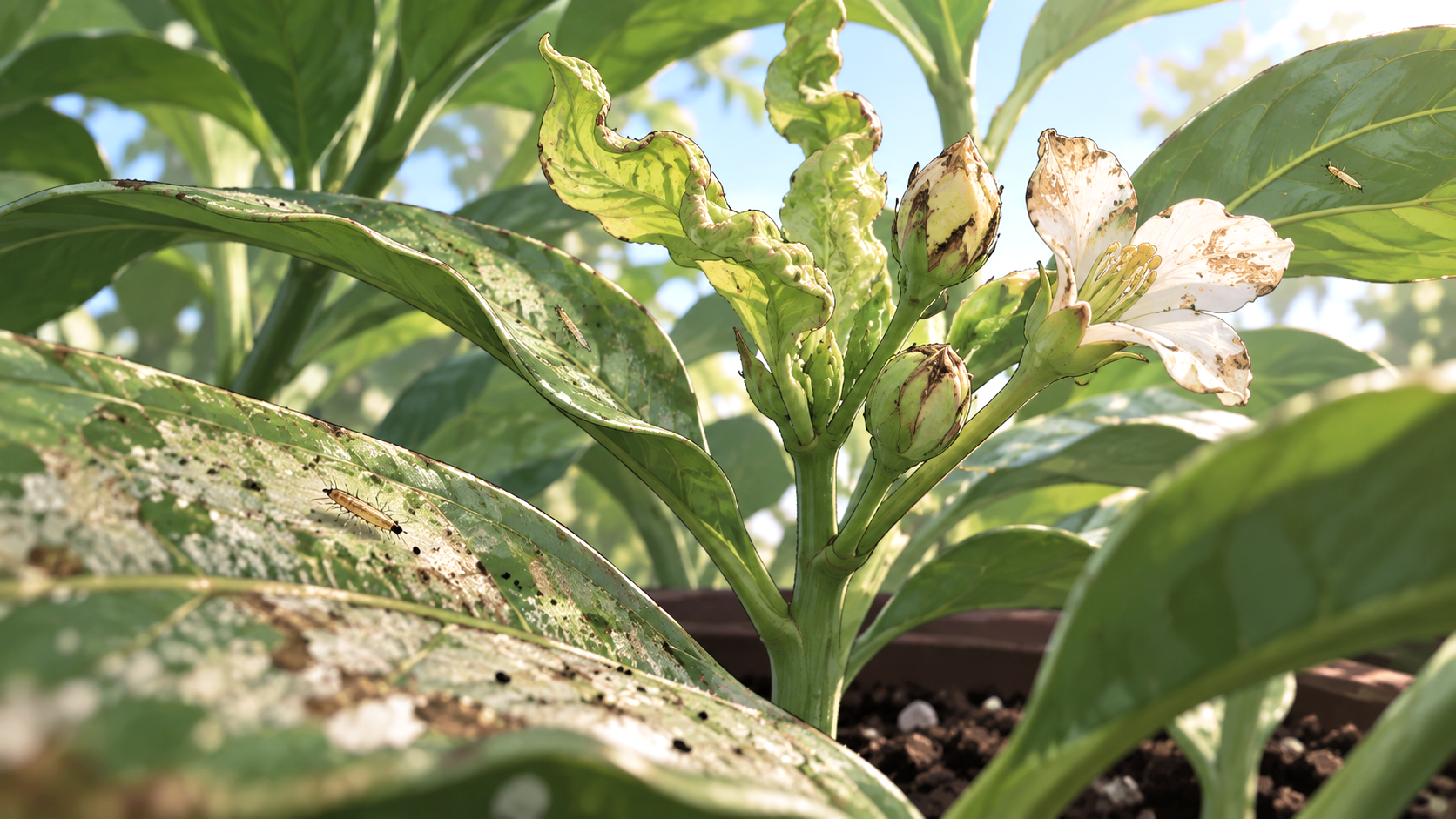
Silvery streaks appear across a leaf. New growth opens twisted or scarred. A flower develops strange discoloration, and tiny black specks show up beside the damaged tissue. These clues can point toward thrips, especially when several appear together. Common signs of a thrips infestation include silvery or pale feeding scars, stippling, distorted leaves and flowers, damaged buds, dark fecal spots, and tiny elongated insects moving across the plant. Because many thrips feed inside protected plant parts, the damage may become noticeable before you actually see the insects.
No single symptom confirms thrips on its own. Spider mites, true bugs, environmental stress, plant diseases, and other problems can produce some similar-looking damage. The strongest diagnosis comes from matching characteristic plant injury with actual thrips, their immature stages, or other evidence of an active population. Knowing what thrips look like makes that confirmation much easier when the insects are only a millimeter or two long.
1. Silvery or Pale Streaks on Leaves
One of the most recognizable signs is irregular silvering or pale scarring across the leaf surface. Thrips damage plant cells while feeding and remove their contents, leaving injured areas that reflect light differently from healthy tissue. The result may look silvery, whitish, grayish, or bleached. Colorado State University Extension describes light, irregular silvery areas around thrips feeding sites as a characteristic form of injury.
The pattern is not always a neat streak. Depending on the plant and thrips species, you may see scattered pale patches, short lines, larger scarred areas, or a mixture of these symptoms. Older injury can become brown as damaged tissue ages. Silvering is a useful warning sign, but it should lead to a closer inspection rather than an automatic diagnosis because mites and other plant problems can also cause pale discoloration.
2. Tiny Black Spots Around Damaged Areas
Look closely at the silvery or scarred areas and you may find another valuable clue: tiny dark spots. Thrips frequently leave dark fecal material around their feeding sites. These deposits may look like minute black dots or shiny specks scattered across the leaf, fruit, or flower. The combination of pale feeding scars and dark fecal spots is considerably more informative than either symptom alone.
The black varnishlike flecks associated with thrips feeding are particularly useful when the insects themselves are difficult to find. However, black specks are not exclusive to thrips, and some true bugs can leave similar deposits. Before treating a plant, inspect the affected area with magnification and look for elongated adults or pale immature thrips nearby.
3. Stippled or Speckled Leaves
Thrips feeding can also produce stippling, which appears as numerous tiny pale spots across the leaf. A lightly affected leaf may simply look speckled, while more extensive feeding can cause the spots to merge into larger discolored areas. The pattern can be especially confusing because spider mites and several other plant-feeding arthropods also cause stippling.
The surrounding evidence helps separate them. Spider mites are oval arachnids that commonly occupy leaf undersides and may produce fine silk webbing. Thrips are elongated insects and do not make webs. Dark fecal spots and larger silvery feeding wounds also support thrips. When the symptoms overlap, the structural differences between thrips and spider mites are much more dependable than stippling alone.
4. Distorted or Twisted New Leaves
Thrips feeding on young tissue can produce distortion that becomes increasingly obvious as the leaf expands. Affected leaves may emerge twisted, curled, rolled, misshapen, or otherwise deformed. In some cases, shoot tips become damaged enough to stop developing normally. Because the feeding occurred before the leaf reached full size, you may inspect the damaged tissue later and find few or no thrips remaining there.
This delayed appearance is important. Thrips injury may not become obvious until damaged tissue grows and expands, so the insect responsible can already have moved elsewhere by the time the symptom catches your attention. Inspect the newest growth around the damaged area, including unopened leaves, buds, crevices, and other protected locations where active thrips may still be feeding.
5. Flowers Become Streaked, Scarred, or Distorted
Flowers can show some of the clearest thrips damage because several pest species readily feed inside buds and developing blooms. Petals may emerge streaked, scarred, discolored, spotted, or distorted. Light-colored flowers can make dark fecal spots and feeding scars particularly noticeable, while darker flowers may show pale streaking or areas where normal color has failed to develop.
The timing of the feeding matters. Damage can occur while the flower is still tightly enclosed within the bud, meaning the petal is already injured before you see it. Colorado State University Extension notes that thrips feeding in buds and developing flowers causes petal distortion and scarring. Opening a suspicious flower and gently tapping it over white paper can help reveal adults or pale immature thrips hiding inside.
6. Flower Buds Fail to Open Normally
A heavily affected bud may not simply produce a scarred flower. Thrips feeding on developing floral tissue can interfere with normal opening, leaving buds deformed or causing flowers to deteriorate prematurely. Roses and other flowering plants can be particularly frustrating because the insects may remain deep within protected floral structures where casual inspection misses them.
A damaged bud should still be opened and inspected before thrips are blamed. Look between petals and around the base of the flower for tiny elongated insects, pale immature stages, feeding scars, and dark fecal deposits. Thrips may be only a fraction of the size of the flower structures surrounding them, so magnification can reveal insects that initially look like moving pieces of debris.
7. Tiny Slender Insects Move Across the Plant
Seeing the insects themselves turns a collection of suspicious symptoms into much stronger evidence. Thrips are extremely small and elongated, with most pest species appearing like tiny moving slivers. Their color varies substantially by species and life stage, ranging from translucent white or yellowish to brown or almost black. Adult thrips generally have narrow fringed wings, although those wings can be difficult to see without magnification.
Behavior can make them easier to notice. Thrips may run quickly when disturbed, and adults can fly. Immature thrips remain wingless and are often pale, which means a single infestation can contain insects that do not all look identical. The differences in thrips colors across species and developmental stages are one reason identification should never depend on finding only black, brown, or yellow insects.
8. Pale Wingless Thrips Appear Near Damaged Tissue
Finding tiny pale insects alongside darker adults can indicate that thrips are reproducing on the plant rather than merely landing there temporarily. The first two actively feeding immature stages are wingless and commonly pale. Depending on the species, they may appear translucent white, cream, yellowish, or light orange. Their bodies remain elongated, and they actively move across suitable plant tissue while feeding.
These young stages can be particularly useful evidence because they indicate development beyond the arrival of an isolated flying adult. Their small size makes them easy to overlook, especially on pale flowers. A closer look at thrips larvae and nymphs helps distinguish them from springtails, aphids, mites, and other tiny organisms that might occur around the same plant.
9. Leaves Become Papery or Drop Prematurely
As feeding injury becomes more extensive, damaged leaves can deteriorate beyond simple silvering. They may become papery, distorted, discolored, or dry and eventually drop from the plant. Severe infestations can also reduce normal growth when large amounts of young tissue are repeatedly damaged. These later symptoms are much less specific than finding thrips and characteristic feeding scars, so they should be interpreted in context.
Leaf drop has dozens of possible causes, including watering problems, root damage, disease, temperature stress, and other pests. A declining plant should therefore not be diagnosed with thrips simply because some leaves are falling. Search the remaining foliage and new growth for more specific evidence, particularly silvery scarring, dark fecal spots, elongated insects, and damaged flowers or buds.
10. Growing Tips Become Curled, Rolled, or Damaged
Some thrips species concentrate their feeding around tender shoot tips. Because this tissue is still developing, injury can produce dramatic distortion. Tips may become curled, rolled, discolored, stunted, or dead. Certain species produce even more distinctive effects on their particular host plants, including tightly rolled leaves and gall-like growth.
Host plant and thrips species matter greatly here. For example, Cuban laurel thrips can cause tightly rolled, podlike terminal leaves on ficus, while myoporum thrips produces characteristic distortion on susceptible Myoporum. This species-specific damage is one reason the different species of thrips should not be expected to produce exactly the same symptoms on every plant.
11. Fruit Develops Scars or Discolored Patches
Thrips can also damage developing fruit. Feeding on young fruit may leave scabby, silvery, brown, or corky scars on the surface as the fruit expands. The exact pattern varies with the crop and species involved. On some fruits, egg-laying or feeding injury can create distinctive scars, while other infestations produce broader surface discoloration.
The cosmetic appearance of the damage does not necessarily indicate equivalent internal injury. On avocado and citrus, for example, thrips can produce conspicuous surface scarring without damaging the internal quality or flavor of the fruit. Other crops can experience more consequential injury. Identifying the host and the responsible thrips species is therefore important before deciding what a scar means for the plant or harvest.
12. Thrips Appear When You Tap Flowers Over White Paper
One of the easiest ways to check a suspicious plant is to place white paper beneath flowers or foliage and gently tap or shake the plant. Tiny insects that were hidden inside flowers, buds, or other protected areas may fall onto the contrasting surface. Thrips appear as extremely small elongated insects and often begin moving across the paper.
This method is particularly valuable because many pest thrips feed in concealed locations, so simply looking across the exposed leaf surfaces can miss them. White paper does not identify the species for you, but it makes the insects easier to find and examine. A hand lens can then reveal whether the dislodged animals have the narrow body expected of thrips.
13. Adults Start Appearing on Sticky Traps
Bright yellow and blue sticky traps can capture flying adult thrips and provide evidence that adults are moving around plants. Traps are especially useful for monitoring because the insects are tiny enough to escape notice during ordinary plant care. Finding several narrow adult thrips on traps near plants can alert you to activity before damage becomes severe.
Sticky traps should not be treated as a complete measure of infestation size. They primarily sample mobile flying adults and do not directly count eggs concealed in plant tissue, wingless feeding larvae, or nonfeeding stages in protected locations. Because only adult thrips can fly, a trap can show adult activity while substantial portions of the population remain elsewhere on or around the plant.
14. Damage Keeps Appearing Even When Few Thrips Are Visible
A frustrating feature of thrips infestations is the mismatch between visible insects and visible damage. Females of many plant-feeding species insert eggs into plant tissue, where they are difficult to see. After hatching, the first two immature stages feed actively, while later prepupal and pupal stages may occupy soil, leaf litter, crevices, or other protected locations depending on the species. The population is therefore distributed across stages that are not equally visible.
Old damage also remains after the insect has moved. A scarred leaf does not become unscarred because the thrips that fed there has left, and injured tissue can become more conspicuous as it expands. Understanding the thrips life cycle helps explain why one quick inspection may reveal only a few insects even though new symptoms continue to appear.
15. Several Nearby Plants Begin Showing Similar Symptoms
Adult thrips can move between plants, and air currents can carry these tiny insects beyond their original host. An infestation that begins on one susceptible plant can therefore spread through a group of houseplants, greenhouse plants, or garden vegetation. Finding similar feeding scars and actual thrips on several nearby plants is a stronger warning than seeing one unexplained spot on a single leaf.
Still, proximity does not prove every damaged plant has thrips. Plants sharing the same location also share watering practices, light conditions, temperature, and exposure to other pests. Inspect each susceptible plant individually, concentrating on new growth, flowers, buds, leaf undersides, and protected crevices. This prevents unrelated plant problems from being incorrectly grouped into one infestation.
How to Confirm That the Signs Really Come From Thrips
Start with the freshest damage rather than old leaves that may have been injured weeks earlier. Use a hand lens to inspect the boundary between healthy and recently damaged tissue, then check flowers, buds, shoot tips, leaf undersides, and other protected areas. Look for elongated adults, pale wingless larvae, silvery feeding scars, and dark fecal spots. Gently tapping suspicious foliage over white paper can reveal insects hidden where direct inspection fails.
Also check for competing explanations. Fine silk webbing and tiny oval mites suggest spider mites. Pear-shaped insects accompanied by sticky honeydew suggest aphids. Tiny jumping organisms concentrated in damp growing media are more consistent with springtails. A broader look at bugs that resemble thrips can prevent similar-looking arthropods from being mistaken for an infestation. UC IPM specifically recommends confirming that pest thrips are actually present before taking control action because weather, pathogens, inadequate plant care, and other invertebrates can produce similar symptoms.
What to Do When You Find Several Signs of Thrips
Once actual thrips are confirmed, inspect the entire plant and nearby susceptible plants rather than concentrating only on the first damaged leaf. Check flowers, buds, new growth, and protected crevices for active stages. Heavily damaged or infested plant material can be pruned where appropriate, and isolated houseplants can be separated from unaffected plants to make inspection and management easier. Avoid assuming that old scars represent continuing feeding because damaged tissue will not return to its original appearance.
Management works best when it addresses the pest’s biology rather than relying on repeated indiscriminate spraying. Eggs may be protected inside plant tissue, some life stages occupy concealed locations, and natural enemies can help suppress thrips outdoors. Cultural care, physical removal, biological control, and appropriately selected lower-risk treatments can be combined when intervention is necessary. The available approaches for getting rid of thrips should be chosen only after the infestation has been confirmed.
More Questions About Thrips Infestations
Can you have thrips without seeing obvious plant damage?
Yes. A small or newly established population may be present before feeding injury becomes conspicuous. Damage can also remain hidden on developing tissue until leaves or flowers expand.
Does finding one thrips mean the plant is infested?
Not necessarily. An adult can arrive from another plant or from outdoors. Finding feeding damage, immature thrips, repeated adult activity, or multiple life stages provides stronger evidence that a population is established.
Where should you look first for thrips on a flowering plant?
Inspect flowers, unopened buds, tender new growth, and protected spaces around developing plant tissue. Many pest thrips feed in concealed locations, so opening flowers and tapping them over white paper can reveal insects that are not visible from the outside.
Can thrips damage remain after the infestation is gone?
Yes. Feeding scars and distorted tissue do not repair themselves after thrips disappear. Existing damage may remain until the affected leaves, flowers, or fruit are shed, removed, or replaced by new growth.
Can thrips infestations spread from one houseplant to another?
Yes. Winged adults can move between plants, and thrips can also be transported with infested plant material. Nearby susceptible plants should be inspected when an established infestation is confirmed.
9 thoughts on “Signs of a Thrips Infestation”