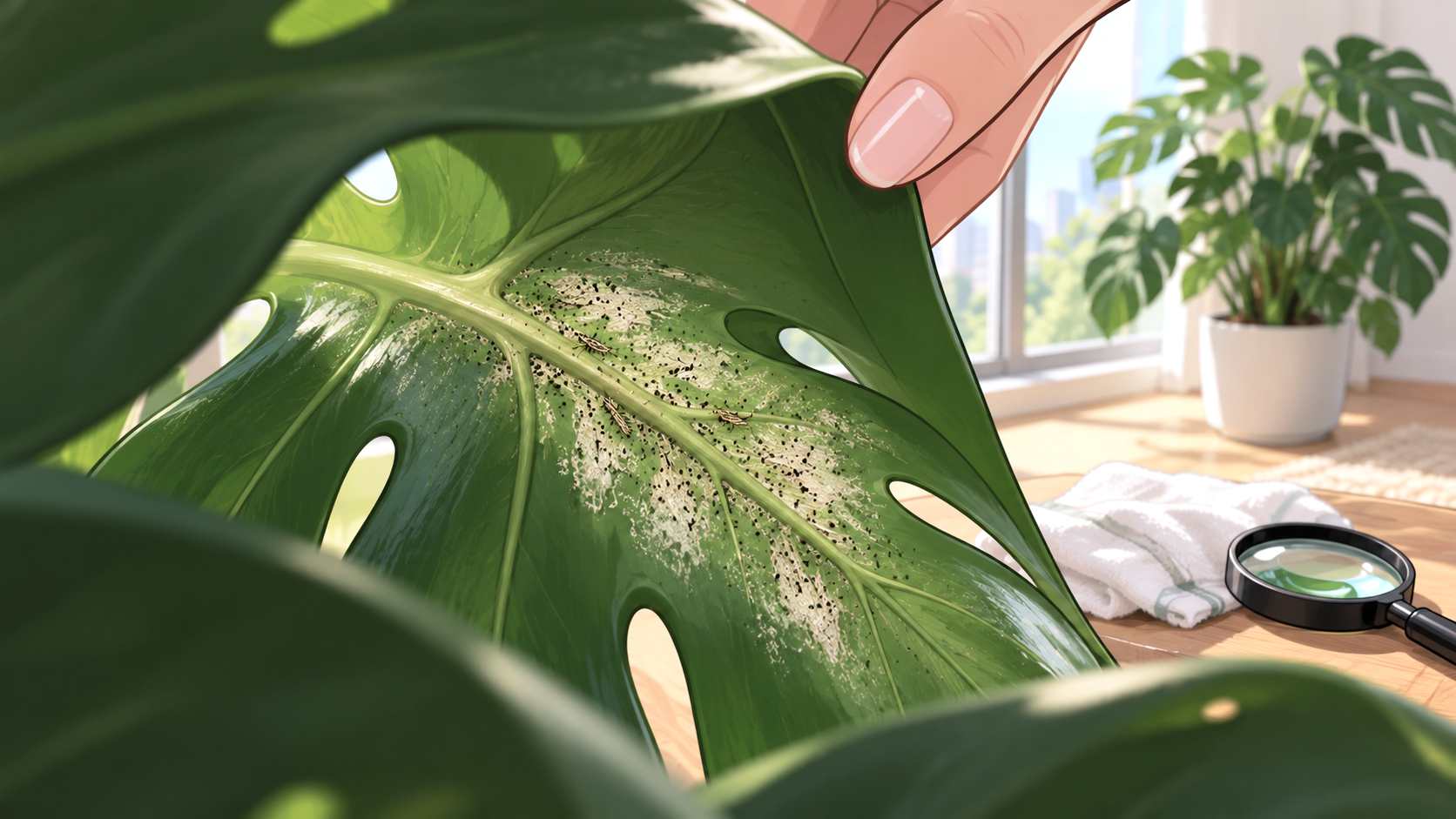
The newest Monstera leaf can reveal a thrips problem before the rest of the plant looks seriously affected. Instead of unfurling into a smooth, evenly green leaf, it may open with silvery scars, pale streaks, brown patches, or distorted sections that were damaged while the leaf was still tightly rolled. Older leaves may develop scattered discoloration and tiny dark specks, while the insects themselves remain surprisingly difficult to find.
Signs of thrips on a Monstera include silvery or grayish feeding scars, pale stippling, tiny black fecal spots, distorted or damaged new leaves, yellowing, and small elongated insects hiding on leaf undersides or in tight plant crevices. Heavy thrips infestations on houseplants can eventually produce extensive silvery-gray damage and premature leaf drop. The combination of fresh damage and the distinctive narrow-bodied appearance of thrips provides much stronger evidence than a brown or yellow Monstera leaf by itself.
What Do Thrips Look Like on a Monstera?
Thrips are extremely small, slender insects, generally less than 3 millimeters long, and many common pest species are considerably smaller. Adults typically have narrow wings fringed with fine hairs, although those wings can be difficult to see without magnification. Immature thrips are wingless and often pale. Depending on species and life stage, individuals can appear whitish, cream, yellowish, tan, brown, or nearly black.
Against a large Monstera leaf, a thrips can look almost insignificant. An adult may resemble a tiny dark splinter moving across the surface, while a pale immature thrips can blend into damaged or light-colored tissue. Houseplant thrips are commonly found on leaf undersides and inside tight plant crevices, making a quick glance across the top of the leaves inadequate. Examine both leaf surfaces, the newest growth, petioles, and protected spaces where plant structures meet.
What Does Thrips Damage Look Like on Monstera Leaves?
Thrips damage typically affects the surface and development of the leaf rather than removing obvious chunks of tissue. Feeding can produce irregular pale stippling, silver or grayish scars, discoloration, and eventually brown damaged areas. Heavy infestations on houseplants can leave foliage with broad silvery-gray patches, while affected leaves may yellow and drop. These symptoms reflect the scarring and distortion caused by thrips feeding.
On a Monstera’s broad green leaves, silvering can be particularly noticeable because it contrasts with healthy tissue. The pattern may consist of short streaks, scattered scars, irregular blotches, or larger damaged sections rather than a uniform change across the entire leaf. Fresh damage deserves the closest inspection because an old scar remains visible even after the insect that produced it has moved somewhere else.
Look for Silvery or Grayish Scarring
Silvering is one of the strongest visual reasons to investigate a Monstera for thrips. The damaged area can look scraped, faded, or reflective compared with the surrounding healthy green tissue. Small feeding sites may occur separately at first and eventually merge into larger irregular patches if feeding continues.
Colorado State University Extension describes light, irregular silvery areas developing around thrips feeding sites. However, silvering alone should not be treated as proof because physical injury and other pests can sometimes produce superficially similar symptoms. Look closely at the silvered area for dark fecal spots and living insects, then inspect nearby leaves for newer damage.
Tiny Black Spots Can Appear Near the Damage
One of the most useful supporting clues is the presence of minute dark spots around feeding sites. Thrips deposit tiny amounts of excrement while feeding, which can appear as shiny black dots scattered across damaged foliage. These specks can initially look like dirt, particularly on a Monstera that has accumulated ordinary household dust.
The location makes them more meaningful. Tiny dark deposits occurring repeatedly within or beside silvery feeding scars deserve a close look with magnification. Houseplant thrips can produce shiny black dots of excrement alongside stippling and silvery-gray damage. If narrow insects are also moving nearby, the evidence for thrips becomes substantially stronger.
New Monstera Leaves Can Unfurl Already Damaged
A new leaf that opens with scars does not necessarily mean thrips attacked it after unfurling. Thrips frequently feed in protected developing plant tissue, and the resulting damage may not become conspicuous until that tissue grows and expands. A small injury made while the Monstera leaf was tightly rolled can therefore become a much larger scar as the leaf unfurls.
This makes emerging foliage an important monitoring location. Inspect the newest leaf before it fully opens, but avoid forcibly unrolling or damaging tender growth just to search for insects. Once the leaf begins opening naturally, examine its surface and the surrounding petiole for thrips. The fact that thrips damage can become apparent only after injured tissue expands explains why a seemingly healthy Monstera can suddenly produce a badly scarred new leaf.
Thrips Can Distort New Monstera Growth
Feeding on immature plant tissue can interfere with normal development. A new Monstera leaf may emerge misshapen, curled, scarred, or unevenly developed rather than opening into its expected form. The damage can be concentrated along particular sections of the leaf if feeding occurred while those surfaces were folded together.
Distortion is useful evidence only when considered alongside more specific signs. Monstera leaves can develop abnormally because of moisture problems, physical damage during unfurling, environmental stress, and other causes. Search distorted leaves for silver scarring, black fecal spots, and actual thrips before connecting the deformation to an infestation. The broader signs of a thrips infestation can help distinguish a pest problem from an isolated damaged leaf.
Brown Patches Can Develop After Thrips Feeding
Thrips damage does not remain silver forever. Injured tissue can darken as it ages and dies, leaving tan or brown patches on the Monstera leaf. A severely affected leaf may consequently show several colors at once, with fresh pale or silver scars alongside older brown areas.
Brown patches are much less specific than fresh silvering. Overwatering, root problems, sunburn, temperature stress, physical injury, low humidity, excessive fertilizer salts, and disease can all contribute to brown Monstera foliage. General houseplant diagnostic guidance emphasizes that many indoor plant problems come from environmental conditions and improper care rather than pests. A brown patch should therefore trigger investigation rather than an automatic thrips treatment.
Yellowing Leaves Can Occur With a Heavy Infestation
Leaves subjected to substantial feeding may eventually yellow and drop. This tends to represent more advanced deterioration than the early silver scars and small feeding marks that initially reveal the pest. A Monstera experiencing continued feeding across multiple leaves may consequently begin looking less vigorous even though the earliest symptoms were primarily cosmetic.
Yellow leaves alone provide almost no diagnostic certainty. Monstera foliage can yellow because of excessive soil moisture, poor root health, insufficient light, nutrient problems, natural aging, or several pests. Thrips become a stronger explanation when yellowing occurs on leaves that also show characteristic scarring, fecal deposits, or active insects.
Check the Undersides of Monstera Leaves
The enormous upper surface of a Monstera leaf naturally attracts attention, but the underside should receive an equally careful inspection. Thrips on houseplants commonly occupy lower leaf surfaces and protected plant crevices. Turn each suspicious leaf over and examine the veins, margins, and areas near the petiole.
A 10X hand lens can transform this inspection. Instead of seeing unexplained beige or black specks, you may be able to distinguish narrow insects moving across the leaf. Check several leaves rather than stopping after one inspection because an infestation will not necessarily be distributed evenly across the plant. Freshly damaged foliage and newer growth deserve particular attention.
Check Where the Leaf Meets the Petiole
Tight plant structures provide hiding places that are easy to miss during ordinary watering and cleaning. Inspect around the junction between the leaf blade and petiole, along grooves and folds, and around emerging growth. These protected areas can shelter tiny insects while the broad exposed leaf surfaces appear relatively clean.
Do not assume that every small particle in these spaces is a thrips. Dust, potting material, dried plant tissue, and other insects can collect there as well. Watch suspected insects for movement and use magnification whenever possible. A living thrips should have the narrow, elongated proportions characteristic of the group rather than appearing as an irregular piece of debris.
Pale Baby Thrips Can Be Harder to Find Than Adults
An established population may contain pale immature thrips as well as darker adults. The first two actively feeding immature stages are wingless and can appear translucent white, cream, yellowish, or other pale shades depending on species and development. Their small size and coloration allow them to disappear visually against pale scars or the lighter portions of new growth.
Finding these feeding stages is valuable because it shows that you are not simply looking at one adult that happened to land on the plant. The appearance of thrips larvae and later immature stages also explains why every insect in an infestation does not look identical. Search for both pale and dark elongated insects rather than expecting an entire population to have one color.
Why You Might See Thrips Damage but No Thrips
The insect that produced a scar does not have to remain beside it. Adult thrips can move around the plant or fly elsewhere, while other stages may occupy protected locations. Many plant-feeding thrips also insert their eggs into plant tissue, and the prepupal and pupal stages of many species occur in soil, leaf litter, or protected crevices. The population can therefore be distributed across places that are not visible during one quick leaf inspection.
Existing damage adds to the confusion because it remains after feeding stops. An old silver or brown scar can persist for the life of that leaf. Understanding how the thrips life cycle moves through feeding and nonfeeding stages helps explain why repeated inspections are more informative than searching the plant once and concluding that no insects are present.
Tap a Monstera Leaf Over White Paper
A simple white-paper test can reveal thrips that are difficult to see against green foliage. Place a clean sheet of white paper beneath a suspicious leaf and gently tap or shake the foliage. UC IPM recommends shaking foliage over a light-colored surface to monitor for thrips. Any dislodged arthropods become easier to see against the contrasting background.
Watch their shape and movement before disposing of them. Thrips should appear narrow and elongated, while other houseplant pests can have dramatically different proportions. A hand lens is helpful for examining whatever falls onto the paper. Repeating the test on several leaves, particularly those with fresh damage, gives you a better picture than testing one old leaf.
Thrips Damage Can Be Confused With Spider Mites
Both pests can produce pale stippling and deteriorating foliage, making spider mites one of the more important alternatives to rule out. Spider mites are tiny oval arachnids rather than slender insects. As populations develop, many pest spider mites produce fine silk webbing across leaves and stems. Thrips do not make this webbing.
Thrips injury also tends to include larger irregular silver scars and can be accompanied by dark fecal spots. Colorado State University Extension notes that thrips wounds on houseplants are generally larger and more silvery than spider mite feeding wounds. When the damage remains ambiguous, inspecting the actual arthropods makes the differences between thrips and spider mites much clearer.
Thrips Can Spread to Other Houseplants
An infested Monstera should not be considered in isolation when other plants are nearby. Adult thrips can fly, and their tiny size makes movement between indoor plants possible. A neighboring houseplant may therefore harbor thrips before obvious damage develops.
Inspect nearby plants for fresh silvering, distorted growth, dark fecal spots, and living insects. Pay particular attention to tender new growth, flowers, leaf undersides, and protected crevices. Finding an infestation early is far easier to manage than discovering similar damage throughout an entire plant collection.
Isolate a Monstera When Thrips Are Confirmed
Moving a confirmed infested Monstera away from unaffected houseplants can reduce opportunities for adults to move directly into neighboring plants. UC IPM recommends isolating houseplants when insect or mite problems are detected. Choose an isolation area where the Monstera still receives appropriate light and environmental conditions rather than placing it somewhere unsuitable simply to separate it.
Treat nearby plants as exposed rather than automatically infested. Inspect them repeatedly over the following weeks instead of immediately applying pesticides to every plant in the room without evidence. Thrips are small and mobile, so continued monitoring matters even after the original Monstera has been moved.
Wash Exposed Thrips From the Leaves
For a Monstera that can be moved safely, rinsing foliage with water can physically remove exposed thrips. Houseplant management guidance specifically includes washing thrips from plants with water as a nonchemical control measure. Pay attention to both sides of the leaves and petioles while avoiding excessive force that could tear tender foliage.
Rinsing will not reach every life stage. Eggs inserted into plant tissue remain protected, while later developmental stages may be located elsewhere. Washing is therefore better treated as one component of management rather than a one-time cure. Repeated inspection afterward will show whether new feeding and living thrips continue to appear.
Remove the Worst Infested Growth When Appropriate
A severely damaged leaf containing numerous thrips can be removed if the Monstera has enough healthy foliage to tolerate pruning. Removing heavily infested plant parts physically eliminates some insects and reduces places where they can continue feeding. UC IPM includes disposal of infested plant material among its recommendations for managing thrips on houseplants.
There is little benefit in stripping a Monstera of every cosmetically imperfect leaf. An old scar does not mean thrips are still living on that particular leaf, and healthy green portions can continue contributing to the plant. Prioritize tissue that is heavily damaged, declining, or actively harboring substantial numbers of insects. Dispose of removed material promptly rather than leaving it beside the plant.
Sticky Traps Can Help Monitor Adult Thrips
Yellow or pale blue sticky traps placed near the plant can capture flying adult thrips. They are useful for monitoring whether adults remain active and can sometimes reveal a problem before you happen to find an insect on a leaf. Colorado State University Extension notes that adult thrips are attracted to sticky traps, particularly yellow or pale blue ones.
A sticky trap cannot tell you the entire size of the infestation. It primarily samples mobile adults and does not capture eggs inside plant tissue or every wingless immature thrips feeding on the Monstera. Use traps alongside direct plant inspections rather than relying on the number of trapped insects as the sole measure of success.
Insecticidal Soap or Horticultural Oil May Help
When physical removal and sanitation are insufficient, insecticidal soap or horticultural oil can be considered for exposed thrips if the product is labeled for indoor use on the plant being treated. These are contact treatments, meaning adequate coverage of the insects and infested plant surfaces is important. UC IPM includes insecticidal soap and horticultural oil among options for houseplant thrips.
A Monstera’s large leaves make thorough coverage possible, but protected crevices and concealed life stages complicate treatment. Never assume a homemade soap mixture is equivalent to a formulated insecticidal soap, and do not apply a pesticide merely because it is described online as natural. Follow the product label exactly, including instructions concerning concentration, indoor use, application frequency, and plant sensitivity.
One Treatment May Not Eliminate the Entire Population
Thrips biology makes one-and-done treatment unreliable. Many plant-feeding species insert eggs into plant tissue, where contact sprays cannot readily reach them. Later nonfeeding stages of many species can occur in soil or protected locations. Colorado State University Extension specifically notes that eggs inside plant tissue and later immature stages in soil can be inaccessible to sprays.
This is why monitoring must continue after the visible adults disappear. Check newly opening Monstera leaves, repeat the white-paper test, inspect sticky traps, and look for fresh feeding scars. Any pesticide that requires repeated applications should be reapplied only at the interval and in the manner specified by its label.
Do You Need to Treat the Potting Soil?
Finding thrips on the leaves does not automatically mean the entire potting mix should be drenched with pesticide. Although the prepupal and pupal stages of many thrips species can occur in soil or leaf litter, other thrips pupate on plants or in protected structures. The exact location varies among species. Treating soil indiscriminately can therefore add pesticide exposure without addressing the main feeding population.
Concentrate first on confirming and managing the thrips actually associated with the Monstera. Keep fallen and removed plant material cleaned up, inspect the plant carefully, and use management measures appropriate to the confirmed pest. Avoid converting every thrips infestation into a soil-treatment problem simply because some species use the growing medium during part of their development.
Old Monstera Leaves Will Not Become Green Again
Thrips control does not erase existing damage. A silver scar, brown feeding patch, or distorted section of leaf remains physically injured even after the infestation has been eliminated. UC IPM emphasizes that pesticides cannot restore plant tissue already damaged by thrips. Waiting for an old scar to disappear can therefore make successful management seem unsuccessful.
Judge progress from the plant’s newest growth instead. A new Monstera leaf that unfurls with little or no fresh scarring is encouraging, especially when repeated inspections also reveal fewer thrips. Conversely, new silvering, fresh fecal spots, or additional larvae show that active feeding continues.
What to Do When You Find Thrips on a Monstera
Start by moving the affected Monstera away from other houseplants and confirming the pest with direct inspection or the white-paper test. Examine every leaf, concentrating on the undersides, new growth, petioles, and protected crevices. Remove heavily infested or declining tissue where sensible, rinse exposed insects from the plant, clean up fallen plant material, and begin monitoring nearby plants and sticky traps. These measures reduce the population while giving you a clearer picture of how serious the infestation actually is.
If thrips continue to appear, an appropriately labeled insecticidal soap, horticultural oil, or another product registered for indoor ornamental plants and thrips can be incorporated according to its label. Avoid relying on pesticide treatment alone because thrips have protected developmental stages and can be difficult to control. The broader process for getting rid of thrips on houseplants works best when repeated monitoring, physical removal, sanitation, and carefully selected treatments are combined.
More Questions About Thrips on Monstera
Can a Monstera keep growing after a thrips infestation?
Yes. A Monstera can continue producing healthy growth after the thrips population is brought under control. Existing scars will remain, so newly developing leaves are a better measure of recovery than old damaged foliage.
Should you cut off a new Monstera leaf damaged by thrips?
Not automatically. A partially damaged leaf can still contain substantial healthy green tissue. Removal makes more sense when the leaf is severely declining or actively harboring a large number of thrips and the plant has enough healthy foliage to tolerate pruning.
Can thrips hide on a Monstera before you notice any damage?
Yes. Small populations can be difficult to detect, and feeding injury may become more obvious only as damaged tissue develops and expands. Regular inspection of new growth can reveal a problem earlier.
Can you keep a Monstera in the same room as other plants during treatment?
Physical separation is preferable when an active infestation has been confirmed because adult thrips can move between plants. Nearby plants should also be inspected repeatedly for early signs rather than assumed to be pest-free.
How do you know when thrips are finally gone from a Monstera?
Look for a sustained absence of living thrips and fresh feeding injury rather than expecting old scars to disappear. Repeated clean inspections, declining sticky-trap catches, and healthy new leaves provide stronger evidence that the infestation has been brought under control.
Pesticide disclaimer: Pesticide registrations and permitted indoor uses vary by location and product. Use only products specifically labeled for the target pest, plant, and application site, and follow the current product label for mixing, application, safety, storage, and disposal.