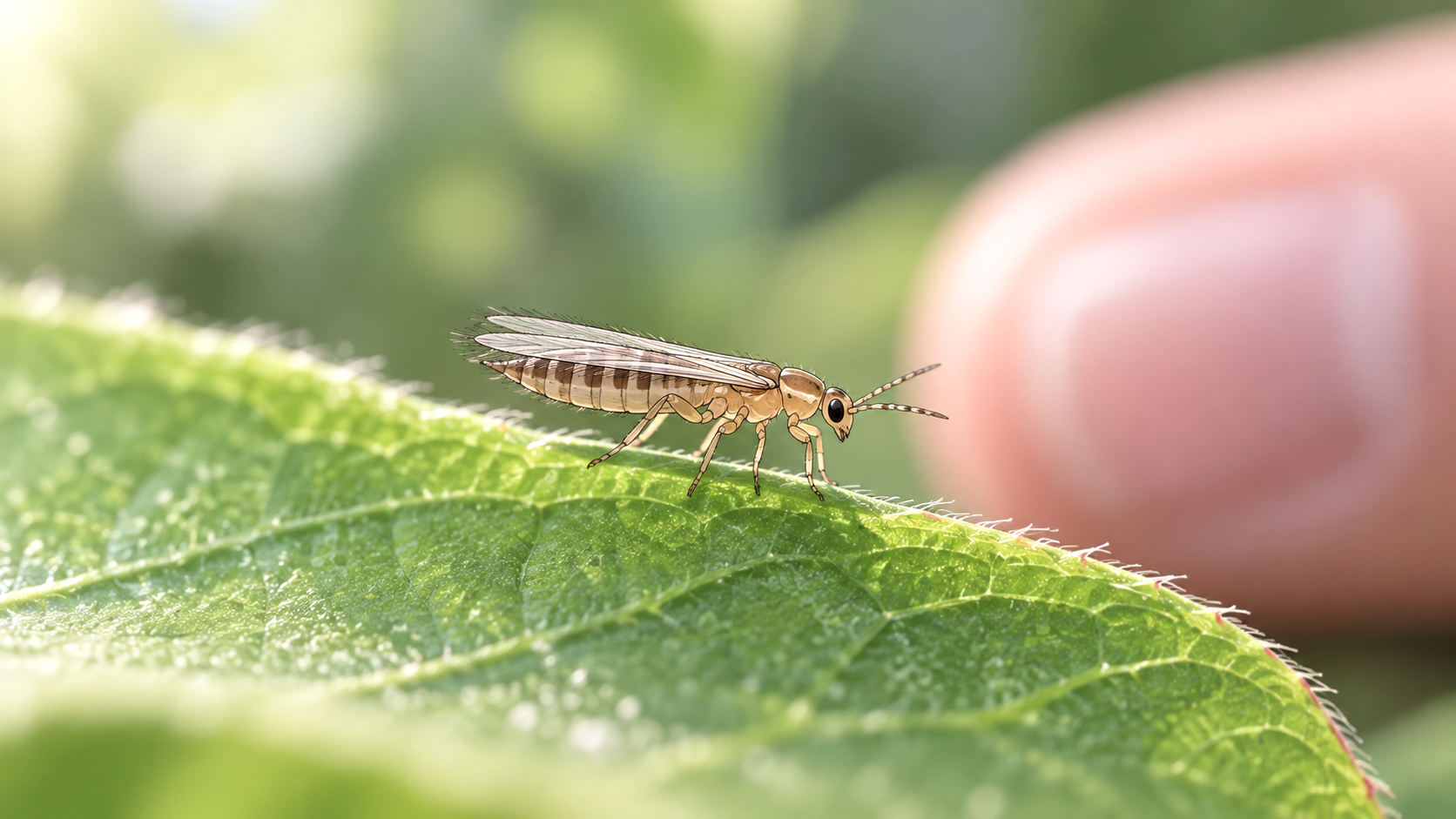
Thrips are tiny, slender insects that often look more like moving slivers than recognizable bugs when you first spot them on a plant. Adults have long, narrow bodies and distinctive fringed wings, while immature thrips are wingless. Depending on the species and life stage, their bodies may appear translucent, yellowish, brown, or almost black.
The easiest feature to notice without magnification is usually their shape. Thrips are narrow and elongated rather than round, broad, or pear-shaped. They may also move surprisingly quickly when disturbed.
Once you know those basic features, it becomes much easier to separate thrips from other tiny insects living around houseplants, flowers, and garden plants.
What Is the Basic Shape of a Thrips?
Thrips have noticeably narrow, elongated bodies. The general identification characteristics of thrips include a slender body and, in adults, two pairs of narrow wings bordered by long fringes of hair.
At ordinary viewing distance, you probably will not see every body part clearly. Their head, six legs, antennae, and segmented abdomen become much easier to distinguish with a hand lens or magnified photograph.
Instead, look first at the overall silhouette. A thrips often resembles a tiny dash or sliver sitting on the surface of a leaf. That shape is quite different from the broader body of an aphid or the tiny rounded appearance you might associate with a mite.
Our broader explanation of what thrips are covers their biology and behavior, but for visual identification, that narrow body shape is one of the best places to start.
What Do Adult Thrips Look Like?
Adult thrips generally have slender bodies, antennae, six legs, and fully developed wings. Their wings are particularly distinctive when you can see them under magnification.
Rather than broad insect wings, thrips have two pairs of extremely narrow wings lined with long hairs. This characteristic is so useful that the fringed wings are one of the primary features used to recognize adult thrips.
When an adult is resting, the wings usually lie back along the body. As a result, you may not immediately recognize them as wings when looking at such a tiny insect.
A hand lens can make an enormous difference. Without one, you may see little more than a narrow yellow, brown, or dark insect moving across the plant. Under magnification, the body, legs, antennae, and folded wings become much more apparent.
What Do Thrips Wings Look Like?
Thrips wings look unusually thin compared with the wings of many other insects.
The margins carry long hairs that create a fringed or featherlike appearance under magnification. The two pairs of long, narrow, fringed wings found on adult thrips are among the group’s most recognizable physical characteristics.
However, do not expect to see a dramatic pair of wings sticking out from the insect. When the thrips is resting, its wings lie along its back and can blend into its already narrow outline.
You also cannot use visible wings as a requirement for identifying every thrips. Immature thrips do not yet have adult wings.
Adult flight is a separate identification clue, and we cover whether thrips can fly in more detail elsewhere.
What Do Young Thrips Look Like?
Young thrips maintain the narrow, elongated appearance of adults, but they are wingless and are often lighter in color. The immature stages are typically slender and elongated, which means the overall thrips shape is already recognizable before adulthood.
Because they lack adult wings, young thrips can look surprisingly different from the winged insect you may have seen in identification photographs.
A pale immature thrips moving across a light-colored leaf can also be difficult to notice. Sometimes movement reveals it before its body shape does.
Their appearance continues to change as they develop, so our separate look at thrips larvae and nymphs focuses specifically on identifying those immature stages.
What Color Do Thrips Look?
There is no single color that identifies a thrips.
Thrips can range from translucent white and yellowish shades to brown and nearly black. Some species have more distinctive markings or coloration. Because of this variation, color alone cannot reliably distinguish thrips species.
Life stage can further change what you see. An immature thrips may be pale while an adult of the same species appears considerably darker.
Therefore, use color as one clue rather than the deciding feature. A tiny black insect is not automatically a thrips, and neither is a tiny yellow one.
We cover those variations more closely in what colors thrips come in, while this article focuses on the physical characteristics that help you recognize thrips in general.
What Do Thrips Look Like on Houseplants?
On a houseplant, thrips can look like tiny moving lines scattered across leaves, flowers, or other plant tissue.
You may find them on leaf undersides, around flowers, or tucked into protected spaces on the plant. The thrips commonly encountered on indoor plants are very small and slender, and they may run quickly when disturbed.
Their speed can actually help you notice them. A stationary thrips can disappear visually among leaf veins, debris, shadows, or natural markings. Once it starts moving, the tiny elongated body becomes easier to follow.
You might also notice plant symptoms before you find the insects themselves. However, damage should remain supporting evidence rather than your only identification method because other plant problems can produce similar symptoms.
If you are trying to determine whether several insects have established themselves on a plant, the signs of a thrips infestation are more useful than identifying a single specimen.
What Do Thrips Look Like Without Magnification?
Without magnification, a thrips may not look much like an insect at all.
You might see a tiny yellowish or dark dash moving across a leaf. Legs and antennae can be difficult to distinguish, while the narrow wings of an adult may be practically impossible to recognize individually.
This is one reason people can overlook thrips even while inspecting an affected plant.
Instead of expecting to see a miniature insect with every anatomical feature clearly visible, watch for a combination of characteristics. Look for a very small, narrow body, deliberate movement across plant tissue, and additional insects with a similar appearance nearby.
A hand lens can then reveal details that were hidden at normal viewing distance.
Use White Paper to Get a Better Look
You do not have to examine every leaf individually when trying to find thrips.
Place a sheet of white paper beneath the foliage or flowers and gently tap or shake the plant. Thrips may fall onto the paper, where the plain background makes their shape and movement easier to see. This white-paper tapping method is recommended for checking plants for thrips.
Watch anything that lands before brushing the paper clean. A thrips should appear extremely narrow and elongated, although its exact color will depend on the species and developmental stage.
A hand lens can then help you check for legs, antennae, body segmentation, and the narrow fringed wings of adults.
This simple method is particularly useful because it gives you an actual insect to inspect rather than forcing you to identify the pest solely from what happened to the plant.
Do All Thrips Look the Same?
Thrips share a recognizable general body plan, but individual species do not all look alike.
Some are pale. Others are dark brown or black. Certain species have distinctive markings, and body proportions can differ as well.
For example, adult sixspotted thrips are pale yellow to whitish and have three visible dark spots on each forewing. Other species lack that particular pattern.
The differences become considerably harder to interpret when you move beyond obvious examples. Some thrips can only be reliably separated at species level through expert examination of microscopic characteristics.
That means identifying an insect as a thrips and identifying its exact species are two different jobs. Our look at the different species of thrips goes deeper into those variations.
How Do Thrips Look Compared With Other Tiny Plant Pests?
The narrow body is your strongest starting point.
Aphids generally have broader, softer, more pear-shaped bodies. Spider mites have a very different body form and belong to the arachnid group rather than the insects. Fungus gnats look much more like tiny flies once you can see their legs and wings clearly.
Still, identifying an extremely small creature from body shape alone can be difficult.
Movement, location on the plant, wings, body proportions, and the type of plant damage can all provide additional evidence. If the insect does not clearly match the slender thrips profile, our thrips vs. fungus gnats comparison is one useful place to narrow the possibilities.
There are several other possible look-alikes, which is why it is better to work through multiple characteristics than identify a pest from one blurry photo or one feature.
What Should You Do After Identifying Thrips?
Once you are reasonably confident that the insects are thrips, inspect the rest of the plant rather than stopping after finding one individual.
Check leaves, new growth, flowers, buds, and other protected plant areas. If several plants sit close together, inspect those as well.
You should also confirm that the insects and the plant symptoms fit together before deciding on control. Other environmental and pest problems can create damage that resembles thrips feeding, so finding the pest itself provides much stronger evidence.
If the identification and symptoms point to an active infestation, the next step is deciding how to get rid of thrips without jumping immediately to unnecessary treatment.
More Questions About What Thrips Look Like
Do thrips have visible legs?
Thrips have six legs, but their small size can make individual legs difficult to see without magnification. On a leaf, the narrow body is often much easier to notice than the legs.
Do thrips have antennae?
Yes. Thrips have antennae extending from the head. Antennal structure can even help with species identification, although the details needed for that level of identification may require a microscope.
Do thrips look like tiny worms?
Young thrips can look somewhat wormlike from a distance because they are narrow, elongated, and wingless. A closer look reveals legs and antennae, which immediately separates them from actual worms.
Why do some thrips photos look completely different from others?
Different species and developmental stages can vary in color, markings, proportions, and wing development. A photograph of one adult species should not be treated as the universal appearance of every thrips.
Can you identify the exact species of thrips from a photo?
Sometimes a distinctive species can be narrowed down from a high-quality image and information about its host plant. However, closely related thrips may require microscopic examination by an expert for reliable species-level identification.
6 thoughts on “What Do Thrips Look Like?”