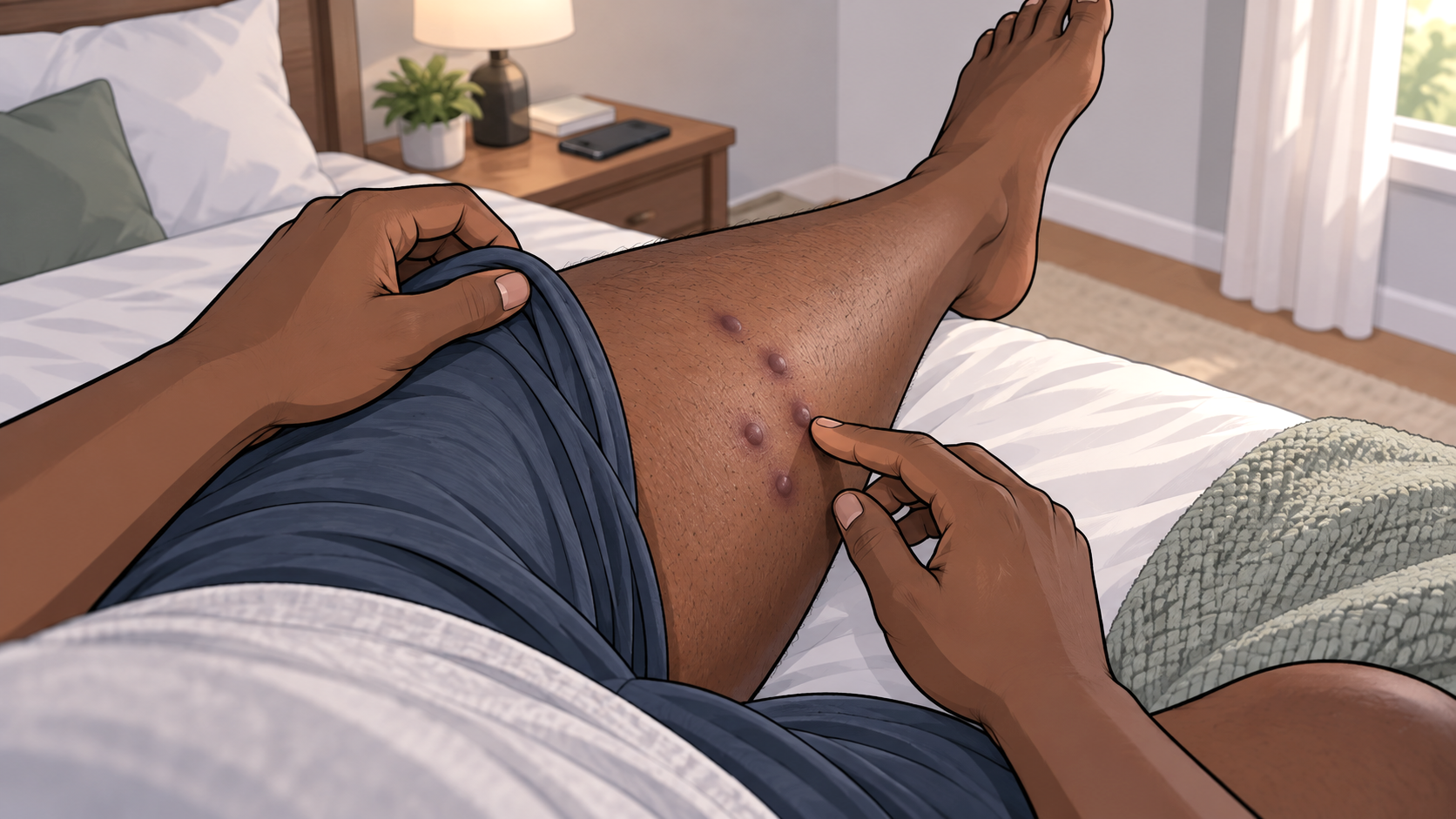
Many descriptions of bed bug bites begin with the same phrase: small red bumps. That description becomes much less useful when redness is subtle against naturally brown or Black skin. The reaction has not disappeared. It may simply be showing itself differently.
On dark or Black skin, bed bug bites can appear faint pink, purple, brown, or darker than the surrounding skin rather than bright red. Raised bumps, swelling, itching, and changes in skin texture may be easier to recognize than redness. After inflammation settles, some bites can also leave darker areas of post-inflammatory hyperpigmentation.
The important difference is visibility, not a separate kind of bed bug bite.
Stop Looking for Bright Red First
The classic red-bump description was never a universal identification rule.
Inflammation increases blood flow in the skin, but the resulting redness can be harder to see as background pigmentation increases. On darker skin, inflammatory color changes may instead appear brown, brown-red, grey, purple, blue, or darker than the surrounding skin.
That matters when looking at suspected bed bug bites. A lesion may be clearly raised and itchy without displaying the bright pink-red halo commonly shown in photographs of lighter skin.
Bed bug-specific dermatology guidance describes bites on darker skin as potentially faint pink or purplish, with older lesions sometimes developing darker brown pigmentation.
For this reason, we would not use “I don’t see any redness” as a reason to rule out a bite reaction on deeply pigmented skin. Color is only one part of what you can see and feel.
Texture Can Tell You More Than Color
When color contrast is limited, look at the surface of the skin.
A bed bug reaction can produce a small raised bump, known clinically as a papule. Other reactions can become more swollen and form wheals. Comparing the affected area with the surrounding skin may therefore reveal a change in contour even when its color seems subtle.
Run your eyes across the skin rather than searching exclusively for red dots. A group of small raised areas may be more noticeable from the side or under good lighting. Swelling can also change the outline of an affected area.
This approach is useful beyond bed bug bites. Dermatology research has increasingly emphasized that inflammation in darker skin should not be assessed from redness alone. Changes in swelling, texture, contour, warmth, and tenderness can provide additional information when visible redness is muted by pigmentation.
That does not make a raised bump diagnostic for bed bugs. It simply gives you a better way to examine a reaction without expecting it to resemble a photograph taken on pale skin.
Purple and Brown Can Be Part of the Initial Reaction
A color change does not have to be red to represent inflamed skin.
On richly pigmented skin, inflammation can have a violaceous, meaning purple-toned, appearance. It can also look brown, dark brown, greyish, or darker than the person’s normal skin tone. Recent dermatology research continues to highlight that visible erythema can be difficult to recognize in darker skin.
Bed bug bites fit within that broader problem. Dermoscopic studies of bites and parasitic conditions in darker skin have even documented purple dots and crusting in bed bug bites.
There is considerable variation, however. One person’s bites might appear as slightly raised purple-brown spots. Another person might develop obvious swelling with little noticeable color change. Someone else may have no visible reaction at all.
That last possibility is important. The CDC notes that reactions to bed bug bites range from no physical signs to small marks and, rarely, serious allergic reactions. Skin tone does not change that basic variability between people.
A Dark Mark Can Outlast the Bite Reaction
The appearance can change again after the itching and swelling begin to settle.
Inflammation can stimulate pigment changes in the skin. In darker skin types, bed bug bites may consequently leave post-inflammatory hyperpigmentation, meaning a darker patch remains after the active inflammatory reaction has subsided.
This can make the history of a bite look very different from the bite itself. The original lesion may have been raised, itchy, and slightly purple. Later, the swelling can disappear while a flat brown or dark mark remains.
Post-inflammatory pigment changes are particularly relevant in skin of color, where they can be more noticeable and persistent after inflammatory skin problems. Bed bug-specific dermatology guidance likewise recognizes darker brown post-inflammatory pigmentation as a possible later appearance.
We think this distinction is especially useful when comparing photographs. A fresh bite and the residual dark spot from an older reaction should not be treated as though they represent the same stage.
The lingering pigmentation also does not tell you whether bed bugs are still feeding. It records a previous inflammatory event rather than current insect activity.
Scratching Can Change the Picture Again
Itching adds another layer to what you see.
Bed bug bites can itch intensely, and repeated scratching can damage the surface of the skin. The CDC notes that excessive scratching can contribute to secondary skin infection.
Once scratching has produced crusting, broken skin, or additional inflammation, the lesion no longer reflects only the original bite reaction. That makes visual identification even less dependable.
On darker skin, the healing process may also leave pigment changes that attract more attention than the original bump. A person looking at the area several days later might therefore see dark spots, crusted marks, or areas of altered pigmentation rather than the stereotypical red welts associated with bed bug photographs.
This is another reason to pay attention to progression. Ask what the area looked and felt like when first noticed, how it changed, and whether new lesions are continuing to appear. Do not assume every dark spot represents a fresh bite.
Bite Patterns Still Look Like Patterns on Black Skin
Color may become less obvious, but the spatial arrangement of lesions can still be visible.
Bed bug reactions can occur as isolated marks, clusters, or lines. On darker skin, that might look like several raised brown or purple-toned bumps following one area of an arm rather than a bright-red row.
However, the pattern deserves the same caution on every skin tone. A straight line of three marks does not prove bed bugs. Clusters are not unique to them either.
Our guide to bed bug bite clusters explains why these arrangements are useful clues but poor diagnostic tests. Flea bites, other arthropod bites, and several inflammatory skin conditions can produce confusingly similar distributions.
Body location can add context. Bed bug bites frequently involve exposed areas such as the arms, hands, face, neck, and legs because those areas may be accessible while a person sleeps. Our article on why bed bugs bite certain body parts explores the importance of exposed skin and sleeping position.
Again, none of those patterns changes because the person has Black skin. What changes is how easily some of the associated color differences can be seen.
Comparing Your Skin With Online Photos Has a Built-In Problem
Image searches can create an unrealistic standard for what a bed bug bite should look like.
Historically, darker skin has been underrepresented in dermatology education and clinical imagery. Reviews of skin-of-color diagnosis have documented the difficulty clinicians themselves can face when inflammatory redness is less conspicuous in deeply pigmented skin.
For a person trying to identify a bite at home, the problem becomes even larger. Lighting, camera exposure, skin tone, stage of the reaction, scratching, individual sensitivity, and image processing can all affect what a photograph shows.
A picture of a bright-red welt on white skin is therefore not a template your skin has to match.
Instead, compare the suspicious area with your own unaffected skin. Notice changes in elevation, swelling, texture, pigmentation, clustering, and itching. That comparison provides more useful information than trying to match your arm against someone else’s photograph.
Even then, the result is only evidence of a skin reaction. It is not evidence of which insect caused it.
Black Skin Does Not Make Bed Bug Bites Diagnosable by Appearance
This is where the investigation needs to leave the skin.
Bed bug bites can resemble mosquito bites, flea bites, and other skin conditions. The inflammatory reaction itself cannot reliably diagnose a bed bug infestation. That limitation applies regardless of skin color.
Instead of repeatedly inspecting a bump under different lighting, inspect the place where you sleep. Look along mattress seams and tags, the box spring, bed-frame joints, headboard, nearby furniture, and cracks and crevices.
Physical evidence can include live bed bugs, eggs, pale shed skins, dark fecal spotting, and rusty stains. Our guide to how to check for bed bugs explains how to search these areas systematically.
If all you have are skin lesions, keep the identification open. Bites without other signs of bed bugs deserve a broader investigation rather than increasingly confident conclusions based on photographs.
That approach is particularly valuable on dark skin because it removes an unnecessary obstacle. You do not need a bite to turn bright red before you have a reason to investigate. You also do not need to identify an insect from your skin when much stronger evidence may be sitting in the mattress seam beside you.
When the Skin Reaction Matters More Than Identifying the Bug
There is a point where deciding whether a lesion looks like a bed bug bite becomes less important than taking care of the skin.
Most bed bug bites require minimal symptomatic treatment. The CDC’s clinical guidance notes that extensive treatment is generally unnecessary for uncomplicated cases, while avoiding scratching and maintaining good hygiene can help prevent secondary infection.
More significant reactions deserve medical attention based on the symptoms themselves, not whether you have successfully identified a bed bug. Seek medical care for severe or worsening swelling, signs of infection, or persistent skin symptoms that concern you. Serious allergic reactions require urgent medical attention.
This is especially worth emphasizing when visible redness is difficult to assess. Do not use the absence of dramatic redness as the sole measure of whether inflammation is significant. Swelling, pain, warmth, tenderness, blistering, drainage, and changes in how you feel can carry important information too.
For reactions that become unusually pronounced, our guide to swollen bed bug bites covers the distinction between ordinary local reactions and symptoms that deserve more attention.
Other Questions About Bed Bug Bites on Dark Skin
Can bed bug bites look black on dark skin?
Inflammatory changes on deeply pigmented skin can appear darker than the surrounding skin, and healing lesions may leave post-inflammatory hyperpigmentation. However, a black or very dark mark has many possible causes and cannot be identified as a bed bug bite from color alone.
Can bed bug bites be hard to see on Black skin?
Yes. The redness associated with inflammation can be much less conspicuous on darker skin. Raised areas, swelling, itching, texture changes, purple or brown discoloration, and comparison with nearby unaffected skin may make a reaction easier to notice.
Do bed bug bites leave dark spots on Black skin?
They can. Post-inflammatory hyperpigmentation can leave darker pigmentation after the active bite reaction settles. The remaining dark mark does not by itself indicate that the bite is still inflamed or that a new bite has occurred.
Are bed bug bites more severe on Black skin?
Skin pigmentation does not provide a useful way to predict how severely an individual will react to bed bug bites. Reactions vary substantially from person to person. What differs visually is that inflammation and its aftermath can be expressed differently against darker pigmentation.
What if I keep getting dark itchy bumps but cannot find bed bugs?
Do not assume bed bugs solely from the bumps. Other arthropod bites and numerous skin conditions can produce itchy pigmented lesions. Continue looking for physical pest evidence, and consider medical evaluation when lesions persist, worsen, recur without an identified pest, or otherwise concern you.
One thought on “What Do Bed Bug Bites Look Like on Dark or Black Skin?”