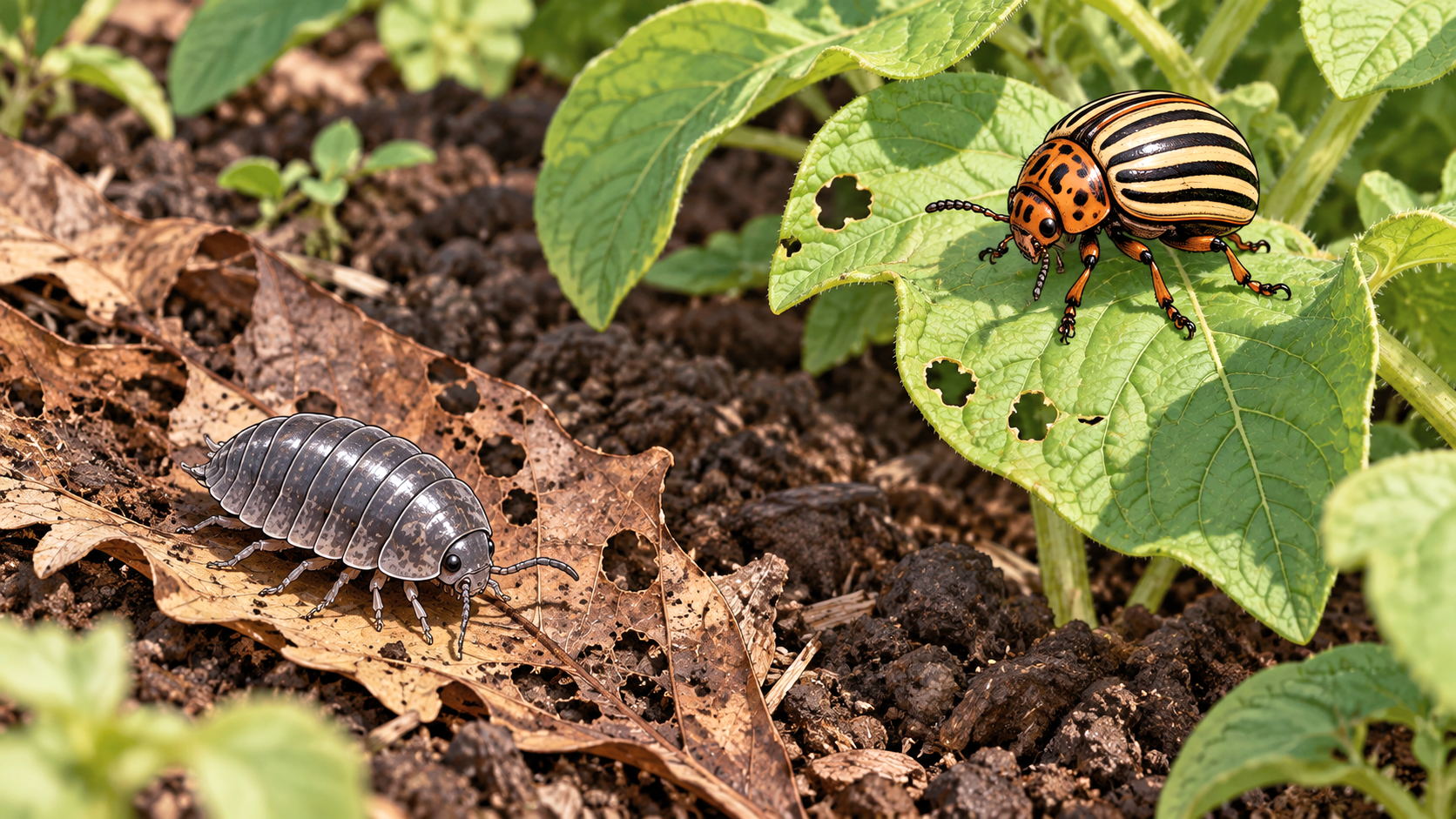
A roly-poly and a potato bug can be the same animal, but the name potato bug also refers to two completely different insects. In some regions, people use potato bug for the common pill bug (Armadillidium vulgare), a small gray crustacean that curls into a ball. Elsewhere, the name refers to the large, wingless Jerusalem cricket or the striped Colorado potato beetle. Identifying which animal someone means requires looking at its body rather than relying on the nickname.
The confusion is well documented in the identification of Jerusalem crickets and other animals called potato bugs. All three occur in gardens, but their appearance, feeding habits, and potential for plant damage differ considerably.
Three Different Animals Called Potato Bugs
The easiest way to resolve the name is to compare the animals most commonly associated with it. A rolled-up gray creature beneath a damp flowerpot is a pill bug, while a large insect with an oversized head is more likely a Jerusalem cricket. A yellow beetle with black stripes feeding on potato foliage belongs to an entirely different group.
| Feature | Roly-poly (pill bug) | Jerusalem cricket | Colorado potato beetle |
|---|---|---|---|
| Scientific identification | Armadillidium vulgare | Stenopelmatus species | Leptinotarsa decemlineata |
| Animal group | Crustacean | Insect | Insect |
| Typical appearance | Gray, oval, armored body | Large head, thick legs, banded abdomen | Rounded yellow body with ten black stripes |
| Adult size | Up to 18 mm | Commonly 30–50 mm | About 10 mm |
| Wings | None | None | Present beneath hardened wing covers |
| Defensive behavior | Rolls into a ball | Uses strong jaws when threatened | Does not roll into a ball |
| Feeding habits | Mainly decaying organic matter | Plant material, roots, and other invertebrates | Leaves of potatoes and related plants |
The name potato bug therefore provides little identification value on its own. A few visible body features usually settle the question.
How a Jerusalem Cricket Differs From a Roly-Poly
Jerusalem crickets look especially different from roly-polies once their heads and legs are visible. They have large, rounded heads, thick digging legs, long antennae, and swollen abdomens marked with alternating lighter and darker bands. Their bodies are not covered in the overlapping armor plates characteristic of pill bugs.
These insects spend much of their time underground. Gardeners commonly encounter them while digging, moving stones, or disturbing soil. Jerusalem crickets are particularly associated with western North America, and the name covers multiple species rather than one universally occurring insect.
Their powerful mouthparts are another notable difference. A Jerusalem cricket can deliver a painful bite when handled carelessly, although it is not venomous. Roly-polies lack that defensive capability. The Montana Field Guide’s Jerusalem cricket account documents their strong jaws and the regional names used for them, while the Amateur Entomologists’ Society’s identification description illustrates their characteristic body proportions.
Neither animal should be picked up roughly to test its defensive response. A photograph showing the head, legs, and entire body is more useful for identification.
Why Colorado Potato Beetles Are a Different Problem
A Colorado potato beetle presents a much more direct threat to potato plants than a roly-poly. Adults and larvae feed on leaves, and heavy feeding can strip substantial amounts of foliage from the plant. The resulting loss of leaf tissue reduces the plant’s ability to support developing tubers.
Adult beetles are recognizable by their yellowish wing covers marked with ten lengthwise black stripes. Their rounded bodies can resemble those of other beetles, but the striped pattern is a strong identification feature. The Connecticut Agricultural Experiment Station’s description also documents their appearance and the eggs deposited on potato foliage.
The larvae look different from adults. They have plump reddish or orange bodies with black spots along their sides and feed openly on leaves. The Colorado potato beetle identification information shows the separate egg, larval, and adult stages.
Finding one of these beetles on a potato plant warrants closer inspection of the foliage. The same response would be unnecessary for a roly-poly wandering beneath the plant, because pill bugs primarily consume decomposing material rather than healthy potato leaves.
Can Roly-Polies Damage Potatoes?
Roly-polies occasionally feed on tender plant tissue and vegetables in direct contact with damp soil. They are capable of chewing exposed surfaces, especially where plant material is already soft or damaged. However, they primarily function as decomposers, breaking down fallen leaves and other organic matter.
The University of California’s pill bug management guidance identifies moisture, decaying vegetation, and low-growing plant material as conditions associated with their activity. Their feeding is generally less consequential than the foliage damage caused by Colorado potato beetles.
A hole in a harvested potato does not identify the responsible animal. Several soil-dwelling organisms can damage tubers, and decay can create openings that other animals subsequently exploit. Finding pill bugs inside an already damaged potato is therefore insufficient evidence that they caused the original injury.
Identifying a Potato Bug Found in Your Garden
Start with where the animal was found and what it was doing. A small, dark-gray creature curled beneath a wet board fits the appearance of a pill bug. An unusually large, tan-headed insect exposed while digging suggests a Jerusalem cricket. A striped beetle sitting on potato leaves deserves examination for Colorado potato beetle activity.
The location is useful supporting evidence, but body structure provides the stronger identification. The University of Florida’s common pill bug profile establishes the features associated with Armadillidium vulgare, including its segmented shell and defensive curling behavior.
For a suspected Colorado potato beetle, examine both sides of nearby leaves for adults, feeding larvae, and egg clusters. When a few plants are affected, hand-removing identified beetles and larvae is an established nonchemical management option. The University of Minnesota’s potato beetle management guidance also addresses how feeding damage and pesticide resistance influence control decisions.
A roly-poly found in the same garden rarely needs treatment. If large numbers are damaging seedlings or low-growing vegetables, reducing excessive surface moisture and removing unnecessary decaying debris addresses conditions that favor them without indiscriminately killing beneficial soil organisms.