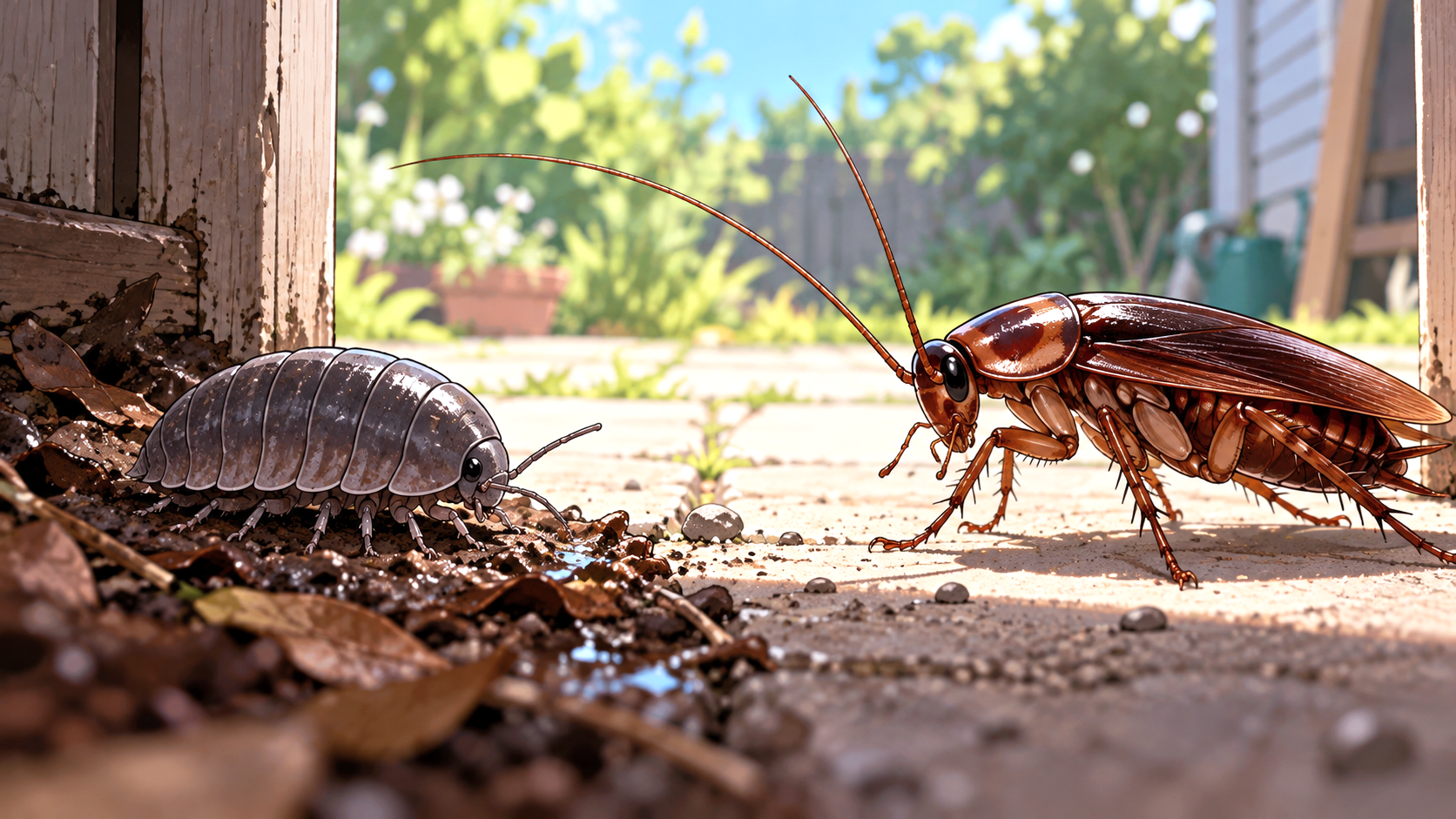
Roly-polies and cockroaches are different arthropods that can sometimes be mistaken for each other, particularly when small, dark-colored individuals appear in damp areas of a home. A roly-poly is a terrestrial crustacean with a rounded, armored back, fourteen walking legs, and the ability to curl into a ball. A cockroach is an insect with six spiny legs, long antennae, and a flatter body built for rapid movement. Cockroaches also have two short, paired appendages called cerci at the rear, which roly-polies lack.
The confusion is most likely when the animal is moving along a bathroom floor, near a basement drain, or beneath a kitchen cabinet. From a distance, both can appear dark brown or gray, but their body structures provide reliable identification features.
Roly-Poly vs Cockroach Identification
A roly-poly’s back looks like a series of overlapping armored plates. Its head is small, and its legs remain tucked beneath the rounded body. A cockroach has a smoother, flattened outline, with long antennae projecting forward and prominent legs extending from its sides.
| Feature | Roly-poly | Cockroach |
|---|---|---|
| Common example | Armadillidium vulgare | German cockroach, Blattella germanica |
| Classification | Crustacean, order Isopoda | Insect, order Blattodea |
| Walking legs | 14 in adults | 6 |
| Antennae | Short, compared with body length | Usually long and slender |
| Body covering | Distinct overlapping dorsal plates | Flatter body with a shieldlike pronotum behind the head |
| Wings | Absent | Present in many adults, absent in nymphs |
| Movement | Walks relatively slowly; can curl defensively | Runs rapidly into shelter |
| Main habitat | Moist soil, mulch, leaf litter | Varies by species; many household pests occupy indoor cracks |
| Main food sources | Decaying plant material | Wide variety of organic foods and debris |
The visible differences are consistent with the identification features of pill bugs and sowbugs and the anatomy of household cockroaches. Their apparent size is less useful for identification because adult pill bugs and some cockroach species overlap in length.
Why Baby Cockroaches Can Resemble Roly-Polies
An immature cockroach, called a nymph, does not have the fully developed wings seen on many adults. Its smaller, wingless body can appear rounded, especially when viewed from above. Some nymphs are dark brown or nearly black, making them superficially similar to the gray, dark-bodied pill bugs that occasionally wander indoors.
The resemblance disappears under closer inspection. Cockroach nymphs have conspicuous antennae, six legs, and a continuous abdominal outline rather than the separate armored plates covering a roly-poly’s back. Their hind legs are also more prominent, contributing to the quick, darting movements characteristic of cockroaches.
Color alone is particularly unreliable. Newly molted cockroaches can appear pale or whitish before their outer covering darkens. Young pill bugs are also pale, but they have multiple body plates and considerably shorter visible antennae. The developmental stages of cockroaches explain why freshly molted individuals can look unlike the familiar brown adults.
For a small specimen, photograph it from directly above while it is stationary. The length of its antennae, number of legs, and body segmentation usually provide more information than its coloring. The same approach helps with other confusing household insects, including earwigs mistaken for cockroaches, which have distinctive forceps at the rear of their bodies.
Finding One in the Bathroom or Basement
Location offers a useful clue, although both animals can occupy moisture-rich areas. Roly-polies commonly enter buildings from outdoor habitats, particularly where wet mulch, leaf litter, or soil borders the foundation. They often appear near ground-level doors, basement walls, and other openings connecting indoor spaces with damp soil.
Cockroaches use moisture differently. German cockroaches establish populations near indoor food, warmth, and water, frequently around refrigerators, sinks, and kitchen cabinets. Oriental cockroaches are more strongly associated with damp basements, drains, and other cool, sheltered locations. The household insect identification guidance identifies these habitat patterns as useful clues.
A single roly-poly beside a basement door is consistent with accidental entry from outdoors. Repeated cockroach sightings beneath appliances, especially when accompanied by egg cases or droppings, warrant an inspection for an established indoor population. The National Pesticide Information Center’s cockroach guidance identifies these signs and explains why species identification affects where an infestation should be investigated.
Moisture reduction benefits both situations, but food sanitation has greater importance when cockroaches are involved. Sealing entry points, repairing leaks, and removing outdoor debris around a foundation can reduce the number of pill bugs entering a house without resorting to indoor insecticide treatments.
Do Roly-Polies and Cockroaches Pose the Same Risks?
Roly-polies are primarily nuisance animals indoors. They do not infest stored food or establish breeding populations in ordinary dry living spaces. Outside, their consumption of decaying vegetation contributes to decomposition, although they occasionally damage tender seedlings and low-growing produce.
Indoor cockroach infestations have more serious implications. Cockroach body fragments, droppings, and other materials contain allergens that can worsen asthma in sensitized people. The Centers for Disease Control and Prevention’s asthma guidance identifies cockroach exposure as a household concern and recommends reducing food, water, and shelter available to these pests.
Cockroaches also contaminate surfaces as they travel between waste, hiding places, and food preparation areas. This makes an insect repeatedly emerging from a kitchen cabinet more concerning than an occasional pill bug wandering across a basement floor. Recognizing the animal correctly prevents unnecessary pesticide applications against harmless visitors while ensuring that genuine cockroach activity receives attention.
What to Do After Identifying the Animal
A roly-poly can be collected with a cup and released into a sheltered outdoor area. Check nearby door thresholds, foundation openings, and damp materials if more continue appearing. In most homes, eliminating excess moisture and improving exclusion are sufficient; a pesticide treatment provides little lasting benefit when the conditions attracting the animals remain unchanged.
For a suspected cockroach, inspect nearby cracks, appliance edges, and cabinet joints before choosing a treatment. Finding additional insects, egg cases, or droppings helps establish whether the sighting represents an infestation. The National Pesticide Information Center’s integrated pest management recommendations favor identification, monitoring, sanitation, and exclusion before pesticide use.
Confirmed household cockroach infestations may require targeted baiting. Cockroach gel baits work through ingestion and must be placed according to the product label, away from children and pets. Widespread pesticide applications are unnecessary for an unidentified arthropod. In particular, cockroach foggers and bug bombs are poor substitutes for finding and treating the hiding places where cockroaches remain concealed.
If several insects continue emerging from an inaccessible area, preserve a specimen or clear photograph for identification before arranging treatment. An accurate identification determines whether the next step is simply correcting a moisture problem or investigating a developing indoor cockroach infestation.
This post reflects our own research and isn’t a substitute for advice from a licensed pest control professional. Always follow the product label. See our full disclaimer for more.