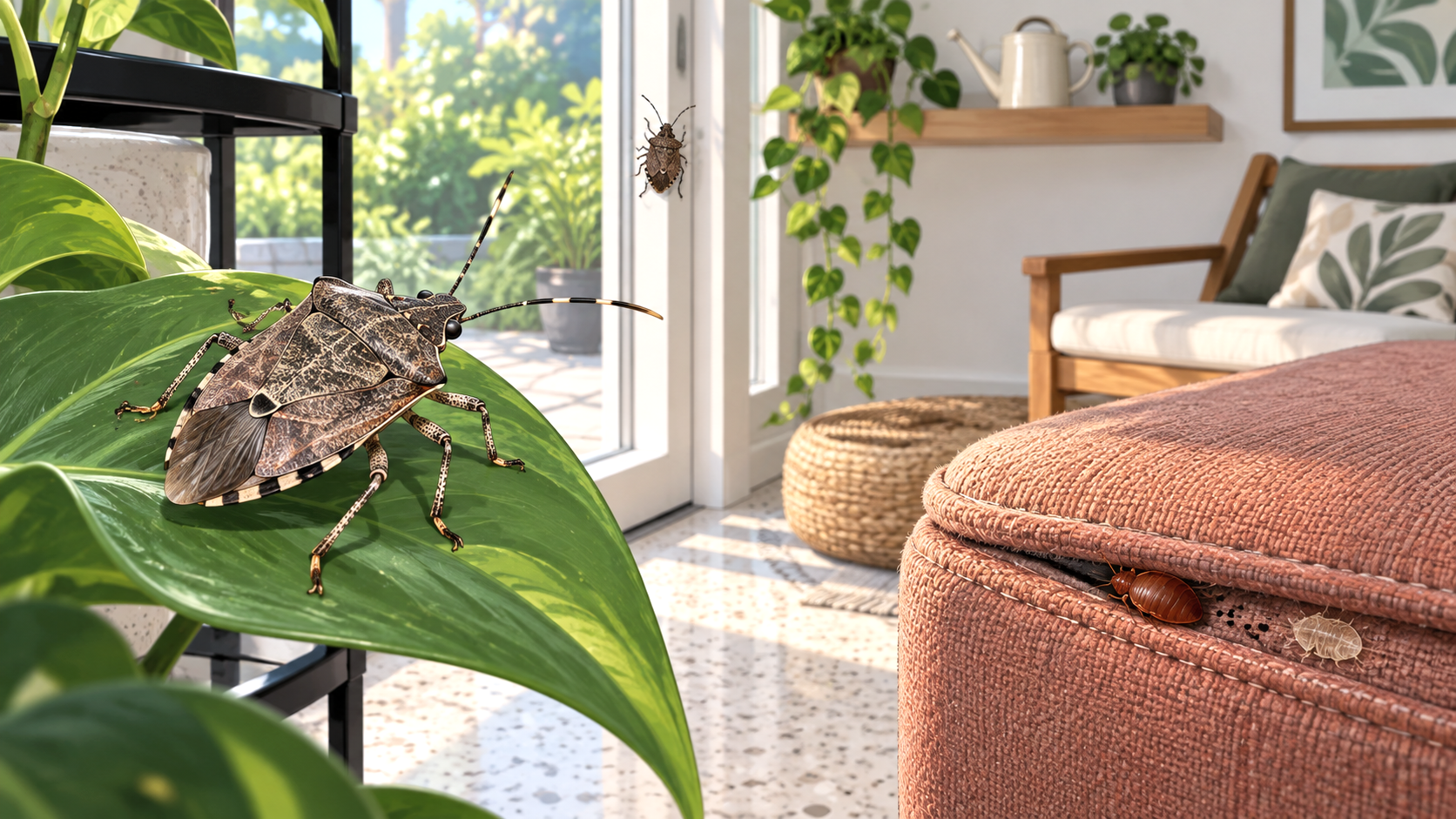
A brown bug on a bedroom wall can send your mind straight to bed bugs, especially when you notice it at night. But the room where you found an insect is not the same thing as the habitat it actually wants. A stink bug can wander through a bedroom without having anything to do with the bed. Stink bugs and bed bugs are easy to separate once you look beyond color. Adult stink bugs are larger, shield-shaped insects with functional wings, while bed bugs are much smaller, broadly oval, flattened, and wingless. Stink bugs enter homes mainly for shelter. Bed bugs remain near people because they feed on blood. The fastest identification often comes from asking why the insect is in the room before studying every marking on its back.
A Stink Bug in the Bedroom May Simply Be in the Wrong Room
Finding an insect beside your bed feels highly relevant when you are worried about bed bugs. With stink bugs, it often is not.
Several stink bug species occur around homes, but the brown marmorated stink bug, Halyomorpha halys, is especially well known for entering buildings. Adults gather around structures in autumn while searching for protected places to spend the winter. Once inside walls or other sheltered spaces, some eventually emerge into living areas.
That means a stink bug can turn up on a curtain, ceiling, lampshade, bedroom wall, or window without feeding on anyone in the room. Brown marmorated stink bugs do not bite people or animals and do not damage buildings. They are household nuisance invaders rather than human parasites.
Bed bugs are in the bedroom for a much more specific reason. The common bed bug, Cimex lectularius, feeds on blood and tends to remain close to places where people sleep or rest. Adults average about 5 mm long and have flattened oval bodies suited to hiding in narrow spaces.
So before comparing colors, consider the context. A large shield-shaped insect sitting beside a sunny window in fall fits a very different story from several small flattened insects concealed in mattress seams.
Turn the Bug Into a Silhouette
Color is one of the weakest clues in this comparison because both insects can be brown. Shape is far more useful.
Look at the insect from directly above. An adult stink bug has the broad, angular outline that gives the group its familiar shield-shaped appearance. In many species, the shoulders flare outward and the body narrows toward the rear. Adult stink bugs are recognizably shield-shaped across the family, although markings and colors vary between species. (extension.umd.edu)
A bed bug has no comparable shoulder-and-shield profile. An unfed adult is broad and oval, with a flattened body and a clearly segmented abdomen. After feeding, it becomes more elongated and swollen, but it still does not acquire the angular outline of a stink bug. Adult bed bugs are generally 5 to 7 mm long.
That size difference is substantial. A brown marmorated stink bug is about 14 to 17 mm long, making it several times longer than a typical adult bed bug. Our guide to the actual size of bed bugs shows how small even the adult stage really is.
If the mystery insect looks almost coin-sized rather than apple-seed-sized, bed bug should move much lower on your list.
Wings Settle the Comparison Quickly
The back of the insect can answer the question almost immediately.
Adult stink bugs have developed wings. Their front wings partially overlap across the back, contributing to the distinctive appearance of an adult true bug. Brown marmorated stink bugs can fly, which is one reason you may see one suddenly buzzing through a room or landing near a window.
Adult bed bugs do not fly. Their wings are reduced and nonfunctional, so they move by crawling. Bed bugs also cannot jump. Our article on whether bed bugs fly or jump covers that limitation separately.
This creates one of the strongest real-world clues in the comparison. If the brown insect you are watching launches from the wall and flies across the room, it is not a bed bug.
You do not need a magnifying glass after that.
Movement is especially useful when the insect is difficult to see clearly. A shaky phone photograph can blur markings and distort proportions, but flight is unambiguous.
The Smell Belongs to the Stink Bug Side of the Story
The name “stink bug” is literal.
Stink bugs possess scent glands and can release a strong odor when disturbed or crushed. Brown marmorated stink bugs are particularly familiar to homeowners because this smell becomes noticeable when insects are handled, squashed, or collected in numbers. Their unpleasant odor comes from defensive secretions released from scent glands.
Bed bugs also produce odors through glands, and heavy infestations can develop a characteristic musty smell. However, that should not be confused with the immediate defensive odor people associate with handling a stink bug.
The circumstances are different. A single stink bug can announce itself the moment you crush or disturb it. A suspected bed bug infestation should be identified through insects, eggs, shed skins, fecal spotting, and other physical evidence rather than relying on odor.
We would never use “it smelled bad when I squashed it” as proof by itself, but paired with the large shield-shaped body it becomes a very strong clue.
What the Insect Leaves Behind Matters More Than Where You Found It
The evidence around the insect tells you whether you are dealing with a visitor or an infestation.
Bed bugs leave a recognizable collection of signs near sleeping and resting areas. These include live bugs, tiny eggs, pale shed skins, dark fecal spots, and rusty or reddish stains from crushed insects. Mattress seams, box springs, bed frames, headboards, and nearby cracks are among the places where this evidence may accumulate. A proper bed bug mattress inspection is therefore much more useful than staring at the bedroom wall where you happened to notice one bug.
Stink bugs do not create that kind of evidence around a bed. Brown marmorated stink bugs entering structures are seeking overwintering shelter, and they do not reproduce or damage the structure while indoors.
Instead, you may find them near windows, doors, attics, wall voids, or other places connected to their seasonal entry into the building. Multiple stink bugs indoors can certainly become annoying, but numbers alone do not turn them into a mattress infestation.
This is one of our favorite distinctions in the comparison because it prevents the bedroom itself from becoming misleading. A stink bug can be in a bedroom. A bed bug problem is built around the sleeping host.
The Antennae Can Identify a Brown Marmorated Stink Bug
When the insect is clearly a stink bug but you want to know whether it is the brown marmorated species, the antennae become useful.
Adult brown marmorated stink bugs are mottled brown and have alternating light and dark bands on the antennae. Similar alternating markings also occur along the exposed edges of the abdomen. These bands are among the key identification features of brown marmorated stink bugs.
Bed bugs have antennae too, but their overall anatomy is already so different that antenna markings are unnecessary for separating these two pests. Their small oval bodies, lack of functional wings, and much smaller size settle the question first.
This is also a useful reminder that “stink bug” describes a large insect family rather than one species. Stink bugs can be green, brown, patterned, predatory, or plant-feeding. The shield-shaped adult body is the more consistent family-level clue.
For a bed bug identification, our broader guide to what bed bugs look like is more useful than trying to compare one specific stink bug species against every bed bug life stage.
The Young Stages Can Create a Different Kind of Confusion
Adult stink bugs and adult bed bugs are dramatically different, but immature insects deserve a little more care.
Stink bug nymphs do not yet have fully developed wings and can appear more rounded than adults. Brown marmorated stink bug nymphs can show combinations of red, black, yellowish, and later darker coloration. They still develop outdoors on host plants rather than creating a breeding population in your mattress.
Bed bug nymphs look much more like miniature versions of adult bed bugs. They are smaller, paler, and can appear nearly translucent when unfed. As they progress through five nymphal stages, they require blood meals before molting to the next stage.
The setting helps here. Stink bug eggs and nymphs are associated with plants. The eggs are generally deposited in clusters on leaves, while brown marmorated stink bug adults are the stage commonly entering buildings to overwinter. (epa.gov)
Bed bug eggs, nymphs, and adults can all occur together in indoor harborages around a sleeping area. Finding several pale juvenile insects, cast skins, eggs, and adult bugs tucked into a mattress seam therefore tells a completely different story from finding one patterned stink bug nymph on a garden plant.
Bites Are Not the Tie-Breaker Because Stink Bugs Are Not Blood Feeders
The two insects use their piercing mouthparts for completely different purposes.
Bed bugs use theirs to take blood meals from people and other warm-blooded hosts. Their bites can cause itchy skin reactions, although reactions vary from obvious marks to no visible response. Bed bug bites themselves are still a poor identification method because many other bites and skin conditions can look similar.
Plant-feeding stink bugs use piercing-sucking mouthparts on plant tissues. Brown marmorated stink bugs do not bite people or pets. They are important agricultural pests because they feed on a wide range of fruits, vegetables, and other plants rather than on human blood. (extension.psu.edu)
That means an itchy rash should not make a correctly identified stink bug suddenly become a bed bug suspect. If you find a stink bug and also have unexplained skin marks, investigate the two observations separately.
Our guide to how to tell whether you have bed bugs focuses on the physical evidence that can actually support that diagnosis.
What You Do Next Depends Entirely on Which Bug It Is
Once the insect is identified, the two problems head in opposite directions.
An indoor stink bug problem is primarily an exclusion problem. Brown marmorated stink bugs enter buildings through cracks and gaps while seeking protected overwintering sites. Sealing openings around doors, windows, siding, utility penetrations, chimneys, and other exterior gaps can reduce future entry. Mechanical exclusion is considered the best method for keeping them from entering buildings.
A bed bug problem cannot be solved by sealing a window. The insects may already be living in furniture, mattress seams, frames, baseboards, and other interior harborages. Control usually requires a combination of inspection, containment, monitoring, heat or other nonchemical measures, and appropriately labeled pesticides where needed.
So before buying anything, preserve the insect if identification remains uncertain. A clear container or sealed bag can keep its body intact for closer examination. Bed bug look-alikes cause enough unnecessary panic that correct identification should always come before treatment.
If the insect is small enough and its shape remains unclear, compare it with our guide to bugs that look like bed bugs. If it is a large shield-shaped flyer that smells when disturbed, however, the bed bug question is usually already over.
Other Questions About Stink Bugs and Bed Bugs
Can stink bugs hide in mattresses?
A stink bug can accidentally crawl onto or around a bed, but mattresses are not their breeding habitat. Brown marmorated stink bugs enter structures mainly to find protected overwintering sites. Finding one on a mattress therefore does not carry the same meaning as finding an actual bed bug concealed in a mattress seam.
Can stink bugs infest a house during winter?
Large numbers can enter buildings in autumn and remain sheltered through winter. They do not reproduce inside the structure, so this is better understood as an overwintering invasion than an indoor breeding infestation.
Are there stink bugs as small as bed bugs?
Stink bug nymphs are smaller than adults, so size alone becomes less useful when comparing immature insects. Shape, coloration, host setting, and other anatomical features should then be considered. An adult brown marmorated stink bug is much larger than an adult bed bug.
Why do stink bugs keep appearing near my windows?
Indoor stink bugs often move toward light and windows after emerging from protected spaces within a building. The insects originally entered while seeking shelter, and gaps around windows, siding, doors, utility penetrations, and similar openings can provide access.
Can you have stink bugs and bed bugs in the same house?
Yes. The presence of one does not prevent the other. They would represent separate pest problems with different causes and control strategies, so each insect should be identified from its own physical evidence rather than assuming every brown bug in the home belongs to one species.